SteelMint Events

Author: SteelMintEvents

  • South Asia: Imported ferrous scrap market recovers post Muharram holidays

    South Asia: Imported ferrous scrap market recovers post Muharram holidays

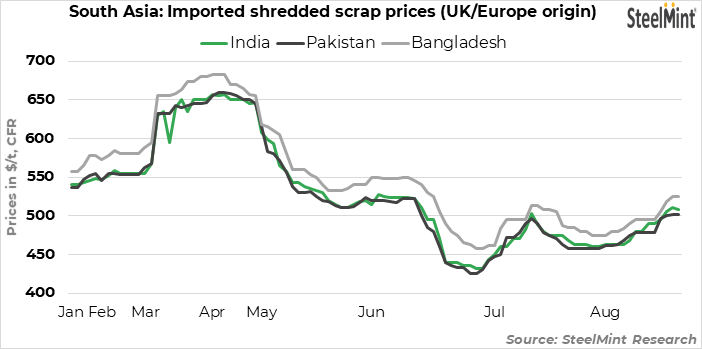
    South Asia’s imported scrap market rebounded in the past days post-Muharram holidays as buyers turned active to replenish the inventory amid limited domestic availability, and recovering demand before the onset of winter season. Meanwhile, imported scrap offers continued their uptrend.

    • India

    India’s imported scrap market remained volatile throughout the week. However, it showed signs of recovery as scrap trade improved towards the weekend. Imported scrap buyers turned active in procurement to build up their inventory as they expect finished steel demand to recover post monsoons.

    Recent trades

    • Around 500 t of Europe-origin HMS (80:20) was traded at $475/t, CFR Nhava Sheva.
    • A trader sold around 2,500 t of Dubai HMS-1 at $510/t Nhava Sheva. Another deal of UK-origin PNS was concluded at $520/t, CFR Mundra basis.
    • Two deals of 500 t each were concluded. Shredded scrap was sold at $510/t CFR Vizag and HMS premium quality at $490/t CFR Mundra.

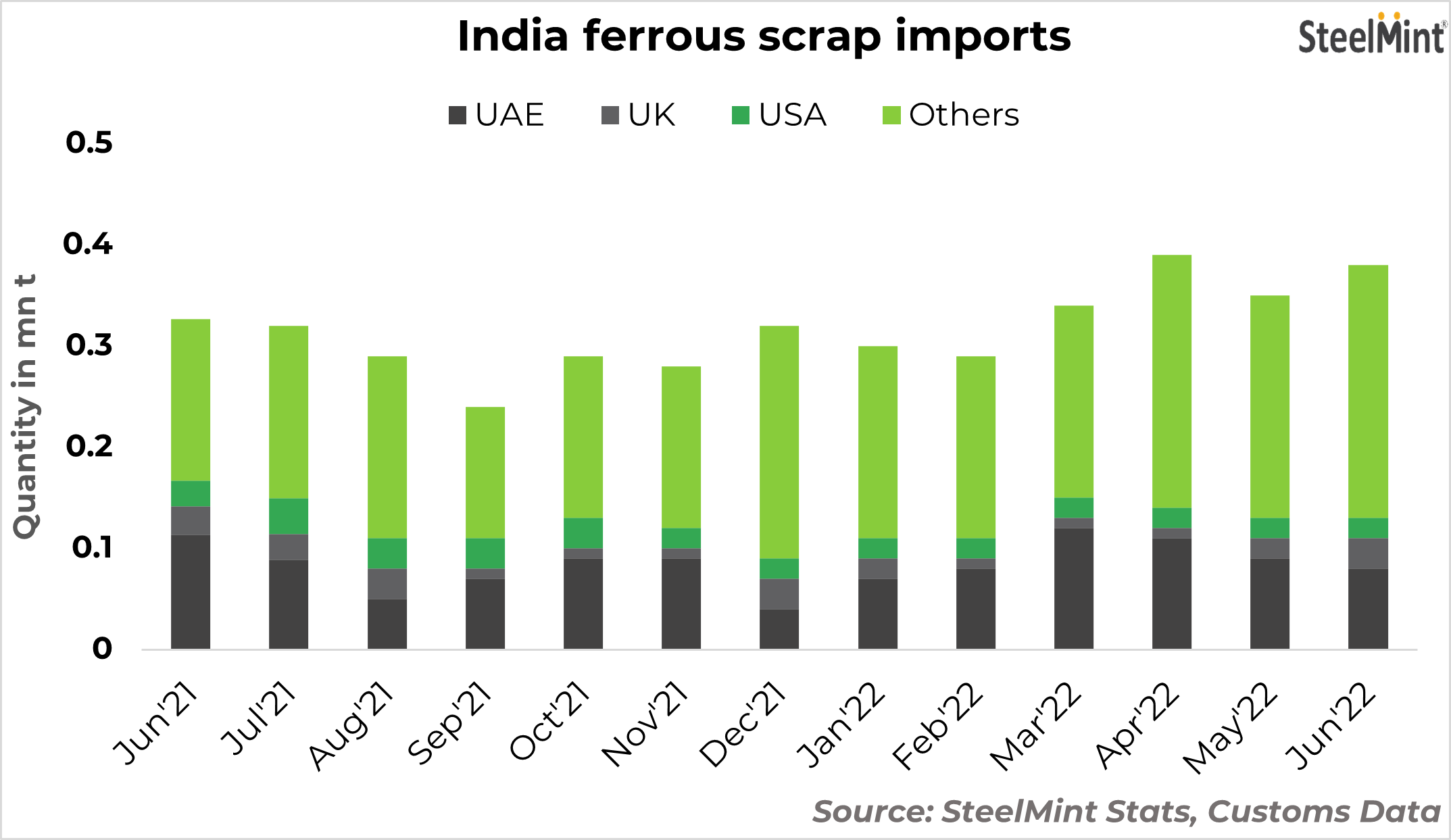
    India’s ferrous scrap imports rose by 16% in July to 0.44 million tonnes (mnt) as compared to 0.38 mnt in June. The UAE continued to be the major exporter at 0.07 mnt, followed by the USA and the UK at 0.05 mnt and 0.03 mnt, respectively.
    • Pakistan

    Pakistani buyers gradually started buying as the rainy season is coming to an end and the national currency also appreciated after declining for the last couple of weeks which brought some relief to scrap buyers after holidays, supporting further bookings.

    Recent trades

    Around 5,000 t of Europe-origin shredded scrap was booked at $495-500/t, CFR Qasim basis.

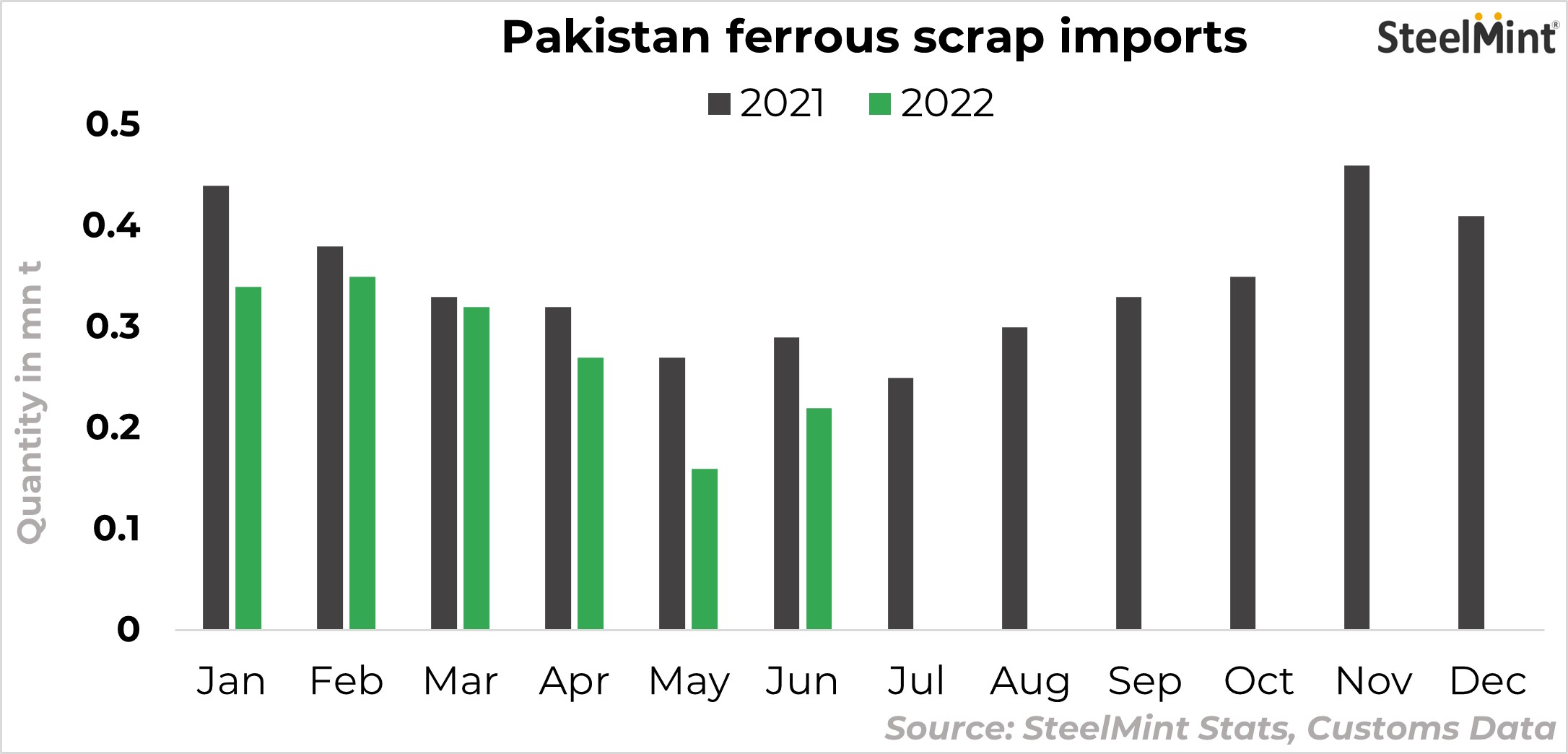
    Pakistan, one of the leading ferrous scrap buyers in South Asia, imported 223,819 t in June 2022 as against 164,699 t in May. Seaborne bookings for June rose significantly by 36% m-o-m. In contrast, on y-o-y basis, scrap imports fell 23% compared to 290,412 t in June 2021.
    • Bangladesh

    Bangladesh’s imported scrap market continues to stay under pressure. Currency depreciation, power cost-push, LC-related issues kept buyers less active in the imported market. Meanwhile, few buyers preferred bulk purchases over containerised scrap due to cost effectiveness.

    Recent trades

    • Bulk: In a recent deal, 30,000 t of US-origin mixed (HMS and shredded) bulk cargo was booked for September 2022 shipment at an average price of $445-450/t CFR Chittagong.
    • Containers: Around 500 t of shredded scrap of UK-origin was traded at $525/t, CFR Chittagong. In another deal, a total of 1,000 t of New Zealand-origin shredded was booked at $520/t.

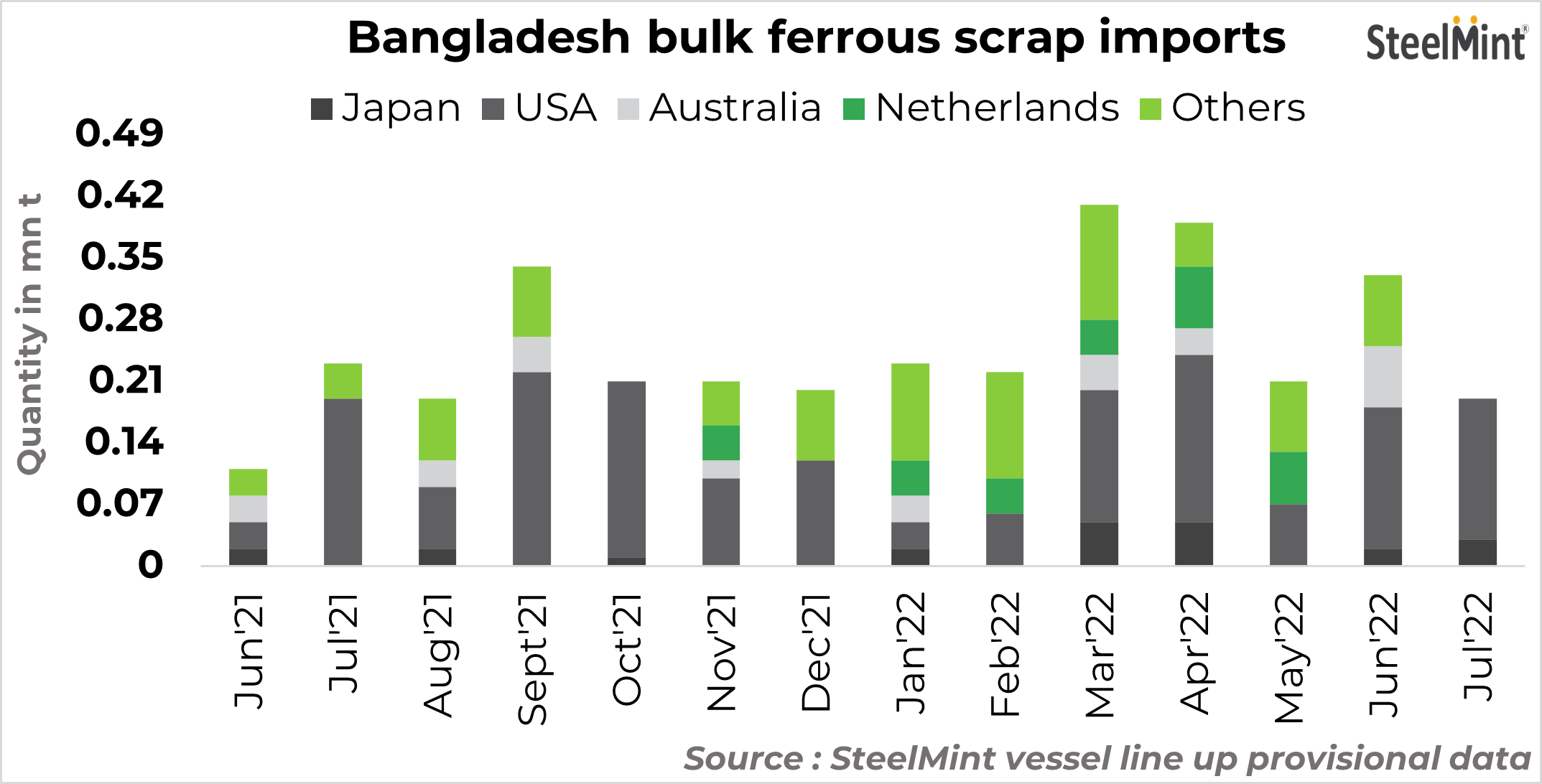
    Bangladesh’s bulk ferrous scrap imports registered a sharp fall of 42% in July 2022 to 0.19 mnt as compared to 0.33 mnt in June. The USA continued to be the top exporter at 0.16 mnt, followed by Japan at 0.03 mnt.
    Factors driving the imported market sentiments:

    • Currency appreciation: The Indian rupee (INR), as with all major currencies, appreciated a little against the dollar. Currently INR is being traded at 79.8 levels.

    Bangladesh currency Taka was mostly stable on a weekly basis and was trading at 95 levels. Market participants believe that buyers will be back in the market if the exchange rate stablises.

    The Pakistani rupee (PKR) bounced back against the US dollar (USD) after plunging to a record low in July. The national currency was traded at 214 in the currency exchange market. Pakistan has a consumption-based economy and relies on imports of commodities including steel and scraps for its manufacturing industry.

    • Increasing steel demand for govt-funded projects: Steel demand in Bangladesh may remain supported mainly due to the government-funded infrastructure projects which were launched to stimulate the economy hit by Covid-19. Projects such as the Ashrayan Project, Metro Rail, Karnafuli Tunnel and elevated expressway from Dhaka Airport to Kutubkhali are expected to boost infrastructure construction. Hence, scrap demand is also likely to remain supported this year as well as in 2023.

    Outlook

    Despite the continue uptrend in prices, industry participants feel the market may pick up next month as the season will start changing and the approaching winter will boost construction activities.

  • Coal Log India 2022

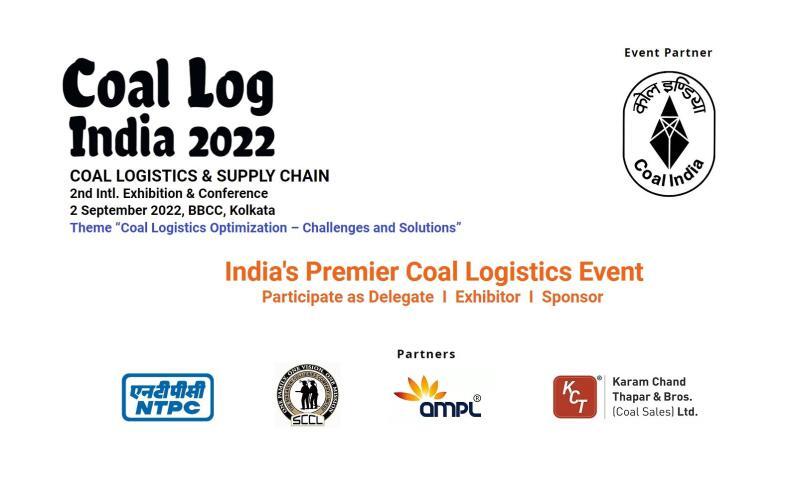
    Coal Log India 2022

    With the theme “Coal Logistics Optimization – Challenges and Solutions”, COAL LOG INDIA 2022, aims at
    addressing the current issues and priorities of the Coal & Mining Logistics and Supply Chain Sector in India.
    This event will be an exciting amalgam of a high caliber Conference Programme, New age logistics and
    supply chain solutions on display, recognizing the innovative Products and Services.

    The Event has been planned to bring together multiple stakeholders-Mining Companies, Captive/
    Commercial Coal Block Operators, Bulk Coal Consumers, Coal Carriers by Road, Sea, Rail etc, State Mining
    and Mineral Departments, State Electricity Generation and Distribution Companies, Solution providers and
    Regulators of Coal Industry, we will have close to 25 top -notch speakers who will deliberate not only the
    down-stream factors but also deal with up-stream influences affecting Logistic and Supply Chain problems
    in Coal Sector, Government Policies, Railways, Future Plans, Safety and Increased use of Technology.

    Register button

  • Coaltrans Asia 2022

    Coaltrans Asia 2022

    Asia’s leading coal event is back in person for 2022

    Coaltrans Asia is returning in-person to the beautiful island of Bali this September. After a two year hiatus this is the perfect opportunity to re-connect with industry leaders, re-forge relationships, and negotiate and trade in person.

    Hear from leading market experts on the global macrotrends impacting coal supply and demand, coal’s role in the energy crisis, and the industry’s progress towards decarbonisation.

    In a volatile and fast-changing environment Coaltrans Asia brings together key players from the entire coal supply chain, offering ministerial-level insights and high-level perspectives for coal producers, energy companies and key industries to plan for 2023 and beyond. We have unique industry access thanks to our close relationship with APBI-ICMA, the membership association for Indonesia’s coal mining industry.

    For 2022 we’ve incorporated more networking opportunities than ever, offering formal and social meeting points. With extended lunch and coffee breaks, two evening drinks receptions, bookable private rooms plus a large meeting space for impromptu conversations, Coaltrans Asia provides the opportunities and space to get business done.

    CoalMint is the Media Partner.

    Register button

  • 10th BMR International Conference

    10th BMR International Conference

    Bureau of Middle East Recycling (BMR) , was formed as a non-profit oriented, non-religious, non-political organization to mainly represent all the suppliers/traders of Middle East Recycling Industry and to bring them under one banner and platform with the unified thoughts of promoting the Recycling Business of Middle East, protecting the environment and sharing information about recycling and to understand the new challenges and support the Recycling industry.

    The Bureau of Middle East Recycling will host its International Conference at the Le Meridien Dubai Hotel & Conference Center in Dubai on 10 and 11 March.

    SteelMint is the Media Partner.

    Register button

  • India’s steel exports fall 34% in Q1; Q2 looks dull

    India’s steel exports fall 34% in Q1; Q2 looks dull

    • Export tax impact blunts overseas sales’ edge
    • Boron-added exports see sudden spurt
    • Export tax retention may see Q2 volumes go below 2 mnt

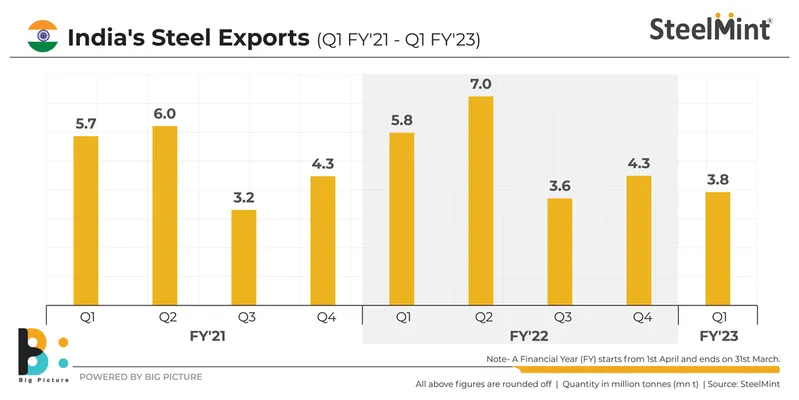
    India’s finished steel exports, including semis, dropped 34% to 3.78 million tonnes (mnt) in the first quarter (April-June, 2022) of the current financial year (FY2022-23) compared to 5.77 mnt seen in the year-ago quarter.

    There was drop across the three categories of flats, longs and billets. Flats exports fell 28% y-o-y to 2.64 mnt (3.68 mnt) in Q1. Longs fell 54% to 0.28 mnt (0.62 mnt) and semi-finished by 41% to 0.86 mnt (1.47 mnt) in this period.

    From a q-o-q perspective, exports were down 13% from 4.33 mnt in Q4 (January-March, 2022)

    On a half-yearly basis too, exports dropped almost 20% to 8.11 mnt in January-June, 2022 against 10.08 mnt in the same period in 2021.

    Reasons for the drop in exports

    1. Export tax impact: The 15% export duty, slapped from 22 May, brought the market to a standstill immediately in its aftermath. After a fortnight’s lull, mills huddled to find a way out of the crisis, in the form of boron-added steel, which escaped the export ambit.
    It is to be noted that while all categories under flats recorded a fall, only “electrical steel” exports skyrocketed by almost 700% albeit on a low base. From as low as 17,650 tonnes in Q1FY22, these rose to 0.14 mnt in Q1FY23. This is an indication that boron-added steel (which falls under electrical steel) category had increased from India and this push had come mainly from June when mills tried to work around the export duty by offering alloy steel. SteelMint’s data reveals that in April 2022, these were at a negligible 2,334 tonnes and in May, 2022, at 7,110 tonnes.

    Under normal circumstances, electrical steel exports constitute barely 10,000 t per month.
    India's steel exports drop 34% in Q1; Q2 looks bleaker

    SteelMint understands that whatever volumes were exported in June, were boron-added with the trade in regular grades of carbon steel having come almost to a standstill.

    Meanwhile, the 3.78 mnt seen in Q1 also includes bookings made prior to the tax imposition. However, all material, including those for which contracts had been signed or those lying at ports – also attracted the export duty.

    2. Vietnam’s imports plunge: Mostly all importing countries showed a y-o-y decline amid tepid home demand, rising energy prices, and inflation. But Vietnam showed the steepest 64% drop in imports from India to a mere 0.14 mnt in Q1FY23 against 0.39 mnt in Q1FY22, mainly for two reasons. One, decline in European demand eroded Vietnam’s exports of value-added steel. Two, its end-users preferred competitively priced domestic material.
    India's steel exports drop 34% in Q1; Q2 looks bleaker

    Outlook


    The export volumes in the second quarter (July-September, 2022) are expected to fall further although, going forward, alloy steel exports from India will increase further.

    SteelMint forecasts that exports in Q2 will be even lower from that in Q1, for two reasons. Very few bookings have happened so far into the second quarter and it looks unlikely that many deals will take place in the remaining portion of the quarter if the export tax continues. In such a scenario, volumes can even drop below 2 mnt.

    Secondly, overseas demand has been lacklustre on the back of the outbreak of the Russia-Ukraine war, energy crisis, inflation, debt crises, Covid lockdowns and supply chain bottlenecks.

    Please click here for the India Steel Conference brochure