SteelMint Events

Author: SteelMintEvents

  • Increased Buying from Bangladesh Mills Push Indian Sponge Iron Export Volumes

    Increased Buying from Bangladesh Mills Push Indian Sponge Iron Export Volumes

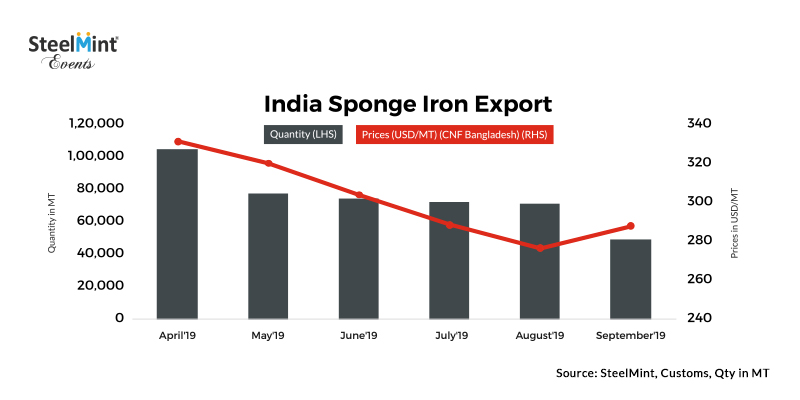
    Indian sponge iron exports have observed a sharp jump of 62% in first six months of FY20 (Apr-Sep’19) against the same period last year, according to data maintained with SteelMint. Exports have increased on account of rising demand from neighboring countries primarily from Bangladesh.

    Indian sponge exports were recorded at 450,000 MT in H1 FY20 against 278,000 MT in H1 FY19, up by 62% Y-o-Y. India exported 237,700 MT sponge iron to Bangladesh in H1 FY20 against 166,570 MT in H1 FY19 registering an increase of 43% Y-o-Y.

    Bangladesh has 6 MnT melting capacity currently and is likely to increase to 11 MnT by 2025.

    Bangladesh accounted for 59% share in Indian sponge exports – Indian sponge iron total export volumes in FY’19 was recorded 685,816 MT, out of which Bangladesh occupied a share of 59% followed by Nepal (16% share), Bhutan (15% share). Other destinations were – Malaysia, Kenya etc.

    Indian sponge iron export prices observed downtrend – Indian sponge iron export prices to Bangladesh fell from USD 330/MT, CNF Chittagong levels in beginning of Apr’19 to USD 270/MT, CNF towards end of Oct’19 following decline in Indian domestic sponge offers.

    To know more on Bangladesh sponge iron imports, book your seat at SteelMint’s 3rd Steel and Raw Material Conference, Bangladesh and get a chance to hear views of renowned industry participants from across the globe. The conference is being organized on 23rd-24th March 2019 in Chittagong, Bangladesh.

    Explore

  • Bangladesh to Add 4 MnT Steel-Making Capacities in Next Few Years: BSRM

    Bangladesh to Add 4 MnT Steel-Making Capacities in Next Few Years: BSRM

    Bangladesh, one of the emerging steel markets in Asia, has been witnessing a rapid increase in steel production capacities since the last couple of years. Rising steel-making capacities are driving raw material imports like steel scrap, pig iron and DRI further.

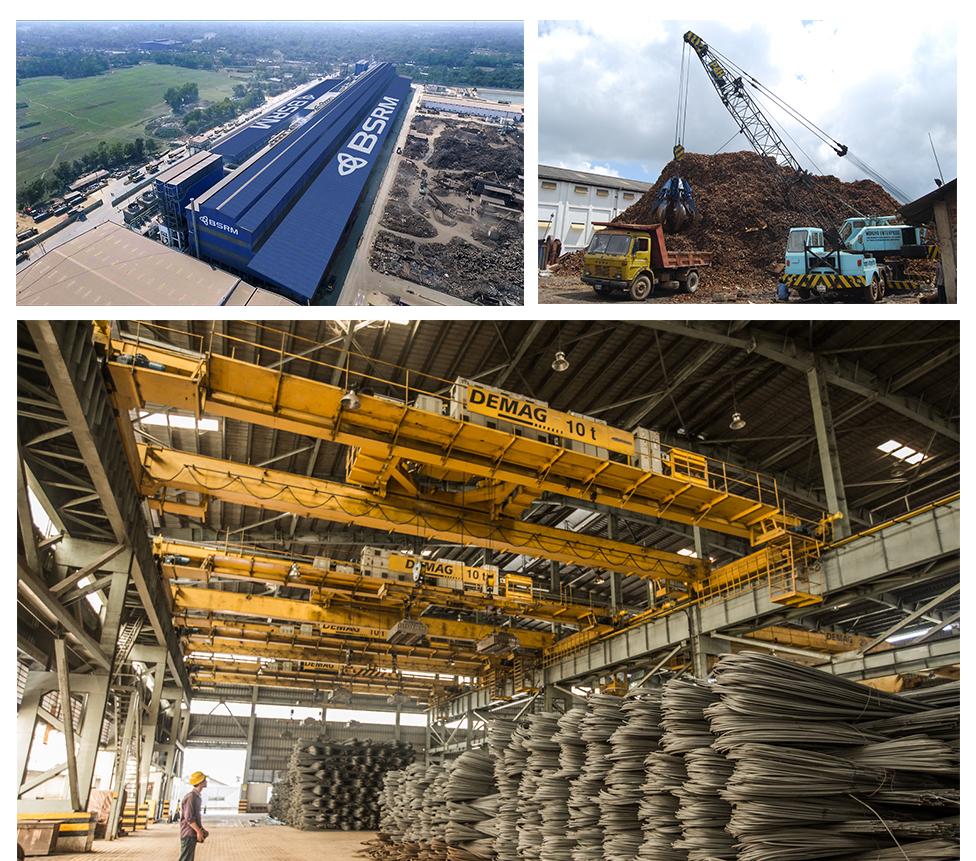
    Bangladesh Steel Re-Rolling Mills (BSRM) is a leading steel manufacturing company in Bangladesh with 1.8 million tonnes (MnT) of installed billet-making capacity. SteelMint, in an interview with Mr. Sanjoy Kumar Ghosh, Head of Supply Chain Management, BSRM, learned about his views on the steel and scrap industries in Bangladesh. Below are edited excerpts from the interview:

    How is Bangladesh performing in terms of economic growth? How do you see the steel industry’s contribution in your country’s economy?

    Bangladesh is now the world’s 3rd fastest-growing economy according to media reports. Its GDP growth rate is currently 8% as per an ADB report (8.2% according to the annual budget in 2019).


    A lot of development work is going on across the country and infrastructural development is one of them. The country is moving forward by all means with a view to applying to the United Nations for its recognition as a ‘Developing Country’ after fulfilling the criteria set by the UN in 2018. If we consider 8% GDP growth, it means at least 16% growth indication for the steel sector in the coming years.

    What is the country’s present per capita steel consumption? How much growth is expected in the coming years?

    Per capita consumption of steel in Bangladesh has seen a significant rise and almost doubled in 5-6 years to 45 kg in 2017. As per estimates, per capita steel consumption may rise to 73 kg by 2022. A lot of infrastructural work, along with mega government projects, is running in the country and it would take another 5-7 years to finish them. So the demand for steel will be there in the future.

    What are the upcoming expansion plans by steel makers and major infrastructure projects being developed by the government?

    Buoyed by the increasing demand for steel amid the implementation of mega infrastructure projects, many of the larger mills have signed up for capacity expansion and other infrastructural activities for improving power generation.

    Major steelmakers, including BSRM, have already initiated a few projects to increase their capacity while a few new companies are waiting to mark their footprint in the steel sector. A lot of infrastructural work, along with big government projects (Padma Bridge, Rooppur Nuclear Plant, Paira Sea Port, the large coal-fired power projects of Matarbari and Rampal, Metro Rail and LNG terminal) are currently going on across the country.

    What is Bangladesh’s steel production capacity and how much more capacity can be added in the near term?

    At present, the current steel production capacity is estimated to be at 6.5-7 MnT and it can be said that at least another 3-4 MnT of steel producing capacity will be added in the next few years on the back of aggressive expansion plans of leading steelmakers.

    How much ferrous scrap did Bangladesh import in the previous years?

    According to the data maintained with the customs department, ferrous scrap imports in financial year (FY) 2017-18 (July 2017-June 2018) was recorded at 2.6 MnT and the volume of scrapped ships imports in Chattogram’s ship-breaking market for recycling activities was recorded at 2.3 MnT. This year, 2018-2019, will be higher than earlier as per customs data.

    How much steel scrap demand is being projected in the coming years?

    As per customs import data in FY2017-18, total steel products, comprising raw material (steel scrap), semi-finished, finished products and imported scrap vessel quantity (ship breaking) was around 7.7 MnT. Among these quantities, around 2 MnT comprised finished products and 0.6 MnT were semi-finished products (HBI, DRI and billets). So the rest of the finished products were needed to be produced domestically. For that we are dependent on imported scraps, scraps generated from ship-breaking yards and other domestically generated steel scraps.

    So to sum up, we can say right now the steel scrap demand in Bangladesh is around 7 MnT which will definitely see a rising trend in the coming years.

    In order to know more on Bangladesh’s rising appetite for steel scrap imports, book your seat at SteelMint’s 4th Steel Scrap, Billet & DRI Trade Summit and to get a chance to hear insights from Mr. Sanjoy Kumar Ghosh. The conference is being organised during 27-29th August, 2019 in Bangkok, Thailand.
  • Vehicle Recycling in India Gains Pace with Recent Roll Out of Draft Policy

    Vehicle Recycling in India Gains Pace with Recent Roll Out of Draft Policy

    In a move that aims to spur growth of vehicle recycling agencies across the country and increase adoption of electric vehicles, the Ministry of Road Transport and Highways (MoRTH) has proposed a draft notification for scrappage of vehicles older than 15 years. It proposes to provide benefits ranging up to INR 40,000 on new purchases after scrappage of the old vehicle of a similar category. Thus, buying a new vehicle might just become cheaper in India, giving slight relief to automakers suffering from dwindling auto demand in the country.

    It has invited suggestions within 30 days after which the amended draft rules shall be taken into consideration.

    The Ministry of Road Transport and Highways has issued the draft amendment of the Central Motor Vehicle Rules, 1989, for public consultation, which proposes the key points below:

    1. Frequent renewal of fitness certificate: Fitness certificates for transport vehicles will have to be renewed in respect of transport vehicles older than 15 years more frequently – every six months against one year under the current norms. It is every 2 years for vehicles up to 8 years old and every year for vehicles that are older than 8 years and up to 15 years old.

    2. Waiving of registration fees with scrappage certificate: Buyers of newly-purchased vehicles would not have to pay registration fees if they present a scrapping certificate of a previously-owned vehicle of the same category issued by an authorised scrapping centre/agency, and the scrapping certificate has not been utilised for any other such cases in the past.

    3. Revision in fees of renewal of certificate: For conducting test and grant and renewal of certificates of fitness with newer registration marks for motor vehicle more than 15 years, it has proposed increased fees.

    4. The government is also working on an information technology to prevent usage of duplicate scrapping certificates.

    5. The road ministry is likely to take up the proposals of taxation benefits for scrapping centres with the proposal of rationalisation of the input tax credit regime under GST for scrapping centres.

    Why is there a need for such a policy?

    The policy majorly focuses on three areas. One is curbing vehicular pollution by scrapping old commercial vehicles more than 15 years that emit toxic gases into the environment. Secondly, it aims to speed up the generation of domestic scrap that could meet the increasing demand in the market. Thirdly, lowering the dependence on scrap imports.

    India presently imports around 5 MnT of steel scrap per annum. India’s total domestic steel scrap demand is likely to double to around 48-52 MnT by 2030, as per government sources.

    In order to know more about India’s vehicle recycling, book your seat at SteelMint’s 4th Steel Scrap, Billet & DRI Trade Summit. The conference is being organised during 27-29th August, 2019 in Bangkok, Thailand.

    Know More

  • Supply Tightness Pushes Chinese Steel Scrap Prices to New High

    Supply Tightness Pushes Chinese Steel Scrap Prices to New High

    China, the world’s largest ferrous scrap consumer, has witnessed a jump in its domestic ferrous scrap prices to above USD 400/MT, a record new 2019 high following supply tightness amid seasonal issues, high utilisation rates for electric arc furnaces (EAFs) and new restrictions on scrap imports that took effect from July 1.

    Shagang Jiangsu price hike

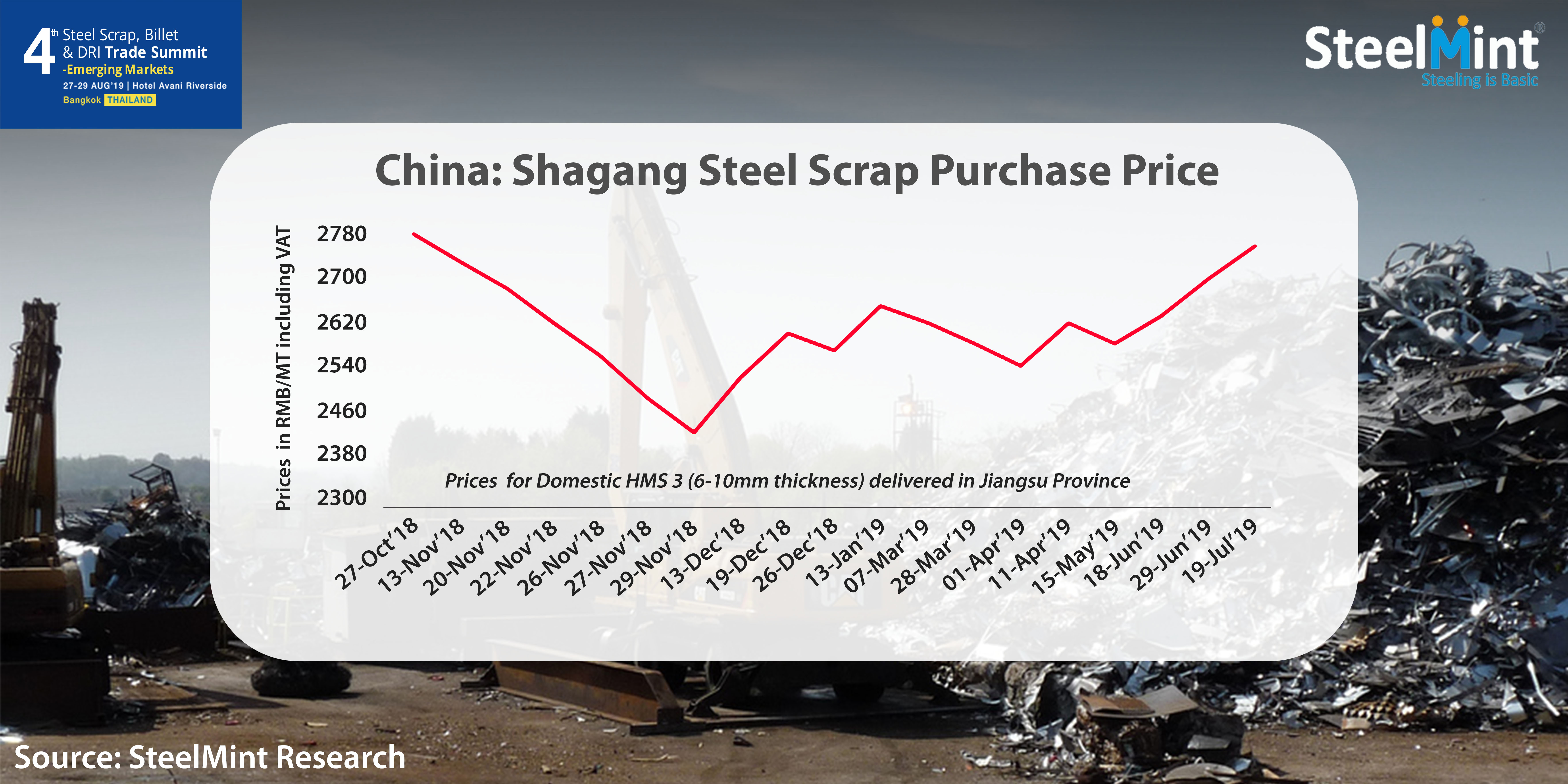
    Eastern China’s largest private ferrous scrap consumer and EAF steelmaker, Shagang Jiangsu Steel Group, announced the price hike for all grades of domestic steel scrap procurement by RMB 60/MT (USD 9) effective from July 19, 2019. The new price of HMS 3 scrap stands at RMB 2,760/MT (USD 403) delivered to headquarter works situated in Zhangjiagang, north of Shanghai, in China, inclusive of 13% VAT. Shagang Steel’s total annual production capacity crossed the 100-MnT mark with 31.9 MnT iron, 39.2 MnT steel and 37.2 MnT rolled products.

    Deterring demolitions

    The Chinese government has continued new rounds of investigations at all major steelworks to ensure environmental protection policies deter demolition of buildings and vessels that generate scrap. Tightening measures on air pollution emphasised on production stoppage for sintering machines. Thus, most of the steelmakers are looking to increase the use of steel scrap in steelmaking.

    On the other hand, scrap supplies have been reduced due to high temperatures while the rainy weather is reducing scrap collection and transportation. Higher demand and scant supplies have sent scrap inventories at processing plants to low levels, leading to a general anticipation that local scrap prices in China will remain firm over the second quarter of 2019.

    Chinese scrap prices jump

    According to prices maintained with SteelMint, it has been observed that Chinese steel scrap prices have jumped by RMB 210/MT (USD 31) or around 7-8% since mid-May. Prices have climbed the highest so far since November 2018.

    Rising costs of BF steelmaking encourage EAF use. Currently, China’s EAF steel mills are producing steel with considerable margins against BF steelmakers. Rising costs of competing feedstocks like iron ore and metallurgical coke have encouraged use of scrap. China’s iron ore prices remained in the range USD 115-120/MT as the main cost increase for BFs. On the other hand, increasing scrap prices also raise the costs of BF mills that use 10-20% scrap.

    Steel scrap imports fall 86% in Jan-May: Sharp fall in imports of ferrous scrap into China has impacted supplying countries to divert their flow to other countries. China’s ferrous scrap imports fell by 86% to 111,507 MT during January-May, 2019 against 776,133 MT during the same period last year. Total imports in 2018 were recorded at just 1.34 MnT, the lowest since 2010. The trend is expected to continue as China reclassified certain categories of scrap steel as restricted raw materials from July 1, 2019.

    Steel scrap exports nosedive in 2019: During January-May, 2019, China’s ferrous scrap exports were recorded at just 2,023 MT, down 99% Y-o-Y against 323,941 MT recorded in 2018.

    To know more on Chinese steel, scrap & the EAF market 2020, book your seat at SteelMint’s 4th Steel Scrap, Billet & DRI Summit and get a chance to hear views of Hongmei Li, Head of Editorial, Mysteel Global. The conference is being organised over 27th-29th August, 2019 in Bangkok, Thailand.
    Know More

  • India’s Largest Merchant Pig Iron Producer Staring at Shut-Down

    India’s Largest Merchant Pig Iron Producer Staring at Shut-Down

    Neelachal Ispat Nigam Ltd (NINL), a public sector steel entity and largest merchant supplier of steel grade pig iron, is battling raw material crisis on financial issues.

    Sources privy to the development said, NINL is battling hard to buy iron ore on its own to feed the plant after MMTC, its lead promoter, stopped supplying the raw material. According to an arrangement, MMTC buys iron ore from the open market to feed the NINL plant at Kalinganagar (Odisha) and also sells the finished products manufactured at the plant. For all buying and sales transactions, MMTC is entitled to a commission of 3%.

    Stakeholders abandoning sinking ship

    The actual reasons for MMTC’s breaking off this arrangement are not known. MMTC, however, has informed the Bombay Stock Exchange (BSE) in a filing last month on its intent to divest its stake in the loss- making PSU. The Odisha government entities, OMC and IPICOL, which between them hold 26% equity each in NINL, are also eager to offload their stakes. MMTC is the largest shareholder in NINL with a stake of 49.9%. Other central public sector enterprises such as NMDC Ltd, BHEL Ltd and MECON Ltd also own minority stakes in NINL but they are not risking their investments in NINL that has piled up losses over the years.

    In fact, the lack of adequate capital infusion has dogged the smooth operations of the NINL plant. Market sources say the plant is not generating enough cash flow to sustain itself and this has triggered speculation of its closure.

    Is JSW interested?

    With NINL almost up for grabs, it remains to be observed how many steel makers in the public or private sector are keen to acquire it and turn it around.

    NINL’s chequered history shows both Steel Authority of India Ltd (SAIL) and Rashtriya Ispat Nigam Ltd (RINL) have made unsuccessful bids to acquire the ailing state-level public enterprise (SLPE). Of late, JSW Steel’s name has been doing the rounds.

    INR 1,700 cr capital infusion needed

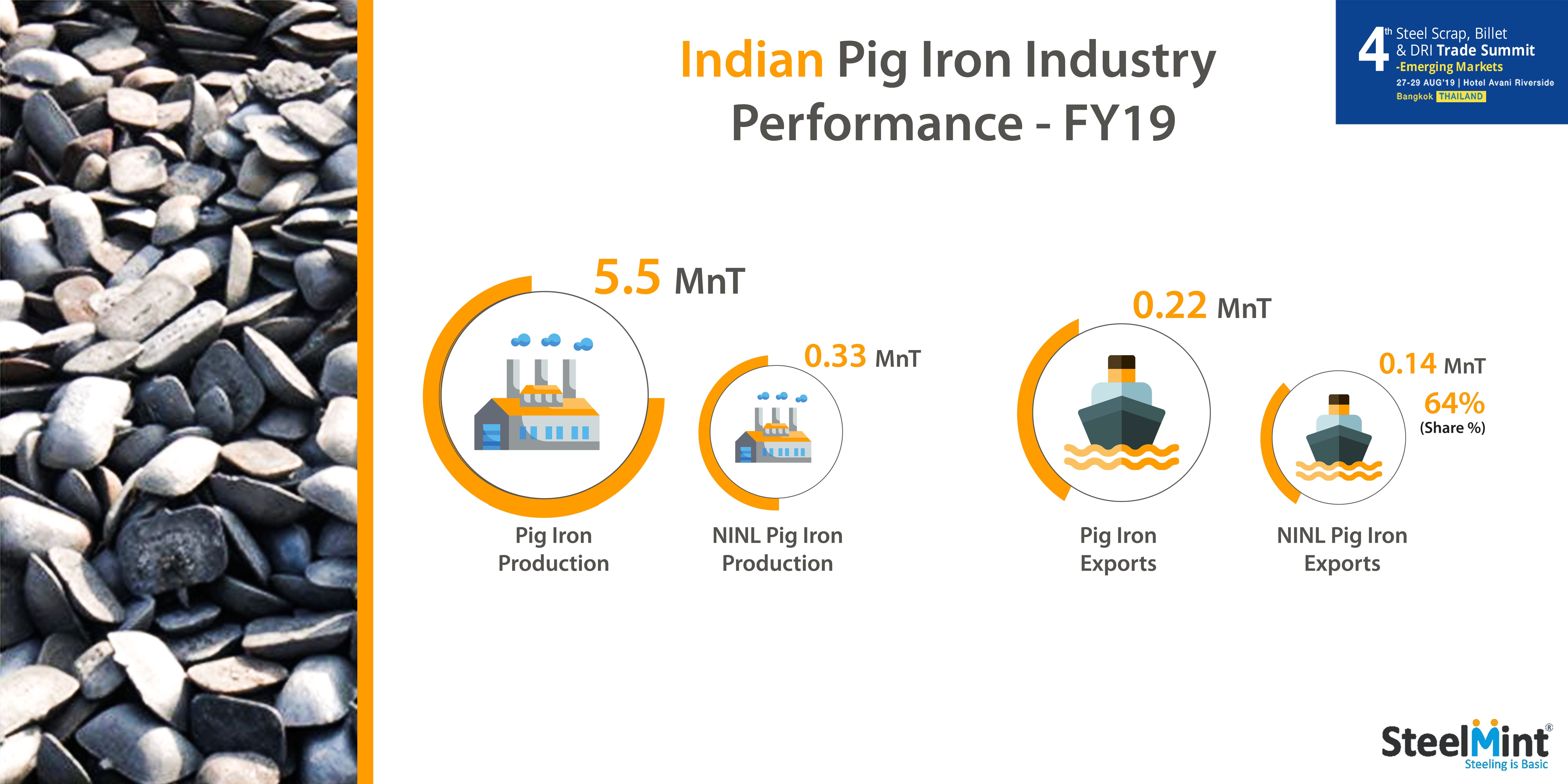
    The closure of the NINL facility is bound to throw the pig iron market into a tizzy since the steel PSU is the largest merchant producer of steel-grade pig iron, with an annual production of 800,000 MT.

    A source close to the development said NINL needs INR 1,700 crore of capital infusion to turn around its operations. But how can the PSU raise the sum when its own major promoters are actively pursuing plans to offload their stakes? And, the stressed, leveraged balance sheet of NINL automatically makes it ineligible to avail formal credit from a bank or financial institution.

    For the past five years in a row, NINL has been stacking up losses. Last fiscal too, it ended in the red despite turning its earnings before interest, taxes, depreciation and amortisation (EBITDA) positive following the successful completion of its blast furnace capital repair work and resuming of steel billets production.

    NINL is among the 200 state-level public enterprises accumulating losses. Their cases are being considered for divestment by the Union government. CPSEs that have historical investments poured into such loss-incurring firms will now have the autonomy to offload stakes.

    To know more on Pig iron trade dynamics, book your seat at SteelMint’s 4th Steel Scrap, Billet & DRI Summit. The conference is being organized during 27-29’th Aug’19 in Bangkok, Thailand

    Know More