SteelMint Events

Author: SteelMintEvents

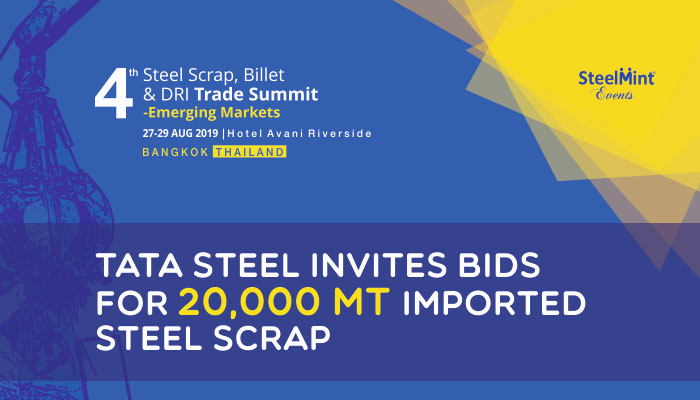
  • Tata Steel Invites Bids for 20,000 MT Imported Steel Scrap

    Tata Steel Invites Bids for 20,000 MT Imported Steel Scrap

    Tata Steel Ltd issued a RFQ (Request for Quotation) for procurement of 20,000 MT imported steel melting scrap for its newly acquired plant Bhushan Steel Limited on Tuesday, SteelMint came to learn from sources who received the RFQ.

    Out of the total issued quantity, 15,000 MT is HMS 1 and 5,000 MT Shredded on CIF Vizag port (India east coast) and will be sourced through e-auction.

    According to the RFQ, scrap packaging should be done in sealed 20ft containers and the origin could be Australia/New Zealand/UK/ Europe/US/North America/South Africa/Malaysia/Singapore/Middle East.

    This is the second tender floated by the company for purchase of imported scrap.

    A month back, the company concluded a tender for 15,000 MT imported scrap. Out of this, 10,000 MT was HMS, which was booked at USD 355-360/MT, CIF Vizag port, and 5,000 MT Shredded, which was booked at around USD 365-370/MT, CIF Vizag port.

    Tata Steel BSL

    In 2018, Tata Steel acquired the Tata Steel BSL Limited (formerly Bhushan Steel Limited) through its wholly-owned subsidiary with a steel production capacity of 5.6 MnTPA located in Odisha.

    4th Steel Scrap, Billet & DRI Trade Summit

    Don’t miss the opportunity of meeting global buyers and sellers at the 4th Steel Scrap, Billet & DRI Trade Summit in Bangkok, Thailand, to be held from 27-29th August 2019.

    Know More

  • Vietnam’s Surging EAF Capacities to Bring in More Scrap Imports?

    Vietnam’s Surging EAF Capacities to Bring in More Scrap Imports?

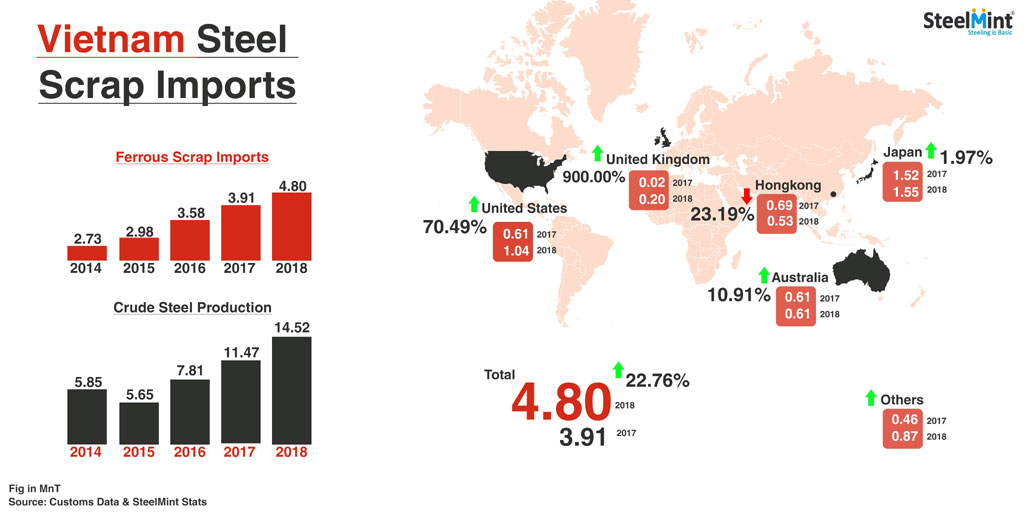
    Vietnam – one of the fastest growing steel markets in South East Asia has continued uptrend in crude steel production and ferrous scrap imports in 2018. As per released customs data, Vietnam imported 4,800,891 MT ferrous scrap in 2018 up 23% Y-o-Y against 2017.

    What makes Vietnam a sweet spot in steel industry?

    Vietnam’s government is optimistic with its projection of growth in construction sector and is expected to expand in long run with upcoming infrastructure projects of the government. Vietnam’s steel demand is learned to be around 21-22 MnT. Vietnam exported around 6.26 MnT steel in 2018 and steel imports recorded at 13.5 MnT.

    Japan remained the largest scrap supplier to Vietnam

    Japan supplied 1.55 MnT ferrous scrap occupying almost 32% share in total imports in Vietnam. Japanese scrap exports climbed marginally by 2% Y-o-Y against 1.52 MnT in 2017. USA scrap exports surged 70% Y-o-Y crossing 1 MnT mark the first time while that from UK jumped 900% to 0.20 MnT in 2018 to Vietnam against 0.02 MnT in 2017.

    Amid rising EAF crude steel production, Vietnam witnessed a fifth successive rise in yearly ferrous scrap imports in 2018.

    According to World Steel Association, Vietnam produced 14.52 MnT crude steel in CY18, up 27% Y-o-Y as against 11.47 MnT crude steel production recorded in CY17. Rising EAF steel output which comprises of almost 65-70% of total production in Vietnam has led the country to become fourth largest scrap importer surpassing USA in 2018.

    Concerns looming on Vietnam ferrous scrap imports

    In Aug’18, Vietnamese government tightened control over scrap imports and said that going forward it will only issue import licenses if the importers can prove that their shipments meet the environmental standards.

    However later in Aug’18, the Vietnam Steel Association (VSA) proposed to extend licenses of existing importers if they meet the environmental standards. Furthermore, as the domestic supply of metal scrap only meets 40% of the industry demand, imports are a major source for steel producers.

    Upcoming steel capacities in pipeline

    A series of steel plants are expected to ramp up capacities in two years down the line including Hoa Phat Steel, Hoa Sen Steel, the Vietnam Steel Corporation, the SMC Steel Company, and the VSC – Posco Steel Corporation (VPS). Surging EAF capacities are likely to push more scrap imports.

    To know more on steel scrap scenario of world’s emerging markets, be a part of 4th Scrap, Billet and DRI Summit during 27-29th Aug’19 in Bangkok, Thailand.

    Know More

  • Will China’s Needle Coke Shortage Derail Their Graphite Electrodes Production Plans?

    Will China’s Needle Coke Shortage Derail Their Graphite Electrodes Production Plans?

    In late 2017, a crisis-like situation engulfed the steelmakers around the world that make steel through the Electric Arc Furnace (EAF) route due to shortage of graphite electrodes amid reforms in China’s steel sector, which further led to dramatic increase in the global electrode prices.

    How did the graphite electrodes crisis start?

    The Chinese government in 2017 decided to shut down on some of the illegal and highly polluting Industries emanating from serious environmental concerns and reports suggest that about 140 MnT of steel capacities, primarily Induction Arc Furnaces, Mini Blast Furnaces and some very old blast furnaces had been shut down in past two years. These closures led to a sudden and significant drop of export of finished steel from China to the rest of the world. All of this, helped the other countries of the world to increase their own production of steel which led to a sudden increase in the demand of graphite electrodes outside of China.

    In addition to a shortage in Electrodes, the demand for its key raw material – needle coke which is already short in supply also increased significantly. Along with this, the growing importance of electric vehicles (EV) in China has also led to the surge in demand of needle coke from EV segment.

    Needle coke availability – A major concern

    China’s closure of inefficient induction furnaces and polluting blast furnaces are expected to be replaced by electric arc furnace. New policy measures announced in China ensures zero growth in steel capacity by requiring steel capacity replacement to be kept in ratio – 1.25:1 or 1:1 (regional differentiation).

    Apart from this it is noteworthy that while the rest of the world produces approximately 45% of the total steel through Electric Arc Furnace route, China till recently has been producing just about 7-8%. The country has just about started to catch up with the rest of the world in this environmental -friendly way of producing steel. China has announced its intentions to produce about 20% of its steel through Electric Arc Furnace by 2020 which means that their Graphite Electrode and needle coke requirements could go up by as much as 3x over the next three to four years.

    However, one of the major areas of concern here is that China is adding EAFs more quickly than coke or electrode capacity and is also making substantial investments into their EV industry.

    China has substantial capacity in ladle electrodes but limited capacity for UHP (ultra-high power) electrodes that are consumed in the West. China utilizes lower quality electrodes sourced with pitch coke and can tolerate the lower quality given the primary product made is commodity grade rebar.

    Fangda Carbon is the only producer of UHPs in China and they are importing high quality coke from South Korea to supplement their production process. China has limited capacity of petroleum needle coke (used for UHP grade GE) and their domestic sources of premium coal based pitch coke for the manufacturing of high grade electrodes have been eroded from the blast furnace capacity rationalization over the past several years.

    China has plans to add more needle coke capacity but the majority of these plants are for pitch coke and face significant challenges of sourcing high quality coal tar pitch and producing at consistent quality levels.

    China’s dependency on imports to meet its needle coke requirements set to stay

    As Chinese coke is generally pitch coke (from coal tar) or some anode grade Calcined material that is being utilized in ladle electrode production, its availability is quite an issue.

    This is because pitch coke requires meaningfully longer bake and graphitizing time, which reduces effective capacity and also is a lower efficiency electrode. Lithium ion battery producers use a mix of petroleum needle coke, owing to its high density and therefore longer driving ranges and battery life span.

    Thus, in order to meet its needle coke requirement for UHP grade electrodes, China has to depend upon imports.

    A look at the Numbers

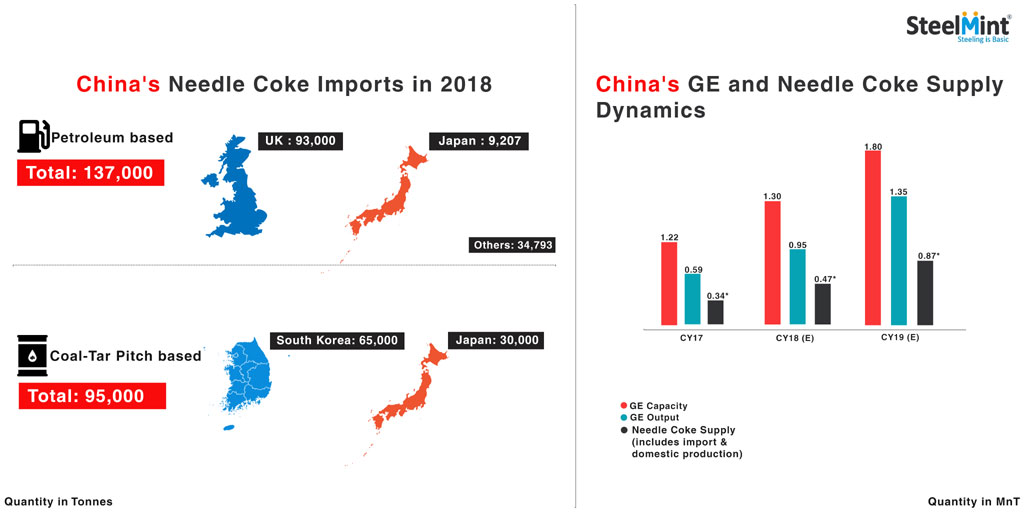
    According to China’s customs data, the country imported about 137,000 tonnes of petroleum-based needle coke in 2018, against 95,000 tonnes in previous year. Out of the total imports about 93,000 tonnes was imported from UK and about 9,207 tonnes from Japan. In case of coal-tar pitch needle coke, China imported about 95,000 tonnes in 2018 with highest volume of 65,000 tonnes coming from South Korea and 30,000 tonnes from Japan.

    Although China has plans to add more needle coke capacity in the coming years ahead, the plans for pitch coke plants face significant challenges of sourcing high quality coal tar pitch and producing at consistent quality levels and thus has to continue its dependency upon imports in order to meet its electrodes requirements for the new upcoming EAF capacities.

    Know More
  • Indian Mine Auctions to Start Off in July – Ministry of Mines

    Indian Mine Auctions to Start Off in July – Ministry of Mines

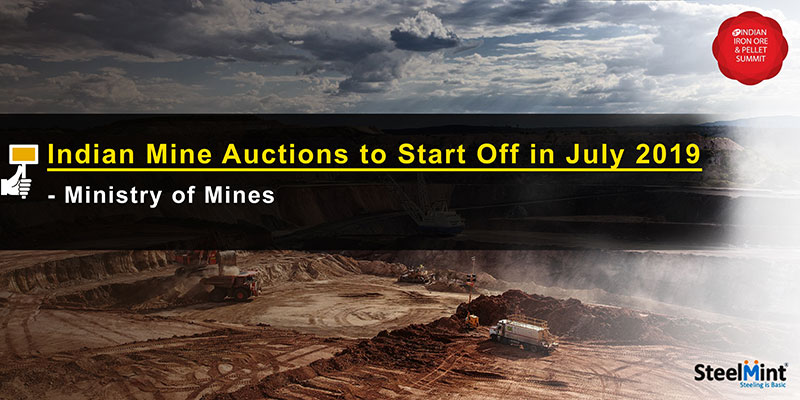
    New Delhi: India’s mine auctions are set to begin in July 2019 and conclude by December 2019, a landmark event wherein a quarter of the country’s iron and manganese ore resources will be up for sale for captive users and merchant miners.

    “We have the firm view that the auction will start from July-August”, said Dr Niranjan Kumar Singh, Joint secretary in the ministry of mines in the Central government. “By December this process will be completed this is our tentative time frame”.

    There are 46 working mining leases mostly in Odisha for the production of iron, manganese and chromite ores that will expire on March 31, 2020. These account for 53 MnT tonnes of iron and manganese ores or 26% of the total production of these two minerals, Singh said.

    Ministry of Environment and Forests

    The Ministry of Environment and Forests has agreed in principle to give forest and environment clearance to the new owners based on Letters of Intent for a period of two years, Singh added.

    “The clearances can be given as grace for two years.The new lease holders can apply for new clearances based on their new mining plans (later),” he said.

    These auctions are significant as many 50-year-old leases will be expiring and will be auctioned for the first time under the new Mines and Minerals (Development and Regulation) Act as opposed to the policy of allocations earlier that drew flack for lack of transparency.

    Interview Credits – Ms Ruchira Singh