SteelMint Events

Category: 3rd SRMC

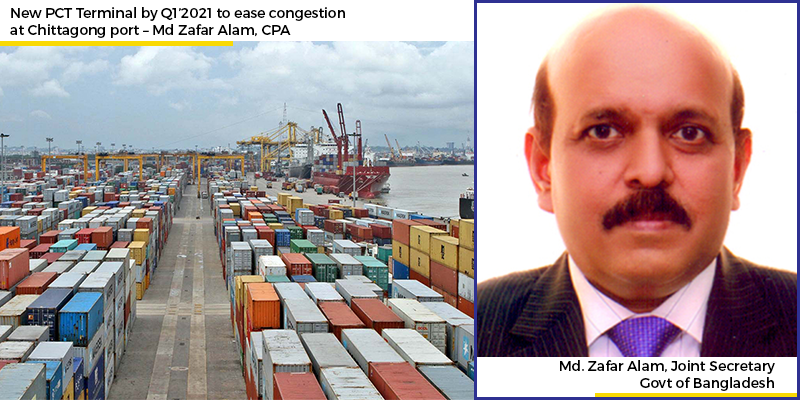
  • New PCT Terminal by Q1’2021 to ease congestion at Chittagong port – Md Zafar Alam, CPA

    New PCT Terminal by Q1’2021 to ease congestion at Chittagong port – Md Zafar Alam, CPA

    Md. Zafar Alam, Jt Secretary, Govt of Bangladesh, is Member (Admin and Planning) at the Chittagong Port Authority.

    In a recent interview to SteelMint, Mr Alam revealed about the expansion plans of Chittagong port to ease imports by steel and various other industries, development of new ports to share burden and role of private players in the port development sector in the coming years.

    Q1 How well equipped has Chittagong port emerged, to handle imports via containers and Bulk cargo, given that numerous steelmakers in the country import scrap through containers?

    A1 Chittagong port started its journey as cargo port. In the mid-seventies of last century, it started to transform into a container port by converting some cargo berths for container operation. Now at Chittagong port Authority (CPA) there are only six berths for cargo operation. Alternatively, CPA used its outer anchorage to discharge cargo through lighterage vessels. These lighter vessels move throughout the country by inland waterways.

    Q2 What are the steps being taken by authorities to ease out the prevailing port congestion at Chittagong, considering its importance for raw material imports for steel mills?

    A2 Chittagong port has taken some projects to develop its cargo and container handling facilities. Among them are, 3 new jetties at Patanga Container Terminal (PCT), 1.2 km long cargo Terminal in Bay Terminal area.
    Moreover, after the commissioning of PCT in the first quarter of 2021, it will spare at least two GCB berths for cargo handling, increasing capacity of Chittagong Port after adding bay terminal. Government has also taken a project to develop cargo and container Port at Matabari and Payra, and these two ports will support the industries dependent on imported raw materials.

    Q3 Is it true that Rice and other food related commodities are given preference for unloading at port, keeping scrap importers waiting longer and paying higher demurrage charges?

    A3 In fact in the existing 6 cargo berths of GCB follows a priority rule and that runs as follows:

    a) For food item- 1 berth
    b) Cement – 1 berth
    c) GI cargo/ Steel Scrap – 2 berth.
    d) RoRo vessel- 1 berth
    e) National flag carrier- 1 berth

    Moreover CPA allocated 3 lighter jetties to the steel mills for handling steel scrap from lighter vessels. CPA is developing at least 10 more lighter jetties to support the raw material import dependent industries.

    Q4 Will the new port, Payra port be utilized for scrap and raw material imports, or is it earmarked for other commodities?

    A4 Yes, Payra port will develop for both container as well as cargo handling purposes.

    Q5 Can you put some light on the govt’s plan of action to expand the Chittagong port’s capacities as well as newer port developments in the coming time? 

    A5 In 2019 Chittagong port handled around 100 million metric tons of cargo and 3.1 million TEUs of containers. Economic development of Bangladesh requires the development of ports. And government has taken initiative to develop Payra port in the middle region of Bangladesh and Matabari port in the south east region of Bangladesh. These ports along with Bay terminal and existing Chittagong Port will support the growing demand of the industries in Bangladesh. These expansion projects include:

    a) Construction of Patanga Container Terminal(PCT)
    b) Construction of Bay Terminal
    c) Expansion of yard facilities of Chittagong Port
    d) Construction of 10 more lighter jetties for the raw materials and cargo
    e) Newmooring Overflow yard; and
    f) introducing ICT based Port community System.

    I am very much optimistic with these development and expansion of Chittagong port could ease the movement of ships, containers and cargo including scrap raw material for the steel industry. Chattogram port has carried out a study about the possibility of setting up lighter jetties around sitakunda to support nearby steel industries.

    We are at the end of the implementation of the seventh five-year plan and we will enter into the eighth five-year plan in the next year, 2021. These will have provisions for private sector involvement in the port development. Private sector can come forward and establish port facilities for the smooth movement of the cargo and container.

    Mr Zafar Alam is one of the prominent speakers at SteelMint’s 3rd Steel and Raw materials conference, Chittagong on 23rd-24th March’ 20, where he will be addressing the concerns about the port congestion issues impacting raw material imports to Bangladesh and the correct solutions for the same.

  • Bangladesh to Add 1.5 MnT Steel Capacities in 2020

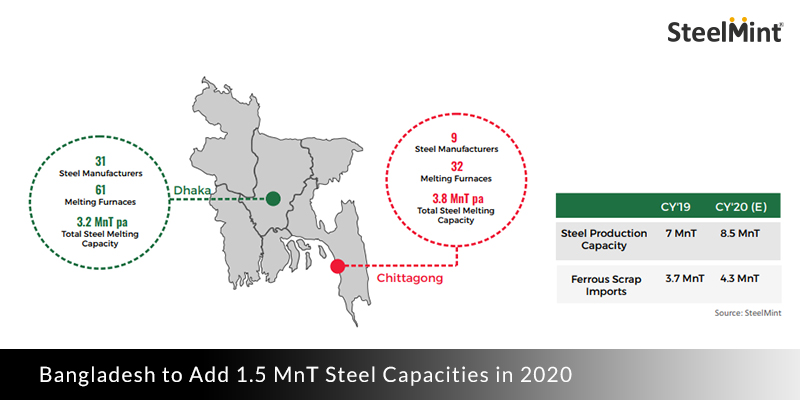
    Bangladesh to Add 1.5 MnT Steel Capacities in 2020

    Bangladesh’s steel industry is growing at a rapid pace on the back of increasing steel demand for the mega infrastructure projects lined up in the country in this decade. To meet the expeditious growth in demand, many large and medium steelmakers are expanding their steelmaking capacities by installing new melting furnaces. Approximately, over 10 induction furnaces of an (avg 25 T) capacities will get commissioned and operational in 2020 itself.

    Major steel mills in Chittagong include – BSRM, Abul Khair, GPH Ispat & KSRM. In Dhaka mills like Rahim Steel, Salam Steel etc expanding their melting capacities aggressively, while even smaller mills like RB Steel, HR Steel and many others are adding new furnaces.

    Bangladesh is expected to add around 1.5 MnT of steel production capacities in the next 12 months, thus leading to a sharp growth in its raw material import demand. Bangladesh’s total scrap imports (bulk + containers) are expected to cross 4.3 MnT by the end of CY’20 and are likely to breach 5 MnT mark by CY’21. Presently Bangladesh imports 3.7 MnT of ferrous scrap (bulk + container) annually, as of CY’19.

    To know more about the Bangladesh steel industry’s growth story, increasing scrap, DRI and HRC imports, changes in its ship-recycling industry and other latest news from the industry, download the Bangladesh Newsletter attached below:

    Bangladesh Newsletter

  • Increase in Tax Structure Pulled Down Bangladesh Scrapped Vessel Imports in 2019 – PHP

    Increase in Tax Structure Pulled Down Bangladesh Scrapped Vessel Imports in 2019 – PHP

    Mr Zahirul Islam is a Director at PHP Family and MD of PHP Ship Breaking and Recycling Ind. Ltd. and PHP Ispat Ltd, overseeing the operations of the Long Steel and Recycled steel divisions of the PHP family. He shared his views about the outlook on ship recycling market in Bangladesh, Hong Kong convention for ship recyclers and PHP’s green ship recycling yard. Below is an edited excerpt from his recent interview to SteelMint.

    Q1. Import of scrapped vessels to Bangladesh for ship recycling witnessed a sharp fall in H2 2019, after record high imports in H1 2019. What were the major policy reasons in 2019 budget, responsible such a fall?

    Ans 1. In 2019 budget, the government has increased Advance Income Tax (AIT) from BDT 300  to BDT 1000 per tonne, and has also imposed 5% Advance Tax. This has increased cost of buying vessel and at the same time we witnessed the local demand for steel drop. These are the main reasons why we saw a sharp fall in scraped vessel import in second half of 2019.

    Q2. How do you see the Bangladesh’s ship-recycling market to perform in 2020?

    Ans 2. Shipping industry is going through a tough time. The China-USA tension and Corona virus risks are some of the reasons why such a situation is being observed. Many ships are being sent for scrapping as ship owner are not getting order.

    This is an ideal situation for the ship recycling industry. Prices of scrap vessels are also coming down now. I think we will see a lot of activities in the recycling industry in 2020.

    Q3. Can you put some light on the Green recycling yard of PHP family and how is it different than normal ship-breaking yards in Bangladesh ?

    Ans 3. PHP Family has invested 6 million USD to transform its traditional yard into a green one. Class NK (the Japanese Classification Society) has recently given statement of compliance to Hong Kong Convention to PHP.

    This is a huge achievement for PHP as Class NK SO is regarded as the best certificate in the world. We ensure environmental and workers safety throughout the recycling process. Our workers get regular training on various safety topics and we bring trainer from abroad to carry out specialized training.

    Q4. What criteria does a ship recycler needs to fulfil to be certified as a Green ship recycler and is there any timeline for the same issued by authorities?

    Ans 4.  A facility needs to meet the requirements of Hong Kong Convention to be certified as green ship-recycler, ensuring that end-of-life ships do not pose any unnecessary risks to human safety and to the environment when recycled.

    The rules cover the design, construction, operation and preparation of ships for dismantling; the operation of ship recycling facilities in a safe and environmentally friendly manner; and the establishment of an appropriate enforcement mechanism for ship-recycling.

    Realistically, a facility may need 2 to 4 years to become green recycler.

    Q5. Does volatile imported scrap price trend impact ship-yard melting scrap prices?

    Ans 5. No, usually, imported scrap market trend does not have an impact on ship-yard melting scrap prices, which generally depend on local demand and supply tightness/availability.

    Q6. Are ship-plates from cutting of scrapped vessels a good alternative to billets for stand-alone rolling mills in Bangladesh? 

    Ans 6. Ship plate cannot be an alternative to billets as their grades are different from each other. Although many manual or hand rolling mills use ship plates for rolling, the grades are not of the same quality.

    Founded in 1969, PHP Family is one of the major conglomerates in Bangladesh comprising of over 30 companies in sectors ranging from Steel, ship recycling power and textiles.  PHP Ship Breaking and Recycling Industries Ltd was incorporated into PHP Family in March 2000 and spread over a total area of 20.2 acres, the PHP’s recycling yard has processed over 140 ships and 1.7 MLDT of ship-breaking volume in total as of 2019, remaining the only ship recycling facility at Bangladesh which complying the requirements of Hong Kong International Convention as of yet.

    To know more about vessel imports and price trends of the ship recycling industry in Bangladesh, book your seat at SteelMint’s 3rd Steel and Raw Material Conference, Bangladesh and get a chance to hear views of renowned industry participants from across the globe. The conference is being organized on 23rd-24th March 2020 in Chittagong, Bangladesh.

  • Bangladesh Scrap Imports Likely to Grow by Over 15% in 2020

    Bangladesh Scrap Imports Likely to Grow by Over 15% in 2020

    Bangladesh steel industry is currently growing at a staggering rate, primarily due to the rising steel demand in the country on account of several large infrastructural projects in the pipeline for this decade. Presently there are several expansion plans underway by various steel manufacturers across the country, to meet the rising steel demand.

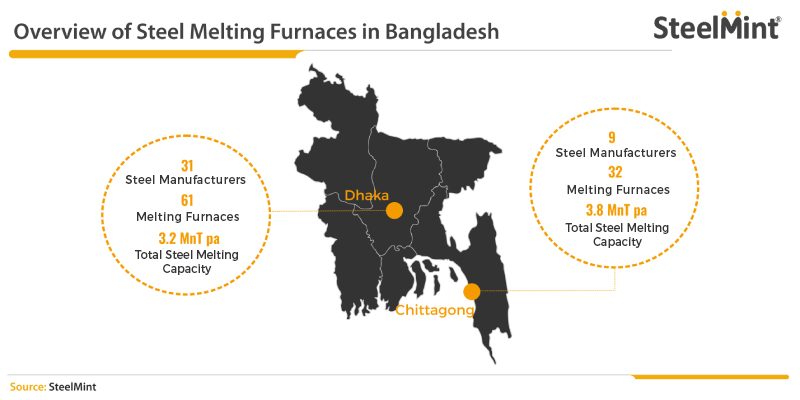
    At present, there are around 97 steel melting furnaces being operated by 42 steel manufacturing companies located mostly in Dhaka and Chittagong regions. Out of 97 furnaces, 94 are induction based furnace and 3 are electric arc furnace.

    Chittagong – home to large steel mills – The Chittagong region primarily houses the larger mills including the top 4 steelmakers of the country, and includes 9 steel manufacturers operating a total of 32 melting furnaces (29 IFs and 3 EAFs) with total annual crude steel capacity of around 3.8 MnT (before GPH Ispat’s new plant’s commencement). The Dhaka region on the other hand comprises of 31 relatively smaller mills operating 61 Induction furnaces with a total melting capacity of around 3.2 MnT per annum, while another 4 induction furnaces are operated by steelmaker in Comilla region.

    Bangladesh steel production to increase by 1-1.5 MnT in 2020: Ongoing expansion in steel melting capacities by existing players will ensure an increment of 1-1.5 MnT of crude steel production in 2020. Recently, GPH Ispat has commissioned its 80 MT (0.86 MnT annual capacity) Quantum EAF and started trial production. Another 8-10 Induction furnaces of around 20 MT capacity each are expected to be commissioned in the next 12 months (this translates to 0.6 MnT capacity per year).

    Bangladesh scrap imports likely to grow over 15% in 2020 – The rising capacities and steel production levels in Bangladesh is expected to ensure a continued growth in imported scrap volumes in coming years.  The annual imported scrap volume (bulk & containers) has shown a sharp rise in recent years and were recorded at 3.6-3.65 MnT in CY 2019. The same is expected to cross 4.2 MnT by end of 2020, with the import volume having a chance to cross the 5 MnT per year mark by 2021 end, given the similar growth rate in production persists.

    Similarly, DRI imports to Bangladesh will also actively increase, in line with the increasing steel production rates. Sponge Iron export from India to Bangladesh may cross 700,000 MT/year mark by 2021 end, from 461,256 MT of exports recorded in CY 2019.

    To know more on the upcoming capacity expansions in the Bangladesh steel industry and its effect on the raw material import dynamics, book your seat at SteelMint’s 3rd Steel and Raw Material Conference, Bangladesh and get a chance to hear views of renowned industry participants from across the globe. The conference is being organized on 23rd-24th March 2020 in Chittagong, Bangladesh.

  • Indian Sponge Iron Exports Up 27% in CY19 On Increased Buying from Bangladesh Mills

    Indian Sponge Iron Exports Up 27% in CY19 On Increased Buying from Bangladesh Mills

    Indian sponge Iron (DRI) exports to Bangladesh have witnessed a sharp  growth in CY 2019, on the back of rising steel melting capacities in Bangladesh consistently pulling up the DRI demand. On an overall basis, India’s sponge Iron exports increased by 27% Y-o-Y, from  671,124 MT in CY ’18 to  854,251 MT during CY‘19. Bangladesh remained the largest importer of Sponge Iron from India, retaining its share of 54% in total India DRI exports, followed by Bhutan and Nepal, with a share of 20% and 15% respectively.

    On a yearly basis, the DRI exports to Bangladesh from India moved up significantly by 26% Y-o-Y, recording exports of  461,256  MT in CY 2019, as against 365,447 MT in CY’ 18.

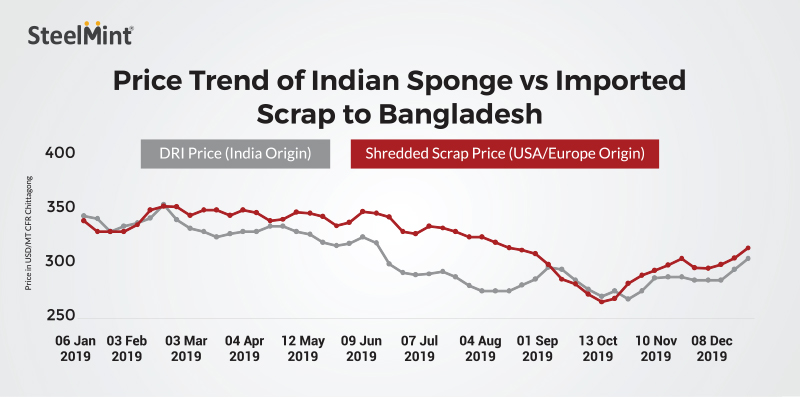
    However, the Indian DRI export volumes to Bangladesh dominated more in H1 2019, when the export offers were in a sharp continuous decline from the beginning of 2019, as compared to the latter half when the offers majorly remained stable for the rest of the year. Starting from USD 340/MT CFR Chittagong levels in Jan’19, the offers to Bangladesh plunged by over USD 60/MT in 6 months and settling down at USD 280/MT CFR levels by the beginning of H2 2019.

    On the contrary, imported scrap offers to bangladesh (from North America/Europe) remained at a significantly higher levels of USD 340-350/MT CFR Chittagong throughout the H1 ’19, before crashing down by USD 70/MT in H2′ 19, thus promoting Bangladeshi buyers towards more active DRI bookings in the first half of the year and giving more preference to imported scrap in the latter half of 2019.

    Another reason for higher average imports by Bangladesh in H1 ’19 as compared to H2′ 19 is the aggressive restocking before the country’s annual budget in Jul‘19, on an anticipation of major tax policy changes in the same. Although,even after the budget concerns getting resolved and monsoon slowdown passing by, the domestic steel sales of bangladesh refused to improve all through the 2019 on persistently slow construction sector, thus affecting the raw material procurement towards the end of the year.

    With many steel manufacturers in Bangladesh expanding their capacities and steel production, the DRI imports by Bangladesh from India are poised to rise further, likely increasing its share in Indian exports even further.

    To know more on the trade dynamics of Bangladesh sponge iron imports, book your seat at SteelMint’s 3rd Steel and Raw Material Conference, Bangladesh and get a chance to hear views of renowned industry participants from across the globe. The conference is being organized on 23rd-24th March 2020 in Chittagong, Bangladesh.