SteelMint Events

Category: 3rd Coal Outlook Conference

  • India: CIL planning to boost e-auction offerings on higher coal availability

    India: CIL planning to boost e-auction offerings on higher coal availability

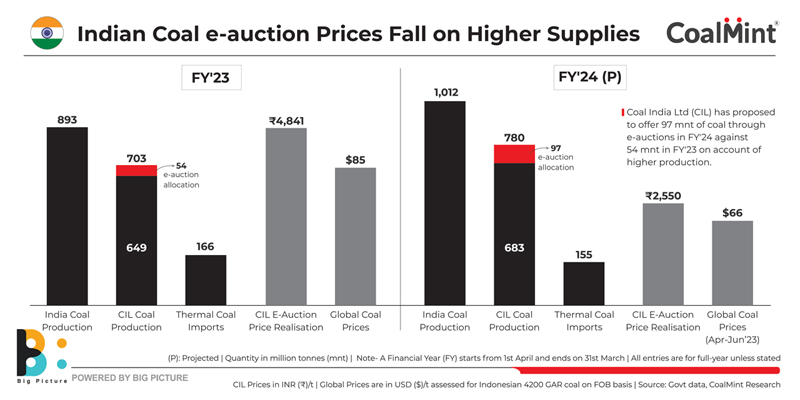
    State-run miner Coal India Ltd (CIL) has floated a calendar outlining the proposed coal volume to be offered under e-auctions during FY’24. The company is planning to sell 97.43 million tonnes (mnt) of coal, which is around 81% higher than 53.91 mnt offered last year of which 52.88 mnt was booked.

    As per policy guidelines, CIL earmarks 10% of its annual production for sale via regular e-auctions based on competitive bidding, whereas the majority of the sale is carried out via fixed price contracts under fuel supply agreements (FSA).

    However, the company has been skewing this norm by regulating the coal offering based upon availability. This year, it has allocated a higher volume for e-auction than the actual norm, based on the projected production of 780 mnt, in view of supply-side improvements.
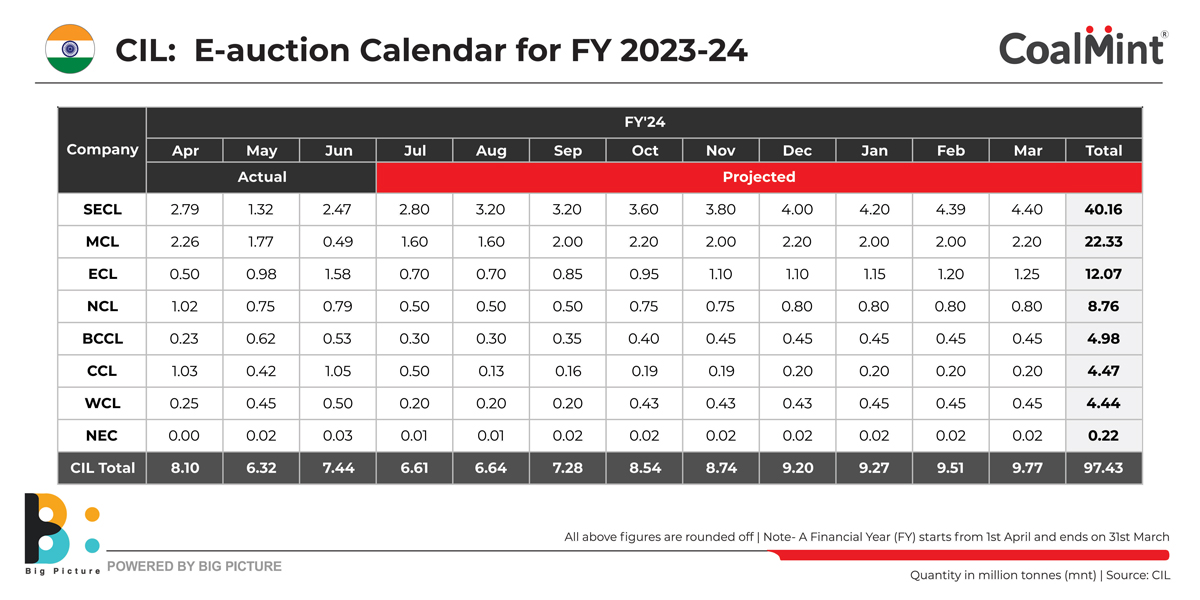
    The auction calendar highlights that CIL has already offered 21.86 mnt of coal in the first quarter (April-June’23) registering an exponential growth of 115% compared to the year-ago period. The remaining 75.56 mnt will be sold in phases during the final nine months.

    There was also indication of reduced offerings in July-August against June levels on account of expected supply disruption during monsoon. From then on the offered quantity rises progressively on a monthly basis in tandem with the increase in production, with total tonnage peaking in March.

    Production to breach 1 bnt-mark

    The government has set a coal production target of 1,012 mnt in FY’24. Of this, CIL’s share has been fixed at 780 mnt, while Singareni Collieries Company Ltd. (SCCL) is expected to contribute 80 mnt. The remaining volume of 162 mnt is expected to come from captive and commercial miners.
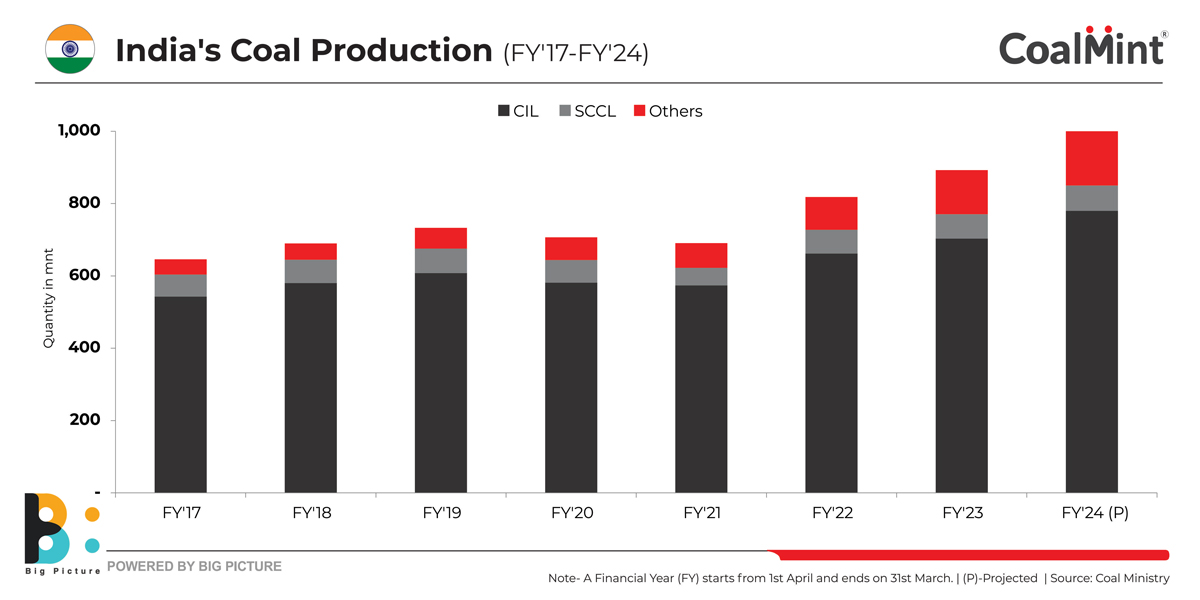
    In particular, CIL has set sights on creating a new production milestone by surpassing the previous high of 703 mnt attained last fiscal.

    In Q1FY’24, CIL’s production jumped 10% y-o-y to 175.5 mnt, which is the highest ever production recorded during Q1 of any fiscal year. Dispatches increased 5% y-o-y to 187 mnt in Q1, which was around 7% higher y-o-y.

    The performance trend indicating sharper production growth relative to dispatches has reduced inventory liquidation at mine level. This has helped the miner to accumulate sufficient inventory and also provide a leeway to increase e-auction volumes.

    Besides, substantial growth in contribution from captive and commercial miners also provides new avenues for buyers thereby augmenting domestic availability.

    Recovery in global supplies

    In the aftermath of the Russia-Ukraine war when disruption in trade flows had triggered an unprecedented surge in coal prices, the Indian government was forced to take necessary measures to ensure fuel security at power plants.

    This also forced CIL to curtail its offerings via e-auctions and resort to diverting the additional tonnage meant for sale in order to increase supplies to power plants.

    However, as global supply pressure eases, there is adequate material availability for the imported coal-based plants which has also gradually reduced the pressure on domestic coal-based power plants.

    Subdued coal-fired power generation

    On the demand side, nominal growth in coal-based power generation owing to favourable weather conditions has also reduced the burden on domestic miners.

    As per data provided by the Ministry of Power (MoP), coal-based power generation grew 2% y-o-y to 315.3 billion units (BU) in Q1FY’24 against 308 BU in Q1FY’23. Last year, the growth in generation volume at this juncture was around 20%.

    Rising stockpiles

    While, CIL has accumulated sufficient inventory at mine pit-heads, the power plants have also shown encouraging signs with regard to inventory build-up aided by higher supplies and subdued generation.
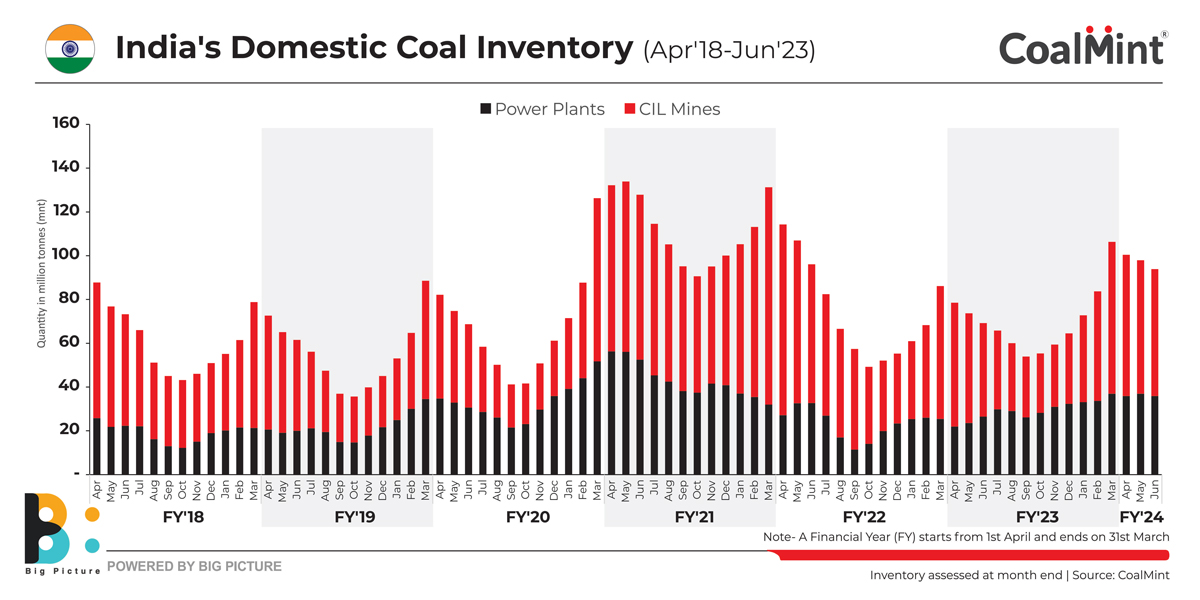
    Coal inventory at power stations was assessed at 35.88 mnt towards the end of June, which is sufficient for 13 days of power generation. Besides, the number of plants having a critical stock position has reduced to 61 currently from 87 in the year-ago period.

    In all, combined inventory at CIL’s mines and power plants has increased to 93.9 mnt in June, up 36% y-o-y.

    Outlook

    The uptick in e-auction volumes is expected to push coal prices lower which are already reeling under the impact of improvement in supplies both at the domestic and global levels.

    CIL’s price realisation for e-auction sales has dropped nearly 40% to INR 2,950/t in the June quarter from INR 4,841/t recorded in FY’23. Prices are expected to inch down to INR 2,550/t in full-year FY’24.

    There seems to be minimal impact on imports from increased e-auction sales as Indian buyers are reaping benefits of ample material availability at cheaper prices. Presently, thermal coal imports on a monthly basis are assessed at around 16-17 mnt in Q1FY’24 against the average of 14 mnt in FY’23.

    However, in a scenario where there is not much improvement in demand, lower e-auction prices may reduce imports which are expected to drop to 155 mnt in FY’24 from 166 mnt in FY’23.

    3rd India Coal Outlook Conference

    How will CIL’s altered auction dynamics affect domestic buyers? Supplies to the non-regulated sector rose 34% in FY’23 –will the trend continue in FY’24? To hear experts deliberate on these topics and much more, register for SteelMint Events’ 3rd India Coal Outlook Conference to be held at JW Marriott, Kolkata, from 24-26 August, 2023.

  • Global coking coal demand likely to rise over 2% in 2023

    Global coking coal demand likely to rise over 2% in 2023

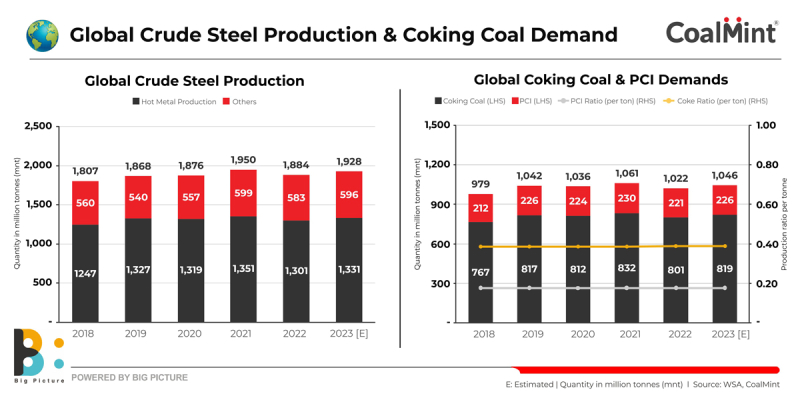
    Global demand for coking coal in steelmaking is expected to increase by around 2.25% y-o-y in 2023. World Steel Association’s (WSA) short-range outlook published in April this year predicts that world crude steel production is expected to increase by 2.3% in 2023 from 1.88 billion tonnes (bnt) last year to 1.92 bnt.

    Therefore, CoalMint estimates that global coking coal demand is likely to reach around 819 million tonnes (mnt) this year from roughly 800 mnt in 2022. Data reveals that global coking coal demand (excluding PCI) has grown nearly 7% since 2018.

    WSA data shows that the share of oxygen steelmaking (BF-BOF) in global crude steel production was over 71% in 2022, with the rest being accounted for by the electric route (predominantly EAFs and also IFs). Therefore, global hot metal production in blast furnaces is expected to be around 1,331 mnt (1.331 bnt) in 2023–an increase of over 2% on the year from 1.301 bnt in 2022.

    Demand for PCI

    Notably, total coking coal demand must also include pulverised coal injection (PCI) used in blast furnaces to accelerate the process of reduction. Demand for PCI coal is likely to inch up to 226 mnt in 2023 from 221 mnt last year. So, total global consumption of coking coal + PCI may rise to 1.04 bnt this year from 1.02 bnt in 2022, as per CoalMint estimates.

    Estimates further show that while the average usage of metallurgical coke in blast furnaces is at the rate of 390 kg per tonne of hot metal, the PCI rate per tonne of hot metal is 180 kg. These figures represent the global average. However, many companies have increased PCI use in the BF by as much as 250 kg per tonne of hot metal and this is mainly a cost-cutting measure. Roughly, 1 tonne of PCI replaces 1 tonne of coke and 1.5 tonne of coking coal is required to produce 1 tonne of coke.

    Trade & price outlook

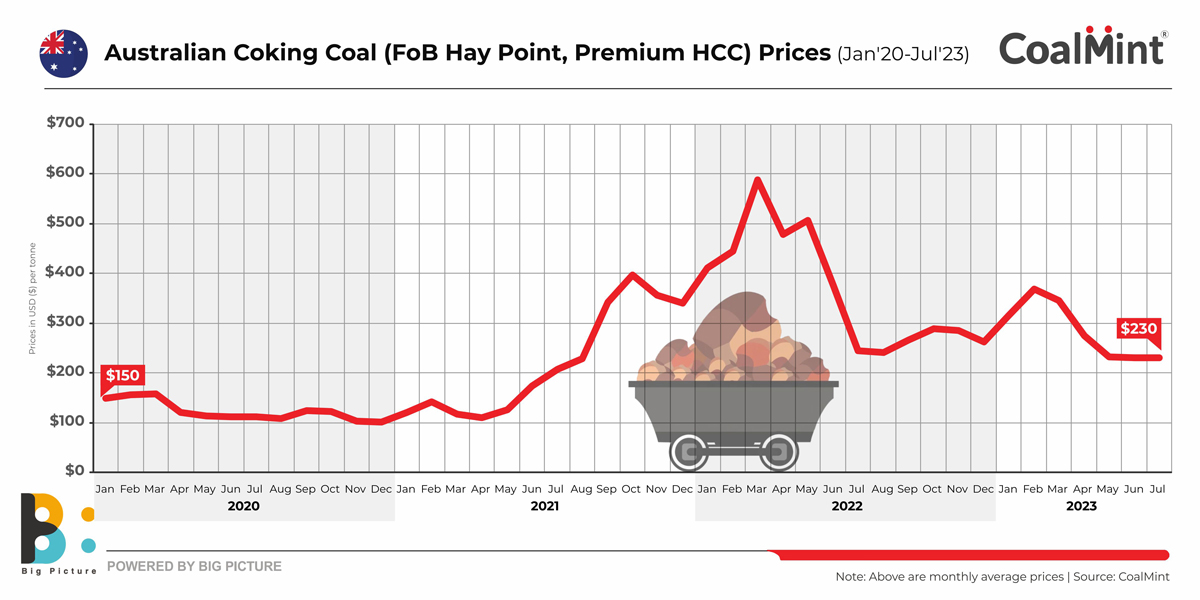
    Australian premium coking coal prices have decreased to $230/t FOB from $300/t in mid-March 2023. Global inflation, monetary tightening, energy market volatility have impacted the steel market adversely. Below are factors which may impact prices in H2CY’23:

    The extent of steel production curbs in China in H2 weighs on market sentiments and also obviously on coking coal demand. China accounts for roughly 56% of global steel production and 18% of seaborne coking coal demand. It is also the biggest spot market for met coal. Australian government sources predict that China’s imports of seaborne coking coal may drop 20% y-o-y in 2023.

    Steel production in India rose over 8% y-o-y in Q1FY’24, as per JPC data. Steel demand is expected to increase by over 7% this year and production is likely to grow by over 10%. Commissioning of new blast furnace mills is surely positive news for coking coal demand. Sources are of the view that prices should revolve between $225-245/t FOB in H2.

    According to the Australian government’s Department of Industry, Science and Resources, almost 15 mnt of blast furnace capacity has come back online again in Europe, as the continent has been able to effectively battle energy inflation. So, coking coal demand will remain largely stable in H2.

    Weakening global steel market sentiment and its impact on exports weigh on the Japanese and South Korean steel industries. The two countries have a combined share of 27% of global seaborne imports. The recovery in manufacturing and automotive supply chains is an upside; however, demand outlook is largely stable.

    Higher supplies are expected to weigh on prices in H2. Australia is ramping up shipments with the end of the La Nina climate episode. Supply outlook from the US and Canada is largely unchanged barring some disruptions in the US. Russia has diverted a portion of its cargoes to Asia, while Mongolia is looking to increase supplies with the laying of new railway networks.

    Thermal coal prices have fallen sharply and the incentive to sell coking coal in the thermal coal market is lacking currently unlike last year. So, supplies will increase further and exert pressure on prices.

    3rd India Coal Outlook Conference

    Hear experts deliberate on ‘Global metallurgical coal & coke market trends: Will supply concerns intensify?’ at SteelMint Events’ 3rd India Coal Outlook Conference to be held at JW Marriott, Kolkata, from 24-26 August 2023. Register now.

  • India: Govt outlines ambitious coal export plan for CIL. Will it materialise?

    India: Govt outlines ambitious coal export plan for CIL. Will it materialise?

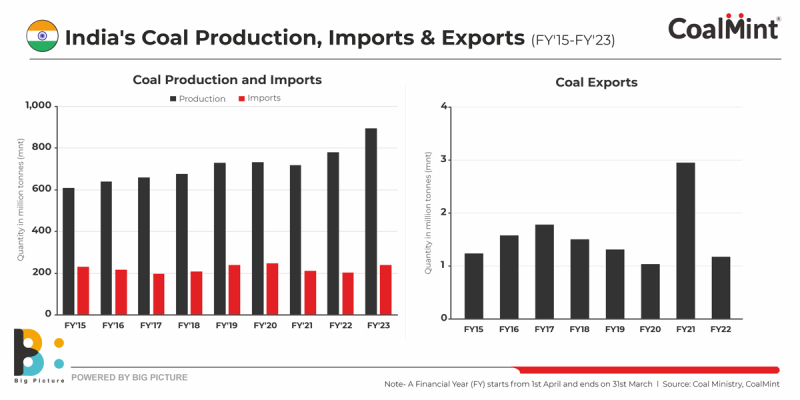
    India recorded highest-ever coal production of over 890 million tonnes (mnt) in financial year 2022-2023 (FY’23), while Coal Ministry projections show that coal supply (domestic + imports) may rise to 1,692 mnt by FY’30.

    State-owned Coal India Ltd. (CIL) is expected to raise production to around 1,120 mnt by FY’30 even as the captive and commercial mines may witness an exponential growth of 130% in production to 281 mnt by that time from around 122 mnt at present.

    Despite surging electricity demand–at a CAGR of over 4% till 2030–imports of bituminous and steam coal are expected to edge down to around 95 mnt by FY’30 from nearly 140 mnt currently. Imports will largely be of non-substitutable G1-G8 grades of coal.

    However, and this is the most interesting part, with domestic miners raising production with each passing year, the government is mulling to channel surplus coal to the export markets–essential in addressing the energy security needs of subcontinental neighbours.

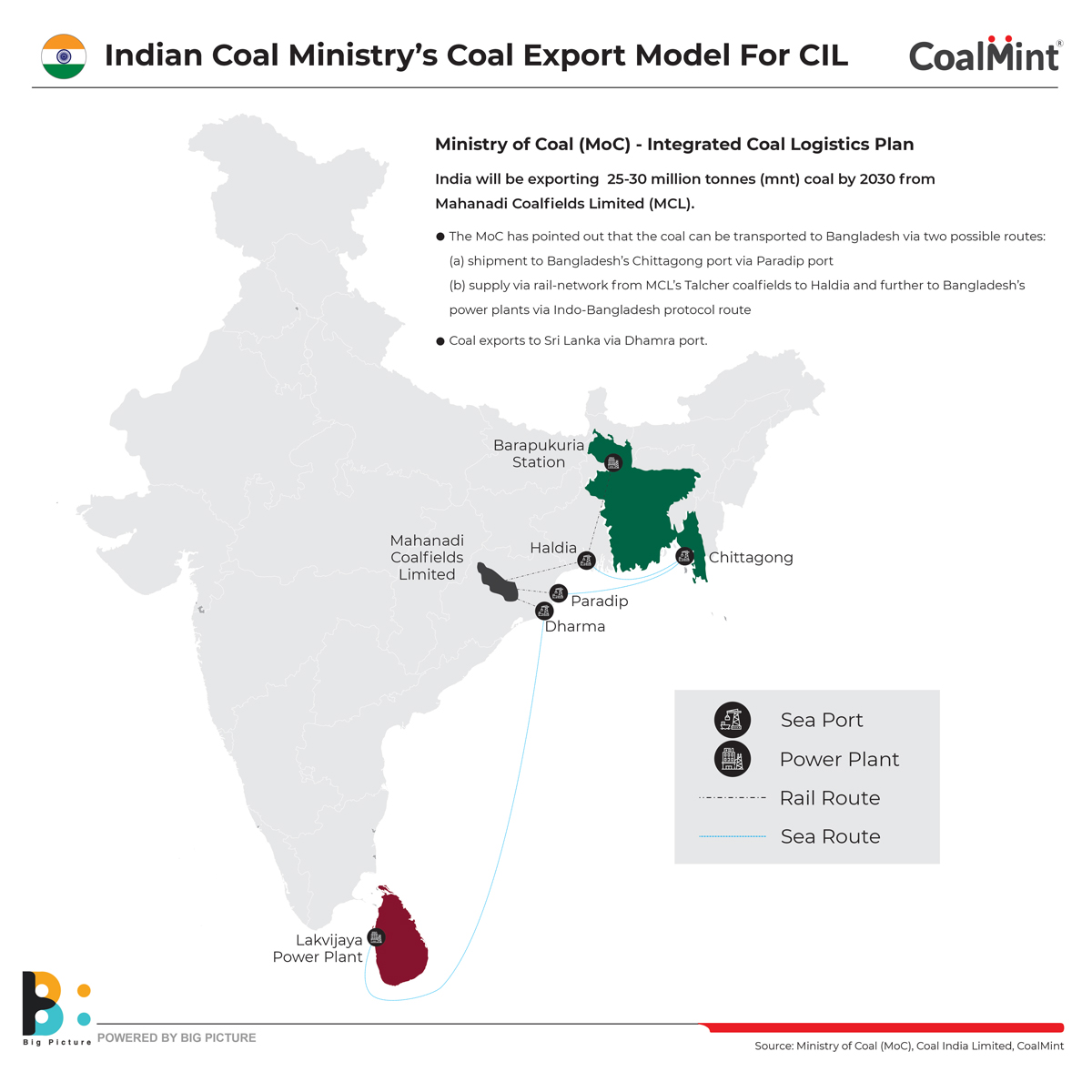
    In a draft version of the ‘Integrated Coal Logistics Plan’, the Ministry of Coal (MoC) has outlined a roadmap to export 25-30 mnt of coal by 2030 from mines located in the eastern region. India currently exports merely 1-2 mnt of coal annually.

    Emerging opportunities

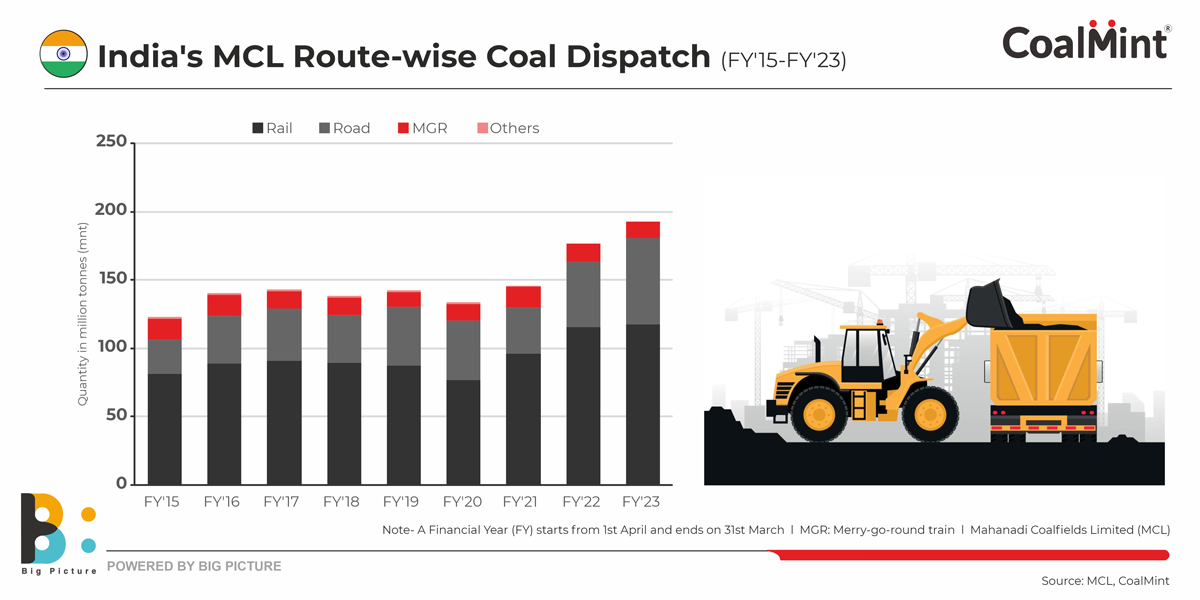
    CIL’s largest subsidiary Mahanadi Coalfields Ltd (MCL) has emerged as a suitable candidate for exploring the export market. In its rail dispatch plan for 2030, MCL has set a target of 298.88 mnt of supply from the current level of 117.8 mnt. This volume is substantially higher than the tentative supply of 192.02 mnt taking into account demand projection from adjoining states along with requirement for coastal movement of coal.
    Even an increase in e-auction volumes has proved insufficient in filling the void. In this scenario, the MoC has suggested that the surplus coal can be used for creating a long-term sustainable export market. MCL’s proximity to sea ports is an advantage when it comes to transporting coal to neighbouring countries.

    Prospective markets

    In the proposed logistics plan, Bangladesh has been identified as a potential export destination. The MoC has pointed out that coal can be transported via two possible routes:

    (a) shipment to Bangladesh’s Chittagong Port via Paradip Port

    (b) supply via rail from MCL’s Talcher coalfields to Haldia and further to Bangladesh’s power plants via the India Bangladesh Protocol Route

    Bangladesh is planning to build new coal-fired power plants. Accordingly, thermal coal demand for power generation is forecast to rise from the present 2.3 mnt to 21-25 mnt by 2025. However, the government is facing difficulties in developing planned capacities due to financing and coal availability issues.

    At present, Bangladesh relies on Indonesian coal and, as per MoC data, the average price of Indonesian 4,200 GAR coal is assessed at around $112.725/t CNF Bangladesh.

    A landed-cost on an energy basis comparative analysis shows that MCL’s coal of 2,950-3,850 GCV is priced between INR 2,534 and INR 2,976/t ($30-36/t) on CNF Bangladesh basis. This highlights the huge disparity between prices from these two origins–one of the key reasons for Indian coal emerging as a substitute for Indonesian material.

    The coal logistics plan also makes a case for exporting around 4 mnt of coal to Sri Lanka, replacing current volumes from South Africa, to fuel the 900 MW Lakvijaya power plant in the island nation.

    The price of 2,950-3,850 GCV coal from MCL on a CFR Sri Lanka basis is seen at INR 3,088-3,530/t ($37.40-$42.75/t), compared to $172.09/t CFR Sri Lanka for 4,800 NAR coal coming from South Africa.

    In order to explore export prospects to Sri Lanka, transporting coal to Lakvijaya’s unloading coal jetty via Dhamra Port has been identified as a viable option.

    Challenges

    The export plan indicates possible congestion in rail networks which poses a threat to the existing coal supply chain. Notably, exports to Bangladesh will require additional coal transportation via railways to the tune of 17.79 rakes/day, while moving coal to Sri Lanka will require additional transportation of 2.85 rakes/day.

    Thus, any scenario involving transportation of addition tonnage for exports would necessitate upgrade of rail infra projects. The MoC has informed that the new Angul-Sukinda rail line would ease congestion on major routes such as Budhapank to Rajatgarh and Cuttack to Paradip. Besides, Dhamra Port can handle around 20 mnt of coal for coastal shipping and exports.

    Outlook

    The prospect of exports holds vital importance for CIL’s production growth, as it would provide assurance against fluctuating demand from the non-power sector and the threat emerging from renewables.

    Nonetheless, despite the projected rise in exports, India will remain a net coal importer as the dependency on coking coal and high-CV steam and bituminous coals is expected to remain in the foreseeable future.

    The planned development of rail and port infrastructure is also likely to encourage commercial miners to explore export markets, given that restrictions on coal utilisation from the auctioned blocks have been lifted.

    3rd India Coal Outlook Conference

    Register for the 3rd India Coal Outlook Conference to be held at JW Marriott, Kolkata from 24-26 August, 2023, to gain an incisive insight into CIL’s production and dispatch outlook, changing e-auction dynamics, ongoing initiatives to expand underground coal mining, as well as sustainable mineral exploration drives.

  • India: Govt permits low-sulphur pet coke imports for steel production. What are its benefits?

    India: Govt permits low-sulphur pet coke imports for steel production. What are its benefits?

    • DGFT allows low-sulphur pet coke blending of up to 10% in coke ovens
    • Sulphur level fixed at below 3% for integrated steel mills
    • High-quality coke to boost BF energy efficiency 

    The Director General of Foreign Trade (DGFT), under the Union Ministry of Commerce & Industry, has allowed imports of low-sulphur pet coke (below 3% sulphur) for use in recovery-type coke ovens of the Integrated Steel Plants (ISP) in the country, as per a recent notification accessed by CoalMint.

    The maximum permissible blending ratio of pet coke in recovery-type ovens has been fixed at 10%, while continuous analysers for measurement of sulphur dioxide emissions through waste/process gases shall have to be installed, which shall be monitored by the State and Central Pollution Control Boards (SPCB/CPCB).

    Backdrop  

    In its 2017 order, the apex court had ruled that no imports of petroleum coke for use as fuel, as opposed to feedstock, would be allowed. Soon after, the Indian Steel Association (ISA) filed an application seeking permission for usage of imported low-sulphur pet coke in steel plants, arguing that steel plants do not use pet coke as a fuel but as an additive.

    “Feedstock is more of a raw material used for the manufacture of a product. In the case of coke ovens, coal is the feedstock for making coke. Additive refers to any substance added in small quantities to the raw material to improve the quality of the product. In the case of steel industry, pet coke is an additive to coal, which is added to improve the quality of coke,” the ISA had stated in its application.

    In a report published in 2018, the Environment Pollution Control Board (EPCA) argued that pet coke imports by steel plants should not be permitted as “it will open the floodgates in terms of use of pet coke and defeat the very purpose of the ban on imports” of this “dirty fuel”. In its latest notification, however, the DGFT has reconfirmed – as per the 2017 SC ruling – that imports would be allowed only as a feedstock and not as fuel.

    Benefits

    Blending of low-sulphur and low-ash pet coke in coke ovens is intended to improve the quality of coke used in the blast furnace (BF) and result in higher efficiency. The ash content of pet coke is only about 0.3% compared with 9-10% for premium imported coking coal. Higher fixed carbon (FC) in high-quality pet coke and low volatile matter (VM) is ideal for BF. Reducing coke consumption in BF-BOF processes is a low-hanging fruit, targeted by global steelmakers. For instance, ArcelorMittal’s Ghent facility in Belgium blends up to 10% pet coke in coke ovens, a ratio compliant with the European emissions limits for sulphur dioxide (< 500 mg/Nm3).

    Typical coke consumption in Indian plants ranges between 344 and 400 kg/thm (tonne of hot metal) compared to the global average of 280 kg/thm. “Pet coke provides both economic and environmental benefits – reduced transport emissions, ash generation, and production emissions – with minimal additional investment,” a steel mill source said.

    Emissions apart, another objection raised against pet coke usage is the seepage of sulphur into steel – an unwanted impurity which increases the brittleness of steel and reduces its corrosion resistance. An increase in the sulphur content of coke would require additional volumes of limestone to remove sulphur as slag. Furthermore, this reaction of sulphur with limestone is endothermic in nature, which means that to compensate for the heat loss, more coke would have to be fed into the furnace, thereby increasing the sulphur content. Also, increasing the pet coke blend beyond 15% reduces coke strength and increases the coke’s reactivity index, thus impairing its suitability for BF operations.

    However, a CPCB study of JSW Steel’s Vijaynagar facility has found that only 2% of sulphur content in the coal blend is liberated as hydrogen sulphide and is emitted along with the coke oven gas (COG) in a recovery-type oven. While 67% of the sulphur is absorbed by the coke, another 31% is retained in sludge and tar. The hydrogen sulphide is removed as elemental sulphur in the desulphurisation plant, and the residual sulphur content falls to less than 250–500 mg/Nm3 in COG. When the COG is combusted, the resultant sulphur dioxide emissions can be as low as 125–150 mg/Nm3 against an emissions norm of 600 mg/Nm3.

    However, for non-recovery-type ovens, around 19% of the sulphur content in the coal blend is directly released in COG as sulphur dioxide. Thus, in this process, the percentage of pet coke blend is limited by the emissions limit of 600 mg/Nm3. However, in India, all ISPs have recovery-type ovens.

    Moreover, a 10% share of pet coke in the coal blend means a 10% reduction in prime coking coal consumption. Coking coal accounts for around 40% of total steelmaking costs. In times of energy market volatility, such as last year when premium HCC prices had crossed $650/t, that share touches around 55-60%. So, there is an argument to be made in terms of cost efficiency, too.

    Way forward   

    Much like increasing the use of pulverised coal injection (PCI) in the BF, increased usage of pet coke in the coal blend is intended to boost BF energy efficiency, reduce coke consumption, and thereby directly reduce emissions. For the integrated steel plants increasing process efficiencies within existing steelmaking infrastructure is a vital interim measure in achieving decarbonisation goals.

    3rd India Coal Outlook Conference 

    Interested to gain a deeper insight into the techno-economics of increasing pet coke usage in coke production and steelmaking? Hear experts deliberate on ‘India’s Steel Production Targets and Emerging Raw Materials Demand Scenario’ at CoalMint’s 3rd India Coal Outlook Conference – to be organised parallelly with SteelMint’s 5th Iron Ore & Pellet Summit and 5th DRI & Metallics Conference – at JW Marriot, Kolkata from 24-26 August, 2023.