SteelMint Events

Category: India Steel Conference 2022

  • India’s steel exports fall 34% in Q1; Q2 looks dull

    India’s steel exports fall 34% in Q1; Q2 looks dull

    • Export tax impact blunts overseas sales’ edge
    • Boron-added exports see sudden spurt
    • Export tax retention may see Q2 volumes go below 2 mnt

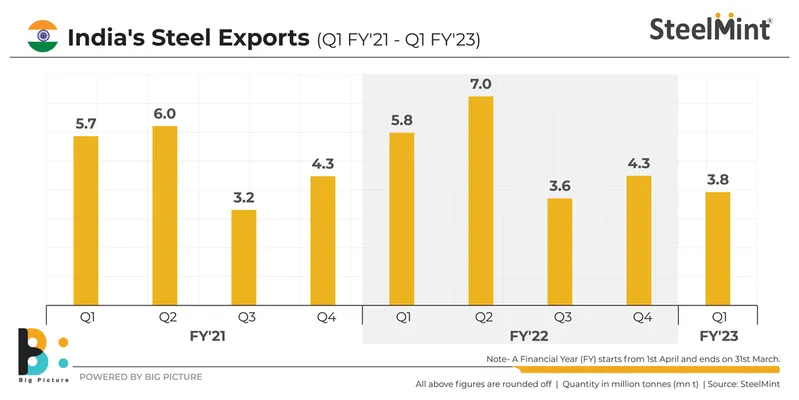
    India’s finished steel exports, including semis, dropped 34% to 3.78 million tonnes (mnt) in the first quarter (April-June, 2022) of the current financial year (FY2022-23) compared to 5.77 mnt seen in the year-ago quarter.

    There was drop across the three categories of flats, longs and billets. Flats exports fell 28% y-o-y to 2.64 mnt (3.68 mnt) in Q1. Longs fell 54% to 0.28 mnt (0.62 mnt) and semi-finished by 41% to 0.86 mnt (1.47 mnt) in this period.

    From a q-o-q perspective, exports were down 13% from 4.33 mnt in Q4 (January-March, 2022)

    On a half-yearly basis too, exports dropped almost 20% to 8.11 mnt in January-June, 2022 against 10.08 mnt in the same period in 2021.

    Reasons for the drop in exports

    1. Export tax impact: The 15% export duty, slapped from 22 May, brought the market to a standstill immediately in its aftermath. After a fortnight’s lull, mills huddled to find a way out of the crisis, in the form of boron-added steel, which escaped the export ambit.
    It is to be noted that while all categories under flats recorded a fall, only “electrical steel” exports skyrocketed by almost 700% albeit on a low base. From as low as 17,650 tonnes in Q1FY22, these rose to 0.14 mnt in Q1FY23. This is an indication that boron-added steel (which falls under electrical steel) category had increased from India and this push had come mainly from June when mills tried to work around the export duty by offering alloy steel. SteelMint’s data reveals that in April 2022, these were at a negligible 2,334 tonnes and in May, 2022, at 7,110 tonnes.

    Under normal circumstances, electrical steel exports constitute barely 10,000 t per month.
    India's steel exports drop 34% in Q1; Q2 looks bleaker

    SteelMint understands that whatever volumes were exported in June, were boron-added with the trade in regular grades of carbon steel having come almost to a standstill.

    Meanwhile, the 3.78 mnt seen in Q1 also includes bookings made prior to the tax imposition. However, all material, including those for which contracts had been signed or those lying at ports – also attracted the export duty.

    2. Vietnam’s imports plunge: Mostly all importing countries showed a y-o-y decline amid tepid home demand, rising energy prices, and inflation. But Vietnam showed the steepest 64% drop in imports from India to a mere 0.14 mnt in Q1FY23 against 0.39 mnt in Q1FY22, mainly for two reasons. One, decline in European demand eroded Vietnam’s exports of value-added steel. Two, its end-users preferred competitively priced domestic material.
    India's steel exports drop 34% in Q1; Q2 looks bleaker

    Outlook


    The export volumes in the second quarter (July-September, 2022) are expected to fall further although, going forward, alloy steel exports from India will increase further.

    SteelMint forecasts that exports in Q2 will be even lower from that in Q1, for two reasons. Very few bookings have happened so far into the second quarter and it looks unlikely that many deals will take place in the remaining portion of the quarter if the export tax continues. In such a scenario, volumes can even drop below 2 mnt.

    Secondly, overseas demand has been lacklustre on the back of the outbreak of the Russia-Ukraine war, energy crisis, inflation, debt crises, Covid lockdowns and supply chain bottlenecks.

    Please click here for the India Steel Conference brochure

  • Steel prices observe 15% correction globally. How will they pan out in August?

    Steel prices observe 15% correction globally. How will they pan out in August?

    Steel mills across the globe are staring down a desert land of dried-up demand, as the Russia-fuelled war rages on in Ukraine. Prices of gas, which power households and factories across the European Union, have surged 700% till date, as per reports, putting the entire Continent and other parts of the world in an uncomfortable inflationary grip which has also decimated steel demand.

    Rebar demand weaker than flats
    While global demand for long steel is weak, especially in China, which cracked down on its real estate market post-the Evergrande collapse, the EU is seeing some light at the end of the tunnel for flats. As per some reports, prices of domestic hot rolled coils inched up on 12 July as buyers are slowly eyeing restocking amid widespread output cuts by mills. Demand is not exactly hunky-dory but Northern Europe buyers are expected to resume restocking for September from end-July.

    But rebar is not so lucky. Buyers are holding back, waiting for prices to drop further. The market is characterized by wide gaps in bids and offers and muted trade.

    In China, rebar dropped below RMB 4,000/t in a long time, on the Shanghai Futures Exchange.

    Traditionally, July and August are challenging months from the demand standpoint, putting mills globally on the backfoot all the more in terms of raising prices.

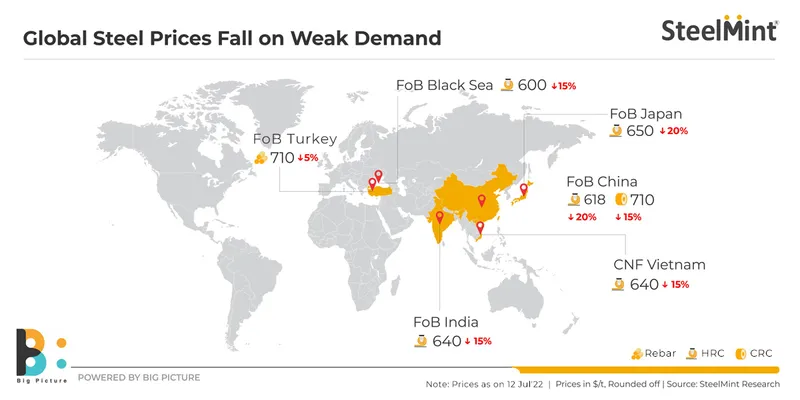
    In fact, data maintained with SteelMint reveals that in just a single month, HRC prices globally have fallen by 15-20%. As on 12 July, 2022, China’s HRC FoB prices have lost 20% m-o-m to $618/t and CRCs by 15% to $710/t. Black Sea HRC FoB prices declined 15% to as low as $600/t, while in Japan, these dropped 20% to $650/t FoB. Vietnam imports and India exports both lost ground 15% to $640/t. In rebar, Turkey’s prices on 12 July were down 5% to $710/t.

    Factors influencing current global steel scenario

    Inflationary pressures in the EU: There is a high risk of recession, especially in the West and governments there are keen to reign in the same through measures such as capping of monetary supply and raising interest rates. But, in a vicious cycle, this will definitely have a fallout on demand, globally.

    The euro’s value has been eroding for months and at the time of writing this story, it was equal to the US currency. A year back, it was at 1.20 to the dollar against 1.13 more recently.

    Two factors are weakening the euro. Rising EU inflation and the US’ comparative insulation from the war. Inflation in the EU has averaged 8.6% in June on the back of spiralling energy prices. On the other hand, with the US somewhat immune to the volatility in oil and gas markets given its own oil reserves and alternate energy sources, the dollar has fared better. The US Federal Reserve has also been raising interest rates for months, making dollar denominated investments safer at present, allowing it to appreciate.

    Meanwhile, the European Central Bank is in a catch-22 situation. The soaring inflation merits increase in interest rates but may just dry up demand in an already beleaguered economy. Being a major consuming region, if demand from the Continent falls, there will be far-reaching ramifications. Possibly, after Ukraine, the EU has been hit the most, economically, by the war.

    Energy crisis looming in Q4? There are fears of a probable energy crisis in Q4. In fact, as per reports, demand has rebounded in Europe in the face of such fears. Among the goods that cannot be imported from Russia into the EU include crude oil and refined petro goods, coal and other solid fossil fuels, iron and steel, amongst others. It may be noted that trade in some commodities like coal will come to a standstill from 10 August, 2022 while Russia’s Gazprom has cut off 60% of gas supply from its Nord Stream pipeline. Obviously, Europe is heavily dependent on Russian supplies and the actual impact will be felt from Q4 onwards although the region is already suffering from energy shortage and power plants are running helter-skelter to revive coal-fired utilities.

    The China factor: China, the largest producer and consumer of steel, is labouring under its own challenges. Covid, falling demand and prices and squeezed margins have the mills fighting with their back to the wall. The off-season is also not supportive of demand or prices. However, the silver lining is the policy measures that can kickstart an infrastructure boom in the second half which can translate into demand revival.

    Outlook
    Most mills globally are sitting on limited inventory because of the widespread production cuts on the back of the spiralling energy crisis and lack of demand.

    However, by end-August or first week of September, the inventory could get depleted, a scenario that will give elbow room for prices to head up globally.

    In addition, Russian mills are heard to have reduced their export volumes due to their very strong local currency. This could offer solace to steel exporting countries.

    So, have prices bottomed out as of now?

    What factors will drive steel prices in H2 2022?

    SteelMint Events is organising India Steel Conference with SUFI at Bombay Stock Exchange (BSE) Mumbai, on 25th Aug’22.