SteelMint Events

Category: Graphite Electrode & Needle Coke

  • What is compelling Iran to set up its own Graphite Electrodes Plant?

    What is compelling Iran to set up its own Graphite Electrodes Plant?

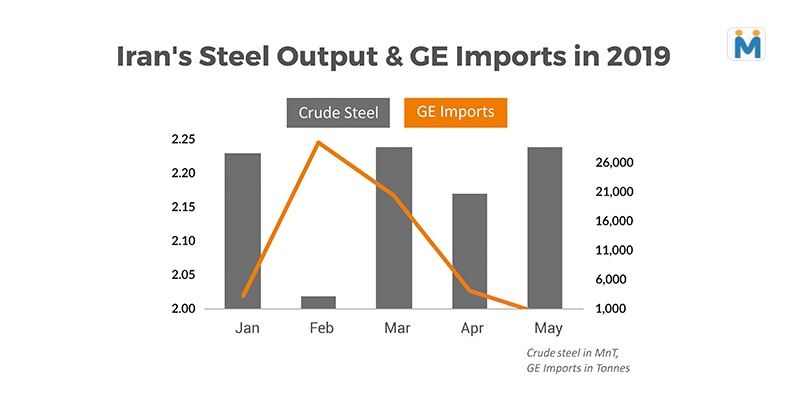
    Iran’s steel industry has been growing rapidly in recent years in line with the country’s ambitious plan to raise output to 55 million tonnes per year by 2025.The country’s crude steel output in 2018 stood at around 22.8 MnT, registering a surge of 7% y-o-y basis. Also in first five months of 2019 (Jan-May), the same stands at around 10.9 MnT up by 5% against the corresponding period of previous year. The Iranian steel industry is largely based on electric arc furnace steelmaking and with growing steel production and demand, the country is facing difficulties in procuring graphite electrodes (GE) – a key raw material for EAFs amid sanctions imposed by U.S. last year.

    In August 2018, U.S. had announced the first tranche of financial sanctions on Iran targeting the Iranian currency purchase and key industries after pulling out of the 2015 nuclear deal with Tehran. This restricted Iran’s purchase of U.S. dollar which is the most preferred currency to carry out the global trade.

    Later on in November 2018, U.S. imposed a second round of sanctions on Iran targeting country’s oil sector where any oil trade with Iran would result in imposition of secondary sanctions on that country. And if this was not enough, in early May this year, the Trump administration imposed third round of sanctions on Iran’s metal industry including iron and steel, aimed at cutting off revenue to Iran completely. These sanctions are warning to other nations that allowing Iranian steel and other metals into their ports will attract secondary sanctions upon them also.

    Subsequently, with such restrictions in place leading to GE shortage in the country, Iran that has already set up a joint venture with the local companies plans to start the trial production of the plant by March 2020. In 2017, a joint venture called Novin Electrode was set up between Iranian state mines and metals holding company Imidro, Mobarakeh Steel Co and Khorasan for the production of graphite electrodes and the total investment estimated in the same was USD 200 million.The initial plant capacity is around 30,000 tonnes which will be increased to 45,000 tonnes per year in the next phase.

    How Iran is meeting its GE requirements amid sanctions?

    Although before sanctions Iran was completely dependent upon imports from India and China to meet their GE requirements, post sanctions India completely stopped exporting the same to Iran. However, from Iran’s customs data it can be seen that GE is still being indirectly supplied to the country from China.

    In 2018, Iran imported about 109,331 tonnes of GE against 87,480 tonnes in 2017, thus marking an increase of 25% y-o-y basis. If we analyse the country-wise imports, in 2018 GE exports from India to the Iran dropped significantly and almost became negligible post August. However, continuing its trend, China remained the top GE exporter to Iran despite sanctions and in fact during Aug-Dec’18, the country’s GE exports to Iran recorded a surge of 42% against the corresponding period of 2017.

    Looking at the 2019 numbers, during Jan-Apr Iran imported about 51,618 tonnes of GE against 36,615 tonnes in the same period last year, thus registering an increase of 45% y-o-y basis. Now out of the total imports of 51,618 tonnes in first four months of ongoing year, about 85% came from China followed by UAE (8%) and Germany (4%) whereas imports from India were quite insignificant.

    As per the market sources, the circumvention of U.S. sanctions is taking place by the trade participants in collusion with shipping agents in Oman and Turkey. The Chinese exporters are directing their exports to Oman or Turkey in middle-east and after altering the bill of lading where the origin of shipment is changed at the port, the same is directed to Iran thus making evasion of U.S. sanctions possible. As this trade arrangement still involves quite a lot of risk, Iran is eagerly focusing on having in-house GE production facility to have interrupted domestic steel production.

    Know More

  • Will the EAF Steel Sector in Southeast Asian Countries Support Graphite Electrodes Demand in Future?

    Will the EAF Steel Sector in Southeast Asian Countries Support Graphite Electrodes Demand in Future?

    The hype around graphite electrodes demand and prices that started in the latter half of 2017 due to supply-side structural changes in China seems to have subsided with GE demand exceeding supply in China and country’s subsequent exports of its produce to various other countries. With no stopping to the price plunge in Chinese as well as global GE prices, let us analyse how the South-east Asia’s EAF steelmaking which requires electrodes as the key raw material will support the GE demand in the coming years ahead:

    Vietnam – Currently, Vietnam’s steel industry is in its stage of development, with most steel producers being small-scale mills. The EAF-based method is widely used in Vietnam (around 80% of steel production) as compared to the BOF process. Many new production lines are coming up and majority of steel makers have concrete plans for capacity expansion while some have plans to more than double their existing capacity.

    According to market research, the construction and construction market in Vietnam reached USD 13 billion in 2017, up 9.7% year-on-year. The average annual growth rate in the next 10 years is expected to reach 7.5%, which will play a powerful role in steel consumption. Moreover, the development of Vietnam’s steel industry in the later period is set to meet not only the needs of the country, but also to expand country’s sales to the ASEAN region, resulting which the output of electric furnace steel will continue to rise, supporting GE demand.

    Indonesia – Indonesia is the most populous country in Southeast Asia however its crude steel production is only about 5 MnT and hence is dependent upon imports to meet its steel requirements. Local steel mills are basically electric furnace based enterprises. Due to the instability of scrap resources and high electricity prices, the operating rate of electric furnace steel enterprises is unstable and the capacity utilization rate is low.

    At present, 80% of Indonesia’s steel resources come from imports, while the government’s target for imports is only 30% resulting which there is a high scope for growth in country’s steel production in the coming years ahead. At present, the two major steel mills in Indonesia (such as Kagang and Gunung Steel) have an electric furnace equipment of 120-130 tones, and other steel mills mainly use 20-70 tonnes of small electric furnaces. Thus, although in the long term country’s electrodes requirement may incresae, at present its demand is quite limited.

    Malaysia – In recent years, Malaysia’s economic development has been relatively flat, and its steel industry has many inherent shortcomings. As an upstream industry in the steel industry, its iron ore raw materials, although available locally, are relatively scarce, and are essential for smelting steel. The coking coal is almost zero, and the imported steel has a greater impact on domestic steel production.

    At present, the apparent consumption of steel in Malaysia is around 12 MnT, mainly based on short-process production, of which EAF production capacity of about 8 MnT. The concentration of steel-making enterprises is low, the production level and automation is low, and the actual capacity utilization rate of EAF steel mills is only about 35%. After 2012, the major steel mills including Golden Lion Group and Anyu Steel are basically new blast furnace projects, and new electric furnaces are rare, which means that the electrodes demand from Malaysia is also quite limited.

    Thailand – Thailand’s construction industry and automobile manufacturing industry are relatively developed. The steel consumption capacity is second only to Vietnam in Southeast Asia. In 2018, Thailand’s crude steel output is about 4.5 MnT. At present, there is only one blast furnace ironmaking enterprise in Thailand, and the rest are electric furnace steelmaking plants, mainly producing blanks. At present, the largest electric furnace steel producers in Thailand are G Steel and Tata Steel (Thailand), all of which are electric arc furnace equipment of more than 80 tonnes. Thus, if the domestic steel demand picks up in the country, it is likely that the GE demand will also increase subsequently in the coming years ahead.

    Image Credits: Industrial Heating

    Know More

  • India: Graphite India Likely to Slash Production Amid GE Market Slump

    India: Graphite India Likely to Slash Production Amid GE Market Slump

    It seems that the slowdown in steel demand and plunge in graphite electrode (GE) prices over the past few months are hitting Indian electrodes manufacturers as, according to some market sources, there is news that Graphite India is contemplating production cuts.

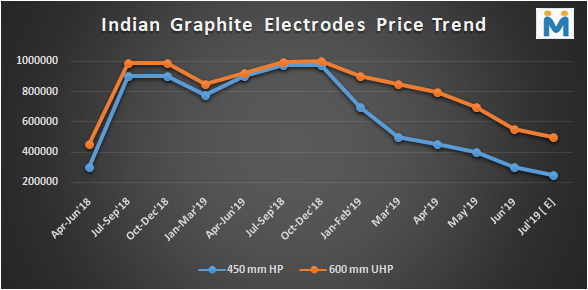
    GE prices in India have been falling since the beginning of 2019, recording a plunge of 35-50%. Graphite India is amongst the largest GE manufacturers in India. With an eye on the weak global GE market scenario, especially in South-east Asia and Europe, and sanctions on Iran by the US, which has resulted in zero exports from India to the Islamic Republic, Graphite India, according to sources, is considering a cut in production unless demand picks up towards the end of this year, which is very unlikely.

    Although the company has not disclosed the quantity of production cuts that may happen, its management might well believe that there is no point in piling up inventory and blocking working capital.

    Graphite India’s annual production is to the tune of 80,000 tonne, and this is primarily from its existing facilities in Durgapur and Nashik. Additionally, it produces another 18,000 tonne at its facility in Germany. The company’s Bangalore unit has suspended operations following environmental concerns. However, the company’s production capacity remains unaffected as it has ramped up production in Durgapur.

    GEs used in electric arc furnaces (EAFs) to manufacture steel witnessed a significant surge in demand in the latter half of 2017 amid supply-side structural changes in China. The country closed all polluting GE units and, at the same time, announced targets to increase the percentage of EAFs in total crude production. This led to a sudden increase in GE demand and shortage in supplies ultimately leading to dramatic rise in prices. With this, the GE prices ex-China also surged, benefiting Indian manufacturers.

    Now, when Chinese GE prices started falling in Nov’18, market participants thought it was a short-term price correction. However, since then the downtrend in electrodes prices has continued and it’s been almost nine months with absolutely no uptick in Chinese GE prices. The key reasons behind this are GE oversupply and tepid domestic steel demand in China. Given the poor in-house market situation, Chinese GE manufacturers have started exporting to the global market, giving tough price competition to Indian manufacturers.

    Will the global GE market witness a lessening of production levels and prices start rising by the end of 2019? Make sure you keep abreast of all upcoming trends by attending the 2nd Global Graphite Electrode Conference to be organized by SteelMint Events from 27-29 August, 2019 in Thailand.

    Know More

  • Poor Steel Demand and Rising Raw Material Prices are Playing Havoc on Indian Graphite Electrodes Prices

    Poor Steel Demand and Rising Raw Material Prices are Playing Havoc on Indian Graphite Electrodes Prices

    It seems that the tables have turned for the global graphite electrodes manufacturers including that of India as after enjoying the price buoyancy for almost two years, the same are falling freely without any restraint.

    Now as per the latest information that various sources have shared with SteelMint, UHP grade GEs have registered a plunge of INR 100,000 – 150,000 (USD 1,500- 2,100/MT) against last month and the price of electrodes of size 600-650mm are in the range of INR 550,000-500,000/MT (USD 7,900 – 7,100/MT) whereas that of smaller size, 450mm are herd to be in the range of INR 225,000-250,000/MT (USD 3,200 – 3,500/MT).

    The domestic GE manufacturers that used to have only 10-12 days inventory are currently sitting on the stock of about 1-2 months as the steel mills are delaying their procurement in the hopes of further fall in the GE prices. On the other hand, GE manufacturers are already dealing with the pressure of rising raw materials, needle coke (NC) costs. The contracts for the petroleum-based needle coke for the second half of 2019 have been settled at USD 4,000-4,500/MT. Now if the GE prices fall further, it is likely that electrodes producers margins may see sharp fall in coming months of the ongoing year.

    The key reasons for GE plunge

    The positive sentiments in India’s electrodes market turned negative when the GE prices in China started plunging towards the end of 2018 amid sluggish domestic downstream demand and increase in the electrodes supplies. When GE prices had surged two years back due to supply side structural changes in the Chinese market, which led to the closure of polluting GE units and subsequent supply shortage, many Chinese GE companies invested either in capacity expansion or building new manufacturing facilities. Over a span of two years, sufficient electrode supply eased concerns in the domestic market subsequently impacting both domestic and global GE prices.

    As India has removed anti-dumping duties on electrode imports from China in August last year, the Chinese GE are entering into India without any restrictions. As per the customs data, India’s electrode imports in the first three months of 2019 have registered an increase of 53% y-o-y basis. Although majority of imports in India are that of non-UHP grade electrodes, still there is a fear in the market that if Indian manufacturers does not lower their UHP grade GE prices, they may face tough competition from their Chinese counterparts in this segment also.

    Apart from this, the GE prices are also plunging from the fact that the steel demand across the globe has turned sluggish over past few months as a result of trade war between U.S. and China and rising protectionism measures amongst key EAF-dominated countries such as U.S., Turkey, and Iran. In fact in case of Iran which was one of the key export destinations, the Indian electrodes manufacturers are not supplying to the country due to the U.S. sanctions imposed on the former last year. This combined with tepid steel demand in various other countries has compelled the Indian GE producers to lower down their electrodes prices and maintain high inventories.

    Will Global GE Prices Bounce Back?

    So, will global GE prices bounce back and can Indian exporters hope for better days ahead? To keep track of the subtle changes in the global GE market make sure you attend the 2nd Global Graphite Electrode Conference to be organized by SteelMint Events from 27-29 August, 2019 in Thailand.

    Know More

  • Russia’s Graphite Electrodes Major Energoprom Invests in Plant Modernisation

    Russia’s Graphite Electrodes Major Energoprom Invests in Plant Modernisation

    SteelMint has learnt that Russian electrodes major, Energoprom (EPM) Group along with the Ministry of Industry and Trade of the Russian Federation and Government of the Rostov Oblast has signed a special investment contract for the modernization of production of graphite electrodes at the site of the EPM – Novocherkassk Electrode Plant. This agreement has been signed within the framework of SPIEF (St Petersburg International Economic Forum), an event in which Russia made efforts to appeal to international businesses and investors.

    As part of the project, it is planned to invest more than 2.7 billion Roubles into the development of the production of large cross-section graphite electrodes by the end of 2023. Taxes and other payments into the treasuries at all levels will amount to around 900 million Roubles, manufactured and sold products over 5 years will amount to more than 20 billion Roubles, about 70% of which will be sold in the domestic market.

    EPM Group’s Novocherkassk plant is already undergoing upgradation for capacity enhancement. In April this year, a robot-assisted nipple center was launched at the EPM – Novocherkassk Electrode Plant, which will increase the machining accuracy by 5 times, thereby bringing the level of production at the plant up to par with that of other global producers. At the end of the year, it is planned to commission a RIEDHAMMER furnace – this is a key investment project, designed to increase the quality and output of graphite electrodes with a diameter of 610 mm.

    The CEO of the EPM Group highlighted that the company has signed a very important agreement that clearly defines the program of the further modernization of the company’s key GE plant. Is it backed not only by a new level of equipment, but also by a marked growth in production volumes. It is expected that investment into the modernization program will result in meeting more than half of the demand of the Russian metallurgy industry in large cross-section graphite electrodes. Following the implementation of the investment program, the output of large cross-section graphite electrodes will double, he pointed out. EPM Group is the single electrodes manufacturer in the country with a GE capacity of 60,000 tonnes per year.

    Russia is one of the major electrodes exporters as it exported about 47,568 tonnes of GE in 2018, registering a growth of 21% y-o-y basis with highest exports being made to U.S. followed by Kazakhstan, Belarus and Germany. In first four months of 2019, Russia has exported about 13,995 tonnes of graphite electrodes.

    Know More