India government has notified the amended mining law which allows the seamless transfer of regulatory approvals like forest and environmental clearances to new owners of operational iron ore mines. This ordinance will come in effect from 10th Jan 2020.
Our Interpretation of the Mineral Law Amendment 2020
1. Ordinances are laws that are promulgated by the President of India on the recommendation of the Union Cabinet, which will have the same effect as an Act of Parliament. They can only be issued when Parliament is not in session. They enable the Indian government to take immediate legislative action
2. State government can auction mining leases before expiry of lease period
3.Successful bidder of the expiring mining leases through auction are deemed to have acquired all rights, clearances, approvals vested with previous bidder for a period of 2 years
4. The transfer is subject to condition that successful bidder will apply and acquire new licenses, clearances and approvals within 2 years from the date of grant of new lease
5. This means successful bidder has to operate at EC limits granted to previous lessee for a period of 2 years (state government has emphasized to produce at-least 80% of previous year’s production)
6. Successful bidder can start operations on the land in which mining operations were carried out by previous lessee for a period of 2 years.
Market expects the amendment to mining law will ease transition of iron ore mines to winning bidder post auction of the blocks whose leases are set to expire in March. This will limit the scope of disruption in iron ore supply subject to things goes as per schedule.
To learn how the mines auction 2020 unfolds, be a part of SteelMint Events’ 4th Indian Iron ore, Pellet and DRI Summit which is scheduled on 2-3 March 2020, in Hotel LaLiT, New Delhi.
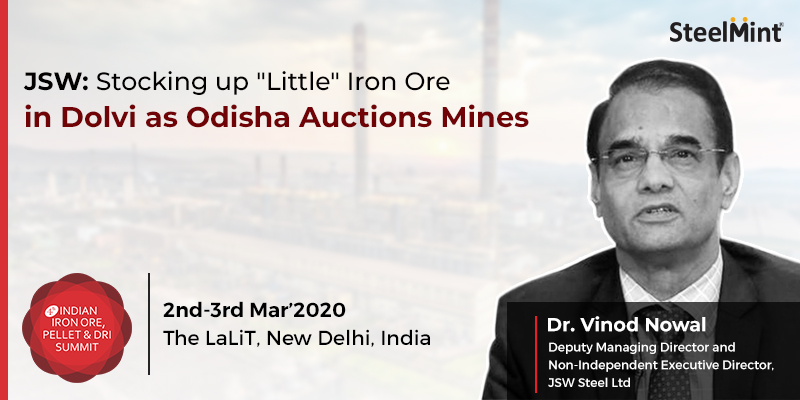
Dr. Vinod Nowal, deputy managing director and non-independent executive director of JSW Steel Ltd is ready to set his foot into a new terrain, one that will colour his boots a rusty red. With JSW’s technical bids for six mines in Keonjhar in Orissa where some of the biggest and the best supply of iron ore is feverishly mined and red dust fills the air, Dr Nowal speaks about the company’s plans to make investments whether it wins or loses the bids.
Following are edited excerpts from a telephonic interview with Ruchira Singh:
Q. Are you expecting any delay in the mine auction process in Odisha?
A. I don’t think there will be any further delay in the auctions. In the last few months we have been meeting the government regularly and they have assured us that they will take measures so that there is continuity of supply.
Q. What could these measures be?
A. There could be a provision for temporary mining under the old rules while simultaneously applying for the environment clearances.
Q. A recent gazette notification suggests that the new mine owners will have to apply for new environment and forest clearances. Doesn’t this suggest there might be a delay in resumption of production when leases expire on March 31?
A. The gazette notification is not clear, but they are likely to formalize something. Legal, environment and mining ministries are working together on this. This is the impression we got.
Q. In the run up to the auctions, are you expecting any disruptions in supply from Odisha? How are you preparing for it?
A. We are regularly buying and using it (iron ore) because as usual demand and supply is there. But it is true that there is not a good network of rail and road.
Q. What is the solution to make mining better in this region?
A. They should go for a new system of conveyer belts and slurry pipelines. That is the only solution. The government has to work and industry has to work — together.
Q. JSW is investing in a slurry pipeline in Keonjhar. Can you please give some details about it?
A. We are making a slurry pipeline. It can be for captive use and for others also. It will take two to three years. It does take that much of time as approvals are needed, construction is needed, technology partner is needed. Once we get the mine, we will start it.
Q. And if you don’t get any mine, will you not build it?
A. We will build the slurry pipeline in case we are getting the mine and hope we get the mine too.
Q. From where to where will the pipeline be built?
A. It will connect the mine area (in Koenjhar) and Paradip. This will link both the Paradip port as well as our upcoming plant (in Jagatsinghpur).
Q. Several iron ore consuming companies have applied for storage area for iron ore in Keonjhar. Are you one of them?
A. No because we are not in Odisha state as a consumer. We are bringing the ore to Maharashtra.
Odisha iron ore being loaded to railway rake
Q. So are you storing up iron ore for potential supply disruption at your plant in Dolvi?
A. We are storing up a little.
Q. Do you expect international iron ore prices to go up? There is Indian disruption coming up and there are bush fires in Australia…
A. People say that to try to inflate prices. These are fires. It is not flooding or storm.
Q. Are you happy with the current prices of iron ore?
A. It is okay. We can buy from the international market. Iron ore is available.
Q. How is the situation of the steel market? We are seeing bigger than usual inventories…
A. Steel inventories have been exhausted. This is the last quarter and it is seeing good demand. We have hit the bottom and things will pick up from here.
Q. How is the foreign market doing? Some companies are seeing better revenues from their overseas businesses. Are you too seeing such a thing?
A. Foreign market is picking up. It has improved.
Q. What is the outlook for steel prices?
A. It has gone up lately by $25-$30/tonne.
Q. What kind of improvements will you make in Odisha?
A. In the area which has given thousands of crores of revenue from minerals, should people be living in such a poor condition? This is also the place where the mineral fund is one of the highest. We will definitely change it.
To learn how the mines auction 2020 unfolds, be a part of SteelMint Events’ 4th Indian Iron ore, Pellet and DRI Summit which is scheduled on 2-3 March 2020, in Hotel LaLiT, New Delhi.
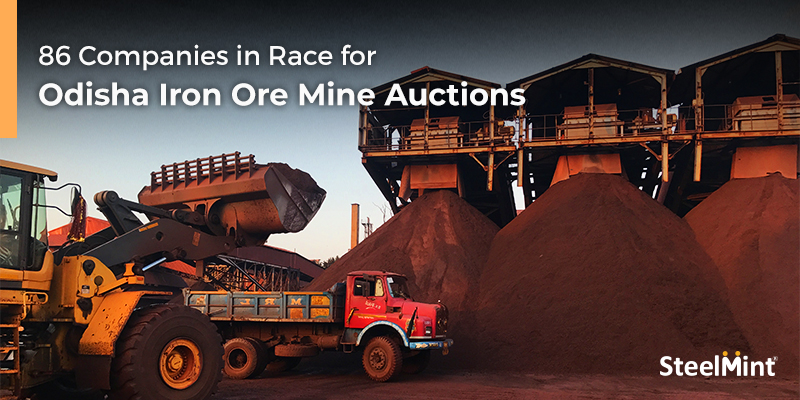
The Odisha government has started afresh the process of mineral block auctions 2020. The deadline for bid submission was on 03 Jan’2020. Out of 20 iron ore and manganese ore mines put up for auction, 18 mines were containing iron ore deposits. According to market sources report to SteelMint Events, nearly 86 companies have aggressively participated in the auctions.
17 iron ore mines have witnessed participation so far as Badampahar mine is undergoing some hearing in Apex Court, shared sources.
Vedanta has bid for the largest number of mine i.e 17 mines followed by Arcelor Mittal bidding for 10 mines. Other major bidders were JSPL, Adani & Yazdani.
The state government annulled previous phase of auction and had floated fresh tender and has also inserted some additional conditions in the tenders for the expiring merchant mine leases. A successful bidder, after obtaining all statutory clearances, needs to produce in the first two years at least 80% of what the mine actually produced in the preceding two years.
Who will be the major bidders in mine auctions?
To learn how the mines auction 2020 unfolds, be a part of SteelMint Events’ 4th Indian Iron ore, Pellet and DRI Summit which is scheduled on 2-3 March 2020, in Hotel LaLiT, New Delhi.
The Odisha government will issue Notice Inviting Tenders (NITs) in respect of nine virgin or freehold mineral blocks tentatively towards the second week of February. The said blocks will be offered for electronic auctions after the successful completion of auction formalities of 20 merchant mine blocks.
“We will initiate the process of auctioning the nine virgin mineral blocks sometime in February. Their auctions will be taken up after we are done with the online auction of 20 merchant mine leases”, Deepak Mohanty, director of mines with the Odisha government said here on the sidelines of a workshop on Gemstones in Odisha – Exploration and Exploitation Strategy.
Which are these blocks?
The virgin blocks in question include seven iron ore deposits; one exclusive manganese block and one block with co-existence of iron ore and manganese. The seven iron ore blocks listed are Purheibahal, Chandiposhi, Rengalaberha North East, Gandhalpada, Netrabandha Pahar (West), Dholtapahar and Jhumka Pathriposhi. Unchabali has mixed iron ore and manganese reserves while Kalimati is the sole manganese block.
The delay in auctions
Auctions of virgin mineral blocks are being delayed as the state government first prioritised the offer of merchant mines whose lease validity ceases by March 31, 2020. January 3 is the deadline for submission of technical and financial bids for the 20 blocks. The blocks are expected to witness frenzied bidding as they being operative mines are explored and are equipped with the attendant infrastructure to ensure smooth extraction and dispatch of minerals.
The conduct of ascending forward electronic auctions and submission of final price offer on the auction platform will be done between January 31 and February 21, 2020 while the Letter of Intent (LoI) is to be issued from February 10 to February 29, 2020.
Additional conditions for expiring merchant mine leases
The state government has inserted some additional conditions in the tenders for the expiring merchant mine leases. A successful bidder after obtaining all statutory clearances needs to produce in the first two years at least 80 per cent of what the mine actually produced in the preceding two years. This clause will be inserted in the Mine Development and Production Agreement (MDPA). Failure to achieve this production benchmark will debar the successful bidder from participating in future auctions for three years. And, in case of blocks reserved for end use, the consumption should be limited to the plant of the bidder located within the country.
To learn about the latest advancements in the mines auction 2020, be a part of SteelMint Events’ 4th Indian Iron ore, Pellet and DRI Summit which is scheduled on 2-3 March 2020, in Hotel LaLiT, New Delhi.
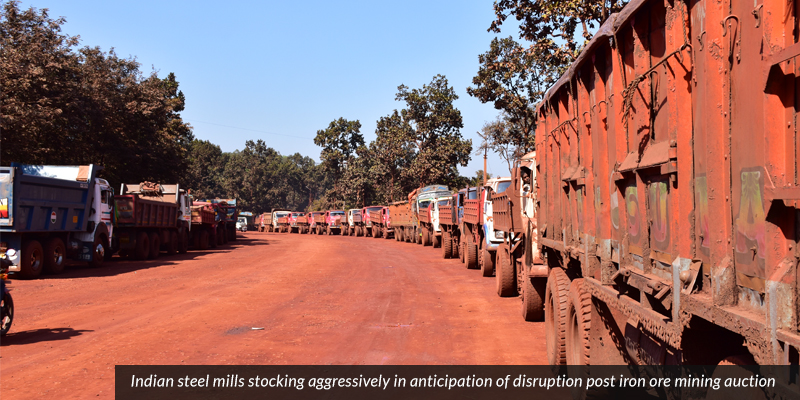
With the dates of 2020 auction edging closer, Indian iron & steel industry is drawing up plans to make up for iron ore supply disruption. India’s largest iron ore producing state – Odisha has lined up auction for 20 iron ore & manganese ore mines and Karnataka has put 6 iron ore mines by March 2020. Let us analyse what would be the shortfall and how would it be compensated.
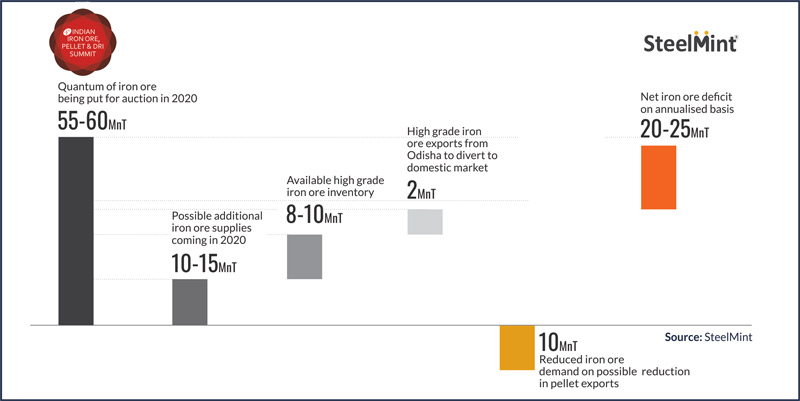
Quantum of Iron ore being put for auction
According to SteelMint analysis, government of Odisha and Karnataka have put together 26 operational mines for auction. These mines produce around 55 MnT iron ore annually, against an EC limit of around 80-85 MnT. There are few merchant mines coming for auction in Jharkhand but they are relatively small (total production would be less than 2 MnT). It is fair to assume that about 55-60 MnT of iron ore will be put for auction across India.
What are possible additional supplies coming in 2020?
Additional iron ore supplies are likely to come up from other existing leases like NMDC, SAIL, OMC, etc. It is believed that total around 10-15 MnT additional iron ore supply is expected to come up post-2020 auctions.
• NMDC’s production limit increased by 3 MnT: Indian Bureau of Mines (IBM), Ministry of Mines, approved the mining plan of NMDC to enhance the production of iron ore from Kumaraswamy (Karnataka) iron ore mines from present level of 7 MnT pa to 10 MnT pa for the years 2020-21 and 2021-22.
• SAIL allowed to sell 25% of annual production: Indian govt. allowed SAIL to sell 25% of its annual production in the merchant market from their captive mines. This translates to around 7 MnT per annum. Although looking at offered quality and logistics issues, we expect around 3-4 MnT ore can actually come to the market.
• OMC should increase production: Odisha Mining Corporation also plans to raise its EC limit from its Daitari & Koira mines
• JSW to add some supplies in 2020: JSW Steel has started iron ore operations at its four ‘C’ category mines out of six mines it won earlier in Karnataka. The other two mines are expected to come into operation soon which would add up further to country’s iron ore supply.
• Export volumes will divert to domestic market: We expect higher realisations in domestic market will result in lowering of iron ore export volumes from India. As per the study of SteelMint, around 20-25 MnT net iron ore deficit on annualized basis still needs to be addressed.
Why is mines auction a concern for Indian steel industry?
The key factor that is expected to play an important role is the transition phase from existing lessess to the new ones. This will depend on the outcome of ongoing discussions between state and central govt. regarding EC, FC and other clearance issues. Expediting the auctions and the subsequent approval processes for mining operations to be undertaken by new leases will be critical to avoid any long term supply shortages.
India produced around 207 MnT iron ore in FY19 (Apr’18-Mar’19). Estimated consumption reported was 195-200 MnT, where as exports were reported at 7 MnT and imports at 12 MnT.
To learn about the latest advancements in the mines auction 2020, be a part of SteelMint Events’ 4th Indian Iron ore, Pellet and DRI Summit which is scheduled on 2-3 March 2020, in Hotel LaLiT, New Delhi.