SteelMint Events

Tag: China

  • Will China’s coal imports from Australia rise post lifting of ‘unofficial’ ban?

    Will China’s coal imports from Australia rise post lifting of ‘unofficial’ ban?

    In a significant development, Chinese authorities have allowed all domestic companies to import Australian coal, thereby putting an end to ‘informal’ trade restrictions imposed in late 2020. Ports and customs offices have been told to allow Australian coal cargoes.

    Earlier this year, the authorities had given four State-owned companies permission to resume purchases of Australian coal. Of the four, State-owned Baowu Group was the lone steel producer, while the rest were power companies.

    It is believed that more than 1 million tonnes (mnt) of Australian coal cargoes are set for Chinese shores in March. Due to the rise in global coal prices after Russia’s invasion of Ukraine, the price difference between China’s domestic coal and Australian coal had substantially decreased. As a result, the withdrawal of the ‘unofficial’ ban on Australian coal will bring marginal economic benefit to China.

    Imports from Australia

    CoalMint data reveal that China’s imports of non-coking coal from Australia, mainly high-energy coal, decreased by about 90% in 2021 from 2020. China’s imports fell to 5.5 mnt from over 42 mnt in the previous year. Imports were recorded at zero in 2022.

    As regards coking coal, China’s imports from Australia declined sharply by over 80% y-o-y in 2021 to just about 6 mnt compared with more than 35 mnt in 2020.
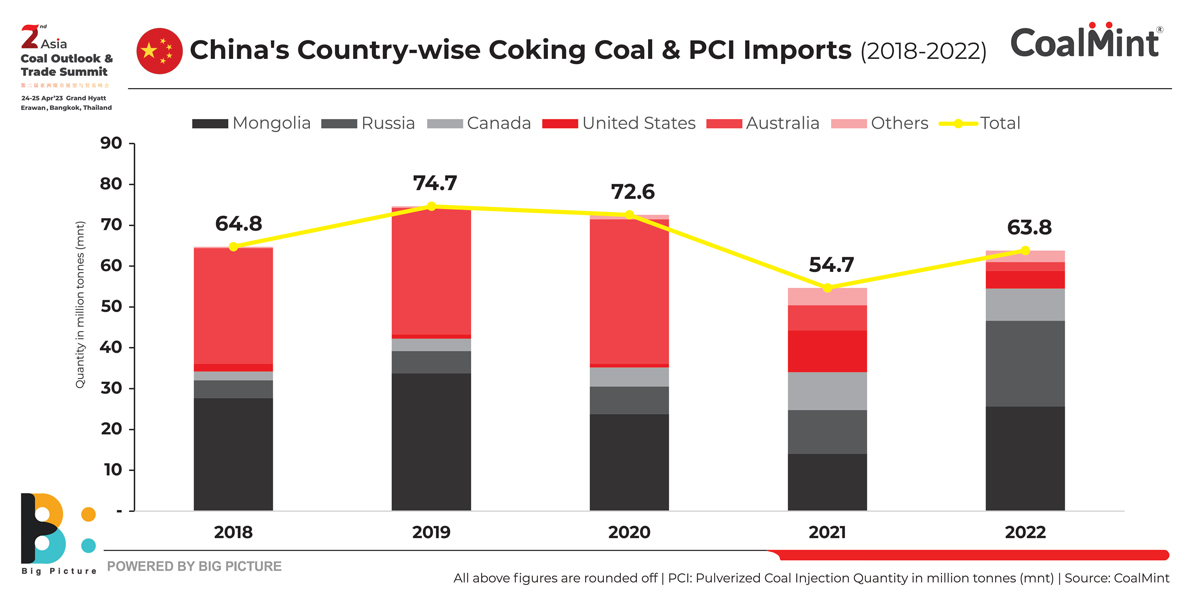
    However, volumes are sure to surge after China’s move to resume imports. The decision to resume coal imports from Australia is partly driven by the need to tame domestic coal prices amid global volatility.

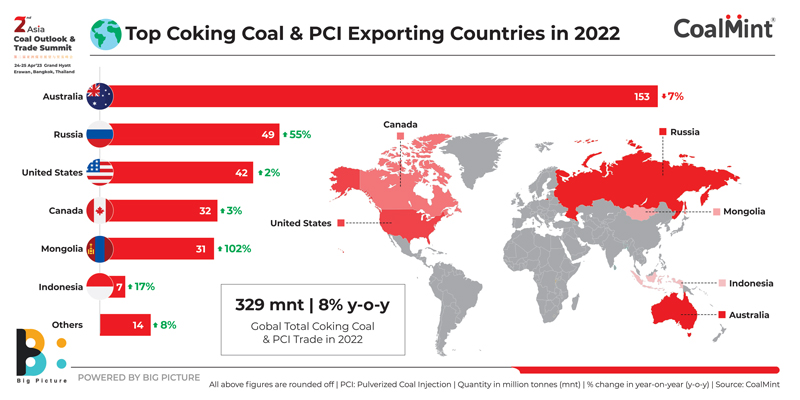
    But China’s coal imports from Mongolia and Russia increased significantly on-year in 2022, as Covid restrictions were slowly eased along the China-Mongolia border allowing for free vehicular movement, as well as cheap Russian coal offers amid global energy inflation.

    Impact on coking coal market 

    Sources believe that with the full reopening of Australian coals into China, the increase in supply of seaborne imported material will exert some downward pressure on the coking coal market. China’s domestic raw coal production in Jan-Feb’23 also increased by around 6% y-o-y to 735 mnt, as per NBS data.

    In fact, coking coal and coke futures on China’s Dalian Commodity Exchange (DCE) edged down after news came in of permission being granted to all Chinese companies to resume Australian coal purchases. FOB Australian prices of premium low-volatile coking coal are still higher than CFR China prices by around $6-10/t. In the CFR China market, prices inched lower on weaker sentiments, with the DCE futures market observing May coking coal and coke contracts dropping by 4.53% and 3.04% yesterday.

    Outlook 

    Domestic met coal production in China is set to face hurdles going forward as environmental restrictions push authorities to clamp down on mining activities in coal-rich provinces. At the same time, high steel industry capacity utilisation at times may drive met coke imports from SE Asian countries with surplus capacities.

    Demand for Australian high-energy Newcastle coal may remain rangebound in the near term even though new domestic coal mining capacity is approved.

    In the short term, however, Australian premium low-volatile hard coking coal may continue to attract buying interest, despite competitive offers from Russia, even as uncertainties persist over pricing and logistics from Mongolia.

    CoalMint’s 2nd Asia Coal Outlook & Trade Summit

    China’s coking coal imports increased by over 15% on the year in 2022. Will imports increase in 2023, too, with the resumption in inflow of Australian cargoes? Would Chinese buyers have appetite for Australian thermal coal given other low-priced alternatives?

    Follow the discussion at CoalMint’s 2nd Asia Coal Outlook & Trade Summit to be held at the Grand Hyatt Erawan, Bangkok, Thailand on 24-25 April, 2023, where Mr. Jiyuan Wang, Marketing Manager, Shaangu Group from China, will share his insights.

  • China may reduce coking coal consumption in steelmaking by 20-25% by 2030

    China may reduce coking coal consumption in steelmaking by 20-25% by 2030

    China, the world’s top steel producer, is seeking to cut down on its consumption of coking coal for steel production in sync with its ‘dual carbon’ goal of peaking emissions by 2030 and attaining carbon neutrality by 2060.

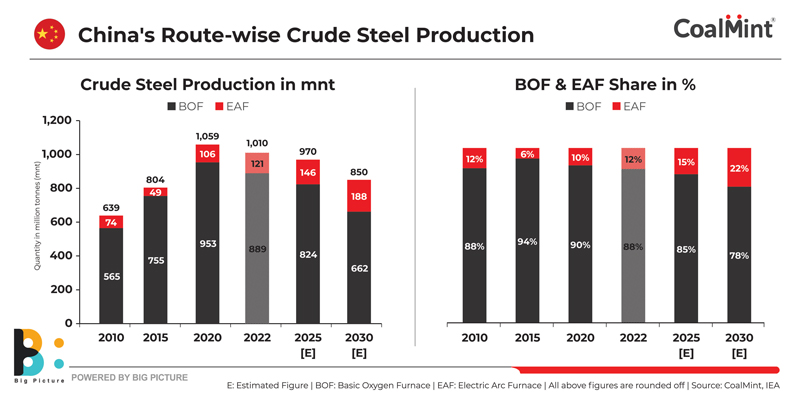
    In line with this objective, the steel industry in China is expected to reduce consumption of coking coal by 20-25% by 2030, reports indicate. It is predicted that the share of predominantly scrap or green DRI-based electric arc furnaces (EAF) in China’s total crude steel production will rise to 22% by 2030 from 12% at present.

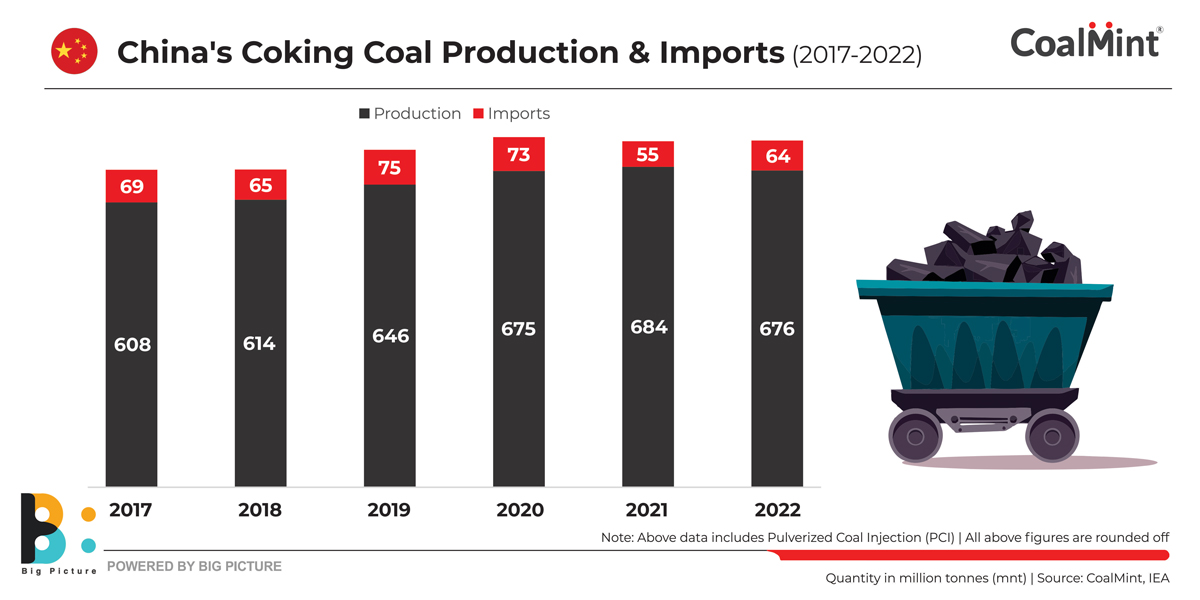
    However, the task is huge, considering the fact that the Chinese steel industry is predominantly coal-based. As per CoalMint data, out of 1.01 billion tonnes (bnt) of steel produced in China in 2022, 88% was churned out through the BF-BOF route. This required mammoth consumption of coking coal: in 2022 China’s coking coal production stood at 676 mnt, while another 64 mnt was imported, IEA data reveals.

    Due to the heavy reliance on the coal-based BF-BOF route, a polluting steelmaking pathway, steel production accounts for about 20% of the country’s total annual carbon emissions making it the largest industrial emitter, as per Global Energy Monitor (GEM) data. When emissions from electricity used by the sector are included, the share goes up to 24%. Thus, it is a key target in the government’s efforts to curb carbon emissions and improve air quality.

    Why might coking coal consumption fall?

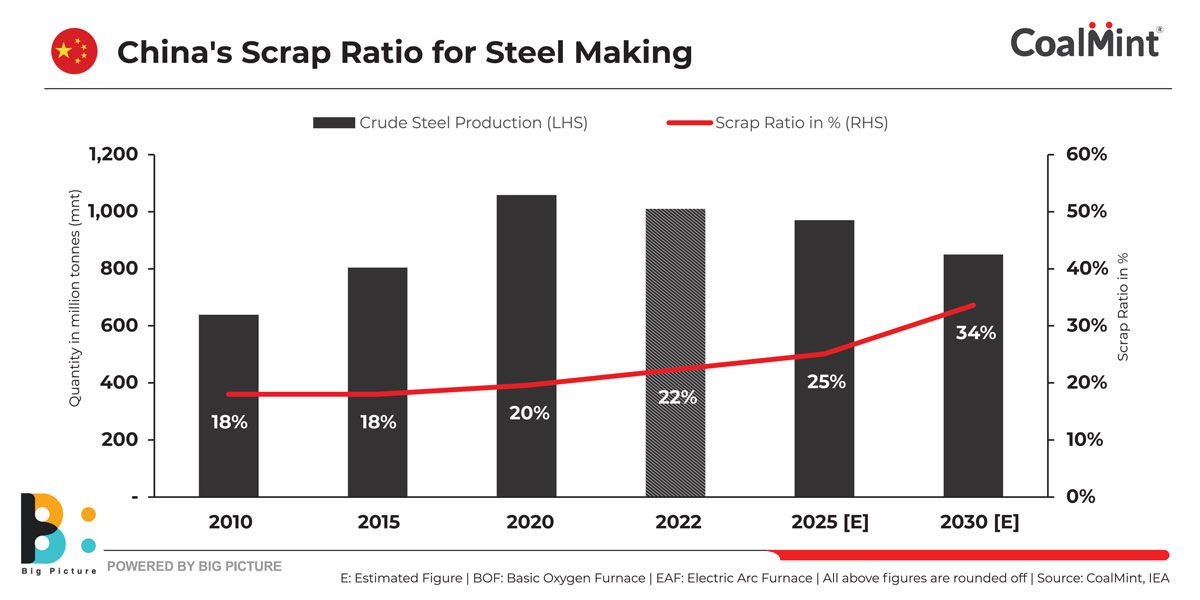
    1. Steel production to drop: It is expected that steel production in China has almost plateaued. Many experts reckon that the 1.059 bnt of crude steel production in 2020 represented the peak. In 2022, crude steel production fell by 2% y-o-y. It is projected that crude steel production will drop to around 850 mnt by 2030.

    The capacity swap scheme is the most important policy intervention in the Chinese steel industry first introduced by the Ministry of Industry and Information Technology (MIIT) in 2014. The 2021 version of the capacity swap scheme revised measures for certain regions, raising swap ratios to 1.5:1 from a previous 1.25:1 in key air pollution control regions.

    The new version was also carefully designed to encourage EAF capacity and non-BF capacity expansions. If new iron ore and steelmaking facilities are environmentally friendly, such as EAFs, Corex, Finex, HIsmelt or hydrogen-based ironmaking plants, capacity can be swapped equally. Thus, coking coal consumption in steelmaking will naturally fall.

    2. Scrap/DRI share in steelmaking to rise: Higher steel scrap usage expectations could eat into coking coal demand. The National Development and Reform Commission (NDRC) sees China’s 2025 steel scrap usage rising to 320 mnt on carbon neutrality goals.
    During the 2021-25 period, Chinese crude steel output could plateau, which would cut molten iron output by 50 mnt and trim 21 mnt of coking coal demand in the period, Baosteel Group’s research arm Hwabao Securities has stated. The scrap ratio in steelmaking is expected to increase to 34% by 2030.

    In 2021, as per GEM data, China approved 39 new EAFs with a total capacity of 28.7 mnt/year through capacity swaps which is more than the sum of 2018-2020. The development of EAF is forecast to play a big role in reducing China’s steel industry carbon emissions.

    3. Hydro gen likely to replace PCI coal: An early use of green hydrogen in the steel industry will be in existing blast furnaces to replace pulverised coal injection (PCI) coal. Experts contend that reducing carbon emissions from blast furnaces will involve the use of higher-grade iron ore and the replacement of PCI coal with hydrogen.

    Therefore, apart from the use of hydrogen in production of fossil-free DRI which is gaining increasing prominence in China, the move towards higher efficiency in BF-BOF steelmaking will see producers transition from low-grade coking coal (PCI coal) to coke oven gas (COG) first and then hydrogen. Therefore, overall coking coal demand is likely to drop.

    Outlook

    At this stage of the global energy transition, high coal prices – as well as energy security concerns – are likely to hasten the transition towards alternative technology, including the replacement of PCI coal with hydrogen. Therefore, the long-term demand scenario for coking coal remains bearish, although it will take another decade or so before the final signs of decline become visible.

    2nd Asia Coal Outlook & Trade Summit

    Want to follow the discussion on how Chinese steelmakers are expected to cut coking coal consumption? Be a part of the discussion on technological breakthroughs in the Chinese steel industry at CoalMint’s 2nd Asia Coal Outlook & Trade Summit to be held at the Grand Hyatt Erawan in Bangkok, Thailand on 24-25 April, 2023

  • China Needle Coke Prices Reverses the Global Trend

    China Needle Coke Prices Reverses the Global Trend

    The upheaval in graphite electrodes demand in past two years and a steady surge in the requirements for graphite anodes for lithium-ion batteries in China has boosted the needle-coke demand in the country.

    In 2018, the overall performance of China’s needle coke market was relatively stable with prices showing an uptrend and reaching to its high in the month of November. However, towards the end of 2018, the plunge in steel demand from downstream sector in China adversely impacted the country’s graphite electrode requirement and so does the needle coke demand and prices.

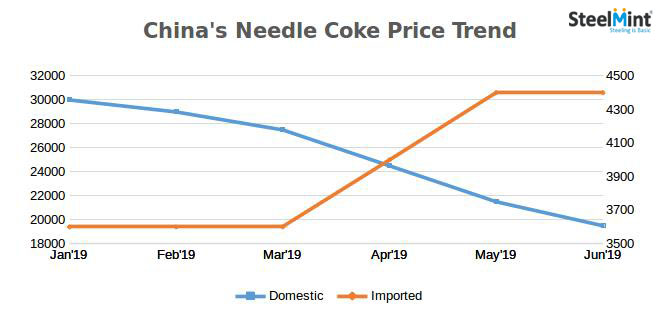
    With the start of 2019, China’s domestic needle coke prices have been falling and have registered a plunge of 35% in the time span of six months. However, the price of high-quality needle coke required for UHP grade GE (usually imported) have been rising continuously recording a surge of 22% during Jan-Jun’19. The domestic needle coke prices in China are currently trending in the range of RMB 19,000-20,000 (USD 2,750 – 2,900/MT) whereas imported needle coke prices are at 4,200 – 4,600/MT.

    According to customs data, in first four months of 2019, China’s petroleum-based needle coke import volume was 46,413 tonnes, 70% of which came from the United Kingdom, 15.3% from the United States, and 9.5% from Japan whereas country’s coal-based needle-coke imports were 27,819 tonnes of which 62% came from South Korea and 38% from Japan.

    Although, the domestic needle coke produced in China still has some time to match the global standards, with the help of some research and development, the quality of the same have improved to some extent and few products have been able to mark their entry in the international market also.

    At present the production capacity of domestic needle coke in China is in the period of rapid expansion and in 2019 some new projects will be officially put into operations:

    China’s upcoming capacities in case of coal-based needle coke:

    Company Name Planned Capacity Estimated year of operation Type
    CNPC Jinzhou Company 100,000 2019 New expansion
    Shandong Yida New Material 70,000 2019 New expansion
    Shandong Jingyang Tech 70,000 2019 New expansion
    SinoPec Maoming Company 100,000 2020 New entry
    Sinopec Jinling Company 100,000 2020 New entry
    Liaoning Baolai Bio-energy 120,000 2020 New entry
    Total 560,000

    China’s upcoming capacities in case of petroleum-based needle coke:

    Company Name Planned Capacity Estimated year of operation Type
    Kaifeng carbon Anshan thermal-energy new material 20,000 2019 New expansion
    Henei Kaifeng Carbon New Material 40,000 2019 New expansion
    Shanghai Baosteel Chemical 100,000 2019 New expansion
    Anshan Steel Holding 40,000 2019 New entry
    Zaozhuang Thriving Carbon Tech 40,000 2019 New entry
    Pingdingshan Risun New Material 40,000 2019 New entry
    Baoshun Chem 50,000 2019 New entry
    Tsdr New Energy 100,000 2019 New entry
    Shanxi Jinzhou Chem 40,000 2019 New entry
    Shanxi Fuma Carbon Material 40,000 2020 New entry
    Ningxia Baichuan new material 50,000 2020 New entry
    Total 560,000

    With the new capacities coming up in China’s needle coke sector and tepid graphite electrodes demand due to sluggishness in downstream sector, the country’s domestic needle coke prices are anticipated to fall further.

    Know More