SteelMint Events

Tag: Graphite Electrodes

  • What is compelling Iran to set up its own Graphite Electrodes Plant?

    What is compelling Iran to set up its own Graphite Electrodes Plant?

    Iran’s steel industry has been growing rapidly in recent years in line with the country’s ambitious plan to raise output to 55 million tonnes per year by 2025.The country’s crude steel output in 2018 stood at around 22.8 MnT, registering a surge of 7% y-o-y basis. Also in first five months of 2019 (Jan-May), the same stands at around 10.9 MnT up by 5% against the corresponding period of previous year. The Iranian steel industry is largely based on electric arc furnace steelmaking and with growing steel production and demand, the country is facing difficulties in procuring graphite electrodes (GE) – a key raw material for EAFs amid sanctions imposed by U.S. last year.

    In August 2018, U.S. had announced the first tranche of financial sanctions on Iran targeting the Iranian currency purchase and key industries after pulling out of the 2015 nuclear deal with Tehran. This restricted Iran’s purchase of U.S. dollar which is the most preferred currency to carry out the global trade.

    Later on in November 2018, U.S. imposed a second round of sanctions on Iran targeting country’s oil sector where any oil trade with Iran would result in imposition of secondary sanctions on that country. And if this was not enough, in early May this year, the Trump administration imposed third round of sanctions on Iran’s metal industry including iron and steel, aimed at cutting off revenue to Iran completely. These sanctions are warning to other nations that allowing Iranian steel and other metals into their ports will attract secondary sanctions upon them also.

    Subsequently, with such restrictions in place leading to GE shortage in the country, Iran that has already set up a joint venture with the local companies plans to start the trial production of the plant by March 2020. In 2017, a joint venture called Novin Electrode was set up between Iranian state mines and metals holding company Imidro, Mobarakeh Steel Co and Khorasan for the production of graphite electrodes and the total investment estimated in the same was USD 200 million.The initial plant capacity is around 30,000 tonnes which will be increased to 45,000 tonnes per year in the next phase.

    How Iran is meeting its GE requirements amid sanctions?

    Although before sanctions Iran was completely dependent upon imports from India and China to meet their GE requirements, post sanctions India completely stopped exporting the same to Iran. However, from Iran’s customs data it can be seen that GE is still being indirectly supplied to the country from China.

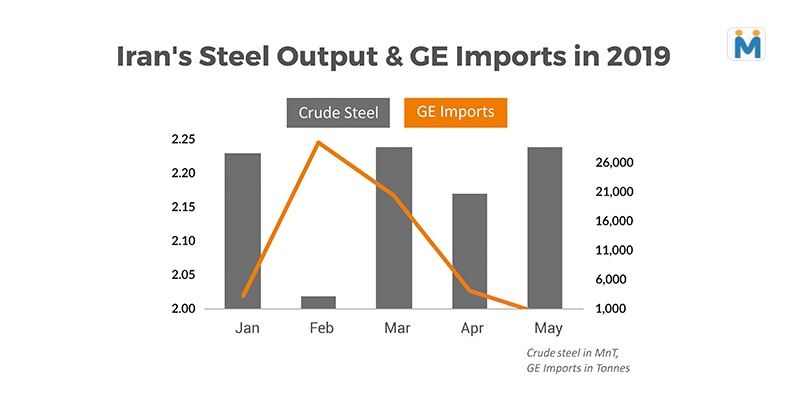
    In 2018, Iran imported about 109,331 tonnes of GE against 87,480 tonnes in 2017, thus marking an increase of 25% y-o-y basis. If we analyse the country-wise imports, in 2018 GE exports from India to the Iran dropped significantly and almost became negligible post August. However, continuing its trend, China remained the top GE exporter to Iran despite sanctions and in fact during Aug-Dec’18, the country’s GE exports to Iran recorded a surge of 42% against the corresponding period of 2017.

    Looking at the 2019 numbers, during Jan-Apr Iran imported about 51,618 tonnes of GE against 36,615 tonnes in the same period last year, thus registering an increase of 45% y-o-y basis. Now out of the total imports of 51,618 tonnes in first four months of ongoing year, about 85% came from China followed by UAE (8%) and Germany (4%) whereas imports from India were quite insignificant.

    As per the market sources, the circumvention of U.S. sanctions is taking place by the trade participants in collusion with shipping agents in Oman and Turkey. The Chinese exporters are directing their exports to Oman or Turkey in middle-east and after altering the bill of lading where the origin of shipment is changed at the port, the same is directed to Iran thus making evasion of U.S. sanctions possible. As this trade arrangement still involves quite a lot of risk, Iran is eagerly focusing on having in-house GE production facility to have interrupted domestic steel production.

    Know More

  • Will the EAF Steel Sector in Southeast Asian Countries Support Graphite Electrodes Demand in Future?

    Will the EAF Steel Sector in Southeast Asian Countries Support Graphite Electrodes Demand in Future?

    The hype around graphite electrodes demand and prices that started in the latter half of 2017 due to supply-side structural changes in China seems to have subsided with GE demand exceeding supply in China and country’s subsequent exports of its produce to various other countries. With no stopping to the price plunge in Chinese as well as global GE prices, let us analyse how the South-east Asia’s EAF steelmaking which requires electrodes as the key raw material will support the GE demand in the coming years ahead:

    Vietnam – Currently, Vietnam’s steel industry is in its stage of development, with most steel producers being small-scale mills. The EAF-based method is widely used in Vietnam (around 80% of steel production) as compared to the BOF process. Many new production lines are coming up and majority of steel makers have concrete plans for capacity expansion while some have plans to more than double their existing capacity.

    According to market research, the construction and construction market in Vietnam reached USD 13 billion in 2017, up 9.7% year-on-year. The average annual growth rate in the next 10 years is expected to reach 7.5%, which will play a powerful role in steel consumption. Moreover, the development of Vietnam’s steel industry in the later period is set to meet not only the needs of the country, but also to expand country’s sales to the ASEAN region, resulting which the output of electric furnace steel will continue to rise, supporting GE demand.

    Indonesia – Indonesia is the most populous country in Southeast Asia however its crude steel production is only about 5 MnT and hence is dependent upon imports to meet its steel requirements. Local steel mills are basically electric furnace based enterprises. Due to the instability of scrap resources and high electricity prices, the operating rate of electric furnace steel enterprises is unstable and the capacity utilization rate is low.

    At present, 80% of Indonesia’s steel resources come from imports, while the government’s target for imports is only 30% resulting which there is a high scope for growth in country’s steel production in the coming years ahead. At present, the two major steel mills in Indonesia (such as Kagang and Gunung Steel) have an electric furnace equipment of 120-130 tones, and other steel mills mainly use 20-70 tonnes of small electric furnaces. Thus, although in the long term country’s electrodes requirement may incresae, at present its demand is quite limited.

    Malaysia – In recent years, Malaysia’s economic development has been relatively flat, and its steel industry has many inherent shortcomings. As an upstream industry in the steel industry, its iron ore raw materials, although available locally, are relatively scarce, and are essential for smelting steel. The coking coal is almost zero, and the imported steel has a greater impact on domestic steel production.

    At present, the apparent consumption of steel in Malaysia is around 12 MnT, mainly based on short-process production, of which EAF production capacity of about 8 MnT. The concentration of steel-making enterprises is low, the production level and automation is low, and the actual capacity utilization rate of EAF steel mills is only about 35%. After 2012, the major steel mills including Golden Lion Group and Anyu Steel are basically new blast furnace projects, and new electric furnaces are rare, which means that the electrodes demand from Malaysia is also quite limited.

    Thailand – Thailand’s construction industry and automobile manufacturing industry are relatively developed. The steel consumption capacity is second only to Vietnam in Southeast Asia. In 2018, Thailand’s crude steel output is about 4.5 MnT. At present, there is only one blast furnace ironmaking enterprise in Thailand, and the rest are electric furnace steelmaking plants, mainly producing blanks. At present, the largest electric furnace steel producers in Thailand are G Steel and Tata Steel (Thailand), all of which are electric arc furnace equipment of more than 80 tonnes. Thus, if the domestic steel demand picks up in the country, it is likely that the GE demand will also increase subsequently in the coming years ahead.

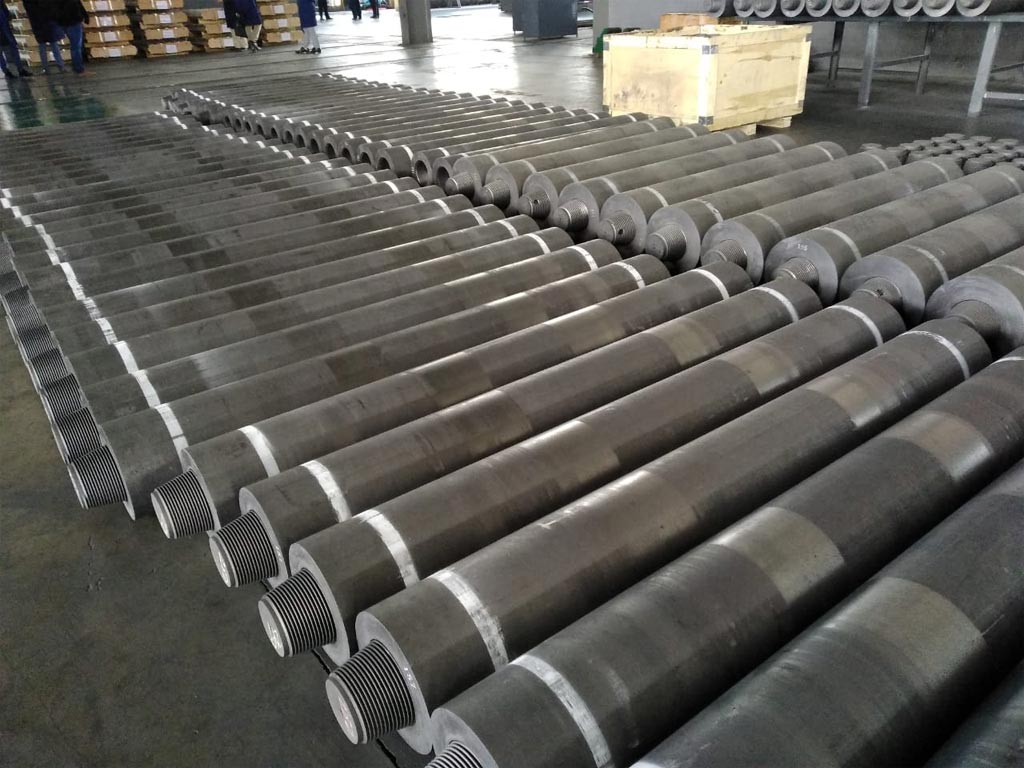
    Image Credits: Industrial Heating

    Know More

  • SteelMint’s China Roadshow: Precious Insights into Graphite Electrodes and Needle Coke

    SteelMint’s China Roadshow: Precious Insights into Graphite Electrodes and Needle Coke

    Graphite Electrodes is an indispensable part of steel making through the EAF route – and it’s evolving all the time in China. In tandem with Needle Coke quality improvements opening up previously unimaginable trade possibilities.

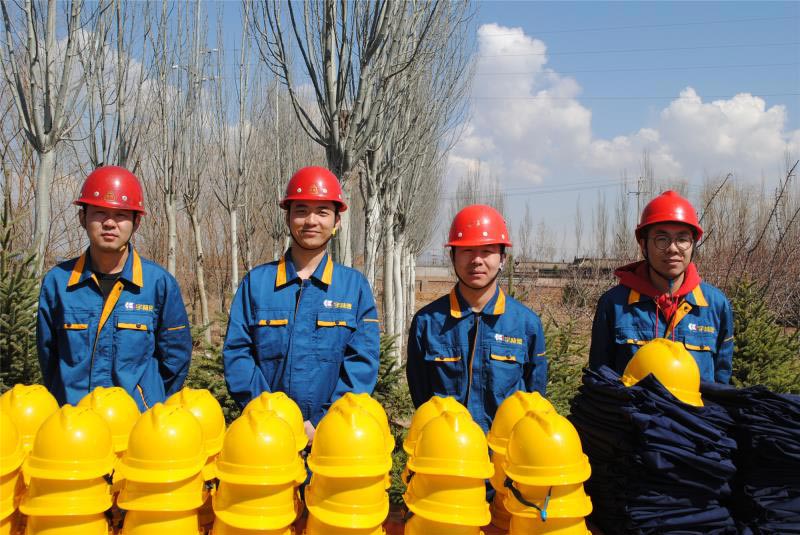
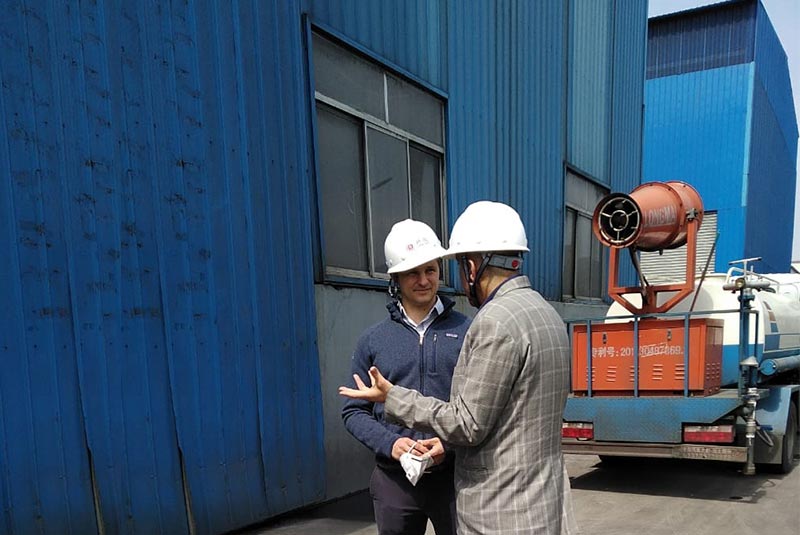
    SteelMint with delegates from world over hit the road in China to find out all this and more. We immersed ourselves in the production processes and the plant visits helped us clear long-standing doubts.
    China has emerged as the epicentre of the global Graphite Electrode (GE) market as it has the potential to shape global GE demand, prices and trade dynamics. In end-2017, the clampdown on 300,000 tonne of inefficient GE capacity in China triggered severe GE shortage across the globe, which further pushed prices upwards, even as steelmakers scrambled to secure supplies. However, the significance of recent announcements of capacity enhancement in China has been grossly downplayed by a section of the industry, with the prevailing opinion being that Chinese plants, inexperienced newcomers as they are, can’t manufacture UHP electrodes as they do not have the required high-specification needle coke.

    Some of the unanswered questions crowding the minds of industry insiders have been:

    • What is China’s GE and needle coke performance potential?
    • Does Chinese GE and needle coke quality match global standards?
    • Is the needle coke manufactured in China ideal for UHP grade production?
    • What is the current expansionary state of EAF steelmaking in China?

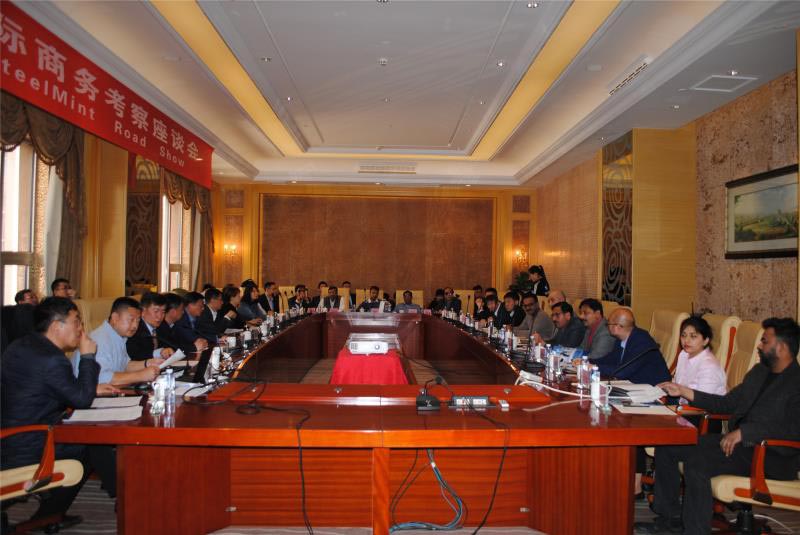
    Despite these pressing queries, the outside world still lacks a coherent understanding of the Chinese GE market. While traders and manufacturers around the world are eager to secure comprehensive, first-hand, ground-zero know how of the Chinese market, their channels of accessing such vital information were, unfortunately, clogged. This bleak scenario, however, used to prevail before SteelMint organised the novel and pleasantly offbeat International Graphite Electrode & Needle Coke Roadshow from 8-12 April, 2019 that included extensive tours of GE and needle coke plants in the country to assess the ground reality. The foremost objective of this tour-de-force of an event was to facilitate interaction between Chinese GE manufacturers and the outside world and to bridge the information gap pertaining to the Chinese GE industry.

    Albeit hectic, the event shone a light on the Chinese GE and Needle Coke market and offered a non-blinkered insight into what the future holds. Here are the key takeaways from the Roadshow:

    China’s GE Production Rising Fast
    Since 2018, the supply of electrodes from China has started to increase. Supply is expected to expand sharply due to new facility investments in 2019 and 2020. In 2018, about 700,000 tonne of GE was produced contributing to a rise of 19%. In 2017, production increased by 16% compared to the previous year. The largest new plant is Baofang Carbon Material Technology, a joint venture between Baosteel Group and Fangda Carbon. It is scheduled to start operations in Lanzhou in 2020 with a nameplate capacity of 100,000 MTPA UHP electrodes.

    Inner Mongolia Emerging as a GE Hub
    With favorable investment policies and low electricity prices, the Inner Mongolia region is emerging as China’s GE hub, with production slated to reach 300,000 tonne this year plus an additional 100,000 tonne in 2020. In 2018, there were about 220,000 tonne of production plans in areas outside Inner Mongolia, but was postponed to 2019. One of them, Baoshan Changdu (40,000 tonne) has started production in Yunnan Province from February.

    Chinese Producers Aggressively Improving GE Quality

    Chinese GE producers are making constant efforts to procure quality needle coke either via imports or through domestic procurement as well as securing technology for quality improvement. Chinese electrode manufacturers are also focusing on producing more of UHP grade GE and that too of sizes higher than 700mm.

    China Market Dominated by Small Diameter Electrodes
    China’s EAFs and refineries are mostly small, with capacities of 50 tonne, essentially dominated by HP and UHP grade manufacturers of sizes under 500mm. More than 200 companies produce electrodes. In particular, it is estimated that there are more than 160 companies in Handan Area, Hebei Province, that specialize in processing and trade. Most companies often produce and sell second-grade electrodes on a very small scale with fake brands, thereby stoking quality concerns.

    Global Non-UHP Grade GE Supply Might Rise
    Chinese GE manufacturers are aggressively increasing the production of HP/RP grade electrodes and amid limited domestic demand they are focusing on exports. With removal of anti-dumping duty on GE imports to India, it is slowly becoming one of the favourite GE export destinations.
     

    GE Prices in China Likely to Remain Stable

    In 2018, the utilization rate of Chinese electrode companies was less than 60%. The expansion of existing suppliers, emergence of new companies and winter production cuts brought down electrode prices in the latter half of the year, subsequently affecting companies’ profit margins. In fact, in Feb 2019, the electrode prices in China fell by 17-20% due mainly to extremely sluggish demand during the New Year holidays. The EAF utilization rate was less than 5% and electrode stocks rose by 27% in preparation for delivery. However, given the fact that domestic as well as imported needle coke prices are surging, electrodes prices are unlikely to fall further in the coming months.

    China’s Needle Coke Demand-Supply Imbalance

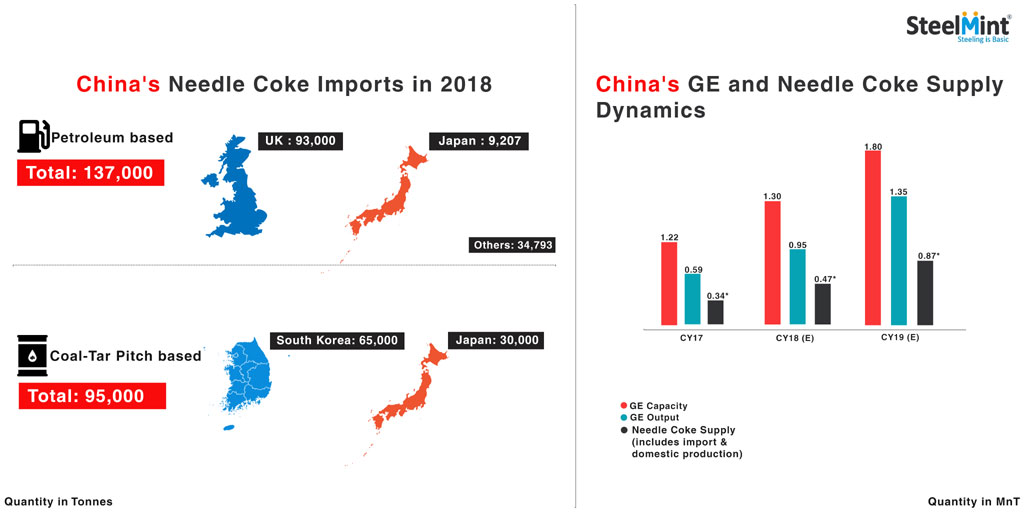
    Needle coke imports and domestic production make up for 870,000 tonne in China whereas demand is 940,000 tonne, resulting in demand-supply imbalance. This apart, a majority of needle coke plants in China are pitch coke-based and high-quality coal tar pitch-based needle coke as well as petroleum-based needle coke still need to be imported.

    Needle Coke Demand from Lithium-ion Battery Segment Growing

    The demand for lithium-ion batteries in China is expected to grow at a rapid pace due to increased demand for new energy vehicles, as well as accelerating demand for energy storage batteries for on-grid and off-grid applications. The country’s needle coke demand from the ion-battery segment is surging. It is anticipated that China will have about 1 MnT of total needle coke capacity by 2020 out of which a substantial portion will be dedicated to the lithium-ion battery segment.

    20% Rise in China’s EAF Capacity

    As per market sources, China, which has increased its EAF steelmaking capacity from 6% of total annual production in 2016 to 12% in 2018, is likely to increase EAF steelmaking to 20% of overall crude production by 2025. Regardless of the forecast, virtually all EAFs in China are meant for production of special and stainless steel, while carbon steel accounts for only 60-70% at the moment. Also, low price competitiveness compared to BFs might stall EAF capacity enhancement. GE demand, therefore, will likely soar in the near- and mid-term.

    The International Graphite Electrode & Needle Coke Roadshow organized by SteelMint offered a rare and holistic insight into the Chinese GE industry that market watchers from across the world are tracking attentively. However, market participants who were eager for a direct interaction with Chinese GE and needle coke bigwigs but have unfortunately missed the bus this time around need not lose heart. Not all good things in life come just once. A golden opportunity that slips between the fingers elicits regret but there is always a second chance to look forward to in intense anticipation. Take heart.

    Industry insiders who could not join the SteelMint Roadshow but are anxious to catch up on precious bits of latest information on the Chinese GE market ought forthwith book their seats at the 2nd Global Graphite Electrodes Conference to be held in Bangkok, Thailand’s Hotel Avani Riverside from August 27-29.


    Know More

  • Will China’s Needle Coke Shortage Derail Their Graphite Electrodes Production Plans?

    Will China’s Needle Coke Shortage Derail Their Graphite Electrodes Production Plans?

    In late 2017, a crisis-like situation engulfed the steelmakers around the world that make steel through the Electric Arc Furnace (EAF) route due to shortage of graphite electrodes amid reforms in China’s steel sector, which further led to dramatic increase in the global electrode prices.

    How did the graphite electrodes crisis start?

    The Chinese government in 2017 decided to shut down on some of the illegal and highly polluting Industries emanating from serious environmental concerns and reports suggest that about 140 MnT of steel capacities, primarily Induction Arc Furnaces, Mini Blast Furnaces and some very old blast furnaces had been shut down in past two years. These closures led to a sudden and significant drop of export of finished steel from China to the rest of the world. All of this, helped the other countries of the world to increase their own production of steel which led to a sudden increase in the demand of graphite electrodes outside of China.

    In addition to a shortage in Electrodes, the demand for its key raw material – needle coke which is already short in supply also increased significantly. Along with this, the growing importance of electric vehicles (EV) in China has also led to the surge in demand of needle coke from EV segment.

    Needle coke availability – A major concern

    China’s closure of inefficient induction furnaces and polluting blast furnaces are expected to be replaced by electric arc furnace. New policy measures announced in China ensures zero growth in steel capacity by requiring steel capacity replacement to be kept in ratio – 1.25:1 or 1:1 (regional differentiation).

    Apart from this it is noteworthy that while the rest of the world produces approximately 45% of the total steel through Electric Arc Furnace route, China till recently has been producing just about 7-8%. The country has just about started to catch up with the rest of the world in this environmental -friendly way of producing steel. China has announced its intentions to produce about 20% of its steel through Electric Arc Furnace by 2020 which means that their Graphite Electrode and needle coke requirements could go up by as much as 3x over the next three to four years.

    However, one of the major areas of concern here is that China is adding EAFs more quickly than coke or electrode capacity and is also making substantial investments into their EV industry.

    China has substantial capacity in ladle electrodes but limited capacity for UHP (ultra-high power) electrodes that are consumed in the West. China utilizes lower quality electrodes sourced with pitch coke and can tolerate the lower quality given the primary product made is commodity grade rebar.

    Fangda Carbon is the only producer of UHPs in China and they are importing high quality coke from South Korea to supplement their production process. China has limited capacity of petroleum needle coke (used for UHP grade GE) and their domestic sources of premium coal based pitch coke for the manufacturing of high grade electrodes have been eroded from the blast furnace capacity rationalization over the past several years.

    China has plans to add more needle coke capacity but the majority of these plants are for pitch coke and face significant challenges of sourcing high quality coal tar pitch and producing at consistent quality levels.

    China’s dependency on imports to meet its needle coke requirements set to stay

    As Chinese coke is generally pitch coke (from coal tar) or some anode grade Calcined material that is being utilized in ladle electrode production, its availability is quite an issue.

    This is because pitch coke requires meaningfully longer bake and graphitizing time, which reduces effective capacity and also is a lower efficiency electrode. Lithium ion battery producers use a mix of petroleum needle coke, owing to its high density and therefore longer driving ranges and battery life span.

    Thus, in order to meet its needle coke requirement for UHP grade electrodes, China has to depend upon imports.

    A look at the Numbers

    According to China’s customs data, the country imported about 137,000 tonnes of petroleum-based needle coke in 2018, against 95,000 tonnes in previous year. Out of the total imports about 93,000 tonnes was imported from UK and about 9,207 tonnes from Japan. In case of coal-tar pitch needle coke, China imported about 95,000 tonnes in 2018 with highest volume of 65,000 tonnes coming from South Korea and 30,000 tonnes from Japan.

    Although China has plans to add more needle coke capacity in the coming years ahead, the plans for pitch coke plants face significant challenges of sourcing high quality coal tar pitch and producing at consistent quality levels and thus has to continue its dependency upon imports in order to meet its electrodes requirements for the new upcoming EAF capacities.

    Know More