SteelMint Events

Tag: Graphite Electrodes Demand

  • Will the EAF Steel Sector in Southeast Asian Countries Support Graphite Electrodes Demand in Future?

    Will the EAF Steel Sector in Southeast Asian Countries Support Graphite Electrodes Demand in Future?

    The hype around graphite electrodes demand and prices that started in the latter half of 2017 due to supply-side structural changes in China seems to have subsided with GE demand exceeding supply in China and country’s subsequent exports of its produce to various other countries. With no stopping to the price plunge in Chinese as well as global GE prices, let us analyse how the South-east Asia’s EAF steelmaking which requires electrodes as the key raw material will support the GE demand in the coming years ahead:

    Vietnam – Currently, Vietnam’s steel industry is in its stage of development, with most steel producers being small-scale mills. The EAF-based method is widely used in Vietnam (around 80% of steel production) as compared to the BOF process. Many new production lines are coming up and majority of steel makers have concrete plans for capacity expansion while some have plans to more than double their existing capacity.

    According to market research, the construction and construction market in Vietnam reached USD 13 billion in 2017, up 9.7% year-on-year. The average annual growth rate in the next 10 years is expected to reach 7.5%, which will play a powerful role in steel consumption. Moreover, the development of Vietnam’s steel industry in the later period is set to meet not only the needs of the country, but also to expand country’s sales to the ASEAN region, resulting which the output of electric furnace steel will continue to rise, supporting GE demand.

    Indonesia – Indonesia is the most populous country in Southeast Asia however its crude steel production is only about 5 MnT and hence is dependent upon imports to meet its steel requirements. Local steel mills are basically electric furnace based enterprises. Due to the instability of scrap resources and high electricity prices, the operating rate of electric furnace steel enterprises is unstable and the capacity utilization rate is low.

    At present, 80% of Indonesia’s steel resources come from imports, while the government’s target for imports is only 30% resulting which there is a high scope for growth in country’s steel production in the coming years ahead. At present, the two major steel mills in Indonesia (such as Kagang and Gunung Steel) have an electric furnace equipment of 120-130 tones, and other steel mills mainly use 20-70 tonnes of small electric furnaces. Thus, although in the long term country’s electrodes requirement may incresae, at present its demand is quite limited.

    Malaysia – In recent years, Malaysia’s economic development has been relatively flat, and its steel industry has many inherent shortcomings. As an upstream industry in the steel industry, its iron ore raw materials, although available locally, are relatively scarce, and are essential for smelting steel. The coking coal is almost zero, and the imported steel has a greater impact on domestic steel production.

    At present, the apparent consumption of steel in Malaysia is around 12 MnT, mainly based on short-process production, of which EAF production capacity of about 8 MnT. The concentration of steel-making enterprises is low, the production level and automation is low, and the actual capacity utilization rate of EAF steel mills is only about 35%. After 2012, the major steel mills including Golden Lion Group and Anyu Steel are basically new blast furnace projects, and new electric furnaces are rare, which means that the electrodes demand from Malaysia is also quite limited.

    Thailand – Thailand’s construction industry and automobile manufacturing industry are relatively developed. The steel consumption capacity is second only to Vietnam in Southeast Asia. In 2018, Thailand’s crude steel output is about 4.5 MnT. At present, there is only one blast furnace ironmaking enterprise in Thailand, and the rest are electric furnace steelmaking plants, mainly producing blanks. At present, the largest electric furnace steel producers in Thailand are G Steel and Tata Steel (Thailand), all of which are electric arc furnace equipment of more than 80 tonnes. Thus, if the domestic steel demand picks up in the country, it is likely that the GE demand will also increase subsequently in the coming years ahead.

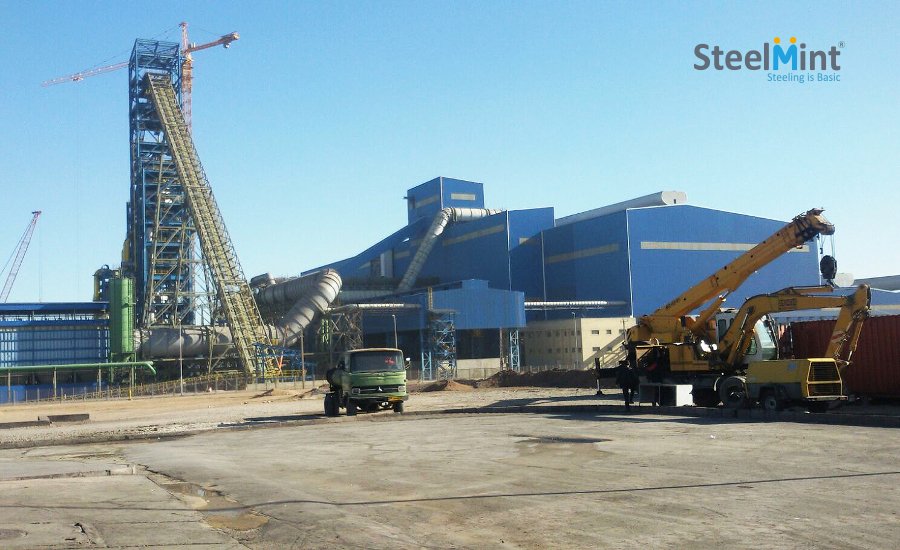
    Image Credits: Industrial Heating

    Know More

  • Will China’s Needle Coke Shortage Derail Their Graphite Electrodes Production Plans?

    Will China’s Needle Coke Shortage Derail Their Graphite Electrodes Production Plans?

    In late 2017, a crisis-like situation engulfed the steelmakers around the world that make steel through the Electric Arc Furnace (EAF) route due to shortage of graphite electrodes amid reforms in China’s steel sector, which further led to dramatic increase in the global electrode prices.

    How did the graphite electrodes crisis start?

    The Chinese government in 2017 decided to shut down on some of the illegal and highly polluting Industries emanating from serious environmental concerns and reports suggest that about 140 MnT of steel capacities, primarily Induction Arc Furnaces, Mini Blast Furnaces and some very old blast furnaces had been shut down in past two years. These closures led to a sudden and significant drop of export of finished steel from China to the rest of the world. All of this, helped the other countries of the world to increase their own production of steel which led to a sudden increase in the demand of graphite electrodes outside of China.

    In addition to a shortage in Electrodes, the demand for its key raw material – needle coke which is already short in supply also increased significantly. Along with this, the growing importance of electric vehicles (EV) in China has also led to the surge in demand of needle coke from EV segment.

    Needle coke availability – A major concern

    China’s closure of inefficient induction furnaces and polluting blast furnaces are expected to be replaced by electric arc furnace. New policy measures announced in China ensures zero growth in steel capacity by requiring steel capacity replacement to be kept in ratio – 1.25:1 or 1:1 (regional differentiation).

    Apart from this it is noteworthy that while the rest of the world produces approximately 45% of the total steel through Electric Arc Furnace route, China till recently has been producing just about 7-8%. The country has just about started to catch up with the rest of the world in this environmental -friendly way of producing steel. China has announced its intentions to produce about 20% of its steel through Electric Arc Furnace by 2020 which means that their Graphite Electrode and needle coke requirements could go up by as much as 3x over the next three to four years.

    However, one of the major areas of concern here is that China is adding EAFs more quickly than coke or electrode capacity and is also making substantial investments into their EV industry.

    China has substantial capacity in ladle electrodes but limited capacity for UHP (ultra-high power) electrodes that are consumed in the West. China utilizes lower quality electrodes sourced with pitch coke and can tolerate the lower quality given the primary product made is commodity grade rebar.

    Fangda Carbon is the only producer of UHPs in China and they are importing high quality coke from South Korea to supplement their production process. China has limited capacity of petroleum needle coke (used for UHP grade GE) and their domestic sources of premium coal based pitch coke for the manufacturing of high grade electrodes have been eroded from the blast furnace capacity rationalization over the past several years.

    China has plans to add more needle coke capacity but the majority of these plants are for pitch coke and face significant challenges of sourcing high quality coal tar pitch and producing at consistent quality levels.

    China’s dependency on imports to meet its needle coke requirements set to stay

    As Chinese coke is generally pitch coke (from coal tar) or some anode grade Calcined material that is being utilized in ladle electrode production, its availability is quite an issue.

    This is because pitch coke requires meaningfully longer bake and graphitizing time, which reduces effective capacity and also is a lower efficiency electrode. Lithium ion battery producers use a mix of petroleum needle coke, owing to its high density and therefore longer driving ranges and battery life span.

    Thus, in order to meet its needle coke requirement for UHP grade electrodes, China has to depend upon imports.

    A look at the Numbers

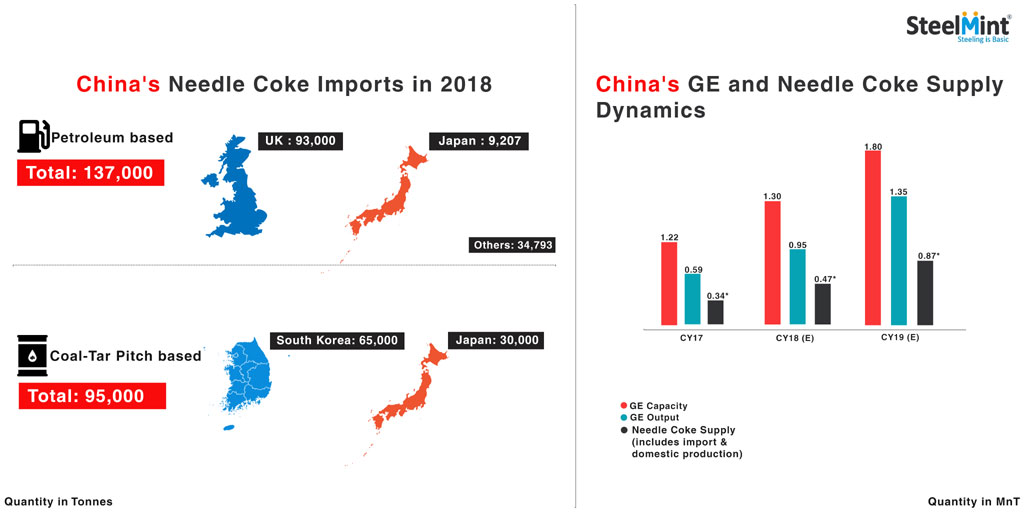
    According to China’s customs data, the country imported about 137,000 tonnes of petroleum-based needle coke in 2018, against 95,000 tonnes in previous year. Out of the total imports about 93,000 tonnes was imported from UK and about 9,207 tonnes from Japan. In case of coal-tar pitch needle coke, China imported about 95,000 tonnes in 2018 with highest volume of 65,000 tonnes coming from South Korea and 30,000 tonnes from Japan.

    Although China has plans to add more needle coke capacity in the coming years ahead, the plans for pitch coke plants face significant challenges of sourcing high quality coal tar pitch and producing at consistent quality levels and thus has to continue its dependency upon imports in order to meet its electrodes requirements for the new upcoming EAF capacities.

    Know More