SteelMint Events

Tag: Intervista

  • New PCT Terminal by Q1’2021 to ease congestion at Chittagong port – Md Zafar Alam, CPA

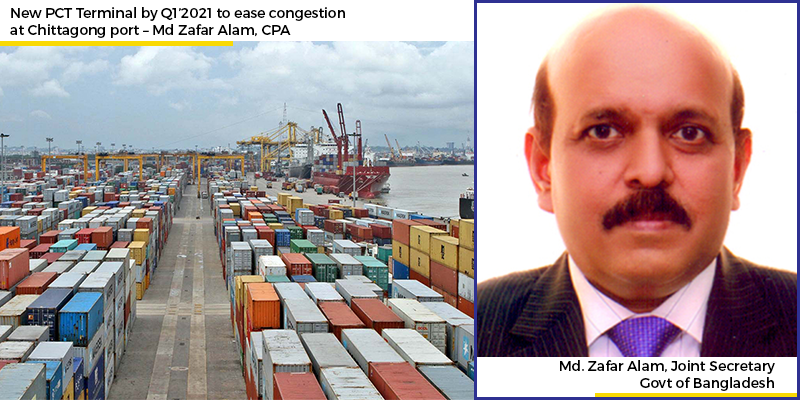
    New PCT Terminal by Q1’2021 to ease congestion at Chittagong port – Md Zafar Alam, CPA

    Md. Zafar Alam, Jt Secretary, Govt of Bangladesh, is Member (Admin and Planning) at the Chittagong Port Authority.

    In a recent interview to SteelMint, Mr Alam revealed about the expansion plans of Chittagong port to ease imports by steel and various other industries, development of new ports to share burden and role of private players in the port development sector in the coming years.

    Q1 How well equipped has Chittagong port emerged, to handle imports via containers and Bulk cargo, given that numerous steelmakers in the country import scrap through containers?

    A1 Chittagong port started its journey as cargo port. In the mid-seventies of last century, it started to transform into a container port by converting some cargo berths for container operation. Now at Chittagong port Authority (CPA) there are only six berths for cargo operation. Alternatively, CPA used its outer anchorage to discharge cargo through lighterage vessels. These lighter vessels move throughout the country by inland waterways.

    Q2 What are the steps being taken by authorities to ease out the prevailing port congestion at Chittagong, considering its importance for raw material imports for steel mills?

    A2 Chittagong port has taken some projects to develop its cargo and container handling facilities. Among them are, 3 new jetties at Patanga Container Terminal (PCT), 1.2 km long cargo Terminal in Bay Terminal area.
    Moreover, after the commissioning of PCT in the first quarter of 2021, it will spare at least two GCB berths for cargo handling, increasing capacity of Chittagong Port after adding bay terminal. Government has also taken a project to develop cargo and container Port at Matabari and Payra, and these two ports will support the industries dependent on imported raw materials.

    Q3 Is it true that Rice and other food related commodities are given preference for unloading at port, keeping scrap importers waiting longer and paying higher demurrage charges?

    A3 In fact in the existing 6 cargo berths of GCB follows a priority rule and that runs as follows:

    a) For food item- 1 berth
    b) Cement – 1 berth
    c) GI cargo/ Steel Scrap – 2 berth.
    d) RoRo vessel- 1 berth
    e) National flag carrier- 1 berth

    Moreover CPA allocated 3 lighter jetties to the steel mills for handling steel scrap from lighter vessels. CPA is developing at least 10 more lighter jetties to support the raw material import dependent industries.

    Q4 Will the new port, Payra port be utilized for scrap and raw material imports, or is it earmarked for other commodities?

    A4 Yes, Payra port will develop for both container as well as cargo handling purposes.

    Q5 Can you put some light on the govt’s plan of action to expand the Chittagong port’s capacities as well as newer port developments in the coming time? 

    A5 In 2019 Chittagong port handled around 100 million metric tons of cargo and 3.1 million TEUs of containers. Economic development of Bangladesh requires the development of ports. And government has taken initiative to develop Payra port in the middle region of Bangladesh and Matabari port in the south east region of Bangladesh. These ports along with Bay terminal and existing Chittagong Port will support the growing demand of the industries in Bangladesh. These expansion projects include:

    a) Construction of Patanga Container Terminal(PCT)
    b) Construction of Bay Terminal
    c) Expansion of yard facilities of Chittagong Port
    d) Construction of 10 more lighter jetties for the raw materials and cargo
    e) Newmooring Overflow yard; and
    f) introducing ICT based Port community System.

    I am very much optimistic with these development and expansion of Chittagong port could ease the movement of ships, containers and cargo including scrap raw material for the steel industry. Chattogram port has carried out a study about the possibility of setting up lighter jetties around sitakunda to support nearby steel industries.

    We are at the end of the implementation of the seventh five-year plan and we will enter into the eighth five-year plan in the next year, 2021. These will have provisions for private sector involvement in the port development. Private sector can come forward and establish port facilities for the smooth movement of the cargo and container.

    Mr Zafar Alam is one of the prominent speakers at SteelMint’s 3rd Steel and Raw materials conference, Chittagong on 23rd-24th March’ 20, where he will be addressing the concerns about the port congestion issues impacting raw material imports to Bangladesh and the correct solutions for the same.

  • Increase in Tax Structure Pulled Down Bangladesh Scrapped Vessel Imports in 2019 – PHP

    Increase in Tax Structure Pulled Down Bangladesh Scrapped Vessel Imports in 2019 – PHP

    Mr Zahirul Islam is a Director at PHP Family and MD of PHP Ship Breaking and Recycling Ind. Ltd. and PHP Ispat Ltd, overseeing the operations of the Long Steel and Recycled steel divisions of the PHP family. He shared his views about the outlook on ship recycling market in Bangladesh, Hong Kong convention for ship recyclers and PHP’s green ship recycling yard. Below is an edited excerpt from his recent interview to SteelMint.

    Q1. Import of scrapped vessels to Bangladesh for ship recycling witnessed a sharp fall in H2 2019, after record high imports in H1 2019. What were the major policy reasons in 2019 budget, responsible such a fall?

    Ans 1. In 2019 budget, the government has increased Advance Income Tax (AIT) from BDT 300  to BDT 1000 per tonne, and has also imposed 5% Advance Tax. This has increased cost of buying vessel and at the same time we witnessed the local demand for steel drop. These are the main reasons why we saw a sharp fall in scraped vessel import in second half of 2019.

    Q2. How do you see the Bangladesh’s ship-recycling market to perform in 2020?

    Ans 2. Shipping industry is going through a tough time. The China-USA tension and Corona virus risks are some of the reasons why such a situation is being observed. Many ships are being sent for scrapping as ship owner are not getting order.

    This is an ideal situation for the ship recycling industry. Prices of scrap vessels are also coming down now. I think we will see a lot of activities in the recycling industry in 2020.

    Q3. Can you put some light on the Green recycling yard of PHP family and how is it different than normal ship-breaking yards in Bangladesh ?

    Ans 3. PHP Family has invested 6 million USD to transform its traditional yard into a green one. Class NK (the Japanese Classification Society) has recently given statement of compliance to Hong Kong Convention to PHP.

    This is a huge achievement for PHP as Class NK SO is regarded as the best certificate in the world. We ensure environmental and workers safety throughout the recycling process. Our workers get regular training on various safety topics and we bring trainer from abroad to carry out specialized training.

    Q4. What criteria does a ship recycler needs to fulfil to be certified as a Green ship recycler and is there any timeline for the same issued by authorities?

    Ans 4.  A facility needs to meet the requirements of Hong Kong Convention to be certified as green ship-recycler, ensuring that end-of-life ships do not pose any unnecessary risks to human safety and to the environment when recycled.

    The rules cover the design, construction, operation and preparation of ships for dismantling; the operation of ship recycling facilities in a safe and environmentally friendly manner; and the establishment of an appropriate enforcement mechanism for ship-recycling.

    Realistically, a facility may need 2 to 4 years to become green recycler.

    Q5. Does volatile imported scrap price trend impact ship-yard melting scrap prices?

    Ans 5. No, usually, imported scrap market trend does not have an impact on ship-yard melting scrap prices, which generally depend on local demand and supply tightness/availability.

    Q6. Are ship-plates from cutting of scrapped vessels a good alternative to billets for stand-alone rolling mills in Bangladesh? 

    Ans 6. Ship plate cannot be an alternative to billets as their grades are different from each other. Although many manual or hand rolling mills use ship plates for rolling, the grades are not of the same quality.

    Founded in 1969, PHP Family is one of the major conglomerates in Bangladesh comprising of over 30 companies in sectors ranging from Steel, ship recycling power and textiles.  PHP Ship Breaking and Recycling Industries Ltd was incorporated into PHP Family in March 2000 and spread over a total area of 20.2 acres, the PHP’s recycling yard has processed over 140 ships and 1.7 MLDT of ship-breaking volume in total as of 2019, remaining the only ship recycling facility at Bangladesh which complying the requirements of Hong Kong International Convention as of yet.

    To know more about vessel imports and price trends of the ship recycling industry in Bangladesh, book your seat at SteelMint’s 3rd Steel and Raw Material Conference, Bangladesh and get a chance to hear views of renowned industry participants from across the globe. The conference is being organized on 23rd-24th March 2020 in Chittagong, Bangladesh.

  • Megatherm Green Induction Furnace Ensures 8% Increase in Productivity

    Megatherm Green Induction Furnace Ensures 8% Increase in Productivity

    Mr. Satadri Chanda, Executive Director of Megatherm since 2016, shared his views about the induction furnace market in Bangladesh and future prospects of the company’s new energy-efficient “green induction furnace” in the emerging steel industry of this country. Below is an edited excerpt from his recent interview to SteelMint.

    Q1. How many induction furnaces for steel melting are operational in Bangladesh? What is the share of Megatherm in the same?

    A. With respect to steel melting, there are around 90-95 induction furnaces currently operational in Bangladesh, while around 4-5 “green IFs” are on the verge of being commissioned in the next 5-6 months. In Bangladesh, most of the mills have replaced their old smaller furnaces with larger 15-20 tonne furnaces in the last five years, apart from new furnaces being set up by the existing players.

    Coming to Megatherm, it has about 50 induction furnaces operational in Bangladesh considering many old furnaces have been replaced by new ones.

    Q2. What are Megatherm’s steel capacities in the pipeline?

    A. We have over half a dozen new IFs in the pipeline for Dhaka and Chittagong mills over the next 12-18 months.

    Q3. When was Megatherm’s new Green Furnace launched in the Asian market and how is this Green Furnace better than its predecessors?

    A. Launched in late 2017, the Green Furnace has been very successfully received in the global market, including India and Pakistan, and now it is making strides in Indonesia, Iran, Saudi Arabia and other markets. It will be formally launched in the Bangladesh market this year.

    Green furnace guarantees an energy consumption of 460 kWh/t to 470 kWh/t (using mill heavy/end cutting scrap at 1600°C), which is significantly more efficient than the consumption of 515 – 545 kWh/t recorded by its predecessors and 500 – 510 kWh/t recorded by latest models of other brands.

    Apart from this, the Green Furnace also guarantees up to 8% increase in productivity compared to the previous record-holding furnaces without the need for furnace capacitor switching as well as a the sustained power factor of over 98% throughout the heat cycle. The load factor has been improved to 95% by increasing power pick-up.

    Q4. Since when have you planned to start marketing Green Furnaces in Bangladesh. How has it been received so far?

    A. While some green furnaces have been sold to Bangladesh mills for observing results and customizing to suit Bangladeshi operating conditions, the Green Furnace will be formally launched during the event. We have recently installed green induction furnaces of 20 T each in Salam Steel, Vikrampur Steel and Montana Steel which have all been commissioned, while another green IF of 20 T at Bandar Steel is about to be commissioned in the first half (H1) of 2020.

    Q5. With Megatherm currently being more dominant among Dhaka-based steel mills with up to 20T furnaces, is there any conscious plan for growing Megatherm’s share in the larger mills of Chittagong?

    A. Megatherm has always depended on product superiority and word of mouth, to ensure sales. Strong active marketing has not been Megatherm’s mode of operation. In all regions where one Green Furnace has been commissioned, we have got a majority market share. Examples include Durgapur, Raipur, Champa, Pakistan and very recently Hyderabad. We expect the same with Chittagong.

    Q6. In your view, what are the major challenges being faced by Bangladesh-based steel mills with regard to melting furnaces?

    A. Bangladesh steel mills are not run as efficiently as plants based out of India and some other regions. This further increases the need to have a more energy-efficient and productive furnace.

    The Megatherm Group is a renowned manufacturer of industrial equipment for metal heating and melting and has its presence across industries like steel, foundry, forging and power. The company is one of the leading players in the induction furnace installations space for steel manufacturers across South Asia and other regions.

    To know more on growing steel melting capacities in Bangladesh and challenges ahead, book your seat at SteelMint’s 3rd Steel and Raw Material Conference, Bangladesh and get a chance to hear views of renowned industry participants from across the globe. The conference is being organized on 23rd-24th March, 2019 in Chittagong, Bangladesh.

  • JSW: Stocking up “Little” Iron Ore in Dolvi as Odisha Auctions Mines

    JSW: Stocking up “Little” Iron Ore in Dolvi as Odisha Auctions Mines

    Dr. Vinod Nowal, deputy managing director and non-independent executive director of JSW Steel Ltd is ready to set his foot into a new terrain, one that will colour his boots a rusty red. With JSW’s technical bids for six mines in Keonjhar in Orissa where some of the biggest and the best supply of iron ore is feverishly mined and red dust fills the air, Dr Nowal speaks about the company’s plans to make investments whether it wins or loses the bids.

    Following are edited excerpts from a telephonic interview with Ruchira Singh:

    Q. Are you expecting any delay in the mine auction process in Odisha?

    A. I don’t think there will be any further delay in the auctions. In the last few months we have been meeting the government regularly and they have assured us that they will take measures so that there is continuity of supply.

    Q. What could these measures be?

    A. There could be a provision for temporary mining under the old rules while simultaneously applying for the environment clearances.

    Q. A recent gazette notification suggests that the new mine owners will have to apply for new environment and forest clearances. Doesn’t this suggest there might be a delay in resumption of production when leases expire on March 31?

    A. The gazette notification is not clear, but they are likely to formalize something. Legal, environment and mining ministries are working together on this. This is the impression we got.

    Q. In the run up to the auctions, are you expecting any disruptions in supply from Odisha? How are you preparing for it?

    A. We are regularly buying and using it (iron ore) because as usual demand and supply is there. But it is true that there is not a good network of rail and road.

    Q. What is the solution to make mining better in this region?

    A. They should go for a new system of conveyer belts and slurry pipelines. That is the only solution. The government has to work and industry has to work — together.

    Q. JSW is investing in a slurry pipeline in Keonjhar. Can you please give some details about it?

    A. We are making a slurry pipeline. It can be for captive use and for others also. It will take two to three years. It does take that much of time as approvals are needed, construction is needed, technology partner is needed. Once we get the mine, we will start it.

    Q. And if you don’t get any mine, will you not build it?

    A. We will build the slurry pipeline in case we are getting the mine and hope we get the mine too.

    Q. From where to where will the pipeline be built?

    A. It will connect the mine area (in Koenjhar) and Paradip. This will link both the Paradip port as well as our upcoming plant (in Jagatsinghpur).

    Q. Several iron ore consuming companies have applied for storage area for iron ore in Keonjhar. Are you one of them?

    A. No because we are not in Odisha state as a consumer. We are bringing the ore to Maharashtra.

    Odisha iron ore being loaded to railway rake

    Q. So are you storing up iron ore for potential supply disruption at your plant in Dolvi?

    A. We are storing up a little.

    Q. Do you expect international iron ore prices to go up? There is Indian disruption coming up and there are bush fires in Australia…

    A. People say that to try to inflate prices. These are fires. It is not flooding or storm.

    Q. Are you happy with the current prices of iron ore?

    A. It is okay. We can buy from the international market. Iron ore is available.

    Q. How is the situation of the steel market? We are seeing bigger than usual inventories…

    A. Steel inventories have been exhausted. This is the last quarter and it is seeing good demand. We have hit the bottom and things will pick up from here.

    Q. How is the foreign market doing? Some companies are seeing better revenues from their overseas businesses. Are you too seeing such a thing?

    A. Foreign market is picking up. It has improved.

    Q. What is the outlook for steel prices?

    A. It has gone up lately by $25-$30/tonne.

    Q. What kind of improvements will you make in Odisha?

    A. In the area which has given thousands of crores of revenue from minerals, should people be living in such a poor condition?  This is also the place where the mineral fund is one of the highest. We will definitely change it.

    To learn how the mines auction 2020 unfolds, be a part of SteelMint Events’ 4th Indian Iron ore, Pellet and DRI Summit which is scheduled on 2-3 March 2020, in Hotel LaLiT, New Delhi.

    Credits – Ms Ruchira Singh

  • Bangladesh to Add 4 MnT Steel-Making Capacities in Next Few Years: BSRM

    Bangladesh to Add 4 MnT Steel-Making Capacities in Next Few Years: BSRM

    Bangladesh, one of the emerging steel markets in Asia, has been witnessing a rapid increase in steel production capacities since the last couple of years. Rising steel-making capacities are driving raw material imports like steel scrap, pig iron and DRI further.

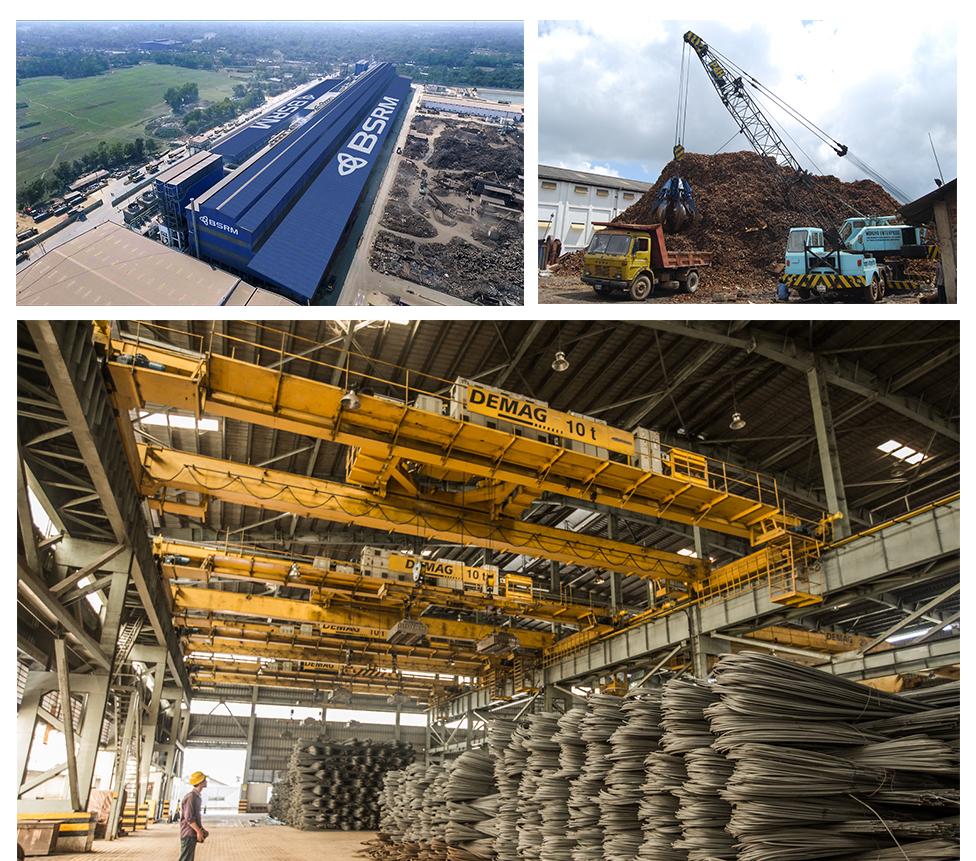
    Bangladesh Steel Re-Rolling Mills (BSRM) is a leading steel manufacturing company in Bangladesh with 1.8 million tonnes (MnT) of installed billet-making capacity. SteelMint, in an interview with Mr. Sanjoy Kumar Ghosh, Head of Supply Chain Management, BSRM, learned about his views on the steel and scrap industries in Bangladesh. Below are edited excerpts from the interview:

    How is Bangladesh performing in terms of economic growth? How do you see the steel industry’s contribution in your country’s economy?

    Bangladesh is now the world’s 3rd fastest-growing economy according to media reports. Its GDP growth rate is currently 8% as per an ADB report (8.2% according to the annual budget in 2019).


    A lot of development work is going on across the country and infrastructural development is one of them. The country is moving forward by all means with a view to applying to the United Nations for its recognition as a ‘Developing Country’ after fulfilling the criteria set by the UN in 2018. If we consider 8% GDP growth, it means at least 16% growth indication for the steel sector in the coming years.

    What is the country’s present per capita steel consumption? How much growth is expected in the coming years?

    Per capita consumption of steel in Bangladesh has seen a significant rise and almost doubled in 5-6 years to 45 kg in 2017. As per estimates, per capita steel consumption may rise to 73 kg by 2022. A lot of infrastructural work, along with mega government projects, is running in the country and it would take another 5-7 years to finish them. So the demand for steel will be there in the future.

    What are the upcoming expansion plans by steel makers and major infrastructure projects being developed by the government?

    Buoyed by the increasing demand for steel amid the implementation of mega infrastructure projects, many of the larger mills have signed up for capacity expansion and other infrastructural activities for improving power generation.

    Major steelmakers, including BSRM, have already initiated a few projects to increase their capacity while a few new companies are waiting to mark their footprint in the steel sector. A lot of infrastructural work, along with big government projects (Padma Bridge, Rooppur Nuclear Plant, Paira Sea Port, the large coal-fired power projects of Matarbari and Rampal, Metro Rail and LNG terminal) are currently going on across the country.

    What is Bangladesh’s steel production capacity and how much more capacity can be added in the near term?

    At present, the current steel production capacity is estimated to be at 6.5-7 MnT and it can be said that at least another 3-4 MnT of steel producing capacity will be added in the next few years on the back of aggressive expansion plans of leading steelmakers.

    How much ferrous scrap did Bangladesh import in the previous years?

    According to the data maintained with the customs department, ferrous scrap imports in financial year (FY) 2017-18 (July 2017-June 2018) was recorded at 2.6 MnT and the volume of scrapped ships imports in Chattogram’s ship-breaking market for recycling activities was recorded at 2.3 MnT. This year, 2018-2019, will be higher than earlier as per customs data.

    How much steel scrap demand is being projected in the coming years?

    As per customs import data in FY2017-18, total steel products, comprising raw material (steel scrap), semi-finished, finished products and imported scrap vessel quantity (ship breaking) was around 7.7 MnT. Among these quantities, around 2 MnT comprised finished products and 0.6 MnT were semi-finished products (HBI, DRI and billets). So the rest of the finished products were needed to be produced domestically. For that we are dependent on imported scraps, scraps generated from ship-breaking yards and other domestically generated steel scraps.

    So to sum up, we can say right now the steel scrap demand in Bangladesh is around 7 MnT which will definitely see a rising trend in the coming years.

    In order to know more on Bangladesh’s rising appetite for steel scrap imports, book your seat at SteelMint’s 4th Steel Scrap, Billet & DRI Trade Summit and to get a chance to hear insights from Mr. Sanjoy Kumar Ghosh. The conference is being organised during 27-29th August, 2019 in Bangkok, Thailand.