SteelMint Events

Tag: Needle Coke

  • China still not major competitor in UHP grade GE market: GrafTech

    China still not major competitor in UHP grade GE market: GrafTech

    In its Q1 2019 earnings call held recently, US-based Graphite Electrode (GE) major GrafTech highlighted the company’s sales and financial performance, market prospects in the short term and the likely risk emerging from the upcoming Chinese GE additions. Listed below are the key points revealed by GrafTech’s top management:

    A majority of Chinese manufacturers are still new in the UHP GE business:

    Asked about the potential risk from the rising GE capacities in China, GrafTech’s top management highlighted that China is adding to its GE capacity massively because with 10% EAF capacity in that country almost 100 MnT of crude steel is being produced by the EAF route. The nation is planning to expand EAF capacity to 20% by 2021, which signifies the addition of another 75 to 100 MnT (equal to the entire US arc furnace industry) of crude steel to existing capacity. In order to service such a huge magnitude of EAF capacity, the country would obviously require GE capacity additions.
    As regards UHP grade GEs, GrafTech’s top management said a couple of Chinese producers are working for years to produce UHP electrodes and during the shortage last year, customers selectively bought Chinese UHP grade GE on a trial basis. However, it has taken years for a couple of well-established Chinese producers to reach a point from where they can produce UHP grade GEs with a consumption and breakage rate that steel producers would prefer to try. UHP electrodes are used in high-intensity applications and high-production melt shops.
    Thus, barring a few, a majority of new GE capacity additions that are claiming to be UHP grade don’t have the experience of producing high-grade GEs. It is unclear how much new capacity is being added to bolster UHP grade production and how long it will take to build and run UHP grade GE plants.

    Availability of good quality needle coke still a big hurdle:

    Asked about the availability of petroleum-based needle coke required to produce high-grade GEs, GrafTech highlighted that producing high-grade petroleum-based needle coke is not easy and it takes years to develop the process and secure specific decant oil supplies. Decant oil, used to produce needle coke, is a secondary product, basically a leftover at the bottom of the barrel during the oil refining process. As refineries have different operations, the quality of decant oil varies widely from refinery to refinery. So it is difficult to secure decant oil with those properties that are required for petroleum needle coke, which, in turn, is required to manufacture high-grade electrodes used in high-intensity melt shops.

    Demand for needle coke from China’s EV segment:

    Top GrafTech executives pointed out that China has a burgeoning requirement of needle coke from the expanding electric vehicles segment. In order to manufacture efficient battery with long life, premium quality petroleum-based needle coke is required. The Chinese still mix different products, including petroleum needle coke and pitch needle coke as well as natural graphite. This is because it’s all about the ability for the product to transfer a charge in the most effective and efficient way. Thus, the Chinese GE industry will face competition from the domestic battery industry which could well prove to be a deterrent to high-grade electrodes production in the future.

    BOX

    Snapshots of GrafTech’s Q1 CY19 Performance

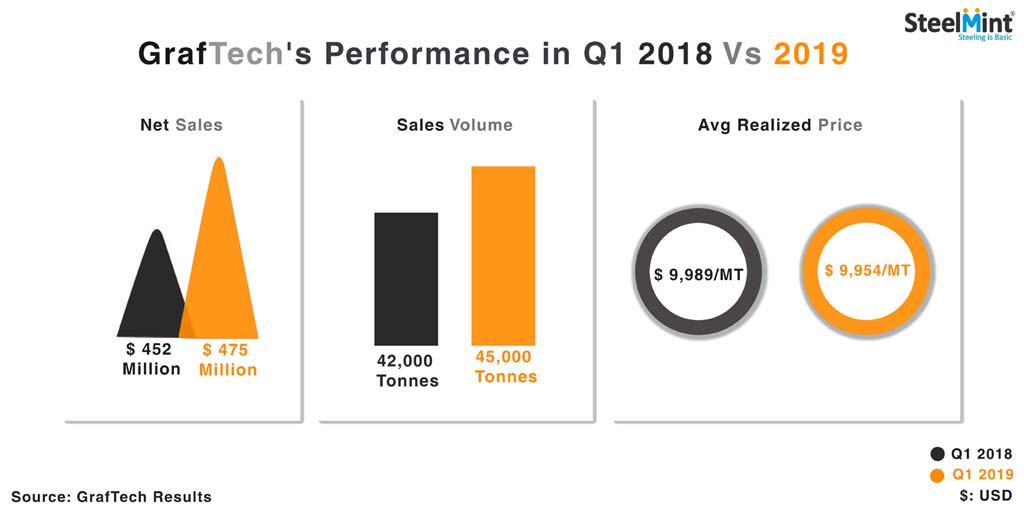
    • Net sales rise by 5% Y-o-Y from USD 452 million in Q1 2018 to USD 475 million in Q1 2019
    • Company registers an increase in sales from 42,000 tonne in Q1 18 to 45,000 tonne in Q1 CY19
    • Average realised price from sale in Q1 CY19 recorded at USD 9,954/MT against USD 9,989/MT in Q1 2018
    • GE major plans to sell majority of volumes on long term (3-5 years), take-or-pay, fixed price or volume contracts
    • Company has entered into long-term agreements with more than 100 customers for 675,000 tonne at an average contract price of USD 9,800/MT for 2018-2023.
    • GraftTech’s ‘Take-or-Pay’ agreements are estimated to reduce from 148,000 tonne (as of 31 Mar’19) to 120,000 tonne in 2022 with average price to plunge from USD 9,800 in 2019 to USD 9,700/MT in 2022.
    • Company plans to focus on operational improvements with capital expenditure of USD 60-70 million in 2019.

    Know More

  • Needle Coke Prices Won’t Fall in Next 2 Years: Chinese Needle Coke Manufacturer Tells SteelMint

    Needle Coke Prices Won’t Fall in Next 2 Years: Chinese Needle Coke Manufacturer Tells SteelMint

    EAF steelmaking in China has witnessed considerable capacity enhancements of late mainly due to the surging environmental concerns and the burgeoning demand for higher grades and specifications. From the current 12%, crude steel produced through the EAF route is expected to contribute to around 20% of overall crude steel production in China by 2020. However, UHP grade Graphite Electrodes (GE) of sizes <600mm are still hard to come by owing to the relative scarcity of high-specification needle coke. There is still a prevailing opinion that China lags behind the US, Japan and India when it comes to manufacturing premium quality GEs to run global standard EAF units.

    Amid such doubts in the minds of prospective investors and buyers about the real market scenario in China and also with a view to the fact that China is slowly emerging as a nerve centre of global GE demand and trade, SteelMint came up with a unique idea of organizing the International Graphite Electrode & Needle Coke Roadshow from April 8 to 12, 2019 that included visits to GE and Needle Coke plants to assess the ground reality in China.

    As part of this roadshow, SteelMint visited Jingyang Technology, a needle coke plant located in the Shandong province. The company has a nameplate capacity of 60,000 MTPA of needle coke and is striving to double its output in the next three years. Below are excerpts from an interview with Shen Jianfeng, Deputy General Manager, Marketing and Sales, Jingyang Technology:

    Can you please elaborate on Jingyang Technology’s business and market share in China?

    SJ: Jingyang Technology started its journey in October 2014 and is mainly focused on manufacturing petroleum-based needle coke. We have a market share of 25% in China. At present our plant’s production is about 65,000 tonne for calcined needle coke, 20,000 tonnes for green coke which means about 85,000 tonnes in total. We expect to increase our capacity to 150,000 tonne by October 2019 after much-awaited expansion plans are implemented. With this expansion the needle coke manufactured is suitable for the production of GEs ranging 600mm and above in size.

    Currently the sulphur content of the needle coke we produce is 0.45%. We use hydrogen to remove the sulphur. After expansion, the sulphur content in our GE can reach below 0.4% (roughly 0.35%) which is equal to the level that the US and Japanese needle coke manufacturers maintain.

    Who are your customers in China? Do you also export to India?

    SJ: Currently our major clients in China are Fangda Carbon, Nantong Yangzi Carbon, Jilin Carbon and Xinxing Carbon to name a few. With regard to the anode material segment, our clients include Shan Shan Tech and Zhongke Electric. And there is one renowned GE manufacturer which is located in Sichuan province and is using our product to manufacture 700mm GE.

    Jingyang Tech has been exporting since 2017 and we have regular orders of 2,000 tonne per month from Russia. Last month we exported 500 tonne to Italy. A few months back we signed a supply contract for 300 tonne per month with a Japanese GE producer. Last year we exported 200 tonne to India and plan to ramp up exports to India.

    What is the current needle coke market situation in China? There is talk of large needle coke capacities coming up in China. How much capacity will be added in the next two years?

    SJ: The current needle coke capacity in China is around 280,000 tonne with coal tar pitch-based needle coke and petroleum-based coke having a percentage share of 71% and 29% respectively in the market. The additional capacities (both coal tar pitch-based and petroleum-based) that are expected to be added is around 720,000 tonne by 2020, thus taking the country’s total needle coke capacity to around 960,000 tonnes.

    Will this capacity addition ease the demand-supply imbalance and lower prices in China?

    SJ: The needle coke manufactured in China is used by two sectors: GE and anode materials. The demand for needle coke from both the segments will likely be around 1 MnT by 2020. However, supplies in the next two years will be around 960,000 tonne, which means that the demand-supply imbalance will continue and prices may not fluctuate much in the next two years.

    Is the quality of petroleum coke-based GE different from that manufactured using coal tar pitch-based needle coke? Are these suitable for making UHP electrodes required in big EAF plants?

    SJ: There is no major difference between GE manufactured using petroleum or coal tar but there is always scope for improvement. However, like Japan, China can also make good quality coal tar pitch-based needle coke that can be used to manufacture electrodes of bigger sizes and specifications. For example, a Chinese needle coke manufacturers have made a breakthrough in production of high quality coal tar pitch-based needle coke used to manufacture 700mm UHP GE. At present, petroleum-based coke is expensive than coal tar pitch based, roughly by RMB 2,000-3,000 per tonne.

    What is the current needle coke price scenario in China?

    SJ: Currently the price in China is around RMB 20,000-25,000 per tonne but it is difficult to make any predictions. Judging by the willingness of customers it seems prices have bottomed out since early April and it is likely that the market will be better in the future.

    How does Jingyang Technology maintain its needle coke quality?

    SJ: We regard quality as supreme and have put in place a whole set of measures to strictly control quality with regard to raw material selection, production control, online monitoring, checking prior to dispatch, customer follow-up, third party inspection and appraisal, etc.

    We have a professional team with rich experience in this industry and it accepts only quality raw materials after sample testing. They comprehensively process the raw materials from difference resources to make the finished product. In the warehouse, we maintain around 40,000 to 50,000 tonne of raw material to stay away from market fluctuations. As regards the final product, 20% is earmarked for anode material and the rest is used in GE production.

    What is the ground level progress of EAF in china? How much capacity can come online in the next two-three years?

    SJ: In my opinion to some extent, the development of needle coke banks on the increase in EAF capacity but the EAF output of steel in China is unlikely to exceed 20% in next 2-3 years. At present current EAF route capacity is less than 12% in total.

    What is the lead time of setting up a needle coke plant in China?

    SJ: It takes about 2 years to set up a needle coke plant for others normally but for us only 10 months are sufficient to set up a new needle coke plant given the knowledge and resources we have.

    Do you have any further plans after the capacity expansion?

    SJ: We plan to start manufacturing of nipples used for electrodes of size 600mm to 650mm.

    How the winter production was cut in 2018 and is likely to be in 2019?

    SJ: Last year the production cuts policy not too strict as policy no longer took the approach of ‘One size fits all’. We had production cuts of 30% in winters of 2018 and will make up for the lost capacity most likely during summers. Besides, this our production majorly complies with the environmental protection requirement with water treating systems in place and thus for 2019 winters, production cuts would not have major impact on us.

    Know More

  • Will China’s Needle Coke Shortage Derail Their Graphite Electrodes Production Plans?

    Will China’s Needle Coke Shortage Derail Their Graphite Electrodes Production Plans?

    In late 2017, a crisis-like situation engulfed the steelmakers around the world that make steel through the Electric Arc Furnace (EAF) route due to shortage of graphite electrodes amid reforms in China’s steel sector, which further led to dramatic increase in the global electrode prices.

    How did the graphite electrodes crisis start?

    The Chinese government in 2017 decided to shut down on some of the illegal and highly polluting Industries emanating from serious environmental concerns and reports suggest that about 140 MnT of steel capacities, primarily Induction Arc Furnaces, Mini Blast Furnaces and some very old blast furnaces had been shut down in past two years. These closures led to a sudden and significant drop of export of finished steel from China to the rest of the world. All of this, helped the other countries of the world to increase their own production of steel which led to a sudden increase in the demand of graphite electrodes outside of China.

    In addition to a shortage in Electrodes, the demand for its key raw material – needle coke which is already short in supply also increased significantly. Along with this, the growing importance of electric vehicles (EV) in China has also led to the surge in demand of needle coke from EV segment.

    Needle coke availability – A major concern

    China’s closure of inefficient induction furnaces and polluting blast furnaces are expected to be replaced by electric arc furnace. New policy measures announced in China ensures zero growth in steel capacity by requiring steel capacity replacement to be kept in ratio – 1.25:1 or 1:1 (regional differentiation).

    Apart from this it is noteworthy that while the rest of the world produces approximately 45% of the total steel through Electric Arc Furnace route, China till recently has been producing just about 7-8%. The country has just about started to catch up with the rest of the world in this environmental -friendly way of producing steel. China has announced its intentions to produce about 20% of its steel through Electric Arc Furnace by 2020 which means that their Graphite Electrode and needle coke requirements could go up by as much as 3x over the next three to four years.

    However, one of the major areas of concern here is that China is adding EAFs more quickly than coke or electrode capacity and is also making substantial investments into their EV industry.

    China has substantial capacity in ladle electrodes but limited capacity for UHP (ultra-high power) electrodes that are consumed in the West. China utilizes lower quality electrodes sourced with pitch coke and can tolerate the lower quality given the primary product made is commodity grade rebar.

    Fangda Carbon is the only producer of UHPs in China and they are importing high quality coke from South Korea to supplement their production process. China has limited capacity of petroleum needle coke (used for UHP grade GE) and their domestic sources of premium coal based pitch coke for the manufacturing of high grade electrodes have been eroded from the blast furnace capacity rationalization over the past several years.

    China has plans to add more needle coke capacity but the majority of these plants are for pitch coke and face significant challenges of sourcing high quality coal tar pitch and producing at consistent quality levels.

    China’s dependency on imports to meet its needle coke requirements set to stay

    As Chinese coke is generally pitch coke (from coal tar) or some anode grade Calcined material that is being utilized in ladle electrode production, its availability is quite an issue.

    This is because pitch coke requires meaningfully longer bake and graphitizing time, which reduces effective capacity and also is a lower efficiency electrode. Lithium ion battery producers use a mix of petroleum needle coke, owing to its high density and therefore longer driving ranges and battery life span.

    Thus, in order to meet its needle coke requirement for UHP grade electrodes, China has to depend upon imports.

    A look at the Numbers

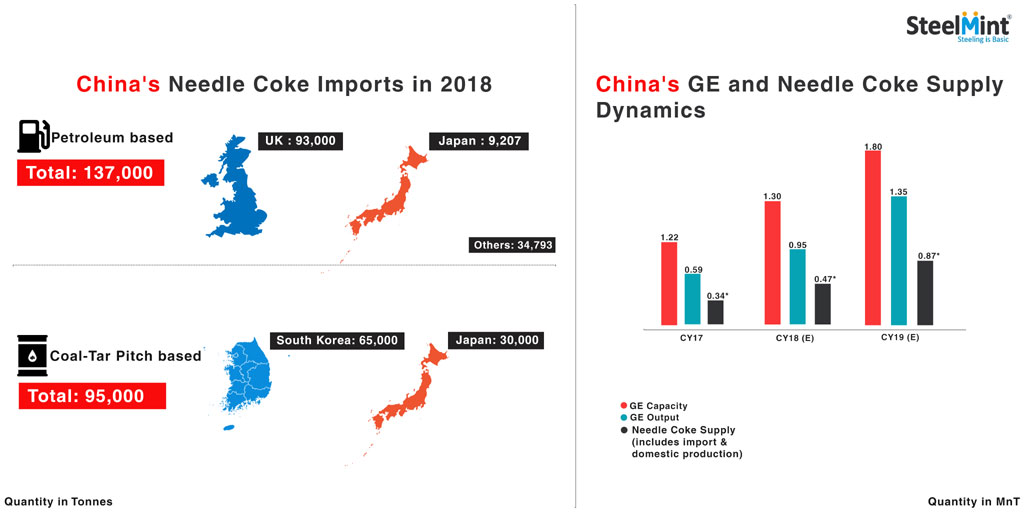
    According to China’s customs data, the country imported about 137,000 tonnes of petroleum-based needle coke in 2018, against 95,000 tonnes in previous year. Out of the total imports about 93,000 tonnes was imported from UK and about 9,207 tonnes from Japan. In case of coal-tar pitch needle coke, China imported about 95,000 tonnes in 2018 with highest volume of 65,000 tonnes coming from South Korea and 30,000 tonnes from Japan.

    Although China has plans to add more needle coke capacity in the coming years ahead, the plans for pitch coke plants face significant challenges of sourcing high quality coal tar pitch and producing at consistent quality levels and thus has to continue its dependency upon imports in order to meet its electrodes requirements for the new upcoming EAF capacities.

    Know More