SteelMint Events

Tag: Needle Coke Prices

  • China Needle Coke Prices Reverses the Global Trend

    China Needle Coke Prices Reverses the Global Trend

    The upheaval in graphite electrodes demand in past two years and a steady surge in the requirements for graphite anodes for lithium-ion batteries in China has boosted the needle-coke demand in the country.

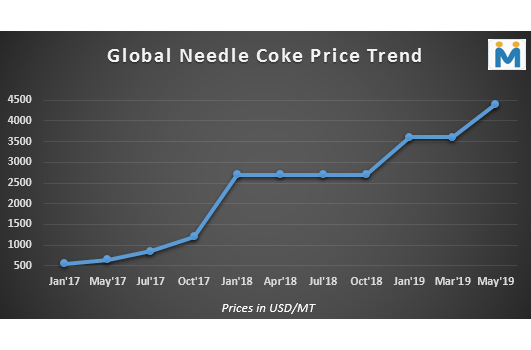
    In 2018, the overall performance of China’s needle coke market was relatively stable with prices showing an uptrend and reaching to its high in the month of November. However, towards the end of 2018, the plunge in steel demand from downstream sector in China adversely impacted the country’s graphite electrode requirement and so does the needle coke demand and prices.

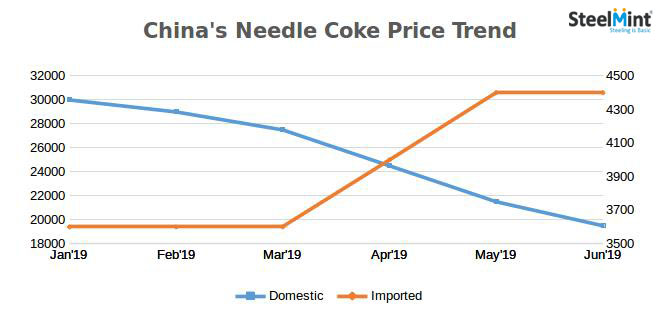
    With the start of 2019, China’s domestic needle coke prices have been falling and have registered a plunge of 35% in the time span of six months. However, the price of high-quality needle coke required for UHP grade GE (usually imported) have been rising continuously recording a surge of 22% during Jan-Jun’19. The domestic needle coke prices in China are currently trending in the range of RMB 19,000-20,000 (USD 2,750 – 2,900/MT) whereas imported needle coke prices are at 4,200 – 4,600/MT.

    According to customs data, in first four months of 2019, China’s petroleum-based needle coke import volume was 46,413 tonnes, 70% of which came from the United Kingdom, 15.3% from the United States, and 9.5% from Japan whereas country’s coal-based needle-coke imports were 27,819 tonnes of which 62% came from South Korea and 38% from Japan.

    Although, the domestic needle coke produced in China still has some time to match the global standards, with the help of some research and development, the quality of the same have improved to some extent and few products have been able to mark their entry in the international market also.

    At present the production capacity of domestic needle coke in China is in the period of rapid expansion and in 2019 some new projects will be officially put into operations:

    China’s upcoming capacities in case of coal-based needle coke:

    Company Name Planned Capacity Estimated year of operation Type
    CNPC Jinzhou Company 100,000 2019 New expansion
    Shandong Yida New Material 70,000 2019 New expansion
    Shandong Jingyang Tech 70,000 2019 New expansion
    SinoPec Maoming Company 100,000 2020 New entry
    Sinopec Jinling Company 100,000 2020 New entry
    Liaoning Baolai Bio-energy 120,000 2020 New entry
    Total 560,000

    China’s upcoming capacities in case of petroleum-based needle coke:

    Company Name Planned Capacity Estimated year of operation Type
    Kaifeng carbon Anshan thermal-energy new material 20,000 2019 New expansion
    Henei Kaifeng Carbon New Material 40,000 2019 New expansion
    Shanghai Baosteel Chemical 100,000 2019 New expansion
    Anshan Steel Holding 40,000 2019 New entry
    Zaozhuang Thriving Carbon Tech 40,000 2019 New entry
    Pingdingshan Risun New Material 40,000 2019 New entry
    Baoshun Chem 50,000 2019 New entry
    Tsdr New Energy 100,000 2019 New entry
    Shanxi Jinzhou Chem 40,000 2019 New entry
    Shanxi Fuma Carbon Material 40,000 2020 New entry
    Ningxia Baichuan new material 50,000 2020 New entry
    Total 560,000

    With the new capacities coming up in China’s needle coke sector and tepid graphite electrodes demand due to sluggishness in downstream sector, the country’s domestic needle coke prices are anticipated to fall further.

    Know More

  • IMO 2020 Regulation May Jolt Global Graphite Electrode Industry

    IMO 2020 Regulation May Jolt Global Graphite Electrode Industry

    IMO 2020 is likely to exert pressure on the main consumers of needle coke – the GE and lithium-ion battery industries

    At a time when it seemed that the panic in the global Graphite Electrode (GE) industry had subsided and prices had returned to normal levels almost after two years, with supplies from China witnessing a dramatic surge, another surprise might just be in the offing. This is the new IMO 2020 regulations to be implemented from 1 January, 2020 which are expected to have a tangible effect on needle coke supplies and prices.

    What are the IMO 2020 regulations?

    From 2020 the International Maritime Organization (IMO) will require ships to reduce their emissions to be equivalent to use marine fuels with a maximum sulphur content of 0.5%, far lower than the current 3.5%. This new measure requires the maritime industry to comply but the shipping industry is not yet ready to deal with this regulation.

    This stringent sulphur regulation has led ship owners and operators to mull all available options they have in order to comply with the IMO regulation, and refiners are considering producing more low-sulphur fuel to meet possibly higher demand, as both parties anticipate an unprecedented change in the marine fuels supply seascape.

    Industry experts believe that given the limited time left and with the shipping industry being unprepared, there are three options for those forced to comply with the new regulation: first, ship owners can install exhaust gas cleaning systems on their ships. Second, ships can run on clean LNG gas as fuel, Third, they can buy compliant fuels at higher costs.

    The installation of exhaust gas cleaning system will definitely lead to increase in costs for the ship owners and operators further resulting in higher freight charges whereas the option of switching to cleaner gas is not easy at all. In case of last option, the refineries have been reluctant to undergo large capital investments required for the major upgrades to increase production of low sulphur marine fuel oils.

    How will the regulation affect needle coke prices?

    Needle coke – an already scarce product – is a key raw material in GE production, which is used both in EAF steel-making and manufacturing of synthetic graphite used as anode material for lithium ion batteries that power electric vehicles.

    There are two types of needle coke – petroleum needle coke produced at oil refineries by converting decant or slurry oil along with high quality vacuum residue (both by-products of the refining process) and coal-based needle coke (sometimes called ‘pitch needle coke’, or just ‘pitch coke’) made from coal tar pitch, a by-product of coking metallurgical coal in BF steel-making.

    There are only 10 needle coke manufacturers in the world, with the majority of them producing petroleum needle coke. Out of the 10, seven operate outside China with Phillips 66 (US and UK) being the largest, followed by Seadrift in the US and C-Chem, Petrocokes, JX Nippon and Mitsubishi in Japan. Indeed, ex-China capacity has remained broadly flat over the past 10 years given the high capital costs, technical expertise and stringent regulatory processes required to set up a greenfield needle coke project. In contrast, China is not only a net importer of needle coke but also a large producer, primarily through the coal-based route, with Sinosteel being the largest.

    Supply side structural changes in China in the last two years have resulted in the promotion of EAFs thereby boosting GE demand and consequently needle coke requirements and prices.

    Under the new IMO rules, the price of low-sulphur crude oil required to produce needle coke is expected to rise as more of it will be diverted toward marine fuels. Needle coke producers would be forced to contend with either increased competition for feedstock or investments in equipment to allow use of high-sulphur oil. Either way, IMO 2020 is likely to exert pressure on the main consumers of needle coke – the GE and lithium-ion battery industries.

    How trade dynamics may change

    Despite rise in demand, no major greenfield or brownfield needle coke projects have been announced outside China over the past few years given the high capital investment as well as technical challenges involved.

    In the case of China, although many steel companies and GE manufacturers have invested in needle coke units due to sudden spurt in demand, a majority of them are coal-tar pitch based projects and environmental concerns will limit supply of coal-tar pitch especially during the winter heating season in a bid to maintain air quality. In case of the handful of petroleum-based projects, the two major challenges are lack of technical knowhow and sourcing of good quality feedstock (low-sulphur crudes) the supply of which is already limited.

    Subsequently, the strong demand from steelmakers and the lithium-ion battery segment as well as the enforcement of the IMO 2020 restrictions will eventually tighten the supply of needle coke from next year onwards thereby adversely affecting prices.

    Know More

  • Needle Coke Prices Won’t Fall in Next 2 Years: Chinese Needle Coke Manufacturer Tells SteelMint

    Needle Coke Prices Won’t Fall in Next 2 Years: Chinese Needle Coke Manufacturer Tells SteelMint

    EAF steelmaking in China has witnessed considerable capacity enhancements of late mainly due to the surging environmental concerns and the burgeoning demand for higher grades and specifications. From the current 12%, crude steel produced through the EAF route is expected to contribute to around 20% of overall crude steel production in China by 2020. However, UHP grade Graphite Electrodes (GE) of sizes <600mm are still hard to come by owing to the relative scarcity of high-specification needle coke. There is still a prevailing opinion that China lags behind the US, Japan and India when it comes to manufacturing premium quality GEs to run global standard EAF units.

    Amid such doubts in the minds of prospective investors and buyers about the real market scenario in China and also with a view to the fact that China is slowly emerging as a nerve centre of global GE demand and trade, SteelMint came up with a unique idea of organizing the International Graphite Electrode & Needle Coke Roadshow from April 8 to 12, 2019 that included visits to GE and Needle Coke plants to assess the ground reality in China.

    As part of this roadshow, SteelMint visited Jingyang Technology, a needle coke plant located in the Shandong province. The company has a nameplate capacity of 60,000 MTPA of needle coke and is striving to double its output in the next three years. Below are excerpts from an interview with Shen Jianfeng, Deputy General Manager, Marketing and Sales, Jingyang Technology:

    Can you please elaborate on Jingyang Technology’s business and market share in China?

    SJ: Jingyang Technology started its journey in October 2014 and is mainly focused on manufacturing petroleum-based needle coke. We have a market share of 25% in China. At present our plant’s production is about 65,000 tonne for calcined needle coke, 20,000 tonnes for green coke which means about 85,000 tonnes in total. We expect to increase our capacity to 150,000 tonne by October 2019 after much-awaited expansion plans are implemented. With this expansion the needle coke manufactured is suitable for the production of GEs ranging 600mm and above in size.

    Currently the sulphur content of the needle coke we produce is 0.45%. We use hydrogen to remove the sulphur. After expansion, the sulphur content in our GE can reach below 0.4% (roughly 0.35%) which is equal to the level that the US and Japanese needle coke manufacturers maintain.

    Who are your customers in China? Do you also export to India?

    SJ: Currently our major clients in China are Fangda Carbon, Nantong Yangzi Carbon, Jilin Carbon and Xinxing Carbon to name a few. With regard to the anode material segment, our clients include Shan Shan Tech and Zhongke Electric. And there is one renowned GE manufacturer which is located in Sichuan province and is using our product to manufacture 700mm GE.

    Jingyang Tech has been exporting since 2017 and we have regular orders of 2,000 tonne per month from Russia. Last month we exported 500 tonne to Italy. A few months back we signed a supply contract for 300 tonne per month with a Japanese GE producer. Last year we exported 200 tonne to India and plan to ramp up exports to India.

    What is the current needle coke market situation in China? There is talk of large needle coke capacities coming up in China. How much capacity will be added in the next two years?

    SJ: The current needle coke capacity in China is around 280,000 tonne with coal tar pitch-based needle coke and petroleum-based coke having a percentage share of 71% and 29% respectively in the market. The additional capacities (both coal tar pitch-based and petroleum-based) that are expected to be added is around 720,000 tonne by 2020, thus taking the country’s total needle coke capacity to around 960,000 tonnes.

    Will this capacity addition ease the demand-supply imbalance and lower prices in China?

    SJ: The needle coke manufactured in China is used by two sectors: GE and anode materials. The demand for needle coke from both the segments will likely be around 1 MnT by 2020. However, supplies in the next two years will be around 960,000 tonne, which means that the demand-supply imbalance will continue and prices may not fluctuate much in the next two years.

    Is the quality of petroleum coke-based GE different from that manufactured using coal tar pitch-based needle coke? Are these suitable for making UHP electrodes required in big EAF plants?

    SJ: There is no major difference between GE manufactured using petroleum or coal tar but there is always scope for improvement. However, like Japan, China can also make good quality coal tar pitch-based needle coke that can be used to manufacture electrodes of bigger sizes and specifications. For example, a Chinese needle coke manufacturers have made a breakthrough in production of high quality coal tar pitch-based needle coke used to manufacture 700mm UHP GE. At present, petroleum-based coke is expensive than coal tar pitch based, roughly by RMB 2,000-3,000 per tonne.

    What is the current needle coke price scenario in China?

    SJ: Currently the price in China is around RMB 20,000-25,000 per tonne but it is difficult to make any predictions. Judging by the willingness of customers it seems prices have bottomed out since early April and it is likely that the market will be better in the future.

    How does Jingyang Technology maintain its needle coke quality?

    SJ: We regard quality as supreme and have put in place a whole set of measures to strictly control quality with regard to raw material selection, production control, online monitoring, checking prior to dispatch, customer follow-up, third party inspection and appraisal, etc.

    We have a professional team with rich experience in this industry and it accepts only quality raw materials after sample testing. They comprehensively process the raw materials from difference resources to make the finished product. In the warehouse, we maintain around 40,000 to 50,000 tonne of raw material to stay away from market fluctuations. As regards the final product, 20% is earmarked for anode material and the rest is used in GE production.

    What is the ground level progress of EAF in china? How much capacity can come online in the next two-three years?

    SJ: In my opinion to some extent, the development of needle coke banks on the increase in EAF capacity but the EAF output of steel in China is unlikely to exceed 20% in next 2-3 years. At present current EAF route capacity is less than 12% in total.

    What is the lead time of setting up a needle coke plant in China?

    SJ: It takes about 2 years to set up a needle coke plant for others normally but for us only 10 months are sufficient to set up a new needle coke plant given the knowledge and resources we have.

    Do you have any further plans after the capacity expansion?

    SJ: We plan to start manufacturing of nipples used for electrodes of size 600mm to 650mm.

    How the winter production was cut in 2018 and is likely to be in 2019?

    SJ: Last year the production cuts policy not too strict as policy no longer took the approach of ‘One size fits all’. We had production cuts of 30% in winters of 2018 and will make up for the lost capacity most likely during summers. Besides, this our production majorly complies with the environmental protection requirement with water treating systems in place and thus for 2019 winters, production cuts would not have major impact on us.

    Know More