SteelMint Events

Tag: Pellet

  • India’s iron ore consumption expected to reach 255-260 mnt by FY25: SteelMint analysis

    India’s iron ore consumption expected to reach 255-260 mnt by FY25: SteelMint analysis

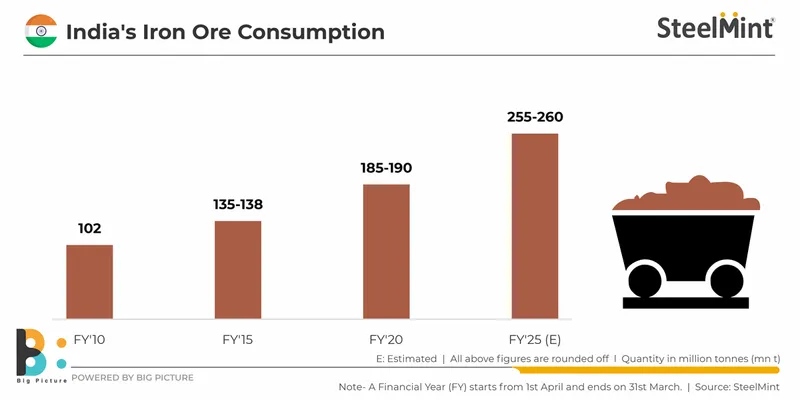
    India’s iron ore consumption is slated to increase to 255-260 million tonnes (mnt) by financial year 2024-25 (FY25), as per a SteelMint forecast. In FY2019-20 (FY20), iron ore consumption was at around 185-190 mnt. This indicates that the jump in FY25 compared to FY20 would be over 35%.

    India’s iron ore consumption has been steadily rising over the last decade, on the back of increased crude steel and sponge iron production. In FY15, iron ore consumption increased to around 138 mnt from 102 mnt in FY10.

    Factors that will support increased iron ore consumption

    The two key drivers of iron ore demand in India will be increased hot metal and sponge iron production.

    Increased steel capacity in coming years: This will come in largely in the form of hot metal production through the blast furnace route. India is the second-largest steel producer, after China. Its steel manufacturers are in various stages of capacity expansion.
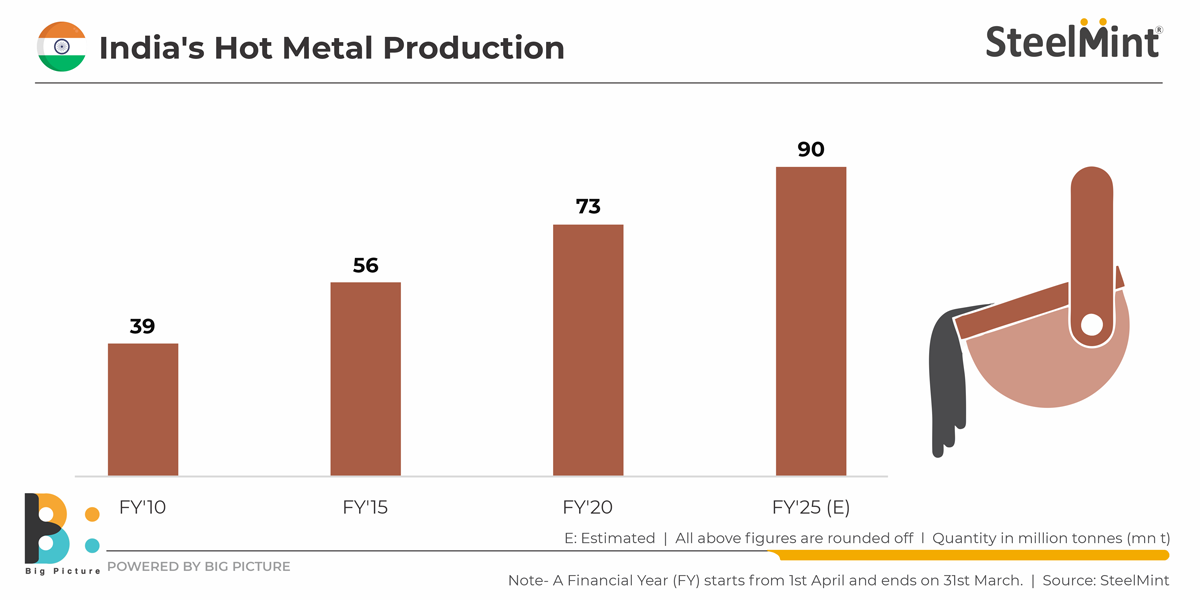
     

    Resultantly, India’s hot metal production, as estimated by SteelMint, will increase to 90 mnt by FY25 from 73 mnt in FY20.

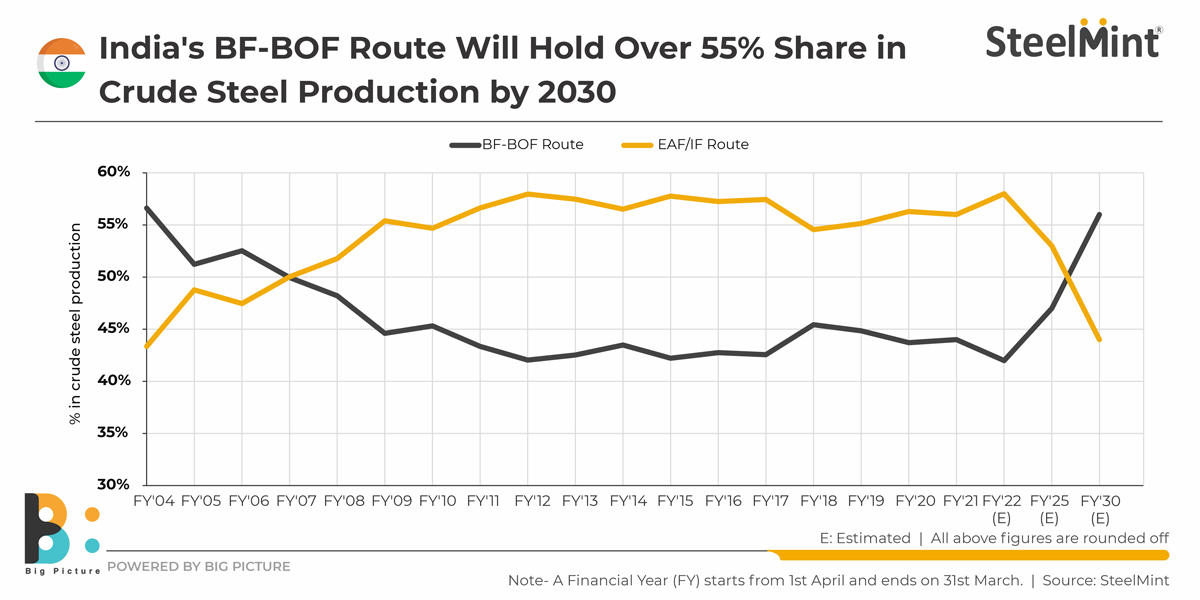
    Currently, India’s installed crude steel-making capacity is at 167.22 mnt, in which the share of the BF-BOF route is 70.23 mnt (42%) and EAF/IF route is 96.99 mnt (58%). However, SteelMint estimates that by FY25, the total crude steel capacity will rise to an estimated 206.04 mnt. In this, the share of BF-BOF will rise to 96.85 mnt or 47% and EAF/IF to 109.19 mnt (a drop to 53%).
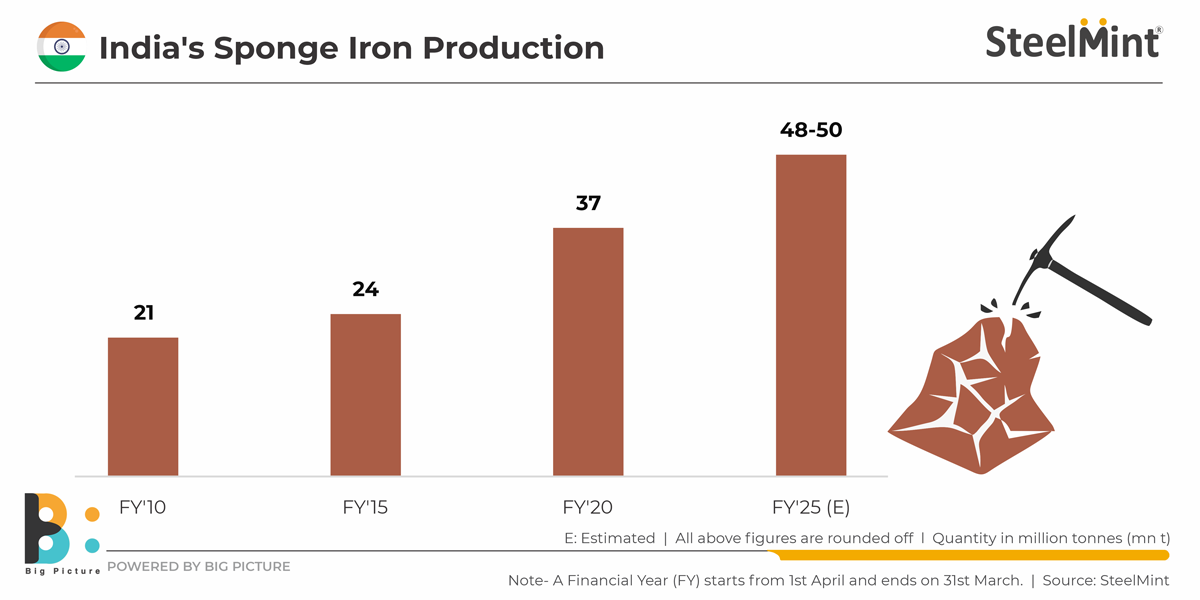
    Expected increase in sponge iron production: The country’s sponge production is also expected to increase over the next few years and by FY25 touch 48-50 mnt, although the segment is experiencing short-term hiccups, in the form of high thermal coal prices etc. However, looking at the long term, production is set to increase from 37 mnt seen in FY20.
     

    Iron ore production expansion plans

    Increased consumption would entail higher production. Where will the iron ore be sourced from? To feed the growing appetite from the steel mills, major miners have chalked out expansion plans. For instance, India’s largest merchant miner, NMDC, aims to expand production to 56-58 mnt by FY25 from the current 42 mnt. OMC, the second-largest merchant miner, will increase output to 38-40 mnt from its present 27 mnt.

    Reforms like dissolution of demarcations between merchant and captive blocks will allow any player (steelmaker or merchant miner) bagging a mine in future auctions to sell in the merchant market without any end-use restrictions. This will increase ore availability.

    Moreover, mills will be able to sell 50% of their mined output in a year in the open market from mines won in previous auctions (prior to the policy announcement dissolving captive-merchant bifurcation). The 50% can be sold after meeting the requirement of the attached plant subject to the payment of additional amount as prescribed under the sixth schedule of the MMDR Act.

    Primary steel manufacturers like SAIL, Tata Steel and JSW Steel are eyeing 38-40 mnt of iron ore production each by FY25. SAIL is currently producing 34 mnt, and Tata Steel and JSW Steel, 31 mnt each. Thus, total iron production from the five key producers may increase from the present 165 mnt to 208-218 mnt by FY25.

    India’s total iron production is expected to grow to 300-310 mnt by FY’25 from 246 mnt in FY20.

    Outlook

    Thanks to new mining policy reforms, which aim to facilitate production, India seems well-placed to meet its iron ore demand in the next few years from domestic resources and will not be dependent on imports.

    An increased number of pellet plants are in the pipeline since end-users want to avoid sinter as a feedstock. The former yields higher productivity and consumes less coal compared to sinter, which means lower carbon footprint. This will support higher iron ore consumption, going forward.

    If the recently imposed export duties on iron ore and pellets remain, then overseas sales will be impacted. If the same is removed or rationalized, then exports can be expected to spring back to previous levels of 15-20 mnt per annum.

  • India: Karnataka iron ore sales drop to over 2-year low in June. What to expect next?

    India: Karnataka iron ore sales drop to over 2-year low in June. What to expect next?

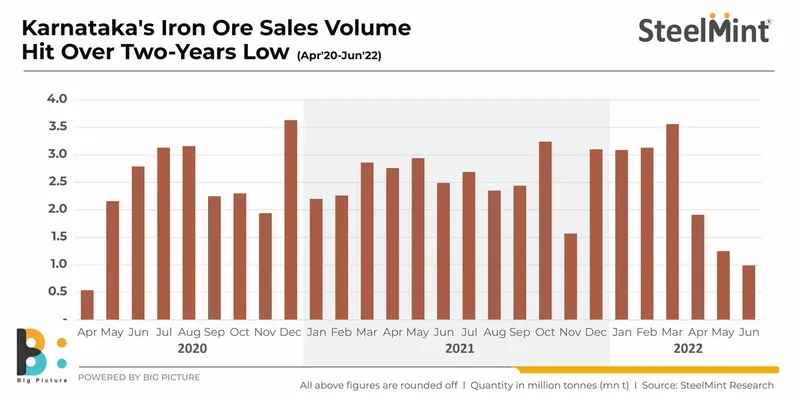
    Iron ore sales in Karnataka dropped to their lowest level in over two years to a little under 1 million tonne (mnt) in June 2022 due largely to the confusion surrounding sales and dispatches following the Supreme Court’s verdict in late May that lifted curbs on exports as well as restrictions on sales of iron ore that had been in place for over a decade.

    Sales drop sharply

    SteelMint provisional data reveal that sales plummeted to just under 1 mnt in June – a drop of over 20% from 1.25 mnt in May. Compared to April, moreover, sales at auctions edged lower by nearly 50%.

    State-controlled NMDC was the leading seller at auctions in June with a share of roughly 75% of the total volumes sold, followed by Vedanta at around 12% and the Karnataka State Mineral Corporation Ltd. (KSMCL) at 11%.

    It needs to be mentioned that NMDC’s sales from the Donimalai mine comprised around 55% of total sales in Karnataka auctions in May, while the Kumaraswamy mine accounted for roughly 20% of total sales.

    While a majority of miners chose the tried-and-tested MSTC platform for auctions, a few others resorted to direct contract/spot sales of iron ore. However, the volume of direct sales was assessed at roughly less than 1/10th of sales via auctions.

    JSW Steel was the leading buyer accounting for a lion’s share of 55% of total sales in e-auctions, followed by BMM Ispat at 7%. Kalyani Steel Ltd. and Mukand Ltd. had a share of 5% each in total sales.

    Uncertainty grips market

    The Supreme Court on 20 May lifted curbs on exports of iron ore from Karnataka and eased all restrictions on sales from the districts of Bellary, Chitradurga and Tumkur where mining activity had been prohibited following environmental violations in 2011.

    Setting aside its 2011 order of direct disposal of the accumulated iron ore through the process of e-auction conducted by the Central Enforcing Agency (CEC)-appointed Monitoring Committee, the apex court ruled that direct contract sales and/or spot sales would henceforth be allowed.

    However, despite the court order, and prior to the issuance of the interim guidelines by the state government, market participants were unsure of the modalities of iron ore evacuation and dispatch, which resulted in a deadlock situation where the mineral for which confirmed orders had been received and advance payments made was not allowed to be lifted for want of requisite permission from the state government.

    SteelMint reported that Vedanta, NMDC and KSMCL had conducted auctions via MSTC post the SC order, while a few private miners had commenced direct sales. However, volumes remained low as well as buying interest in auctions – partly due to the prevailing gloomy steel outlook and, in some measure, because of the relatively lower grades being offered.

    The apex court had lifted the five-year-old ceiling on production from 30 mnt to 35 mnt for A and B category mines in 2018. So, there is still a cap on total production in the state, although subject to judicial review.

    Amidst iron ore shortage, pellet prices in Bellary remain supported compared to other regions in central and eastern India. Iron ore pellet (Fe 63%) prices in Bellary moved up to INR 9,800/t exw as assessed on 08 July as against INR 9,400/t on 5 July, as per SteelMint assessment. Prices have hit over a month-high since end-May’22.

    Outlook

    The Karnataka government has issued guidelines that allow miners now both to sell iron ore through direct contracts/spot sales as well as e-commerce platforms such as MSTC. Further guidelines on disposal of old stocks mined prior to 2011 and stocks at expired leases and cancelled stockyards will be issued shortly.

    Therefore, clarity regarding dispatches of old stocks as well as freshly-mined ore is slowly emerging that is likely to lift the uncertainty that affected production and sales in Karnataka. Also, amidst rising pellet prices, interest in iron ore auctions has seen a gradual recovery of late.

    Therefore, SteelMint expects sales in the state to witness steady growth in July.

    Join us in our event, to know more about Karnataka iron ore production & demand outlook

    SteelMint Events will be hosting the 5th Indian Iron Ore & Pellet Summit on 3-4 August, 2022 at The Lalit, New Delhi. The conference will discuss key issues being faced by the iron ore and pellets industry in India. The focus will be on market dynamics, policy-related changes, growth challenges and enablers, sustainability and decarbonisation goals, the way forward and many more talk points.

  • Role of Pellet Industry in achieving the target of 300 MT of Steel Production by 2030

    Role of Pellet Industry in achieving the target of 300 MT of Steel Production by 2030

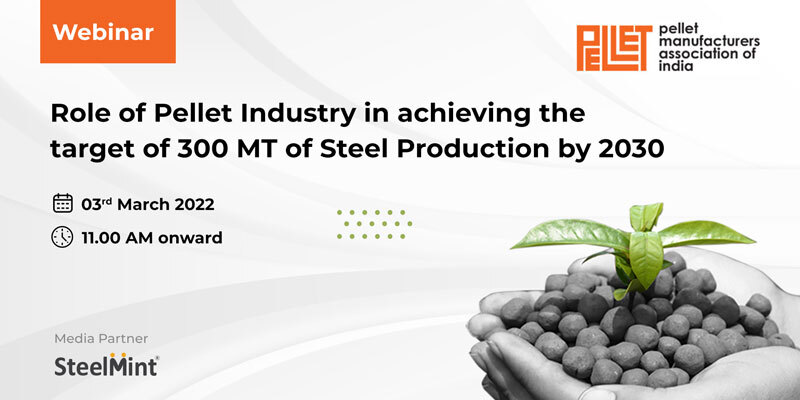
    PMAI is organizing a webinar on ‘Role of Pellet Industry in achieving the target of 300 MT by 2030’ on Thursday 3 March 2022 from 11.00 AM onward .

    Smt Rasika Chaube, Additional Secretary, Ministry of Steel will be giving the keynote address.

    Captains of India’s steel industry and experts in the area of pelletisation and beneficiation will share their experience on the technological aspects . In order to give an insight into the Policy aspects of pellets industry, senior Govt officials from department of steel, mines, and NITI Aayog will join in the panel discussions.

    Register button