SteelMint Events

Author: SteelMintEvents

  • Analysis: Sponge iron producers switch to alternate coal blends amid shrinking margins, resilient import prices

    Analysis: Sponge iron producers switch to alternate coal blends amid shrinking margins, resilient import prices

    Depressed sponge iron demand in the Indian domestic market, coupled with elevated South African coal prices and limited availability of domestic coal for the non-power sector, has compelled Indian DRI producers to experiment with coal from Mozambique, Russia, and even Australia.

    In fact, diversion of high-grade South African coal to Europe have already pushed sponge iron units in India to switch from the most popular RB2 (5500 kcal/kg NAR) grade coal from the country to low-CV RB3 (4800 kcal/kg NAR) since the past few months.

    As 4800 NAR has lower fixed carbon content vis-a-vis 5500 NAR, a higher quantity of the former is required to produce one tonne of DRI.
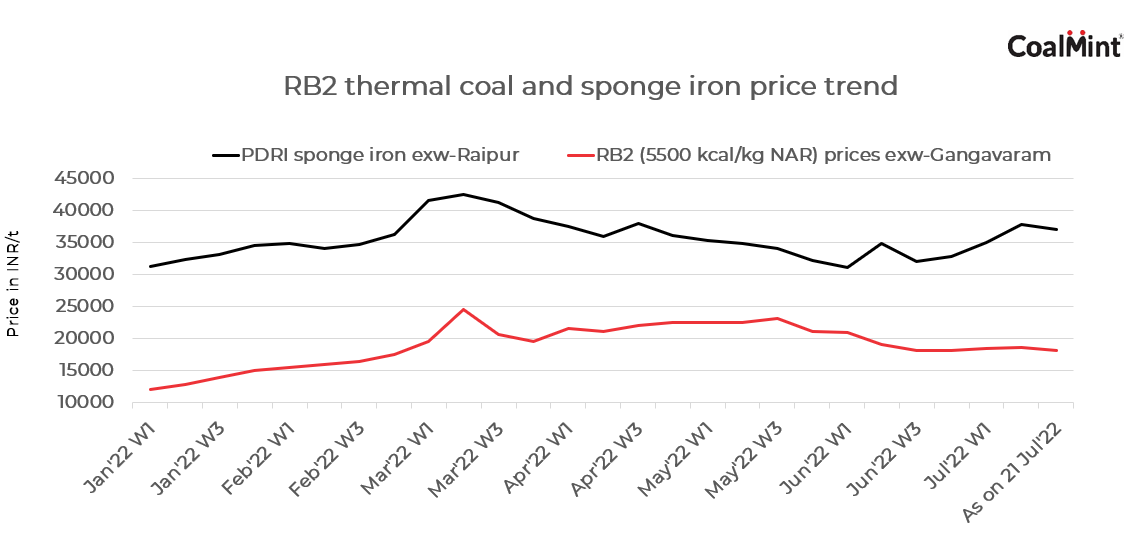
    Shrinking margins of DRI producers due to high South African coal prices have compelled them to look for alternate blends. Although sponge iron prices have picked up since the sharp decline following the government’s introduction of an export duty on steel, any major fall in coal prices has remained limited due to elevated global prices.

    CoalMint learnt from various mill sources that DRI producers are experimenting with various blends of Russian, Mozambican and Australian coal; any blend that fits the bill should have to be one that helps manufacturers tide over sluggish domestic demand and optimise costs of production that have more than doubled in one year.

    Mozambican coal: Steelmaker JSPL, after some initial experiments, has come up with certain findings pertaining to Mozambican VT 1 grade coal (from Vulcan Energy), which is a suitable alternative to South African RB2. About 0.8 t of this coal will be required to produce 1 tonne of sponge iron.

    However, some sponge iron producers in Chhattisgarh informed that while Mozambican coal seems a suitable alternative for DRI, it is low in volatile matter as compared to South African coal, which fails to make it an exact replacement for the latter. In fact, a blend of the two might give sponge iron units the desired results, sources informed. Very low-VM coal affects sponge metallisation rate.

    Russian coal: High-CV Russian thermal coal that is making its way to India at quite cheaper rates has also attracted the attention of sponge iron manufacturers. Although not used widely, experiments by a few indicate that it has South African RB1 grade coal qualities and its good FC and low sulphur content would make it an ideal choice for sponge producers. However, users are not very sure of the exact results and are of the opinion that a blend of South African and Russian coals could give desired outcomes.

    Australian coal: Interestingly, Australian thermal coal, not usually preferred by sponge iron plants because of its very high VM, is now being experimented with by few sponge iron units in south India as they are completely import-dependent.

    While Australian thermal coal is not coming into India in huge volumes since the past few months, a reputed importer, having its own mine in Australia, is heard to be bringing 4400-4600 NAR grade coal with low VM and FC, which is being used in a ratio of 70:30 (5500 NAR S. African: 4600 NAR Australian) for one tonne of sponge iron.

    Concerns persist

    While various blends are a ray of hope for the sponge iron sector, market participants have also highlighted a key concern that these blends make sense against the backdrop of sluggish demand in which plants do not have to function at full capacity and lower yield is expected.

    However, it would be interesting to see if any of these coals or blends can give higher yields during a period of buoyant demand. If successful, this could be a game changer for the sector as better realisations coupled with lower cost of production would help producers improve margins in the long run.

  • SteelMint analysis: Bangladesh likely to improve scrap imports to raise steel melting capacity by 2025

    SteelMint analysis: Bangladesh likely to improve scrap imports to raise steel melting capacity by 2025

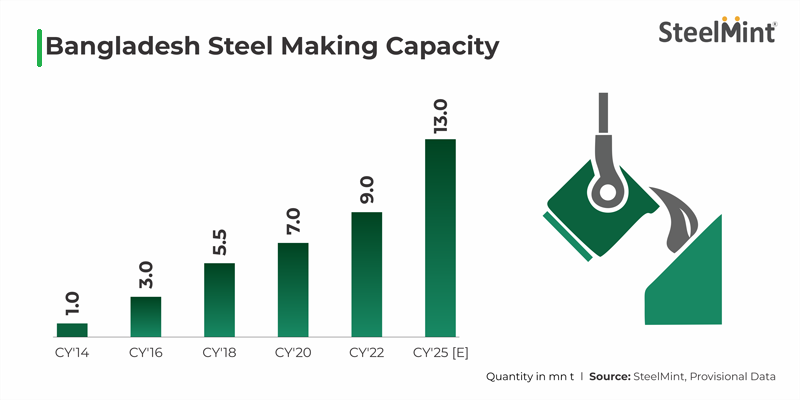
    • Bangladesh set to increase steel melting capacity around 13 mnt by 2025
    • BSRM, AKS, GPH and many other mills are setting up additional capacity
    • Bashundhara, Meghan & Akij entering steel business

    Bangladesh, one of the largest ferrous scrap importers in South Asia, is likely to witness an increase in steel melting capacities from 9 million tonnes (mnt) per annum currently to around 13 mnt by 2025 due to the growing demand for steel, cement, power and upcoming infra projects.

    Renowned steel producers in Bangladesh like BSRM, AKS, GPH, and many other mills are setting up additional capacity and facilities to cater to government-funded infrastructure projects in the coming years.

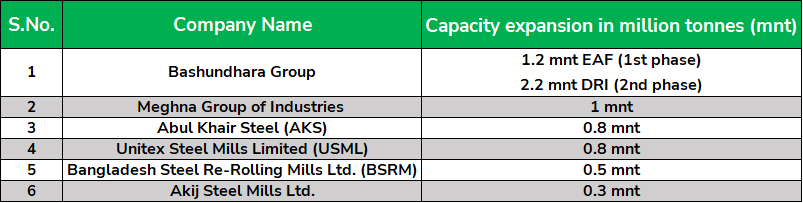
    Bashundhara Group is expanding its capacity to 1.2 mnt (EAF) in the 1st phase and 2.2 mnt (DRI) in the 2nd phase; Meghna by 1 mnt (EAF); AKS and Unitex by 800,000 t; BSRM by 500,000 t; and Akij by 300,000 t.

    Why is Bangladesh an emerging economy?

    • GDP growth rate: The economy of Bangladesh has a projected GDP growth rate of 6.4% for FY’23 as an emerging and fastest growing economy after India in South Asia.
    • Increasing steel demand for govt-funded projects: Steel demand in Bangladesh may remained supported mainly due to the government-funded infrastructure projects which were launched to stimulate the economy hit by COVID-19. Projects such as the Ashrayan Project, Metro Rail, Karnafuli Tunnel and elevated expressway from Dhaka Airport to Kutubkhali are expected to boost infrastructure construction. Hence, scrap demand is also likely to remain supported this year as well as in 2023.
    • Development of port facilities: Due to inadequate port facilities in the country, large ships were unable to enter Chittagong port. However, the Bangladeshi government has started working on projects such as the Matarbari Deep Seaport, which is estimated to be completed by 2026. Once these projected ports are completed, steel manufacturers will be able to import scrap more easily, which will ultimately speed up their production.

    Expert opinion

    Over the past five years, Bangladesh has become an integral part of the ferrous scrap trade in the South Asian region. As new steel capacities come onstream, scrap suppliers are looking forward to continuing the close relationship with the country in the years ahead,” stated Zain Nathani, Director, Nathani Group of Companies, India.

    Sanjoy Ghosh, Head of Supply Chain, BSRM, said: “Steel industries in Bangladesh are entering into a new phase amid higher demand forecast in line with projected economic growth. Despite the current global economic turmoil, all major plants are into enhancing their capacity and also new plants are trying to create a footprint in the market in order to cater to future demand. So, it is challenging time ahead for entire steel industry.”

    Scrap import scenario

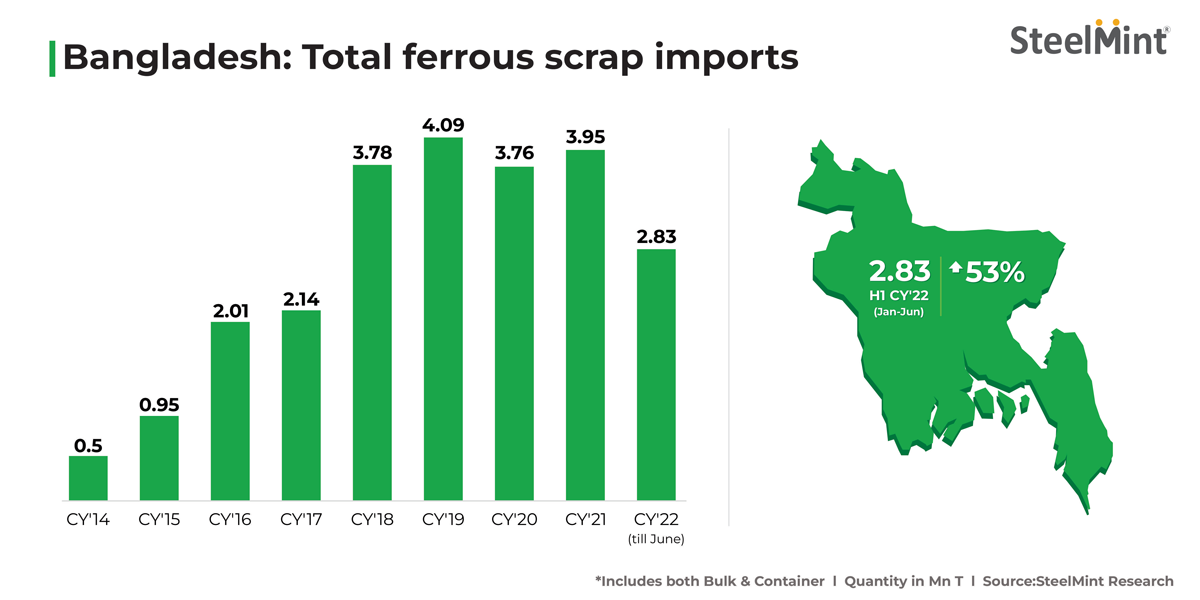
    Bangladesh is a country which is entirely dependent on scrap for steelmaking. The volume of imported ferrous scrap (both bulk and container) into Bangladesh stood at 2.83 million tonnes (mnt), up 53% in the first half (H1) of 2022 as against 1.85 mnt seen in the same period in 2021.


    Bangladesh: Total ferrous scarp imports

    As Bangladesh is eying over 6% GDP growth in the current year, the South Asian nation is making a concerted effort to spearhead infrastructure spending, which is expected to increase steel consumption going forward. However, it will be interesting to see if demand remains supportive against the backdrop of rising steel capacity.

    Join our event to know more on whether Bangladesh’ scrap imports will touch 6 mnt by 2025.

    SteelMint Events will be hosting the 3rd Steel & Raw Material Conference, Emerging Bangladesh on 20-21 September, 2022 at Hotel Radisson Blu, Chittagong, Bangladesh. The conference will explore key issues like the country’s steel production and demand outlook, global scrap trade flow changes, especially post-the Russia-Ukraine war, the ship recycling scenario, key emerging sectors, price trends and a lot more.

  • India’s iron ore consumption expected to reach 255-260 mnt by FY25: SteelMint analysis

    India’s iron ore consumption expected to reach 255-260 mnt by FY25: SteelMint analysis

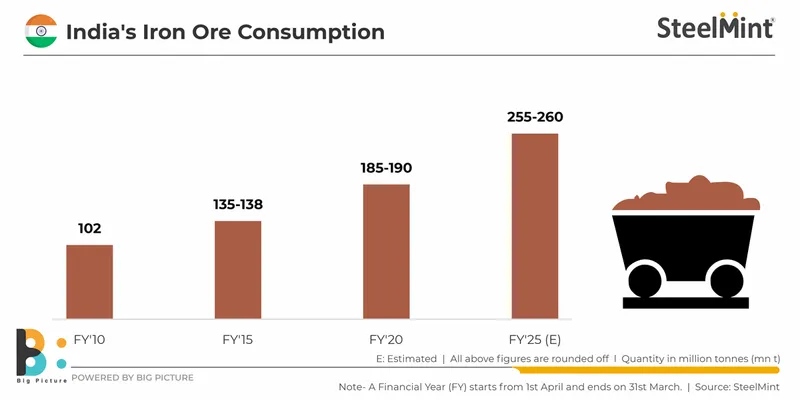
    India’s iron ore consumption is slated to increase to 255-260 million tonnes (mnt) by financial year 2024-25 (FY25), as per a SteelMint forecast. In FY2019-20 (FY20), iron ore consumption was at around 185-190 mnt. This indicates that the jump in FY25 compared to FY20 would be over 35%.

    India’s iron ore consumption has been steadily rising over the last decade, on the back of increased crude steel and sponge iron production. In FY15, iron ore consumption increased to around 138 mnt from 102 mnt in FY10.

    Factors that will support increased iron ore consumption

    The two key drivers of iron ore demand in India will be increased hot metal and sponge iron production.

    Increased steel capacity in coming years: This will come in largely in the form of hot metal production through the blast furnace route. India is the second-largest steel producer, after China. Its steel manufacturers are in various stages of capacity expansion.


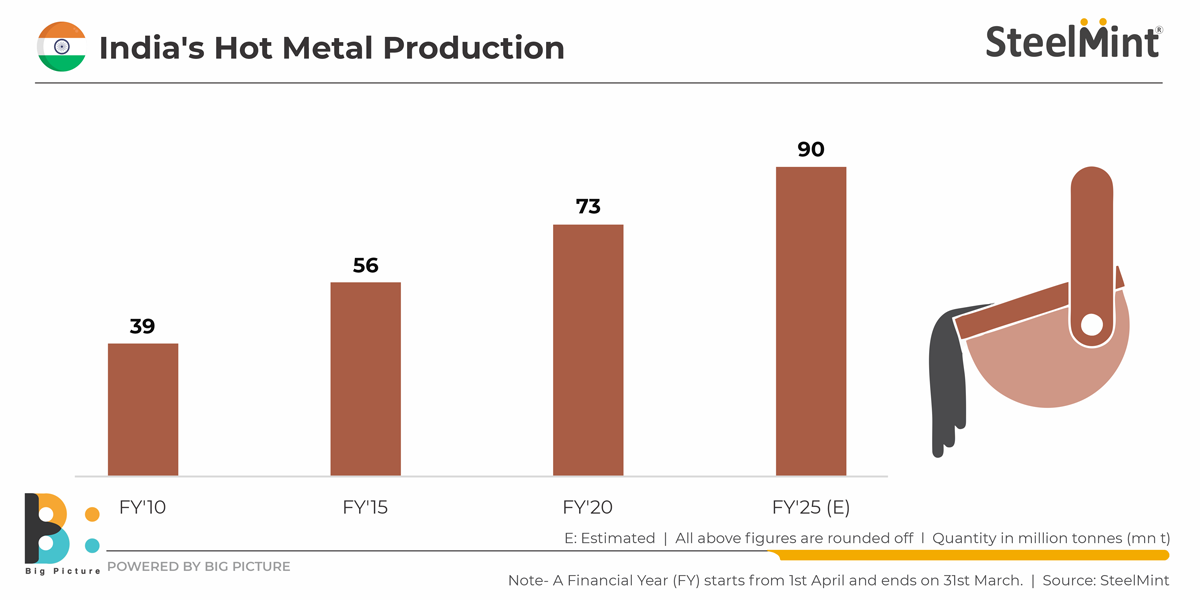
    Resultantly, India’s hot metal production, as estimated by SteelMint, will increase to 90 mnt by FY25 from 73 mnt in FY20.

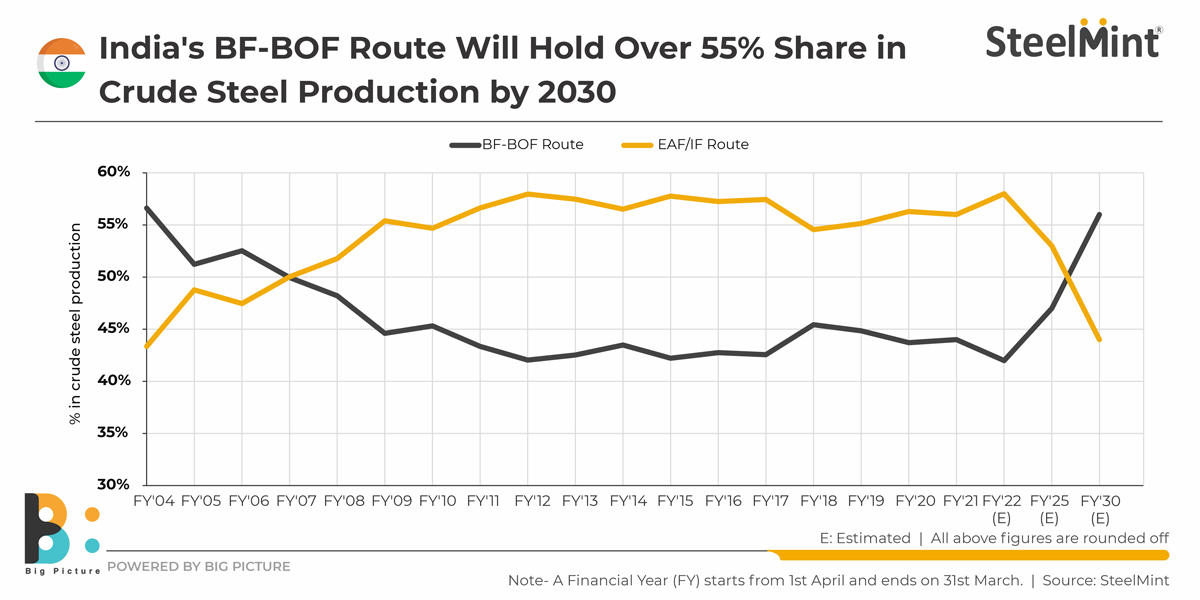
    Currently, India’s installed crude steel-making capacity is at 167.22 mnt, in which the share of the BF-BOF route is 70.23 mnt (42%) and EAF/IF route is 96.99 mnt (58%). However, SteelMint estimates that by FY25, the total crude steel capacity will rise to an estimated 206.04 mnt. In this, the share of BF-BOF will rise to 96.85 mnt or 47% and EAF/IF to 109.19 mnt (a drop to 53%).

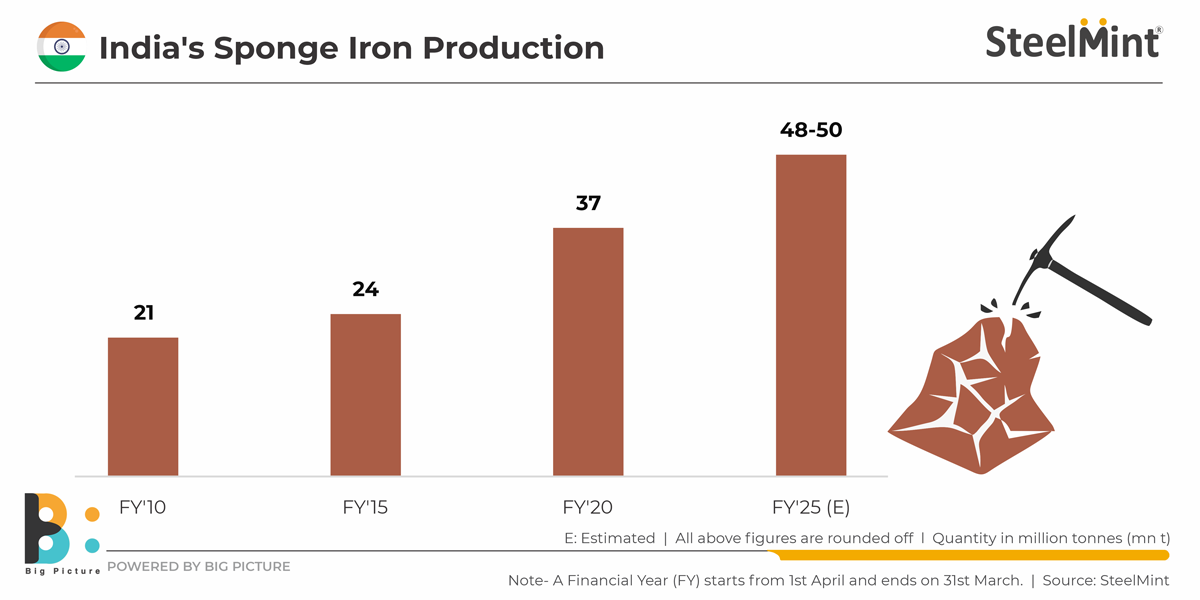
    Expected increase in sponge iron production: The country’s sponge production is also expected to increase over the next few years and by FY25 touch 48-50 mnt, although the segment is experiencing short-term hiccups, in the form of high thermal coal prices etc. However, looking at the long term, production is set to increase from 37 mnt seen in FY20.


    Iron ore production expansion plans

    Increased consumption would entail higher production. Where will the iron ore be sourced from? To feed the growing appetite from the steel mills, major miners have chalked out expansion plans. For instance, India’s largest merchant miner, NMDC, aims to expand production to 56-58 mnt by FY25 from the current 42 mnt. OMC, the second-largest merchant miner, will increase output to 38-40 mnt from its present 27 mnt.

    Reforms like dissolution of demarcations between merchant and captive blocks will allow any player (steelmaker or merchant miner) bagging a mine in future auctions to sell in the merchant market without any end-use restrictions. This will increase ore availability.

    Moreover, mills will be able to sell 50% of their mined output in a year in the open market from mines won in previous auctions (prior to the policy announcement dissolving captive-merchant bifurcation). The 50% can be sold after meeting the requirement of the attached plant subject to the payment of additional amount as prescribed under the sixth schedule of the MMDR Act.

    Primary steel manufacturers like SAIL, Tata Steel and JSW Steel are eyeing 38-40 mnt of iron ore production each by FY25. SAIL is currently producing 34 mnt, and Tata Steel and JSW Steel, 31 mnt each. Thus, total iron production from the five key producers may increase from the present 165 mnt to 208-218 mnt by FY25.

    India’s total iron production is expected to grow to 300-310 mnt by FY’25 from 246 mnt in FY20.

    Outlook

    Thanks to new mining policy reforms, which aim to facilitate production, India seems well-placed to meet its iron ore demand in the next few years from domestic resources and will not be dependent on imports.

    An increased number of pellet plants are in the pipeline since end-users want to avoid sinter as a feedstock. The former yields higher productivity and consumes less coal compared to sinter, which means lower carbon footprint. This will support higher iron ore consumption, going forward.

    If the recently imposed export duties on iron ore and pellets remain, then overseas sales will be impacted. If the same is removed or rationalized, then exports can be expected to spring back to previous levels of 15-20 mnt per annum.

  • Russian coal finds new home in China, India as Europe cuts off trade

    Russian coal finds new home in China, India as Europe cuts off trade

    • Exports to India rise to 6 mnt in first six months of 2022
    • Logistical hurdles may force Russian miners to cut production
    • Recent RBI policy to facilitate coal trade with Russia

    Four months have slipped past since Russia invaded Ukraine and the NATO countries slapped sanctions on Russia, thereby directly hurting the country’s export prospects. In the meantime, however, coal exports from Russia have increased manifold.

    Russian coal exports totalled a whopping 108.7 million tonnes (mnt) in the first six months of the year, up 4% on a year-over-year basis, as per data gleaned by CoalMint from various sources.

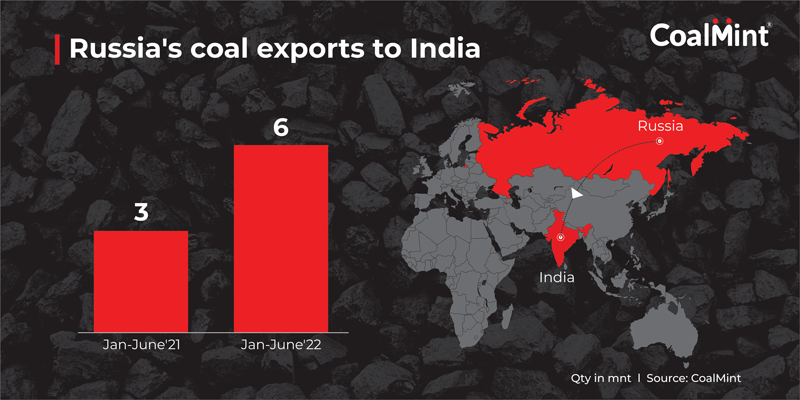
    Shipments to India have risen to 6 mnt in the first six months of the year, as agaisnt 3.1 mnt during Jan-June’21, CoalMint data bear out.

    Russian coal exports during January-June this year have largely been indicative of a shift in global trade flows, as the loss of markets in Europe and Japan was more than offset by increased purchases by Indian and Turkish buyers.

    Despite a steady decline in Russian coal exports to Europe following the sanctions, shipments to major Asian markets are seen rising going ahead as buyers bet big on high-CV coal from Russia, which comes at a discount vis-?-vis other origins.

    Buyers of Russian coal

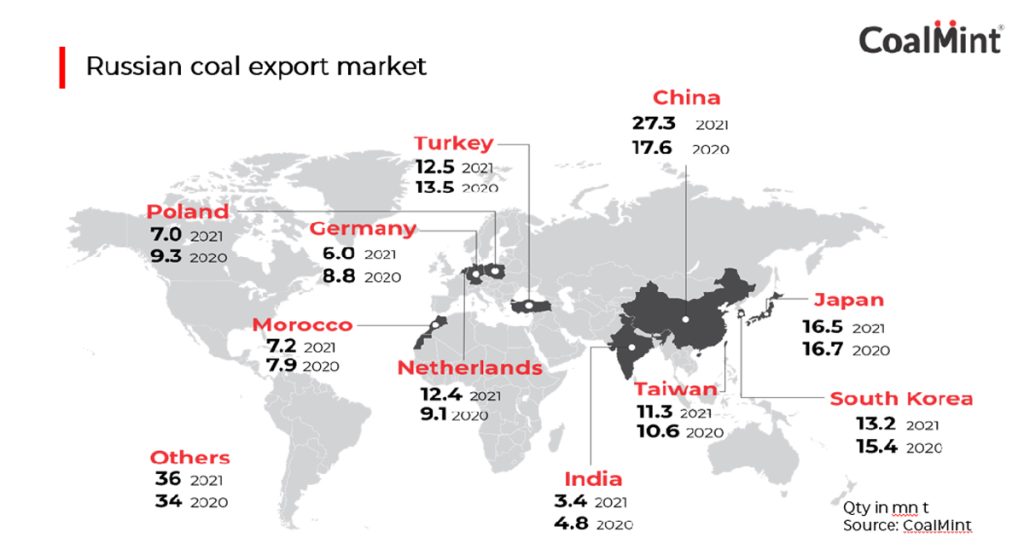
    Among the major countries showing interest in Russian coal, China tops the list. Russia exported 44 mnt of coal to China in 2021, making up 21% of its total export of the fuel, customs data show.

    Despite record-high coal output in China this year, Russian deliveries have increased significantly as Chinese buyers have snapped up discounted fuel ahead of anticipated strong demand in summer.

    India, the world’s second-leading coal importer, is also Russia’s best hope in the Asian market, as the Indian government has refrained from condemning the attack on Ukraine and remains open about securing cheaper energy supplies from Russia.

    Despite just a 3% share for the Indian market in 2021 from Russia’s total exports, shipments to India have risen to 6 mnt during Jan-Jun’22 and continues to rise, CoalMint data bear out.

    To Vietnam, Russia delivered a total of 4 mnt of coal last year; the emerging South East Asian steel powerhouse accounted for 10% of Russia’s coal exports.

    Turkey is also emerging as a major buyer of Russian coal going ahead, with reports of it having increased shipments from February this year.

    Several small buyers such as Pakistan and Bangladesh are also inclined towards Russian coal. However, weak economic conditions and investors pulling out funds from coal projects hinder buying appetite.

    New routes for exports to India

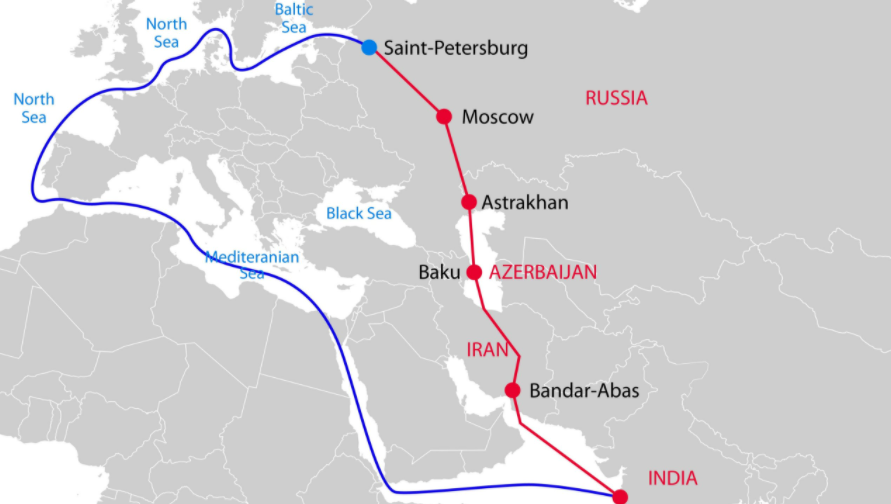
    To cater to India’s coal demand, Russian companies have launched regular chartered ships to India to ensure uninterrupted supply. Both countries are in talks to revive the Vladivostok-Chennai shipping corridor as part of a partnership in the Indo-Pacific region.

    Russian consignments via Iran are making their way to Indian ports, following the operationalisation of the International North South Transport Corridor (INSTC). Indian authorities have urged Iran to facilitate regular use of the 7,200-km long INSTC.

    Despite higher freight costs between Russia and India, coal transportation is unlikely to be a hurdle given the attractive prices, an expert informed CoalMint.

    Elevated prices of traditional coal imports from South Africa and Australia are likely to make way for Russian shipments.

    While the cement and power sectors prefer buying Russian coal, several other coal-consuming sectors such as the sponge iron industry in India are experimenting with Russian coal, and assessing its impact on productive volumes, the expert added.

    Coal production

    Coal output in Russia continues to remain strong amid resilient demand from the new markets in Asia.
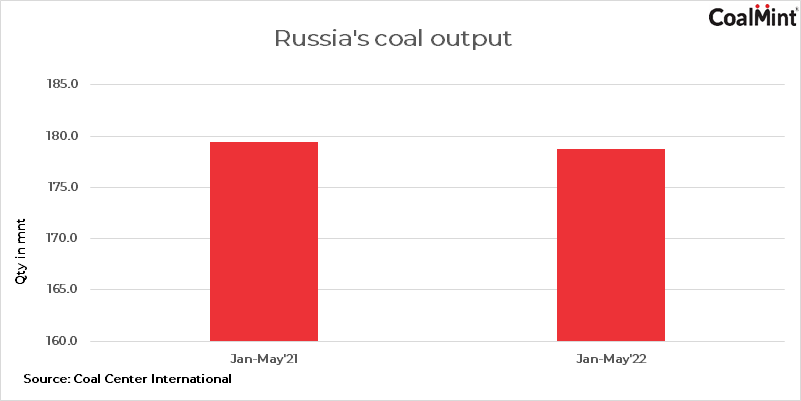
    As per data from Coal Center International, a Russian weekly, coal output in the country fell slightly by 0.4% on a y-o-y basis to 179 mnt during Jan-May 2022.

    A major fall in output that was largely anticipated this year with the loss of markets in Europe was more than compensated by elevated global prices, wherein it was possible to offer discounts without impacting margins of Russian miners, CoalMint learnt from sources.

    Large-scale safety checks at underground and open-pit mines after the explosion at Listvyazhnaya mine (SDS) led to operations being suspended at more than 20 mines since January this year.

    Dispatch scenario

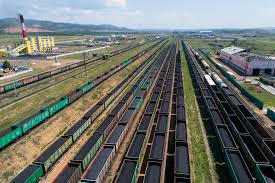
    Coal transportation via the Russian railways, on the other hand, remains steady. However, the exodus of European investors from Russian port and rail development projects is an ominous sign.

    Apart from the limited throughput capacity of the eastern range of the railways, coal suppliers are also facing difficulty in redirecting all unclaimed volumes from the north-western terminals to the far eastern ports, which may likely force a number of mining companies to cut coal production in H2 2022.

    Issues with Baikal-Amur Mainline (BAM) and the TransSiberian Railway (TSR) have been a key factor hindering the growth of transshipment volumes to the far eastern ports.

    Russian news agency Interfax reported recently, citing the energy ministry, that the country’s coal production in 2022 could fall 17%, y-o-y, to 365.1 mnt, while exports could decrease 30% to 156 mnt.

    Demand prospects in H2

    Russia, the world’s third-largest coal exporter, is trying to carve out a market share, as elevated coal prices delivered from other origins make Russian coal an attractive option for Asian countries confronting a supply squeeze, particularly India.

    To know more about the Russian coal market and its changing course of trade dynamics for the second half of the year join us at India Coal Outlook Conference. CoalMint will be hosting the India Coal Outlook Conference on 3-4 August 2022 at The Lalit, New Delhi, to discuss the key issues pertaining to domestic coal production and supply, the government’s objective of controlling imports and domestic supply gap affecting many industries, the need to increase the purchasing power of Indian steel companies in the volatile global coking coal market as well as issues related to decarbonization of the coal value chain.

  • Steel prices observe 15% correction globally. How will they pan out in August?

    Steel prices observe 15% correction globally. How will they pan out in August?

    Steel mills across the globe are staring down a desert land of dried-up demand, as the Russia-fuelled war rages on in Ukraine. Prices of gas, which power households and factories across the European Union, have surged 700% till date, as per reports, putting the entire Continent and other parts of the world in an uncomfortable inflationary grip which has also decimated steel demand.

    Rebar demand weaker than flats
    While global demand for long steel is weak, especially in China, which cracked down on its real estate market post-the Evergrande collapse, the EU is seeing some light at the end of the tunnel for flats. As per some reports, prices of domestic hot rolled coils inched up on 12 July as buyers are slowly eyeing restocking amid widespread output cuts by mills. Demand is not exactly hunky-dory but Northern Europe buyers are expected to resume restocking for September from end-July.

    But rebar is not so lucky. Buyers are holding back, waiting for prices to drop further. The market is characterized by wide gaps in bids and offers and muted trade.

    In China, rebar dropped below RMB 4,000/t in a long time, on the Shanghai Futures Exchange.

    Traditionally, July and August are challenging months from the demand standpoint, putting mills globally on the backfoot all the more in terms of raising prices.

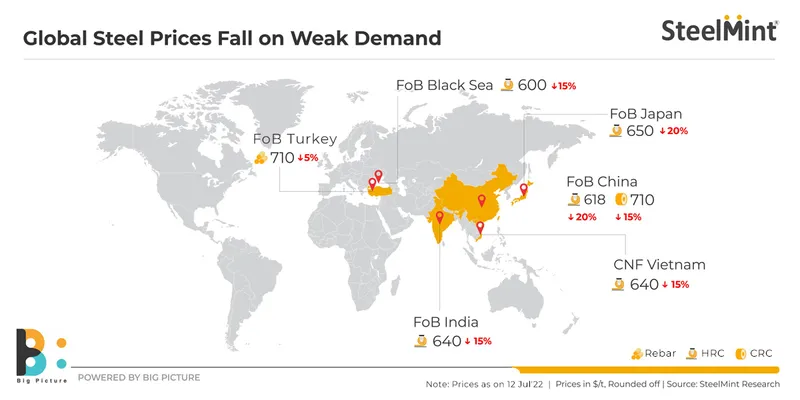
    In fact, data maintained with SteelMint reveals that in just a single month, HRC prices globally have fallen by 15-20%. As on 12 July, 2022, China’s HRC FoB prices have lost 20% m-o-m to $618/t and CRCs by 15% to $710/t. Black Sea HRC FoB prices declined 15% to as low as $600/t, while in Japan, these dropped 20% to $650/t FoB. Vietnam imports and India exports both lost ground 15% to $640/t. In rebar, Turkey’s prices on 12 July were down 5% to $710/t.

    Factors influencing current global steel scenario

    Inflationary pressures in the EU: There is a high risk of recession, especially in the West and governments there are keen to reign in the same through measures such as capping of monetary supply and raising interest rates. But, in a vicious cycle, this will definitely have a fallout on demand, globally.

    The euro’s value has been eroding for months and at the time of writing this story, it was equal to the US currency. A year back, it was at 1.20 to the dollar against 1.13 more recently.

    Two factors are weakening the euro. Rising EU inflation and the US’ comparative insulation from the war. Inflation in the EU has averaged 8.6% in June on the back of spiralling energy prices. On the other hand, with the US somewhat immune to the volatility in oil and gas markets given its own oil reserves and alternate energy sources, the dollar has fared better. The US Federal Reserve has also been raising interest rates for months, making dollar denominated investments safer at present, allowing it to appreciate.

    Meanwhile, the European Central Bank is in a catch-22 situation. The soaring inflation merits increase in interest rates but may just dry up demand in an already beleaguered economy. Being a major consuming region, if demand from the Continent falls, there will be far-reaching ramifications. Possibly, after Ukraine, the EU has been hit the most, economically, by the war.

    Energy crisis looming in Q4? There are fears of a probable energy crisis in Q4. In fact, as per reports, demand has rebounded in Europe in the face of such fears. Among the goods that cannot be imported from Russia into the EU include crude oil and refined petro goods, coal and other solid fossil fuels, iron and steel, amongst others. It may be noted that trade in some commodities like coal will come to a standstill from 10 August, 2022 while Russia’s Gazprom has cut off 60% of gas supply from its Nord Stream pipeline. Obviously, Europe is heavily dependent on Russian supplies and the actual impact will be felt from Q4 onwards although the region is already suffering from energy shortage and power plants are running helter-skelter to revive coal-fired utilities.

    The China factor: China, the largest producer and consumer of steel, is labouring under its own challenges. Covid, falling demand and prices and squeezed margins have the mills fighting with their back to the wall. The off-season is also not supportive of demand or prices. However, the silver lining is the policy measures that can kickstart an infrastructure boom in the second half which can translate into demand revival.

    Outlook
    Most mills globally are sitting on limited inventory because of the widespread production cuts on the back of the spiralling energy crisis and lack of demand.

    However, by end-August or first week of September, the inventory could get depleted, a scenario that will give elbow room for prices to head up globally.

    In addition, Russian mills are heard to have reduced their export volumes due to their very strong local currency. This could offer solace to steel exporting countries.

    So, have prices bottomed out as of now?

    What factors will drive steel prices in H2 2022?

    SteelMint Events is organising India Steel Conference with SUFI at Bombay Stock Exchange (BSE) Mumbai, on 25th Aug’22.