SteelMint Events

Author: SteelMintEvents

  • India: Imported Manganese Ore Prices Reach Over 4-Year High – Near-Term Outlook

    India: Imported Manganese Ore Prices Reach Over 4-Year High – Near-Term Outlook

    • Around 10% of 50 mnt of seaborne trade impacted
    • Global miners increase export offers for June shipments
    • Chinese demand surges but domestic supply remains tight
    • Weak import demand for Indian Mn alloys may cap prices

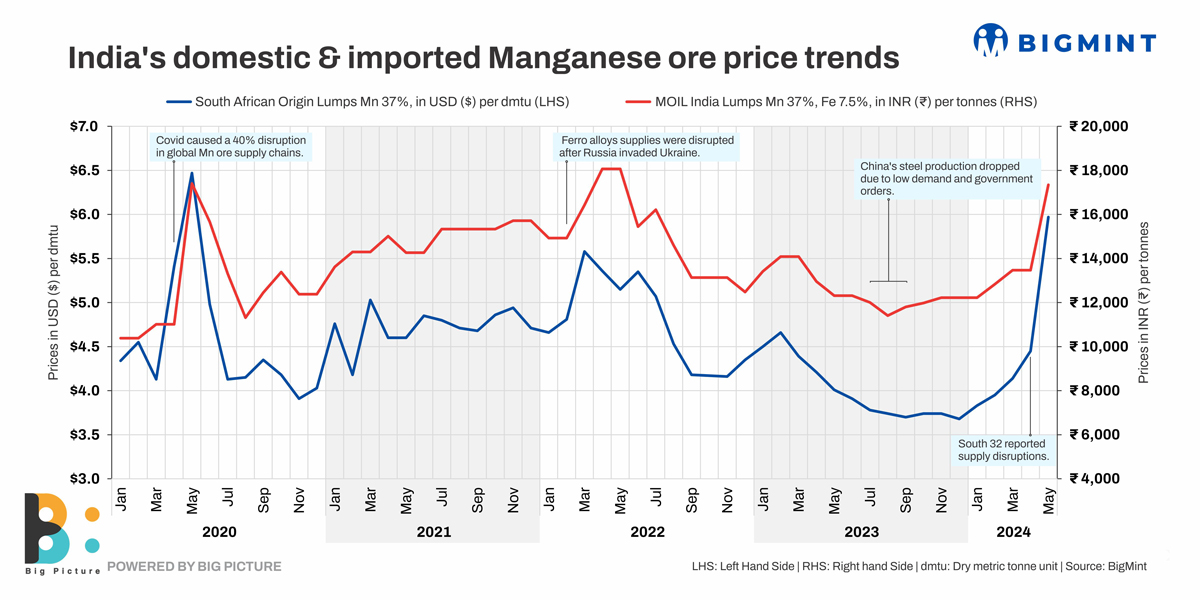
    Morning Brief: In a significant development, imported manganese ore prices hit over a 4-year high in May, 2024. The disruption mirrored a similar event in May 2020 and has significantly impacted the manganese ore market. Prices of manganese ore lumps (Mn 37%), CNF east coast, India, (South African-origin) were recorded at $6.4/dmtu last week, the highest since May 2020.

    Global miners like South32 Ltd and Eramet Comilog hiked their offers. South32, the world’s leading miner, has increased offers for its 37% grade South African manganese ore lumps by $2.2/dmtu to $6.50/dmtu CIF China for June shipments. Additionally, its 37% grade South African semi-carbonate lumps rose by $5.1/dmtu CIF China.

    Eramet Comilog, a leading manganese ore exporter based in Gabon, has announced its June shipment prices of manganese ore destined for China. The price of Gabonese lump ore with 44.5% manganese content increased significantly by $2/dmtu, to $6.90/dmtu CIF China. Limited mine supply, along with China’s reduction of stockpiles, have bolstered manganese ore prices. Moreover, India’s largest manganese ore miner, MOIL, raised offers. Prices of grades above 44% have witnessed a 40% growth m-o-m, while lumps below 44% have increased by 25% in May 2024.
    Supply disruptions have impacted about 10% (5 mnt) of the total seaborne trade of around 50 mnt, BigMint understands.

    Reasons behind price hike
    Cyclone disrupts operations at South32: Following tropical cyclone Megan’s structural damage to its terminal and other infrastructure at the mine, Groote Eylandt Mining Company (GEMCO) decided to cease production at its 6 million tonnes/year (mnt/y) mine. It may be noted here that 60% of GEMCO is owned by South32, with Anglo American holding the remaining 40% share. The miner withdrew its 3.4 mnt guidance for its portion of GEMCO’s production in the financial year ending 30 June, shortly after the hurricane made landfall. South32’s GEMCO output for the previous fiscal year was at 3.55 mnt.

    Derailment issue in Gabon: Gabon, the world’s second largest manganese ore mining country, experienced a derailment accident on 26 April, with nearly 300 metres of track damaged and 26 empty cars impacted. The repair time may take about two weeks to a month. With a monthly manganese ore transportation volume of over 5,00,000 tonnes (t) per month in Gabon and a long-term supply stoppage of South32 manganese ore, and if the repair time at Gabon’s transportation railway is too long, there may be further tension in manganese ore supplies. Complexities surrounding this issue also drove imported manganese ore prices higher.

    Return of Chinese mills post-holidays: The enthusiasm of Chinese enterprises for procurement has also increased manganese ore prices as they returned to the market after a series of holidays, starting with the Lunar Year in February and ending with Labour Day in May. However, the enthusiasm of manufacturers to replenish inventory has decreased. The increased demand has decreased the number of inventory days by more than 30% compared to the beginning of the year. In the past month, inventory in Ningxia and the southern production hub have slightly rebounded from absolute lows. The main reason behind the decreased inventory was the rise in demand amid tight supply of raw material (manganese ore) which had rendered major manganese ore producers temporarily out of operation. China is the largest buyer of manganese ore from Australia but supply was scant from here too as miners had rationalised production because of weather issues. And delayed shipments of high-grade manganese ore also created a panic situation forcing these Chinese smelters to increase import volumes from Gabon, and South Africa.

    Outlook
    South32 anticipates restarting export sales and wharf operations in Q3FY’25 (January-March 2025) based on their initial estimates. However, sources acknowledged challenges. “We are exploring alternative shipping options to mitigate the impact of the wharf outage. These options may create a limited export capacity for ore in the near future. This may drive prices higher,” said a company spokesperson.

    Samancor’s joint venture, on the other hand, is planning to resume mining at South32’s GEMCO unit in June post-suspending in March, aiming to build stockpiles before the 2024-2025 wet season. Recovery measures from March’s cyclone impact include de-watering and infrastructure repairs. Wharf operations and exports are set to recommence in Q3FY’25.

    Global miners expect prices to remain on the higher side for about a month. However, the outlook is mixed for the next couple of months. Factors that may weigh down prices include weak demand for Indian manganese alloys from traditional markets like the European Union (EU), Japan etc. This may lower exports and divert volumes in the domestic market which may cap the price hike.

    In addition, Indian steel demand may pick up in H2 which may boost manganese alloys demand, but in the short term no significant increase is expected. The manganese ore cargoes booked by Indian smelters in March-April at lower price levels will be arriving in June.
  • India: Domestic Silico Manganese Prices Near One-Month Low

    India: Domestic Silico Manganese Prices Near One-Month Low

    • Panic selling, lower offers weigh on prices
    • Need-based procurement in domestic market

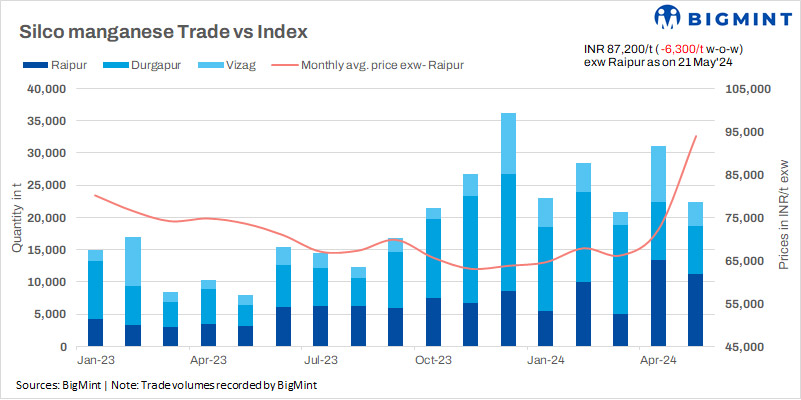
    The domestic silico manganese market witnessed a counterintuitive price correction this week, exhibiting a significant downward trend that defies recent market expectations. Key producing regions in India experienced a notable price decrease on a w-o-w basis compared to the assessment ending 14 May, 2024. Prices are seen edging close to one month low, as per data maintained with BigMint.

    BigMint’s assessments on 21 May revealed a substantial w-o-w decrease of INR 6,300-7,900/t ($76-$95/t) for grade 60-14 silico manganese. Prices of this grade were assessed yesterday at INR 84,000-87,200/t ($1,008-$1,048/t) exw. Notably, offers in Raipur were at INR 87,000-88,000/t ($1,045-$1,057/t) exw.

    Market overview

    1. Need based procurement in the domestic market: India’s steel mills procured silico manganese according to their needs. This cautious approach reflects buyers’ anticipation of further price cuts, resulting in lower purchase volumes in the immediate run. The reluctance to acquire at current rates puts additional strain on silico manganese smelters, which are already struggling in a shrinking market. In addition, lower offers from traders and panic sales on expectation of further price drop has resulted in price drop.

    2. Cost-competitive offers from other regions: Manufacturers from Raigarh are offering material in the range of INR 83,000 to 84,500/t ($775), putting pressure on the Raipur domestic price. Few other merchants provided lower rates, making the players cautious to accept higher offers. However, major smelters are accepting offers ranging from INR 86,500-88,000/t ($1038-$1,055/t).

    “One of the key producers from Vizag notified BigMint that we are unable to trade at INR 86,000/t exw in Vizag since competitive prices from Raigarh and Durgapur are significantly lower than the Vizag smelters’ offerings. Vizag is under pressure to lower prices due to drop in manganese alloys export prices and price drop.”

    3. Fall on silico manganese export prices : The Indian silico manganese export market encounters significant headwinds due to subdued demand. Export prices have fallen by $30 per tonne compared to the previous week, reflecting a buyer’s market. Weak demand from the alloy steel sector, a key consumer of silico manganese, is pressuring prices and requiring price cuts to clear existing stockpiles. Low overall trading activity in the global market further weakens export prospects by limiting buying activity. Furthermore, port inquiries in India suggest potential for further price decreases, with inquiries at $1,090-1,110/t FOB (Vizag/Haldia). Recent deals concluded at these lower levels raise buyer expectations of a sustained downward price trend.

    4. Imported manganese ore supply shortage seen easing: Prices of imported manganese ore, a crucial element in silico manganese production, remained unchanged. This stability contradicts the anticipated upward pressure on silico manganese prices due to rising raw material costs. Notably, Samancor’s joint venture plans to resume mining at South32’s GEMCO unit in June post suspending in March, aiming to build stockpiles before the 2024/2025 wet season. Recovery from March’s cyclone impacts includes dewatering and infrastructure repairs.

    Outlook

    India’s domestic silico manganese market faces potential price fluctuations. Weak export demand and competition from other regions could push prices down, while global miners expect higher prices to persist. Closely monitoring these conflicting factors is crucial for market participants to make informed decisions on pricing and production in this uncertain short-term environment.

    Additionally, India’s domestic silico manganese market shows mixed price signals. While downward pressure exists, some smelters secured deals at INR 90,000/t exw Vizag, highlighting potential pockets of stability. Close monitoring of market activity remains crucial.

    BigMint suggests monitoring the upcoming imported Mn ore weekly index, situation in Europe, the ongoing buying activity from Southeast Asia, and the performance of the domestic steel trade would be critical in predicting the future trajectory of silico manganese prices in India.

  • India: Ferro Chrome Prices Remain Stable as Market Awaits Upcoming Auctions

    India: Ferro Chrome Prices Remain Stable as Market Awaits Upcoming Auctions

    • Bids for some grades drop in OMC’s auction
    • Tsingshan’s June’24 tender prices stable m-o-m
    • European benchmark prices to be discontinued from June

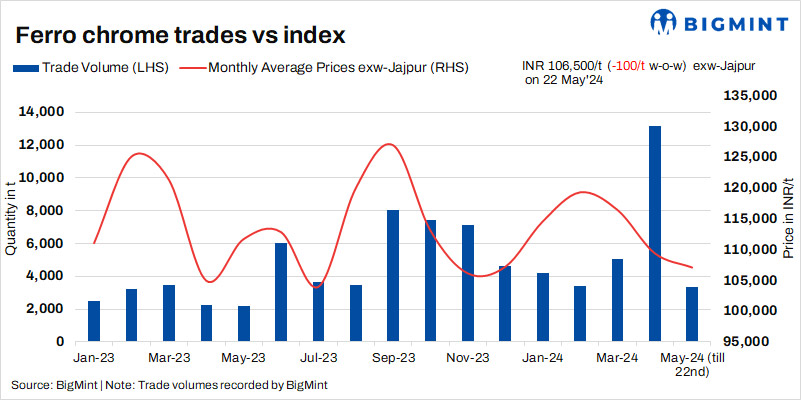
    Indian high-carbon ferro chrome (HC60%, Si:4%) prices remained steady w-o-w, decreasing slightly by INR 100/t ($1/t) w-o-w compared with the previous assessment on 15 May 2024. Prices stayed stable because the market did not show any significant improvement in demand.

    As per BigMint’s assessment on 22 May, high-carbon ferro chrome (HC60%, Si:4%) prices were INR 106,500/t ($1,279/t) exw-Jajpur. Last week, around 600 t of trades were finalised in the price range of INR 104,000-108,000/t ($1,249-1,297/t).

    With a slight increase of INR 100/t ($1/t) w-o-w to INR 114,300/t ($1,373/t) exw-Jajpur, prices of high-carbon low-silicon ferro chrome (HC60%, Si:2%) also stayed stable. Low-carbon (C:0.1%) ferro chrome prices, however, decreased by INR 2,000/t ($24/t) w-o-w to INR 235,000/t ($2,822/t) exw-Durgapur on 23 May.

    Auctions in domestic market: On 21 May, OMC’s chrome ore auction was concluded, with all 67,300 t of material sold out. For high-grade ore (52 to +54%), premiums increased by 24-55% (INR 4,900-11,700; $59-141) over the base price. However, the bids for the remaining grades decreased by around INR 2,600 ($31).

    Two more ferro chrome auctions are scheduled for 24 May, one by OMC and the other by Vedanta-FACOR. Market participants are keeping an eye on the outcomes of these auctions.

    Taking into account the generally low level of domestic demand, a key producer told BigMint: “We have currently stopped offering in the domestic market and only catering to export orders as realisation is a bit better in exports.”

    Global market conditions: Ferro chrome (HC60%) prices in China inched up by RMB 100/t ($14/t) w-o-w to RMB 9,150/t ($1,263/t) exw-Inner Mongolia. According to reports, rising raw material costs contributed to the price rise.

    Tsingshan has announced its ferro chrome tender prices for June at RMB 8,995/t ($1,242/t), unchanged m-o-m. It could be due to firm domestic prices over the past few weeks.

    Furthermore, a significant South African producer of ferro chrome, Merafe, has declared that it would stop releasing quarterly European benchmark prices from 2024.

    Uptrend in stainless steel sector: Prices for 304 grade stainless steel went up by INR 5,000/t ($60/t) w-o-w, reaching INR 182,000/t ($2,186/t) exw-Mumbai. This resulted from a $1,540/t w-o-w increase in LME nickel prices. Some producers also increased their prices. However, given the recent fluctuations in LME nickel prices, the market is still uncertain.

    Outlook

    The moderate response to OMC’s chrome ore auction may exert additional pressure on prices. However, given the current cost dynamics, a significant fall seems less likely. Further clarity may emerge after the upcoming auctions.

  • India: Ferro Molybdenum Prices Surge Due to Limited Supply

    India: Ferro Molybdenum Prices Surge Due to Limited Supply

    • Growing demand from Europe, China
    • LME prices maintain stability

    In comparison to the previous assessment on 15 May, ferro molybdenum prices in India experienced a rise of INR 61,000/t ($733/t) w-o-w. Prices increased as there were reports of material shortage across the globe which got boosted by the rise in demand.

    Indian ferro molybdenum prices were at INR 2,681,000/t ($32,197/t) exw-Nagpur on a 60% pro rata basis, as per BigMint’s assessment on 22 May. In the previous week, around 10 t of material was sold within the price bracket of INR 2,650,000-2,690,000/t ($31,825-32,305/t).

    Weekly market movement

    Supply limitations, growing demand: Global markets experienced molybdenum oxide shortages, which restricted the availability of finished materials. As a result, prices increased in both the domestic and international markets due to a surge in inquiries, mainly from China and Europe.

    “The market is bullish right now, but bulk deals at higher prices are yet to be concluded as the market needs few days to absorb these prices,” a well-known domestic producer told BigMint.

    Global price trajectories: Ferro molybdenum (Mo:60%) prices in China increased by RMB 10,000/t ($1,410/t) w-o-w to RMB 250,000/t ($35,245/t) exw-Inner Mongolia. According to sources, a local mine in China recently sold molybdenum concentrate (50-50%) for around RMB 3,910/t ($551/t). Additionally, there was a shortage of molybdenum concentrate as well.

    While prices in South Korea (Mo:60%) inched up by $0.3/kg w-o-w to $51/kg, they remained stable w-o-w in the US (Mo:70%) at $61/kg.

    The London Metal Exchange (LME) saw little change in pricing w-o-w, with a $0.09/pound increase to $21.89/pound on 21 May.

    Outlook

    If this trend persists, we might see additional price increase in the coming days.

  • Bangladesh Needs to Harness the Potential of Rooftop Solar Energy

    Bangladesh Needs to Harness the Potential of Rooftop Solar Energy

    Bangladesh Needs to Harness the Potential of Rooftop Solar Energy


    Despite challenges, the sector offers a lot of promises

    The Bangladesh government raised electricity tariffs yet again in February 2024, following several adjustments in 2023. The government also increased gas prices for selected categories. Consumers, including industries, are now bearing the brunt of high energy tariffs and looking for a probable way out.

    However, high electricity tariffs make rooftop solar financially more viable now. This is one area that building owners can explore to reduce their soaring power bills. Yet, the pace of rooftop solar implementation is slow. The encouraging sign is that the rooftop solar sector started to gain traction.

    Speakers in a recent webinar titled ‘Scaling up rooftop solar deployment in Bangladesh’ have opined that this momentum needs to be accelerated.

    The webinar was jointly organized by Energy & Power magazine and the global think tank Institute for Energy Economics and Financial Analysis (IEEFA). Mollah Amzad Hossain of the Energy & Power magazine moderated the session.

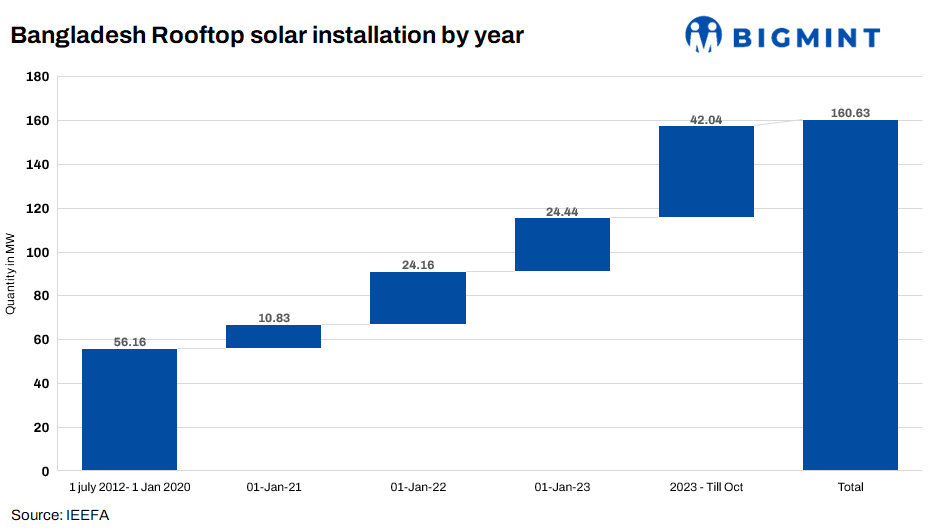
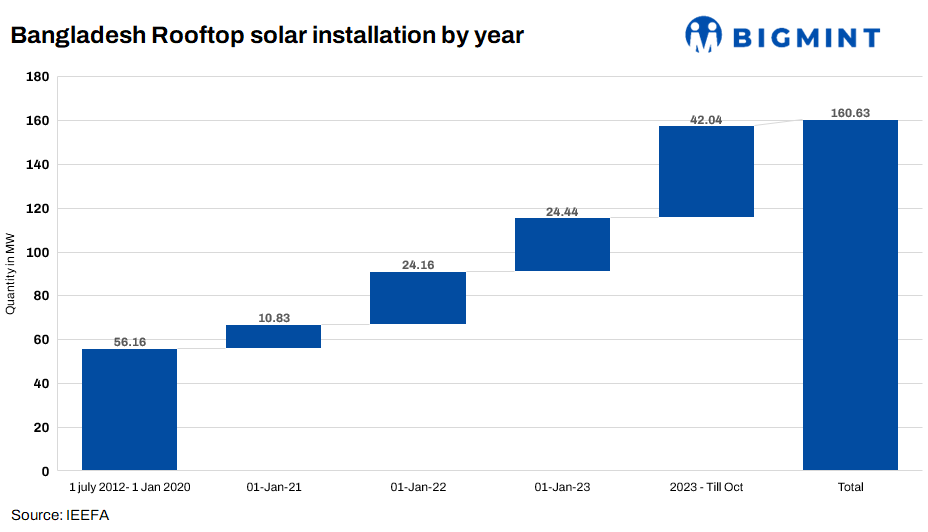
    Delivering the keynote presentation, IEEFA’s lead energy analyst for Bangladesh, Shafiqul Alam provided a snapshot of the rooftop solar sector of Bangladesh which has a combined capacity of 166.28MW as of 1 March 2023. While the combined capacity remains at a paltry level, the sign is encouraging as the installation rate in 2023 surged compared to other years. He shared the key challenges that hinder the quick take up of rooftop solar in Bangladesh. Among other things, lack of awareness, difficulty in accessing finance, high import duties on solar accessories, capacity level of stakeholders, and absence of business models for utilities impact the sector.

    The rooftop solar systems that were installed to obtain grid connection eventually delivered little or no energy. This also negatively impacts people’s motivation to install rooftop systems in the country.

    In the keynote, Alam also highlighted that six key levers can help Bangladesh upscale rooftop solar systems in the foreseeable future.

    These are

      • Raising awareness of the stakeholders on the benefits of rooftop solar and recent changes in regulations. SREDA may enhance its efforts in targeted awareness programmes for different stakeholders.
      • Streamlining finance-A new funding scheme to upscale rooftop solar will be important as the available financing schemes of IDCOL and the central bank have limited funding scope. Risk mitigation instruments like a credit risk guarantee scheme will help reduce financial institutions’ perceived risk in providing loans to rooftop solar.
      • Policy and regulatory intervention-The import duties should be waived at least for a limited period. Additionally, the 70% cap on rooftop solar system capacity should also be lifted. SREDA may work with the ministry to streamline these.
      • Quality assurance-Poor quality accessories, particularly in small systems, are still an issue. BSTI should increase market monitoring to ensure the quality of rooftop solar accessories. Testing lab should also be increased.
      • Capacity development of stakeholders -Different stakeholders demonstrate low capacity. For example, some banks are still not used to lending to rooftop solar. SREDA may organise additional capacity development training for banks and other stakeholders.
      • Business models for utilities -To quickly increase rooftop solar capacity in the country, utilities will need to play an important role. However, they do not have incentives. New business models can allow utilities to earn revenue and thus remain sustainable in the long run.

    Alam further said that a combined rooftop solar capacity of 2,000 MW could help Bangladesh save money between US$ 0.48 billion and US$1.0 billion per annum by reducing expensive fossil-fuel-based power generation during the day peaks.

    Bangladesh should pursue efforts to enhance renewable energy capacity to reduce import dependence and enhance its energy system resilience.

    Speaking at the webinar, Engr. Nurul Aktar, President of Bangladesh Solar and Renewable Energy Association (BSREA) said that high import duties and low awareness level of stakeholders affect rooftop solar implementation. The country needs to multiply efforts to enhance rooftop solar capacity.

    The CEO of IDCOL said: “Rooftop solar is one of the key financing areas of IDCOL”. However, he agreed with the keynote speaker that IDCOL’s facility would not be enough to the demand for financing in the sector. He feels awareness raising on the benefits of rooftop solar is necessary.

    Former Dean of BUET, Prof Ijaz said that due to the Carbon Border Adjustment Mechanism (CBAM) and other international pressure, our export-oriented industries would need to implement rooftop solar. However, only a rooftop will not be enough. Industries will need to implement energy efficiency measures too.

    Responding to a question from the audience, Shafiqul Alam said that the current electricity tariffs in Bangladesh are better than the feed-in tariff that influenced the rooftop solar boom in Vietnam in 2020.

    Attending as the special guest of the webinar and IEEFA South Asia’s director, Vibhuti Garg mentioned that Bangladesh may look into innovative business models such as virtual net metering and peer-to-peer trading. Blended finance instruments can play a big role in transforming the sector. As the cost of solar technology continues to come down, the attractiveness of rooftop solar will increase further.

    Chief guest of the webinar, Director General of Power Cell, Engr Mohammad Hossain said that the solar home systems programme is a success story for Bangladesh. Solar home systems have played their roles. Now, we need to expand rooftop solar as we also have land scarcity. We are internally working on removing the 70% cap on rooftop solar installation capacity. Moreover, we are working on how to initiate corporate power purchase agreements. We are hopeful that we will be able to improve grid quality to accommodate variable rooftop solar systems. In fact, with nuclear power expected to be online soon, the grid will improve by that time.

    Source: Energy & Power, Bangladesh

    4th Bangladesh International Trade Summit

    Bangladesh, a strategically significant country in the Asia Pacific, is emerging as a hotspot of economic growth. The country’s phenomenal economic expansion is fuelled by a buoyant steel sector which is on an expansion spree. This is expected to encourage the participation of more global companies and attract precious foreign reserves for the country.

    BigMint Events will be hosting the 4th Bangladesh International Trade Summit on 14-15 May 2024, at Hotel Pan Pacific Sonargaon, Dhaka, Bangladesh. The two-day conference looks to bring together key stakeholders from the steel, cement, and power sectors, including industry stalwarts, policymakers, traders, and investors. It seeks to provide a network for collaboration and an ideal platform for discussion of prevailing industry trends and challenges.