SteelMint Events

Author: SteelMintEvents

  • China Needle Coke Prices Reverses the Global Trend

    China Needle Coke Prices Reverses the Global Trend

    The upheaval in graphite electrodes demand in past two years and a steady surge in the requirements for graphite anodes for lithium-ion batteries in China has boosted the needle-coke demand in the country.

    In 2018, the overall performance of China’s needle coke market was relatively stable with prices showing an uptrend and reaching to its high in the month of November. However, towards the end of 2018, the plunge in steel demand from downstream sector in China adversely impacted the country’s graphite electrode requirement and so does the needle coke demand and prices.

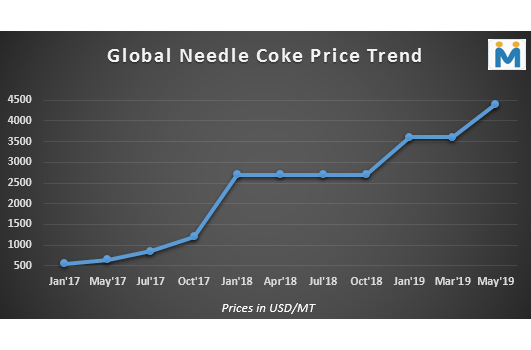
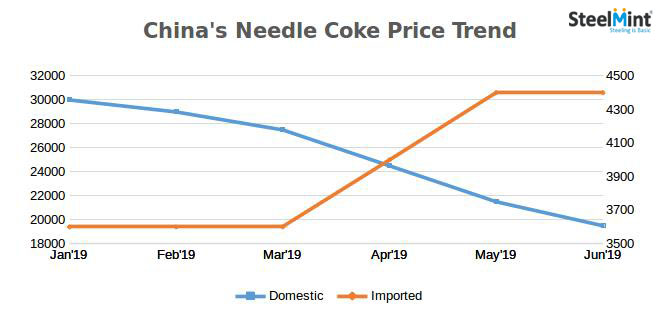
    With the start of 2019, China’s domestic needle coke prices have been falling and have registered a plunge of 35% in the time span of six months. However, the price of high-quality needle coke required for UHP grade GE (usually imported) have been rising continuously recording a surge of 22% during Jan-Jun’19. The domestic needle coke prices in China are currently trending in the range of RMB 19,000-20,000 (USD 2,750 – 2,900/MT) whereas imported needle coke prices are at 4,200 – 4,600/MT.

    According to customs data, in first four months of 2019, China’s petroleum-based needle coke import volume was 46,413 tonnes, 70% of which came from the United Kingdom, 15.3% from the United States, and 9.5% from Japan whereas country’s coal-based needle-coke imports were 27,819 tonnes of which 62% came from South Korea and 38% from Japan.

    Although, the domestic needle coke produced in China still has some time to match the global standards, with the help of some research and development, the quality of the same have improved to some extent and few products have been able to mark their entry in the international market also.

    At present the production capacity of domestic needle coke in China is in the period of rapid expansion and in 2019 some new projects will be officially put into operations:

    China’s upcoming capacities in case of coal-based needle coke:

    Company Name Planned Capacity Estimated year of operation Type
    CNPC Jinzhou Company 100,000 2019 New expansion
    Shandong Yida New Material 70,000 2019 New expansion
    Shandong Jingyang Tech 70,000 2019 New expansion
    SinoPec Maoming Company 100,000 2020 New entry
    Sinopec Jinling Company 100,000 2020 New entry
    Liaoning Baolai Bio-energy 120,000 2020 New entry
    Total 560,000

    China’s upcoming capacities in case of petroleum-based needle coke:

    Company Name Planned Capacity Estimated year of operation Type
    Kaifeng carbon Anshan thermal-energy new material 20,000 2019 New expansion
    Henei Kaifeng Carbon New Material 40,000 2019 New expansion
    Shanghai Baosteel Chemical 100,000 2019 New expansion
    Anshan Steel Holding 40,000 2019 New entry
    Zaozhuang Thriving Carbon Tech 40,000 2019 New entry
    Pingdingshan Risun New Material 40,000 2019 New entry
    Baoshun Chem 50,000 2019 New entry
    Tsdr New Energy 100,000 2019 New entry
    Shanxi Jinzhou Chem 40,000 2019 New entry
    Shanxi Fuma Carbon Material 40,000 2020 New entry
    Ningxia Baichuan new material 50,000 2020 New entry
    Total 560,000

    With the new capacities coming up in China’s needle coke sector and tepid graphite electrodes demand due to sluggishness in downstream sector, the country’s domestic needle coke prices are anticipated to fall further.

    Know More

  • China: Dull EAF Scenario Weigh Graphite Electrodes Prices Down

    China: Dull EAF Scenario Weigh Graphite Electrodes Prices Down

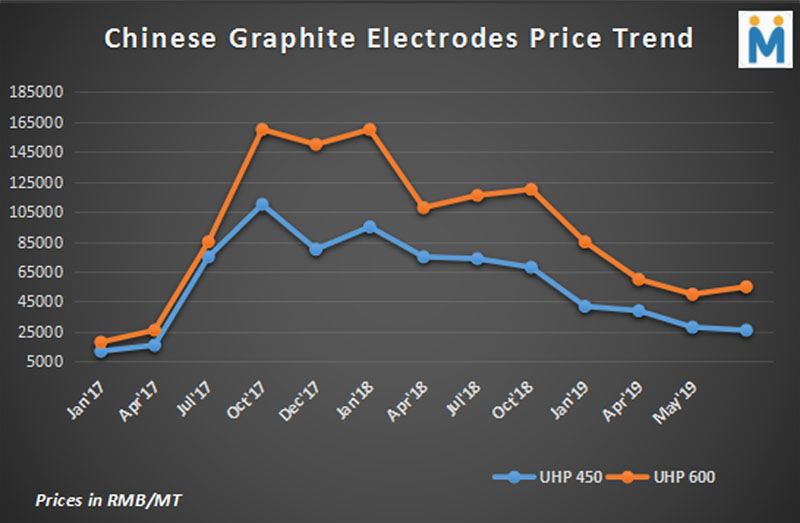
    With the GE prices in China falling since November last year and then becoming stable over past one month, the big question hovering is where is the country’s electrodes prices are heading to. To get an answer to this let us analyse few of the important happenings in the country’s GE and steel market.

    As per the SteelMint sources, although the lower grade graphite electrodes prices plunged down further this week, the UHP grade GE prices of higher size continues to remain unaltered over past one month.

    The current prices in China of UHP grade GE of size 450mm are heard to be in the range of RMB 24,000 – 26,000/MT (USD 3,470 – 3,760/MT) whereas that of size 600mm are in the range of RMB 48,000 – 60,000/MT (USD 6,940 – 8,675/MT). The price of HP grade electrodes of 450mm are in the range of RMB 21,000 – 22,000/MT (USD 3,040 – 3,760/MT), according to China based CBC data.

    The demand for higher grade electrodes of size 600mm-700mm have increased in the overseas market as the quality of the same have improved over the period of time, thus supporting their prices. However, in case of non-UHP grade and lower size UHP electrodes, there is a situation of overcapacity amid tepid demand from downstream sector and difficulties in development of EAF steelmaking. In fact few small GE units have temporarily shut down their operations and have adopted wait and watch approach.

    Obstacles in steel production via EAF route

    As highlighted by director of Iron & Steel department of China’s MIIT (Ministry of Industry & Information Technology) costs are restricting the development of EAF steelmaking in the country. The cost of EAF steel is higher by around RMB 400-500/MT (USD 58-72/MT) compared to that from converters and reason being higher raw material costs. The scrap prices that adds up to around 75% of the EAF costs are currently trending at a higher range. In most favourable condition, the scrap prices of around RMB 1,600/MT would make EAF more competitive against blast furnaces, but current scrap prices are around RMB 2,300-2,400/MT making electric furnaces a costly route of steel production. Apart from scrap higher cost of electricity, which comprises 6-15% of the total cost of EAF production is also contributing to slower development of EAF steelmaking facilities in China.

    Availability of scrap might also prove to be hindrance for EAF steel manufacturers in the near term. This is because in 2018, steel produced in China Steel produced down the EAF route in China in 2018 was almost 90 MnT. Total scrap use in all steelmaking was 220 MnT. But with integrated steelmakers consuming 160 MnT, only 60 MnT was used by EAFs and thus if the percentage of EAF steel output increases, scrap will be in short supply therefore in the near term.

    The likely price trend of GE in near term

    As per the market survey carried out by an agency, the average operating rate across 33 Chinese electric arc furnace (EAF) steelmakers that use steel scrap, rather than iron ore, as feedstock is expected to dip from 80% in May to 79% in ongoing month of June.

    This downtrend have been supported from the fact the mills in south are facing heavy rainfall thus, hurting demand and weighing down on prices, pushing mills into losses. As a matter of fact some mills have curtailed their production amid anticipation of heavy losses.

    Given the EAF market scenario, the GE prices especially that of non-UHP and lower size, are unlikely to move up in the upcoming time period. In case of UHP grade electrodes of higher size, the positive overseas demand is likely to support their prices

    Know More

  • IMO 2020 Regulation May Jolt Global Graphite Electrode Industry

    IMO 2020 Regulation May Jolt Global Graphite Electrode Industry

    IMO 2020 is likely to exert pressure on the main consumers of needle coke – the GE and lithium-ion battery industries

    At a time when it seemed that the panic in the global Graphite Electrode (GE) industry had subsided and prices had returned to normal levels almost after two years, with supplies from China witnessing a dramatic surge, another surprise might just be in the offing. This is the new IMO 2020 regulations to be implemented from 1 January, 2020 which are expected to have a tangible effect on needle coke supplies and prices.

    What are the IMO 2020 regulations?

    From 2020 the International Maritime Organization (IMO) will require ships to reduce their emissions to be equivalent to use marine fuels with a maximum sulphur content of 0.5%, far lower than the current 3.5%. This new measure requires the maritime industry to comply but the shipping industry is not yet ready to deal with this regulation.

    This stringent sulphur regulation has led ship owners and operators to mull all available options they have in order to comply with the IMO regulation, and refiners are considering producing more low-sulphur fuel to meet possibly higher demand, as both parties anticipate an unprecedented change in the marine fuels supply seascape.

    Industry experts believe that given the limited time left and with the shipping industry being unprepared, there are three options for those forced to comply with the new regulation: first, ship owners can install exhaust gas cleaning systems on their ships. Second, ships can run on clean LNG gas as fuel, Third, they can buy compliant fuels at higher costs.

    The installation of exhaust gas cleaning system will definitely lead to increase in costs for the ship owners and operators further resulting in higher freight charges whereas the option of switching to cleaner gas is not easy at all. In case of last option, the refineries have been reluctant to undergo large capital investments required for the major upgrades to increase production of low sulphur marine fuel oils.

    How will the regulation affect needle coke prices?

    Needle coke – an already scarce product – is a key raw material in GE production, which is used both in EAF steel-making and manufacturing of synthetic graphite used as anode material for lithium ion batteries that power electric vehicles.

    There are two types of needle coke – petroleum needle coke produced at oil refineries by converting decant or slurry oil along with high quality vacuum residue (both by-products of the refining process) and coal-based needle coke (sometimes called ‘pitch needle coke’, or just ‘pitch coke’) made from coal tar pitch, a by-product of coking metallurgical coal in BF steel-making.

    There are only 10 needle coke manufacturers in the world, with the majority of them producing petroleum needle coke. Out of the 10, seven operate outside China with Phillips 66 (US and UK) being the largest, followed by Seadrift in the US and C-Chem, Petrocokes, JX Nippon and Mitsubishi in Japan. Indeed, ex-China capacity has remained broadly flat over the past 10 years given the high capital costs, technical expertise and stringent regulatory processes required to set up a greenfield needle coke project. In contrast, China is not only a net importer of needle coke but also a large producer, primarily through the coal-based route, with Sinosteel being the largest.

    Supply side structural changes in China in the last two years have resulted in the promotion of EAFs thereby boosting GE demand and consequently needle coke requirements and prices.

    Under the new IMO rules, the price of low-sulphur crude oil required to produce needle coke is expected to rise as more of it will be diverted toward marine fuels. Needle coke producers would be forced to contend with either increased competition for feedstock or investments in equipment to allow use of high-sulphur oil. Either way, IMO 2020 is likely to exert pressure on the main consumers of needle coke – the GE and lithium-ion battery industries.

    How trade dynamics may change

    Despite rise in demand, no major greenfield or brownfield needle coke projects have been announced outside China over the past few years given the high capital investment as well as technical challenges involved.

    In the case of China, although many steel companies and GE manufacturers have invested in needle coke units due to sudden spurt in demand, a majority of them are coal-tar pitch based projects and environmental concerns will limit supply of coal-tar pitch especially during the winter heating season in a bid to maintain air quality. In case of the handful of petroleum-based projects, the two major challenges are lack of technical knowhow and sourcing of good quality feedstock (low-sulphur crudes) the supply of which is already limited.

    Subsequently, the strong demand from steelmakers and the lithium-ion battery segment as well as the enforcement of the IMO 2020 restrictions will eventually tighten the supply of needle coke from next year onwards thereby adversely affecting prices.

    Know More

  • Iran Subverting US Sanctions, Importing Chinese GE ?

    Iran Subverting US Sanctions, Importing Chinese GE ?

    The political friction between the US and Iran took a turn for the worse in the beginning of this month with the former imposing a new round of sanctions on Tehran, severely restricting the Islamic Republic’s trade with other countries.

    After pulling out of the 2015 nuclear deal with Tehran, the US had announced the first tranche of financial sanctions on Iran in August last year, targeting the purchase of Iranian currency thereby affecting key industries. The sanctions restricted Iran’s purchase of US dollars – the most preferred currency in global trade.

    Again in November 2018, the US slapped a second round of sanctions on Iran, this time targeting the country’s precious oil sector. Any country importing Iranian oil today naturally invites secondary sanctions upon itself. And, to top it all, in early May this year the Trump administration imposed the latest round of sanctions on Iran’s metal industry including the iron and steel industry, aimed at cutting off revenue to Iran. These sanctions are a warning to other nations that allowing Iranian steel and other metals into their ports will attract secondary sanctions.

    GE Imports Steady Despite Sanctions

    Amid these trade restrictions being imposed on Iran one of the key sectors that will take a major hit is steel. This is because about 85% of steel production in Iran takes place through the EAF route and the remaining via BFs. The key raw material required to produce steel in electric furnaces is Graphite Electrodes (GE) and Iran is totally dependent on imports to meet its GE requirements.

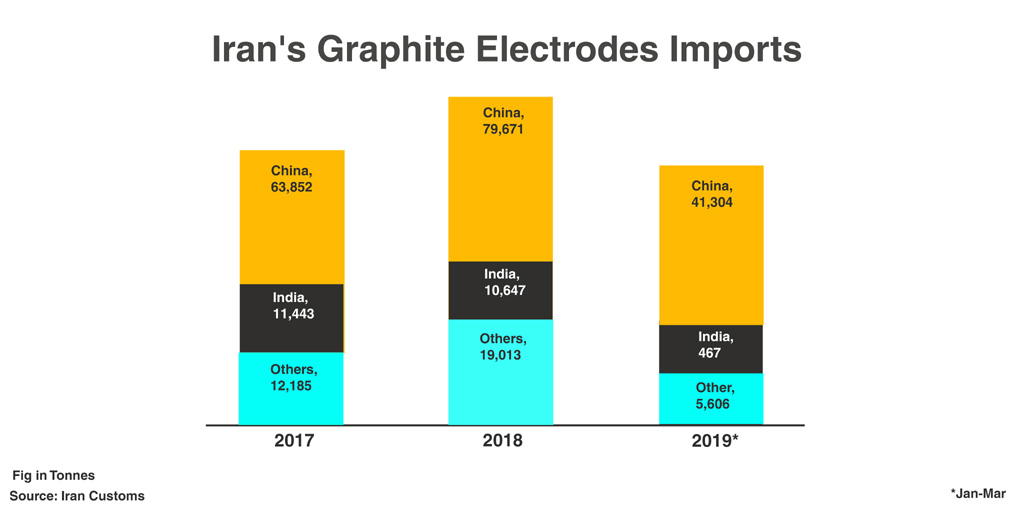
    Iran imported about 85% of its GE requirement from China and India last year. With the sanctions in place, it was anticipated that the country’s electrodes imports would suffer a setback and so would steel production. However, Iranian customs data show that GE inflow into that country has not only continued after the clampdown of sanctions but have actually registered a Y-o-Y rise.

    In 2018, Iran imported about 109,331 tonne of GE against 87,480 tonne in 2017 – a 25% rise on a Yo-Y basis. In fact, Iran’s GE imports post sanctions, i.e. from Aug to Dec’18, have surged by 24% against the corresponding period of the previous year.

    Country-wise GE import trends over the past few years show that the highest imports came from China followed by India. However, the scenario changed in 2018 as GE exports from India to Iran dropped to almost negligible levels after August. But China has remained the top GE exporter to Iran despite sanctions; in fact during Aug-Dec’18, China’s GE exports to Iran recorded a surge of 42% against the corresponding period of 2017.

    During Jan-Mar 2019 Iran imported about 47,377 tonne of GE against 29,166 tonne in the same period last year, thus registering an increase of 62%. Now, out of the total imports of 47,377 tonne in the first three months of the ongoing year, about 87% came from China followed by UAE (6%) and Germany (5%) whereas imports from India were quite insignificant.

    Subverting the Sanctions

    While analyzing import data one major question that arises is how Iran is able to import GE from China despite the sanctions in place. And the answer to this riddle lies in the fact that circumvention of the sanctions by the trade participants is being made possible through collusion with shipping agents in Oman and Turkey.

    As per market sources, Chinese exporters are directing their exports to Oman or Turkey in the Middle-East. After altering the bill received upon landing in which the origin of the shipment is changed at the port, the goods are channeled to Iran thus making evasion of the US sanctions possible. Although none of the industry participants from China will acknowledge that such a trade arrangement is in place, China’s GE export data is testimony to continuing – even increasing – exports to Iran. China’s customs data show that out of the 76,172 tonne of GE exported from China in 2019, about 13% were directed to Oman and Turkey during the first three months of the current year and the trend was almost similar after the sanctions were imposed last year.

    Thus, with its GE requirements properly met, Iran has been able to continue churning out steel. In fact the country’s crude steel production in 2018 registered an increase of 5% (Y-o-Y) at 21.3 MnT. During Jan-Mar 2019 production stood at 6.5 MnT, up 7% compared to the same period last year.
    Increasing production apart, tepid domestic demand is forcing Iran to export cheap steel to other Middle-East and Southeast Asian countries including India, hurting Indian manufacturers. As per trade sources, about 65,000 tonne of steel, mostly HRC, entered India after the import papers were altered in the UAE, thus subverting the US sanctions.

    Big Burning Question

    The Indian steel industry is demanding imposition of effective trade barriers on cheap steel imports from Iran. The big question is whether Iranian importers as well as exporters will continue trade by circumvention of the sanctions or will the US come up with stricter regulations for global trade with Iran in the near future.

    Know More

  • Tata Steel Thailand Plans to Ramp Up Steel Capacity Utilization – Mr. Rajiv Mangal

    Tata Steel Thailand Plans to Ramp Up Steel Capacity Utilization – Mr. Rajiv Mangal

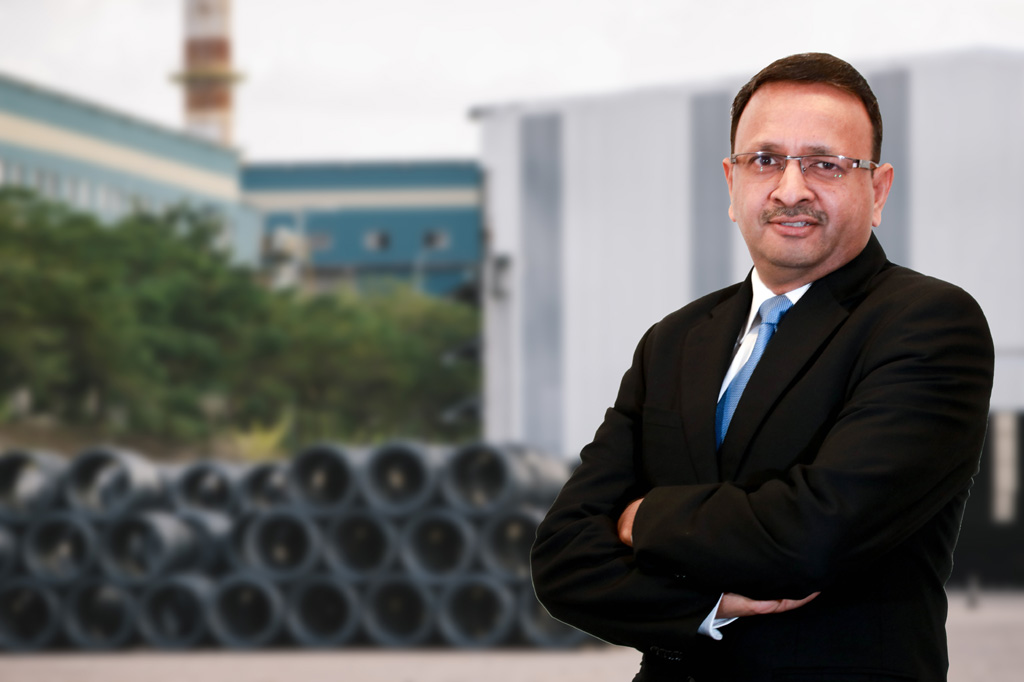
    Tata Steel – Thailand is one of the renowned names in manufacturing of long steel products. SteelMint in interaction with Mr. Rajiv Mangal, President & CEO of Tata Steel (Thailand) Public Company Limited learned about his views on ramp up plans of the company and expected increase in country’s crude steel production in the coming years. Below are the edited excerpts from the interview

    1. Has Thailand steel industry poised for growth, what is the future outlook?

    Unlike other countries in ASEAN region where dependence of steel sector on construction is very high (>75%), Thailand’s steel consuming sectors are diverse. Total apparent finished goods steel consumption in the country was 17.4 MnT in 2018, up by 4.8% Y-o-Y. This translates to approx. 263 kg per capita of steel consumption. Construction, Machine & Appliances and Automobiles sectors consumed 55%, 21% and 19% shares of the total steel consumed in 2018 respectively.

    As per Iron & Steel Institute of Thailand (ISIT), steel consumption in 2019 is likely to be around 19 MnT , an increase of approx. 8% in 2018. Personally, I feel growth will be in the range of 4-6% on account of continuing trade frictions in international arena and political uncertainty in the country after the general elections in March 2019.

    2018 witnessed a Y-o-Y increase in automobile, cement and canned seafood production by 8.9%, 1.2% and 13.6% respectively. With the first car policy after effects almost gone and huge infrastructure development plans announced for next five years by the Thai Govt, steel consumption is expected to witness healthy growth coming years.

    There are roughly 20 crude steel-making facilities in Thailand, nearly all of which use electric arc furnace technology to produce steel. In comparison, over 150 hot-rolling, cold rolling, cold-drawing, and coating mills are in operation in Thailand which relies heavily on imports of semi-finished and finished steel products for their manufacturing inputs.

    2. Is steel capacity utilization low in Thailand?

    In 2018, Thailand imported 15.2 MnT of steel, an 8 percent increase from 14.2 MnT in 2017. At the same time, domestic production was approx. 7.1 MnT with average capacity utilization below 50%. This is not good for the financial health of the domestic steel industry. One of the major reason for low capacity utilization in Thailand is that 100% steel production is based on secondary route of steel making. This makes the cost of steel produced locally higher than primary route steel manufactured in major steel producing countries like China, Japan and Korea. At the same time, most of the steel made in the country is in upstream and commodity by nature. With new blast furnace based capacities coming on stream in Vietnam and Malaysia in last one year, challenge for Thai steel producers have aggravated. Need of the hour is consolidation and shifting up in the value chain.

    3. What are the measures being taken by Tata Steel Thailand to increase production and demand from local mills and how is the scenario after HBIS take over?

    Tata Steel Thailand has a rated capacity of 1.7 MnT pa of long products spread across three manufacturing sites in Thailand. By virtue of better product mix, pan Thailand reach and sale of branded products, average capacity utilization of the company is in the range of 70-75%. This is much higher than country’s average. Exports account for 10-12% of the total sales. During 2011-16, Thailand saw widespread dumping of wire rods from China. With structural changes in Chinese steel industry and Thai Govt imposing tariff and non-tariff measures, imports from China has come down in last 2 years.

    In coming years, Tata Steel Thailand plans to enhance capacity utilization beyond 80-85% by increasing sale of high end wire rods suitable for auto sector, ready to use Cut & Bend products and high strengthRebars for construction companies. With strong brand presence in Laos, Cambodia and Myanmar, exports to these countries is also poised to go up.

    The share purchase agreement signed with HBIS in end Jan’19 is not yet closed.

    4. Do you see steel scrap imports rising in coming years in Thailand, what is your forecast?

    As scrap remains the primary raw material for steelmaking in Thailand, its consumption is bound to increase in line with steel production increase in coming years. At the same time, domestic steel industry has taken up with the Govt to promote exports of value added products and discourage export of scarce raw material like steel scrap. Another factor to be closely tracked is increase in steel production & consumption in Vietnam and Malaysia from the new investments in last 2-3 years. If these countries resort to aggressive exports, Thailand may witness increased imports of semis and finished products. Thus rate of change in import of scrap in Thailand will depend upon policy for prevention of scrap exports and imports of semis and finished steel from neighboring countries.

    To know more on scrap industry in emerging markets, book your seat at SteelMint’s 4th Steel Scrap, Billet & DRI Summit. The conference is being organized during 27-29’th Aug’19 in Bangkok, Thailand.
    ~ Inputs by Dr. Sheena Abraham

    Know More