SteelMint Events

Author: SteelMintEvents

  • Global tonnage down over 10% in ship recycling; Bangladesh remain on Top spot

    Global tonnage down over 10% in ship recycling; Bangladesh remain on Top spot

    • Eased LC issues help Bangladesh secure vessels
    • Prices of both containers, tankers fall y-o-y
    • Indian prices may increase amid scant inventory

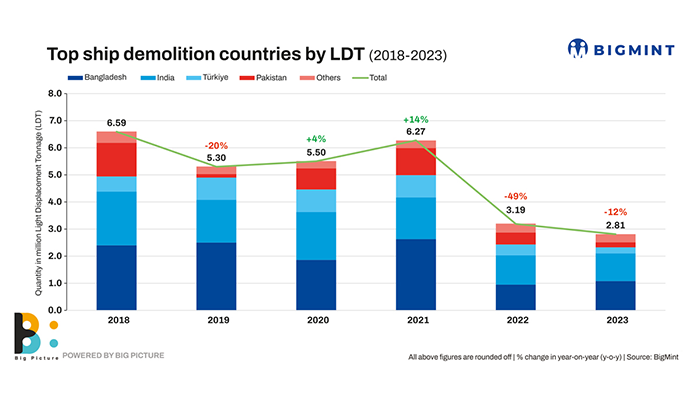
    Morning Brief: The global ship-breaking market remained in deep waters in 2023. Total tonnage sunk 13% to 2.8 million light displacement tonnage (LDT) compared to 3.2 million LDT recorded in 2022.

    Bangladesh had snatched back its position as the largest ship-breaker globally in terms of tonnage earlier last year from India and retained it till the end. It concluded the year with total tonnage rising over 20% to 1.10 million LDT against 0.9 million LDT in 2022. It also led in terms of vessels demolished, at 138 units compared to 128 in 2022, up 39% y-o-y.

    India, on the other hand, slipped 9% to 0.9 million LDT (1.1 million LDT). However, the number of ships demolished rose a modest 8% to 138 from 128 in 2022.

    Pakistan and Turkiye have been neck-and-neck since 2022. Demolition tonnage fell 50% last year for both to 0.02 million LDT from 0.04 million LDT in 2022. Both saw a drop in the number of vessels recycled but Pakistan’s plunged 65% to a mere 15 while Turkiye experienced a modest 8% drop to 44 (48 in 2022).

    Bangladesh, India, and Pakistan set benchmarks as they traditionally command the lion’s share of the global ship recycling market — last year’s was over 80%.

    Price remain underwater y-o-y

    Demolition scrap prices fell y-o-y but Bangladesh still managed to remain slightly more supported than the other two.

    For instance, container prices in Bangladesh dropped the least, by 6%, to $579/LDT in 2023 against $616/LDT in the previous calendar.

    Pakistan’s container prices crashed by 8% to $550/LDT ($601/LDT) while India’s fell 7% to $565/LDT ($606/LDT) in this period.

    Tanker prices showed a deeper drop. As in containers, in tankers too, Bangladesh weathered the storm better than the others, with its recycled rates falling 7% to $561/LDT last year compared to $600/LDT in 2022.

    In Pakistan, the fall was the sharpest, by 10%, to $533/LDT ($590/LDT). India saw a drop of 8% to $546/LDT ($591/LDT).

    Factors impacting ship recycling market in CY’23

    Bangladesh recyclers swim against the tide: Despite the challenges of inflation and a sliding currency, Bangladesh ship recyclers managed to keep their head above the water thanks to a few reasons. One, in early 2023, the country secured a substantial $4.7-billion IMF loan, which bolstered its foreign exchange reserves and helped it open letters of credit (LCs) to secure the much-needed tonnage. In 2023, Bangladesh’s foreign exchange reserves stood at $17.20 billion, falling slightly short of the relaxed minimum target of $17.78 billion. But its recycled ship buyers bid aggressively, upping the competition heat with Indian counterparts. This is essentially because, unlike India, Bangladesh mills are entirely dependent on imported scrap and are willing to pay more to secure the raw material. Thus, average prices of containers and tankers were higher compared to that of India and Pakistan, although these were lower y-o-y. It was also heard that smaller, cost-effective vessels lured buyers.

    Secondly, although LC openings hit record lows in 2023 because of the falling forex reserves, later in the year the government eased rules, benefitting ship-breakers. Because of the higher prices offered, more ships diverted towards Bangladesh, especially from the Far East due to the geographical proximity and lower delivery costs involved.

    Thirdly, tonnage improved amid an increase in recycling yards(PDF). The country got its first green shipyard, PHP Ship Breaking and Recycling Industries Limited, in 2017. Following a four-year gap, three more — SN Corporation, Khwaja Ship Breaking, and Kabir Steel –received the green yard nod. Currently, there are four green yards (among the total 20-25), which are officially recognised as meeting the environmental standards set by the Hong Kong International Convention (HKC).

    Challenges rock the Indian boat: The Indian recyclers swam in choppy waters, particularly in Alang, and not without reason. First, the region faced increased competition as it took on additional recycling activities from competing sub-continental markets, leading to strain on resources and facilities. This surge in activity put pressure on prices for ship owners and cash buyers, reflecting oversupply and intense competition among yards. Secondly, the slight fluctuations in the Indian rupee added to uncertainty and disparity in pricing. Thirdly, regulatory hurdles came in the way. For instance, the UAE ruling, banning its own flagged vessels from’beaching’ in India, further disrupted the flow to Alang. Fourth, a shortage of tonnage hindered operations and contributed to fluctuations in local plate prices. Alang witnessed the lowest tonnage in the last 10-12 years, at around 23,000 LDT.

    The market experienced a lacklustre start in 2024, possibly due to the challenges overhang from the previous year, with some transactions being redirected to Pakistani buyers, indicating a shift in market dynamics. Overall, the Alang market witnessed subdued activity characterised by decreased demand in both the plates and scrap segments amid competing raw materials like sponge iron etc.

    Pakistan unable to make waves: As the third-largest ship recycling country, Pakistan has been finding it increasingly hard to attract sellers. After a prolonged 6-7-month period of inactivity (February-August), caused by severe currency problems, political unrest, and economic crises, buyers re-entered and surpassed India and Bangladesh in average vessel prices in August and also saw some sales. This swift market shift resulted from improved local sentiments and issuance of LC approvals for specific individuals. However, in October, the tonnage again dropped on weaker buyer sentiments amid the ongoing economic crisis. In the initial 10 months of 2023, domestic ship-breaking scrap prices experienced significant volatility, fluctuating between PKR 165,000- 200,000/t because of the PKR’s devaluation, demand from other competing markets, challenges in opening LCs, and scarcity of available vessels for recycling. The ratio of melting scrap to rerolling scrap from vessels is 20:80, underscoring the need for ship-breaking scrap.

    Outlook

    In Bangladesh, seven additional green yards are under process in 2024, which will increase tonnage in the near future. Green ship-yards can attract more customers and generate higher profits.

    In India, prices are not likely to go down from current levels and can, instead, increase as there are few vessels left for demolition amid scant inventories.

    But, overall, with countries adopting stricter carbon emission norms, ship-recycled scrap usage will increase, going forward, in comparison to sponge iron.

    4th Bangladesh International Trade Summit

    Bangladesh, a strategically significant country for Asia-Pacific, is emerging as a hotspot of growth through sustainable practices. The economic expansion is expected to encourage the participation of more global companies and attract forex for the country.

    BigMint Events will be hosting the 4th Bangladesh International Trade Summit on 14-15 May 2024, at Hotel Pan Pacific Sonargaon, Dhaka, Bangladesh. The two-day conference shall bring together key stakeholders from the steel, cement, and power industries, including industry stalwarts, policymakers, traders, and investors. It shall provide a network for collaboration and an ideal platform for discussion of prevailing industry trends and challenges.

  • Bangladesh: Steel demand to surge by CY’27; Infrastructure & Port projects to lead the way

    Bangladesh: Steel demand to surge by CY’27; Infrastructure & Port projects to lead the way

    • Chattogram, Matarbari to ease congestion, boost scrap imports
    • Mills eye production increase to feed additional demand
    • Urbanisation, improved global scenario to support mills

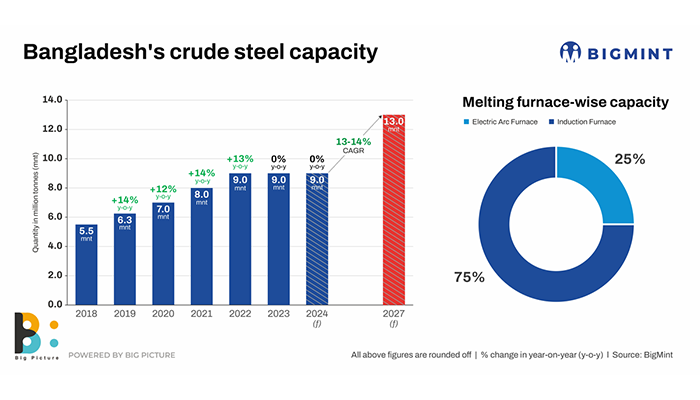
    Morning Brief: Bangladesh, a key South Asian country, is set to see an increase in steel demand in the medium-to-long term. Working towards this end, the country’s steel melting capacity is expected to increase by another 3 million tonnes (mnt) or over 40% to 13 (mnt) by 2027 from 9 mnt in CY’24 and crude steel production is seen rising over 35% to 8 mnt from almost 6 mnt in CY’24.

    A slew of infrastructure projects is nearing completion while a cache of new ones is likely to be announced, which will contribute 25-30% of steel demand. As a result, the country’s steel consumption is slated to increase 25% to around 10.60 mnt by 2027 from 8.5 mnt in CY’24.

    Current steel market overview

    Total crude steel production in 2023 was at 4.9 mnt with an utilisation of 60-65% of the 9 mnt capacity. Steel is produced through the electric furnace route with induction furnaces contributing 75% and electric arc furnaces the balance 25%.Current consumption is at 7.6 mntpa and increasing at 10% per annum. Out of the current consumption, 70% is contributed by government projects.

    Bangladesh was one of the fastest growing economies in the Asia Pacific last year, with a CAGR of 8.5% over 2019-22.

    Expansion plans of key mills

    Keeping future steel demand in mind, Bangladesh’s key mills are looking at expansion.

    Meghana Group of industries : Meghana is coming up with 1 mnt melting capacity is expected to complete it by FY2025.

    Abul Khair to increase melting capacity in 3 years: Abul Khair’s rerolling mills are expected to be completed by FY2025. It is planning to expand melting capacity by FY’27.

    Plans are also afoot to set up a 1.6-mnt rebar capacity by March. Thus, a total capacity of 3 mnt in rolling, and 1.6 mnt in crude steel production is in the pipeline.

    BSRM: Leading steel producer BSRM has announced plans to increase MS rod capacity by 0.5-0.6 mnt. The current melting capacity is 2.2 mnt, and rolling capacity, at 1.8 mnt. BSRM will add 0.6 mnt rolling capacity in the near future.

    It’s notable that other mills like Basundhara, Unitex and Haqeez are expanding their melting capacities, despite the extended completion period to FY27. This reflects the dynamic landscape of the steel industry, with companies strategically positioning themselves for future growth.

    Factors that will support increased steel demand

    Development of port facilities is being undertaken which will not only raise demand, but also facilitate increase in steel-and raw material-related trade. Development of port facilities will address limitations of existing infrastructure, allow entry of larger vessels, ease imports of scrap and boost trade and economic growth.

    These projects cumulatively are expected to increase steel demand by 20-25% over the next three years.

    Chattogram Port expansion: Chattogram Port, the premier seaport of Bangladesh, is undergoing significant development and expansion to meet growing import and export needs. The Bay Terminal is the most significant ongoing project, aiming to increase Chattogram Port’s capacity six times. The project involves constructing four terminals to accommodate larger vessels and handle increased cargo. Construction is expected to start in 2024 with partial operation targeted for 2026. Global port operators like PSA Singapore and Dubai-based DP World are expected to invest in the project, bringing in foreign investment and expertise.

    Matarbari to ease larger vessel movement: The Matarbari Deep Seaport project is progressing well. The channel construction was completed in November 2023. The foundation stone for the first terminal was laid in the same month. Construction is expected to be completed by December 2026.

    Once operational, Matarbari will allow the entry of larger vessels, facilitate easier imports of bulk cargo, and reduce congestion at Chittagong Port. The project is expected to attract new investments in steel and other industries due to improved import capabilities.

    Patenga Terminal to reduce congestion: This newly-built terminal, inaugurated in 2023, aims to reduce congestion at existing facilities with a capacity to handle 2.5 million TEUs of containers annually. The terminal is expected to facilitate faster cargo handling and improve overall port efficiency.

    Expansion of existing terminals: Existing terminals like Chittagong Container Terminal (CCT) are also undergoing expansion and modernization. Projects include upgrading equipment, increasing yard space, and improving automation to handle larger cargo volumes.

    Focus on technology & efficiency: The Chattogram Port Authority (CPA) is focusing on implementing digital solutions to improve efficiency and transparency in port operations. This includes initiatives like online cargo tracking, paperless documentation, and automated gate systems. Such advancements will increase ease of doing business.

    Other infra projects near completion: The Metro Rail and Dhaka Airport expansion projects are ongoing. The former, slated for completion this year, has seen cost and time overruns and may see closure in 2025. The latter will likely see completion of its third terminal by April 2024.

    Scrap import scenario

    Since there are no iron ore mines in Bangladesh, it is solely dependent on imported scrap for producing steel and has emerged as a key price setter in the seaborne scrap trade, along with Turkiye.

    The volume of imported ferrous scrap (both bulk and container) into Bangladesh stood at 4.68 mnt in 2023, down 10% against 5.2 mnt in 2022. The country is lately also exploring newer supplier geographies in containers that include Singapore, Malaysia, and Hong Kong.

    Bangladesh is the second largest destination for ship dismantling in the world and is coming up with four Green ship recycling yards, underscoring that it is active in domestic scrap generation which is at around 0.3 mntpa.

    Current challenges

    The country is currently battling some challenges in the post-Covid and war era.

    Inflation: The average inflation rate of 9.5% in 2023 was the highest in a decade. Rising interest rates have also stymied purchasing power and steel demand at present.

    LC constraints: Interest rates have increased in LC issuance, hampering scrap imports. The deposit required for LC approvals has also increased to 20% from the earlier 10%. Forex issues/remittance have dropped in the last two years. FY’21 saw the highest remittance flow at $24.77 billion but which dropped 18% in FY’22, rising slightly by 2.75% in FY’23.

    Outlook

    Growing urbanisation will see new project announcements by 2027, which will increase steel demand. Improved infrastructure and a global trade environment may also stabilise forex reserves and create room for better economic opportunities.

    4th Bangladesh International Trade Summit

    Bangladesh, a strategically significant country for Asia-Pacific, is emerging as a hotspot of growth through sustainable practices. The economic expansion is expected to encourage the participation of more global companies and attract forex for the country.

    BigMint Events will be hosting the 4th Bangladesh International Trade Summit on 14-15 May 2024,at Hotel Pan Pacific Sonargaon, Dhaka, Bangladesh. The two-day conference shall bring together key stakeholders from the steel, cement, and power industries, including industry stalwarts,policymakers, traders, and investors. It shall provide a network for collaboration and an ideal platform for discussion of prevailing industry trends and challenges.

  • Singapore International Ferrous Week 2024

    Singapore International Ferrous Week 2024

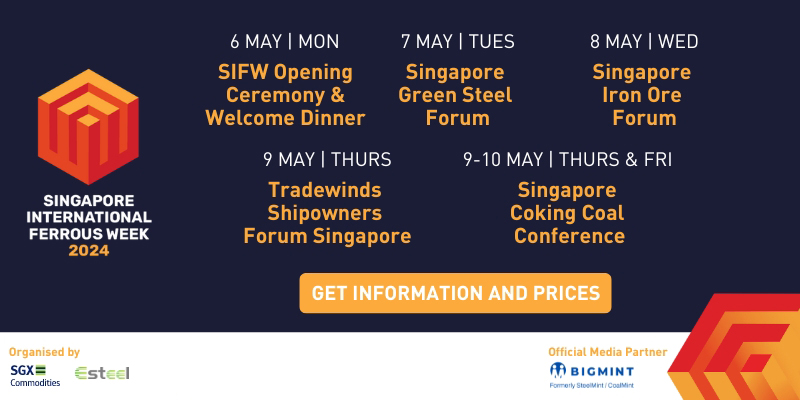
    2024 Event Calendar

    6 May 2024

    SGX COMMODITIES AWARDS AND COCKTAIL RECEPTION (By-invite-only)
    SIFW OPENING CEREMONY AND WELCOME DINNER

    7 May 2024

    SINGAPORE GREEN STEEL FORUM

    8 May 2024

    SINGAPORE IRON ORE FORUM

    9 May 2024

    SINGAPORE COKING COAL CONFERENCE
    TRADERWINDS SHIPOWNERS FORUM SINGAPORE

    10 May 2024

    SINGAPORE COKING COAL CONFERENCE

    SIFW OPENING CEREMONY AND WELCOME DINNER

    6 May 2024

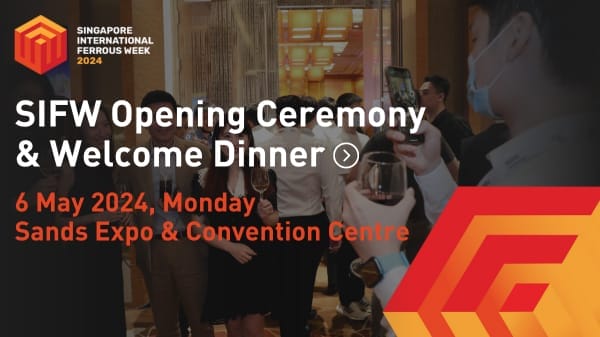
    SIFW Opening Ceremony & Welcome Dinner 2024 | 6 May 2024

    Kick off your SIFW 2024 journey in style at the official Opening Ceremony and Welcome Dinner. With over 1000 influential leaders and industry peers gathered in one evening, this dinner reception is your gateway to making new friends, and reconnecting valuable relationships.

    SINGAPORE GREEN STEEL FORUM

    7 May 2024

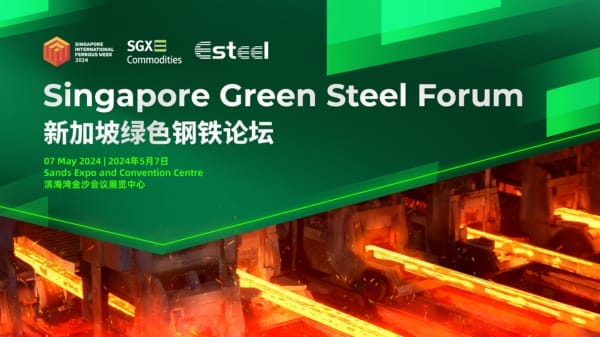
    The Singapore Geen Steel Forum will address the green transformation and sustainable development of the steel industry. Convening miners, steel mills, research institutions, intergovernmental agencies and financial institutions, participants can look forward to a day of insightful presentations, lively discussions, and opportunities to make new connections.

    SINGAPORE IRON ORE FORUM

    8 May 2024

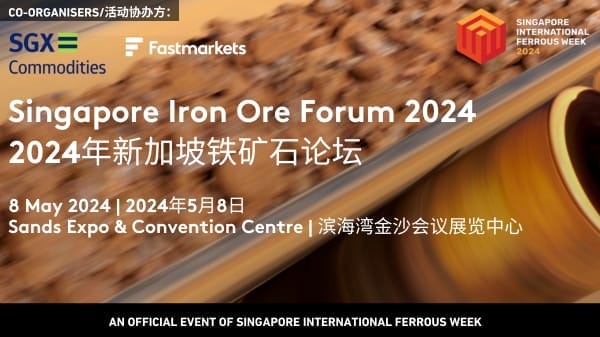
    SGX Commodities is partnering with Fastmarkets on Singapore Iron Ore Forum. The Singapore Iron Ore Forum is your opportunity to connect with the market and gain insights from Asia’s leading iron ore experts to help you prepare for the challenges and opportunities that lie ahead.

    TRADERWINDS SHIPOWNERS FORUM SINGAPORE

    9 May 2024

    TradeWinds will be back in Singapore to examine the issues that matter most to Asia’s premier shipping hub – the outlook for dry bulk and containers, ship finance, decarbonisation and much more. Join us on 9 May 2024 to convene with industry leaders and understand their strategies for confronting the challenges of modern shipping and delivering commercial success.

    SINGAPORE COKING COAL CONFERENCE

    9 – 10 May 2024

    Singapore Coking Coal Conference | SIFW 2024

    Singapore Coking Coal Conference is a must-attend for coking coal buyers, sellers, traders, brokers, and vendors, tackling critical & sensitive topics such as greenfield project finance, supply & demand outlook, pricing, true sustainability and strategies to survive and thrive in the competitive Asian markets.

    Website
  • Critical Materials Conference – Johannesburg 2024

    Critical Materials Conference – Johannesburg 2024

    Critical Materials Conference – Johannesburg 2024

    Venue: @Sandton Hotel, Johannesburg

    Schedule: 09/09/2024 – 11/09/2024

    Join Project Blue and key government, industry and finance stakeholders to discuss ferroalloy trends in South Africa’s mining heartland.

    Meet us in Johannesburg for an exciting programme and get the latest market intelligence on supply, demand and prices in the ferroalloys space. Connect with industry peers across the supply chain, reconnect with existing contacts, and do business on the sidelines of the event.

    Delegate rates

    Rates are calculated at checkout during your registration process

    Draft agenda

    The full agenda will be released in Q2 2024

    Day 1

    17:30  Registration and drinks

    Day 2

    07:30  Registration and networking

    09:00  Welcome and introduction

    Keynote session

    09:10  Global geopolitical and economic outlook

    09:30  Outlook for iron, steel and special steels

    09:50  Ferroalloy pricing trends

    10:10  Coffee and networking

    Manganese session

    11:00  Manganese market trends in China

    11:20  Key trends in the manganese alloy market

    11:40  The impact of batteries on the manganese supply chain

    12:00  Panel discussion

    12:30  Lunch

    Vanadium session

    14:00  Vanadium market outlook

    14:20  Vanadium trends in China

    14:40  How will VRFBs change the market?

    15:00  Panel discussion

    15:30  Coffee and networking

    Other ferroalloys session

    16:00  Outlook for tungsten

    16:20  Outlook for niobium

    16:40  Outlook for silicon

    17:00  End of day two

    19:00 Gala dinner @Sandton Hotel

    Day 3

    07:30  Registration and networking

    09:00  Welcome and introduction

    09:05 Government keynote

    South Africa session

    09:30  Outlook for ferroalloys in RSA

    09:50  Electricity and logistics in RSA

    India session

    10:10  India economic outlook

    10:30 Outlook for ferroalloys in India

    10:50  Coffee and networking

    China session

    11:20  China economic outlook

    11:40 Ferroalloys trends in China

    Country sessions discussion

    12:00  Panel discussion

    12:30  Lunch

    Chromium session

    14:00  Stainless steel market dynamics

    14:20  Key trends in chrome ore and alloys markets

    14:40  Chromium market trends in China

    15:00  Panel discussion

    15:30  Coffee and networking

    Other stainless materials session

    16:00  Nickel market outlook

    16:20  Molybdenum market outlook

    16:40  End of conference

    Venue information

    @Sandton Hotel

    5 Benmore Rd, Benmore Gardens, Johannesburg, 2196

    Website
  • MENA GREEN STEEL SUMMIT 2024 IN-PERSON & VIRTUAL |  SEPTEMBER 25TH-26TH, DUBAI, UAE

    MENA GREEN STEEL SUMMIT 2024
    IN-PERSON & VIRTUAL | SEPTEMBER 25TH-26TH, DUBAI, UAE

    About Our Event

    why you should join

    • Obtain market intelligence on the latest market and technology development in green steel technology.
    • Conducting technical exchanges with hundreds of industry professionals and decision makers
    • Establish new contacts and explore potential business growing opportunities
    • Collaboratively charge toward sustainable steelmaking
    Great Speaker new experience networking afterparty

    summit highlights

    MENA Green Steel Summit 2024 starts on September 25

    First Day – SEP 25, 2024

    • STEEL AND IRON ORE’S DECARBONIZATION ROADMAP IN A 2050 NET-ZERO SCENARIO
    • IRON AND STEELMAKING – TRANSFORMATION FOR SUSTAINABILITY TOWARDS A GREENER FUTURE
    • GREEN HYDROGEN IN STEELMAKING – OPERATIONAL IMPLEMENTATION CHALLENGES
    • UNLOCKING GREEN STEEL – HOW THE MENA CAN BE PART OF THE GLOBAL EFFORT TO DECARBONIZE THE STEEL INDUSTRY
    • HOW THE INCREASING MARKET DEMAND FOR GREENER STEEL WILL RESHAPE FUTURE STEELMAKING?
    • STAINLESS STEEL — PROVIDING THE SUSTAINABLE MATERIALS CHOICE
    • ADVANCES IN UAE’S METALS SECTOR TO FACILITATE INFRASTRUCTURE INVESTMENTS TOWARDS SUSTAINABILITY
    • RAW MATERIALS — UPSTREAM SUPPLY CHAINS UNDER GREEN AND DECARBONIZATION PRESSURE
    • CRITICAL INSIGHTS: ENERGY CRISIS IN EUROPE AND THE IMPACT ON FUTURE ESG AMBITIONS
    • TOWARDS INDUSTRY 4.0: HOW THE DIGITALIZATION OF STEEL VALUE CHAIN CAN SUPPORT A GREEN TRANSFORMATION?
    • HYDROGEN DRI AND SCRAP – TRANSFORMATION OF PRIMARY AND SECONDARY PRODUCTION
    Second Day – SEP 26, 2024

    • RESPONSIBLE STEEL – BUILDING A MORE SUSTAINABLE STEEL INDUSTRY
    • HOW GREEN DIGITALIZATION ACTS A DRIVER OF DECARBONIZATION TOWARDS GREEN STEELMAKING
    • CRAFTED SCRAP – ADVANCED TECHNOLOGY FOR HIGH QUALITY GREEN STEEL PRODUCTION
    • SUSTAINABILITY PERSPECTIVES: HELP OR HINDRANCE? THE ROLE OF ENERGY PRICES IN THE GREEN STEEL TRANSITION
    • IMPLEMENTATION OF NEW TECHNOLOGIES IN STEEL INDUSTRY — FROM PRODUCERS’ PERSPECTIVE
    • GLOBAL SCRAP AND METALLICS MARKETS DYNAMICS- HOW BIG A ROLE SCRAPS AND METALLICS PLAY IN DECARBONIZING THE STEEL INDUSTRY
    • SUSTAINABLE STEEL FOR PACKAGING: CLOSING THE LOOP ON STEEL AND METAL PACKAGING
    • SUSTAINABLE STEELMAKING FOR THE PRODUCTION PROCESSES OF TODAY AND TOMORROW
    • PARTNERSHIP ACROSS THE VALUE CHAIN TO DELIVER CARBON NEUTRAL STEEL
    Website