SteelMint Events

Category: 3rd SRMC

  • GPH Ispat Commissions Operation at its Quantum EAF Furnace

    GPH Ispat Commissions Operation at its Quantum EAF Furnace

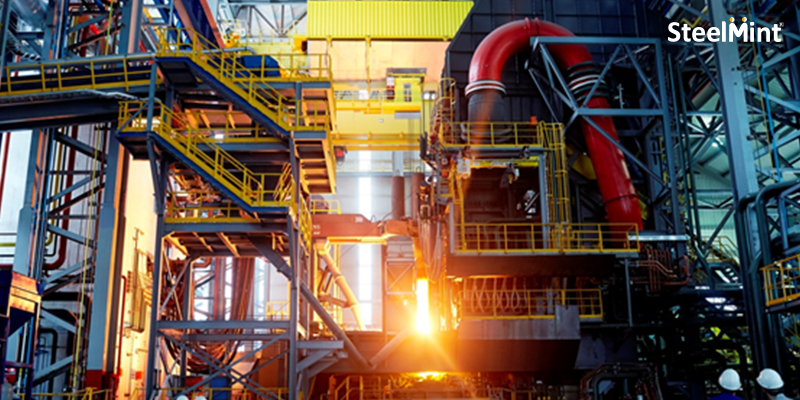
    GPH Ispat, one of the major steelmakers based in Chittagong, Bangladesh was long waiting the operationalizing of their Quantum Electric Arc Furnace, the first of its kind the region, at their new steel plant in Sitakunda region. The steelmaker yesterday, on 15th January 2020 finally performed its 1st heat at their new furnace. This was successfully conducted right up to the rolling stage, putting GPH Ispat right on the cusp of becoming the 3rd largest steelmaker in Bangladesh, once the production is scaled up after test phase.

    Supplied by the global engineering solutions provider “Primetals Technologies” the new plant includes an 80 T Quantum EAF Furnace with a preheating system, which provides a staggering 36 heats per day for steelmaking, on account of a low tap-to-tap time of just 40 minutes, ensuring an annual steel melting capacity of 840,000 MT/year. Along with the existing melting capacity of 170,000 MT via its older Induction furnaces, the combined steelmaking capacity of GPH Ispat breaches 1 MnT per year.
    The other advantages of this Quantum EAF are reduction in flicker and electrical grid network disturbances, Minimized furnace movements along with the permissibility of taphole refilling under Power-On condition with automation, ensuring the safer operation of the furnace.

    The new plant also expands the steelmakers rolling capacity, adding an additional 640,000 MT/year to the already existing 150,000 MT rolling capacity from the previous mill. The new WinLink Flex installed in this plant ensures a rolling speed of up to 27 meters per second, in addition to which, the new three-strand continuous billet caster with a high casting speed of up to six meters per minute, allows two of the three strands to feed the downstream rolling line almost continuously, thus eliminating the need for the usual reheating furnace and reducing operational costs.

    GPH Ispat is confident that post the testing phase as the full scale production at their new plant commences in the coming months, it will help them in producing higher grade of steel products and meeting the international standards.

    To know more about the expansions and upcoming capacities in the Bangladesh Steel Industry, book your seat at SteelMint Events’ 3rd Steel and Raw Material Conference, Emerging Bangladesh and get a chance to hear the views of renowned industry participants from across the globe. The conference is being organized on 23rd-24th March 2020 in Chittagong, Bangladesh.
  • Megatherm Green Induction Furnace Ensures 8% Increase in Productivity

    Megatherm Green Induction Furnace Ensures 8% Increase in Productivity

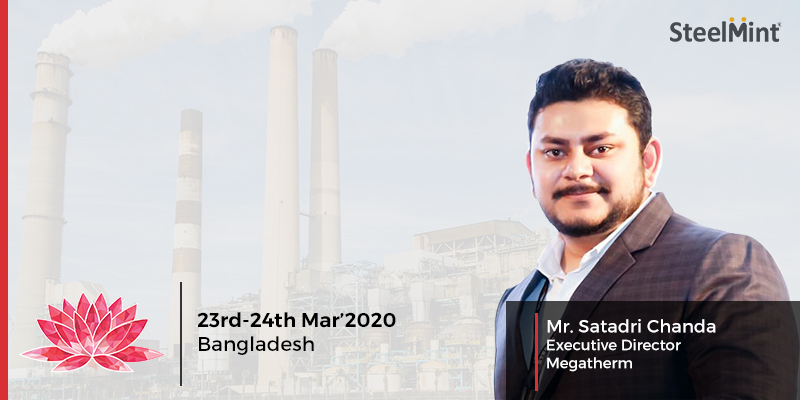
    Mr. Satadri Chanda, Executive Director of Megatherm since 2016, shared his views about the induction furnace market in Bangladesh and future prospects of the company’s new energy-efficient “green induction furnace” in the emerging steel industry of this country. Below is an edited excerpt from his recent interview to SteelMint.

    Q1. How many induction furnaces for steel melting are operational in Bangladesh? What is the share of Megatherm in the same?

    A. With respect to steel melting, there are around 90-95 induction furnaces currently operational in Bangladesh, while around 4-5 “green IFs” are on the verge of being commissioned in the next 5-6 months. In Bangladesh, most of the mills have replaced their old smaller furnaces with larger 15-20 tonne furnaces in the last five years, apart from new furnaces being set up by the existing players.

    Coming to Megatherm, it has about 50 induction furnaces operational in Bangladesh considering many old furnaces have been replaced by new ones.

    Q2. What are Megatherm’s steel capacities in the pipeline?

    A. We have over half a dozen new IFs in the pipeline for Dhaka and Chittagong mills over the next 12-18 months.

    Q3. When was Megatherm’s new Green Furnace launched in the Asian market and how is this Green Furnace better than its predecessors?

    A. Launched in late 2017, the Green Furnace has been very successfully received in the global market, including India and Pakistan, and now it is making strides in Indonesia, Iran, Saudi Arabia and other markets. It will be formally launched in the Bangladesh market this year.

    Green furnace guarantees an energy consumption of 460 kWh/t to 470 kWh/t (using mill heavy/end cutting scrap at 1600°C), which is significantly more efficient than the consumption of 515 – 545 kWh/t recorded by its predecessors and 500 – 510 kWh/t recorded by latest models of other brands.

    Apart from this, the Green Furnace also guarantees up to 8% increase in productivity compared to the previous record-holding furnaces without the need for furnace capacitor switching as well as a the sustained power factor of over 98% throughout the heat cycle. The load factor has been improved to 95% by increasing power pick-up.

    Q4. Since when have you planned to start marketing Green Furnaces in Bangladesh. How has it been received so far?

    A. While some green furnaces have been sold to Bangladesh mills for observing results and customizing to suit Bangladeshi operating conditions, the Green Furnace will be formally launched during the event. We have recently installed green induction furnaces of 20 T each in Salam Steel, Vikrampur Steel and Montana Steel which have all been commissioned, while another green IF of 20 T at Bandar Steel is about to be commissioned in the first half (H1) of 2020.

    Q5. With Megatherm currently being more dominant among Dhaka-based steel mills with up to 20T furnaces, is there any conscious plan for growing Megatherm’s share in the larger mills of Chittagong?

    A. Megatherm has always depended on product superiority and word of mouth, to ensure sales. Strong active marketing has not been Megatherm’s mode of operation. In all regions where one Green Furnace has been commissioned, we have got a majority market share. Examples include Durgapur, Raipur, Champa, Pakistan and very recently Hyderabad. We expect the same with Chittagong.

    Q6. In your view, what are the major challenges being faced by Bangladesh-based steel mills with regard to melting furnaces?

    A. Bangladesh steel mills are not run as efficiently as plants based out of India and some other regions. This further increases the need to have a more energy-efficient and productive furnace.

    The Megatherm Group is a renowned manufacturer of industrial equipment for metal heating and melting and has its presence across industries like steel, foundry, forging and power. The company is one of the leading players in the induction furnace installations space for steel manufacturers across South Asia and other regions.

    To know more on growing steel melting capacities in Bangladesh and challenges ahead, book your seat at SteelMint’s 3rd Steel and Raw Material Conference, Bangladesh and get a chance to hear views of renowned industry participants from across the globe. The conference is being organized on 23rd-24th March, 2019 in Chittagong, Bangladesh.

  • Increasing Coated Steel Capacities to keep Bangladesh HRC Imports Strong

    Increasing Coated Steel Capacities to keep Bangladesh HRC Imports Strong

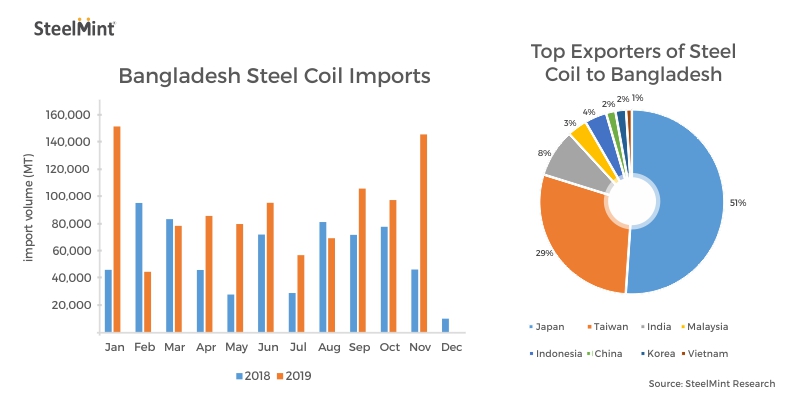
    One of the emerging steel markets – Bangladesh is rising up to be a major importer of bulk steel coil for raw material in its cold rolling and galvanizing industries. According to data maintained with SteelMint, in Nov’19, Bangladesh’s bulk steel coil import has witnessed a sharp surge with a flurry of Bulk cargoes arriving at berth, leading its monthly imports to reach the highest volume in the last 10 months.

    The bulk HRC imports by the country rose by 50% M-o-M as Bangladesh imported 145,795 MT of of Steel coil in Nov’19 as compared to 97,463 MT on Oct’19. Prior to this, the highest import volume was observed in Jan’19 when the steel coil imports were recorded at 151,628 MT. It is to be noted that Nov’19 HRC import volume was 2nd highest in over 4 years since Aug’15.

    Japan continues to remain the largest HRC exporter to Bangladesh

    Among the major exporters of steel coil to Bangladesh, Japan has continued to retain the pole position, exporting 98,438 MT of material alone in Nov’19, with a share of just under 68% in the total imports by Bangladesh. Taiwan, India and Malaysia with one bulk vessel each stood at the other top exporters to Bangladesh.

    In a Y-o-Y comparison for the period of Jan-Nov, Bangladesh has registered a staggering growth of around 49% Y-o-Y, with its imports in 2019 (Jan-Nov) being reported at 1,008,054 MT, breaching the 1 MnT mark in annual import volume for the first time ever, in comparison to 678,145 MT in 2018 (Jan-Nov)

    In 2019 (till Nov’19), Japan stood as the largest supplier of Steel coil to Bangladesh with a 51% of share in its total imports this year, as it supplied 514,767 MT of material during Jan-Nov’19, up by 7% y-o-y in comparison to the same period in 2018. The other top suppliers to Bangladesh in 2019 were Taiwan, India, Indonesia and Malaysia with a share of 29%, 8%, 4% and 3% respectively in Bangladesh’s total imports this year as of yet.

    Interestingly, Taiwan has increased its export volume to Bangladesh by more than six folds in 2019, registering a 652% Y-o-Y and supplying 289,735 MT this year as compared to just 38,528/MT in 2018, thus looking to compete with Japan as the top supplier in the coming years.

    Overview of Bangladesh flat steel industry

    Major players in Bangladesh’s flat steel industry include PHP Steel Complex, Abul Khair and KDS Group.

    PHP Steel Complex is now operating 4 separate industries that are; PHP Cold Rolling Mills Ltd., PHP Continuous Galvanizing Mills Ltd., PHP NOF Continuous Galvanizing Mills Ltd., and the captive power plant- PHP Power Generation Plant Ltd. The current total production capacity is 0.25 MnTPA.

    Abul Khair has renowned flat steel products, namely ‘Goru Marka Dhew Tin’, ‘Cow Brand Colour Coated Steel’ & ‘Zinkalum’ with a production capacity of over 750000 MTPA.

    KDS Group has monthly capacity of 3,000 MT of color coated steel, 8,000 MT for galvalume and 6,000 MT for GI.

    Outlook

    In recent visit to Bangladesh, SteelMint learned that steel mills are completely reliant on imported HRC for their coated & color coated units. Existing players are eyeing for capacity enhancement in coming years. This will surely keep HRC import volumes to Bangladesh on higher side.

    To know more about the finished flat steel industry in Bangladesh book your seat at SteelMint Events’ 3rd Steel and Raw Material Conference, Emerging Bangladesh and get a chance to hear views of renowned industry participants from across the globe. The conference is being organized on 23rd-24th March 2020 in Chittagong, Bangladesh.
    Explore

  • Bangladesh Observes Sharp Decline in Import of Scrapped Ships in Q3 2019

    Bangladesh Observes Sharp Decline in Import of Scrapped Ships in Q3 2019

    Bangladesh is one of the largest ship-breaking and recycling hubs in the world, which forms an important source of ferrous scrap to the country’s increasingly scrap-dependent steel industry. Bangladesh is on a course of surpassing India to become the country with the largest number of used ships imported in CY 2019.

    However in Q3’2019, the country witnessed a sudden slump in its imports of scrapped ships.

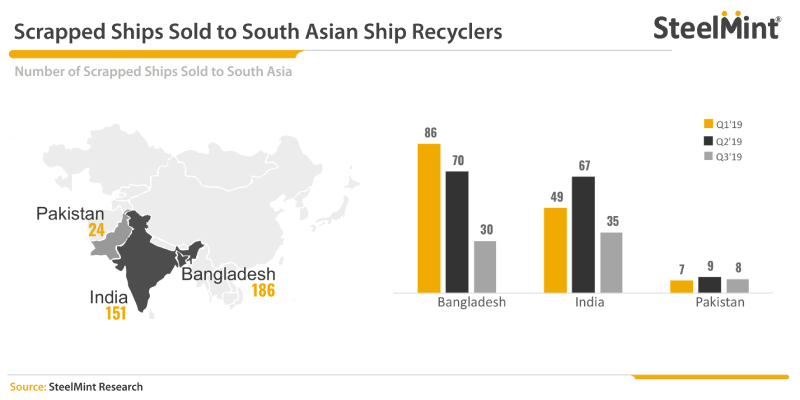
    The number of scrapped vessels imported to Bangladesh for ship-breaking and scrap generation, witnessed a significant fall of 57% Q-o-Q in Q3 CY’2019 with just 30 vessels being imported in the quarter, as against 70 vessels imported in Q2 CY’19, as per data released by NGO Shipping platform. Notably, in Q1’2019, the number of vessels imported stood at 86, the highest quarterly figure as yet.

    The major reasons attributed to the sharp fall in vessel import numbers in Q3 are the new taxes imposed in Bangladesh’s annual budget implemented from July’19, as well as the oversupply in the surplus imports in the preceding quarters. An additional VAT at a specific rate of BDT 1000/Tonne was imposed on import of scrap ships after the implementation of the budget, a change from the initial proposal of the budget in Jun’19, which had  proposed a 5% VAT on the value.

    In anticipation of the tax alterations in this year’s budget, most of the ship-breaking yards in the country had booked scrap vessels in excess, in the preceding Q1 and Q2’19. The surplus scrapped ships after being processed created an oversupply in the local scrap market of Chittagong which lasted for around 3-4 months, thus discouraging recyclers from importing further vessels, amid huge quantities of unsold inventories of scrap.

    The said over supply in the market also pulled down the ship yard scrap prices in the domestic market, with offers for local ship yard scrap, falling from BDT 37,000/MT to 29,000/MT ex Chittagong, within a span of just 3 months in the quarter.

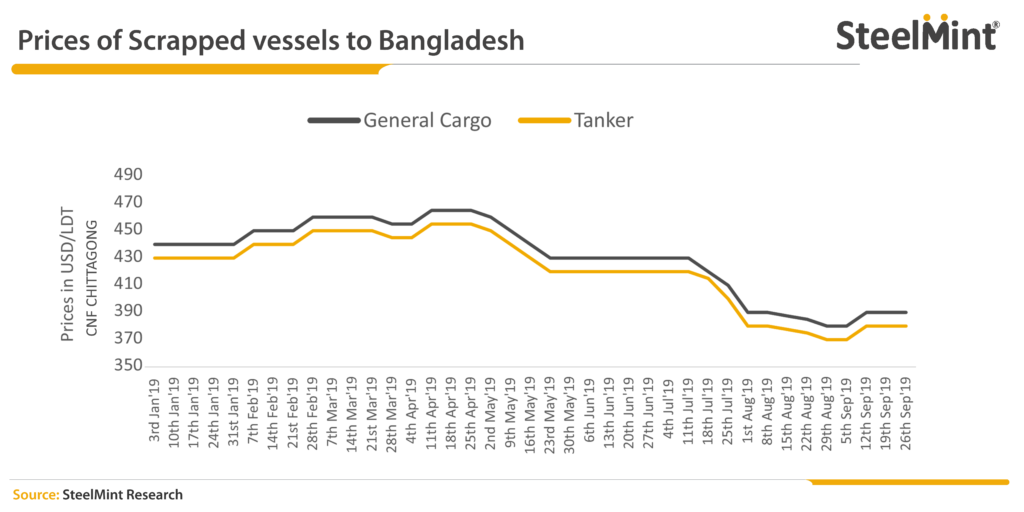
    The severely weakened demand for import of scrapped vessels from a major buyer like Bangladesh led to a continuous fall in its prices, with the offers for Tanker vessels sharply declining from USD 420/LDT CFR Chittagong in the beginning of Q3’19 to around USD 370/LDT CFR by Sep’19.

    On the other hand, for the period of Jan-Sep 2019, Bangladesh has considerably improved against other South Asian markets in terms of number of scrapped vessels imported and even surpassing India for the 1st time. From Jan to Sep’19, Bangladesh imported 186 scrapped vessels, against 151 vessels imported by India, while Pakistan remained at 3rd with just 24 vessels imported till Sep’19.

    In 2018 (Jan-Sep’18) Bangladesh had lagged behind India with 124 scrap vessels being imported during this period, as compared to 195 vessels imported by India. However, even with a significantly lesser number of vessels imported, Bangladesh had surpassed India in terms of total volume of scrapped ships imported, as the country’s volume for imports of scrapped vessels stood at 1.79 Million LDT in Jan-Sep’18, as against 1.46 Million LDT for India, thus indication that Bangladesh imported larger scrapped vessels on an average for recycling.

    To know more about ship recycling industry in Bangladesh book your seat at SteelMint’s 3rd Steel and Raw Material Conference, Bangladesh and get a chance to hear views of renowned industry participants from across the globe. The conference is being organized on 23rd-24th March 2020 in Chittagong, Bangladesh.
    Explore

  • Bulk Ferrous Scrap Imports to Bangladesh Surge 39% in Jan-Oct 2019

    Bulk Ferrous Scrap Imports to Bangladesh Surge 39% in Jan-Oct 2019

    Bangladesh, an emerging steel market and one of the growing importers of ferrous scrap in Asia, has witnessed a sharp increase in bulk ferrous scrap imports in 2019.

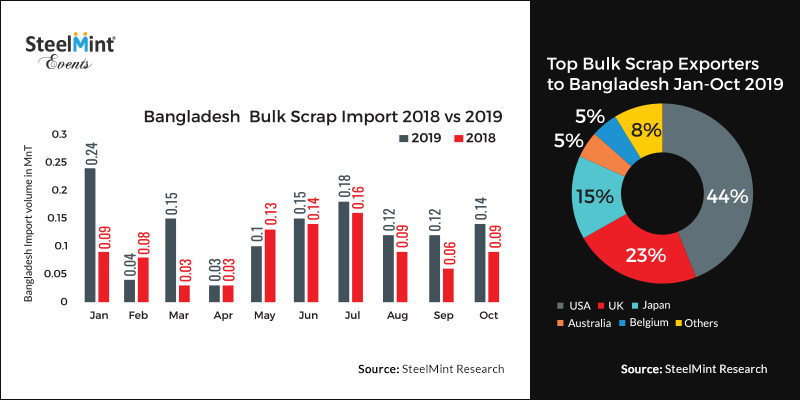
    During the period of Jan-Oct’19, bulk scrap imports to Bangladesh have been recorded at 1.25 MnT, witnessing a significant increase by 39% Y-o-Y as compared to 0.90 MnT during the same period Jan-Oct’18.

    Rising melting capacities and expansion plans of major steelmakers in the country has led to an increased ferrous scrap demand, while even more steelmakers are now turning active in booking scrap through bulk cargo vessels, as compared to only two major steelmakers booking bulk scrap till last year.

    46 bulk scrap vessels arrived at berth – So far in 2019, a total of 46 bulk vessels of ferrous scrap arrived on berth in Bangladesh’s sea port, which is again a sharp increase against 31 bulk vessels last year (Jan-Oct’18).

    USA remained the largest bulk scrap supplier – In terms of preferred origins for bulk scrap to Bangladesh, USA has remained the largest supplier in 2019 as well with 0.55 MnT as yet, however its share in total bulk scrap imported to Bangladesh has come down to 44% in 2019 (Jan-Oct) from 68% during Jan-Oct’18. However share of origins like UK, Japan and Australia considerably increasing their share this year.

    Increased preference for UK & Japanese scrap cargoes – In particular, bulk scrap imports share from UK has increased from 13% in Jan-Oct’18 to 23% in Jan-Oct’19. Interestingly, out of the 47 bulk vessels with scrap that have come to berth at Chittagong port this year, Japan has a contribution of 13 bulk vessels with nearly 0.2 MnT, recording a two-fold jump against same time span last year.

    In Oct 2019, bulk scrap imports to the country witnessed an increase by 19% M-o-M.

    After govt imposed import duty made billet imports to Bangladesh non viable since 2015, scrap imports gradually went on to completely replace billet imports to Bangladesh by 2018. Further, the share of bulk vessels in the total scrap imports to the country has also been observing an increase since then.

    To know more on Bangladesh scrap imports, book your seat at SteelMint’s 3rd Steel and Raw Material Conference, Bangladesh and get a chance to hear views of renowned industry participants from across the globe. The conference is being organized on 23rd-24th March 2019 in Chittagong, Bangladesh.

    Explore