SteelMint Events

Category: 6th Indian Iron Ore & Pellet Summit

  • India: What is the status of iron ore blocks auctioned since 2015?

    India: What is the status of iron ore blocks auctioned since 2015?

    • Over 60% of auctioned blocks in Odisha, Karnataka since the MMDR Amendment Act, 2015
    • Average auction premium at over 100%
    • Production to increase as many auctioned mines may come onstream

    Around 100 iron ore mine blocks have been successfully auctioned in India since the historic amendment of the Mines and Minerals Development & Regulation Act (MMDR Act) in 2015, as per SteelMint data.

    MMDR Amendment: Key facts

    The landmark MMDR Amendment Act, 2015 paved the way for the introduction of the auctions regime in India’s mining and minerals sector by replacing the older first-come-first-serve system in a bid to ensure transparency in allocation of mineral blocs.

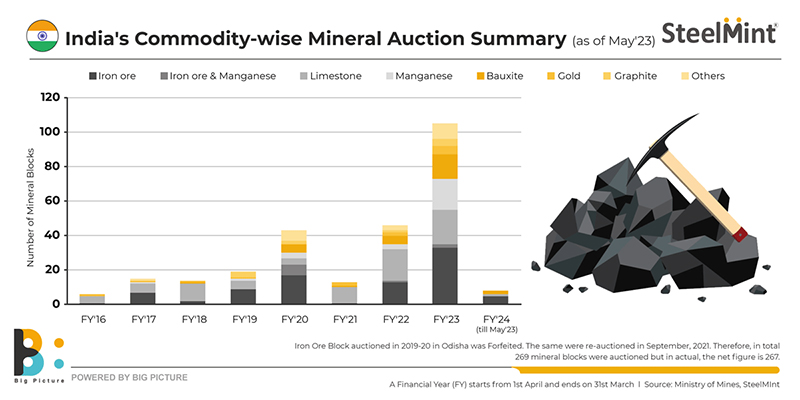
    The reforms undertaken in 2015 have resulted in successful auctions of 273 mineral blocks in different states of the country since 2016. Importantly, the pace of mineral auctions has quickened since the MMDR Amendment Act of 2021, with around 105 iron ore blocks getting auctioned in FY’23.

    This has been possible due to radical reforms in the 2021 Amendment such as the abolition of the ‘end-use’ restriction for auctions and uninterrupted transfer of valid old environmental clearances to the preferred bidder.

    It bears recall that the 2015 MMDR amendment had set forth specific clauses as regards renewal of mine leases. While merchant mines had their leases extended till 2020, the captive iron ore mines were given a timeline till 2030 after which those mines must come under the auction hammer.

    In order to augment domestic iron ore supplies, Section 8(A) of MMDR Act was further amended allowing any lessee of a captive mine to sell minerals up to 50% of the total mineral produced in a year after meeting the requirement of the end-use plant linked with the mine. This, however, would require an additional amount to be paid to the concerned state government.

    Similarly, government companies or corporations whose mining leases have been extended after the commencement of the MMDR Amendment Act, 2015, shall also pay such additional amount for the mineral produced after the commencement of MMDR Amendment Act, 2021.

    The additional amount for extension of mining leases is 1.5 times the prevailing rate of royalty for iron ore mines.

    Auctioned blocks

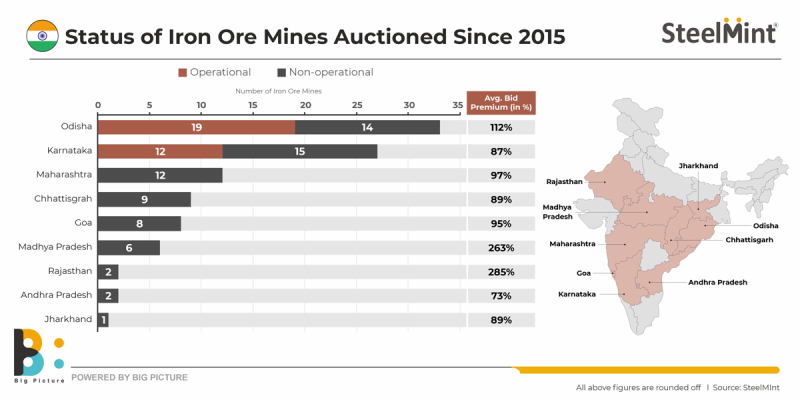
    Notably, out of the 100 iron ore blocks auctioned thus far, 33 are in Odisha and 27 in Karnataka – India’s leading iron ore producing states. Among the other key producers, 12 blocks are in Chhattisgarh, 9 in Maharashtra and 8 in Goa.

    Details of auctioned blocks
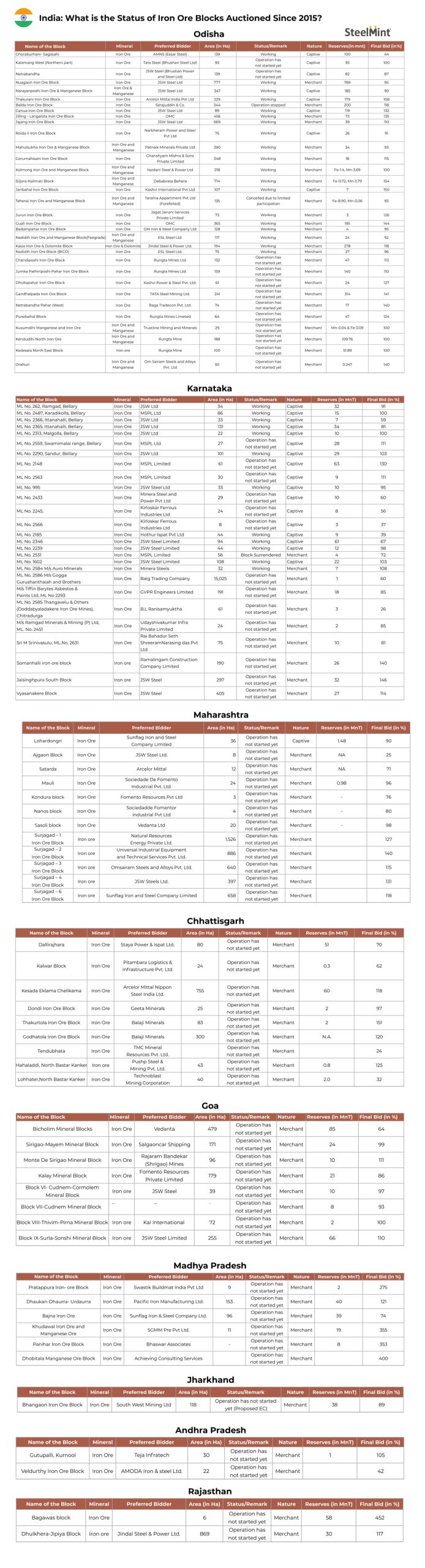
    There are blocks in Madhya Pradesh and Andhra Pradesh, too. However, major iron ore-producing-state Jharkhand has just one block. A lion’s share of that state’s iron ore production is accounted for by captive steel producers.

    In an indicator of over-enthusiastic participation in iron ore auctions – mainly by steel players eager to secure long-term supplies in view of surge in capacity – the general average auction premium quoted stands at over 100%, as per SteelMint estimation.

    Outlook

    India’s iron ore production in FY’23 inched towards 260 million tonnes (mnt). Out of the auctioned blocks, just over 30-odd are in working status which shows that many more mines – especially those auctioned since 2021 – will move towards operationalisation sooner rather than later.

    Therefore, SteelMint’s outlook is positive as regards iron ore production even as domestic steelmaking capacity gathers pace.

    What are the key government policies that may reshape the Indian minerals industry and how long might high premiums sustain for mineral block auctions? Gain cutting-edge insights from experts on these issues and much more at SteelMint Events’ flagship 6th Indian Iron Ore & Pellet Summit to be held from 24-26 August at JW Marriot, Kolkata.
  • India: Mills raise imports of Australian iron ore on possible increase in sinter burden

    India: Mills raise imports of Australian iron ore on possible increase in sinter burden

    In a recent development, certain Indian steel mills have started importing Australian iron ore fines in place of mainstream Brazilian iron ore concentrates.

    SteelMint has heard that Australian miners have started supplying low- to medium-grade iron ore fines (Fe57%-60.5%) to western India-based mills, with recent news of major miner Roy Hill commencing shipments after a pause of five years. An estimated volume of 0.5-1 million tonne (mnt) of shipments have been heard of late. Vessel named “Hedwig Oldendroff” carrying 179,500t Australian iron ore fines is expected to arrive at Jaigad port by end Jun’23.

    Preference for fines instead of concentrates can be traced to the fact that mills are most likely increasing the sinter burden in their blast furnaces instead of pellets, SteelMint learn from market sources. This is because it is difficult to ship and transport iron ore concentrates over long distances in the rainy season.

    Indian mills typically feed 25-30% of pellets and 50-55% of sinter as charge mix in blast furnace, although this differs across steel mills. Notably, the leading private sector mills, with considerable pelletisation capacities, are increasing the pellet burden in their blast furnaces to maximise gas permeability through charge mix for efficient reduction, higher energy utilisation, and keeping the slag rate per tonne of hot metal under check so as to maximise output and efficiency.

    Why are mills turning to imports?

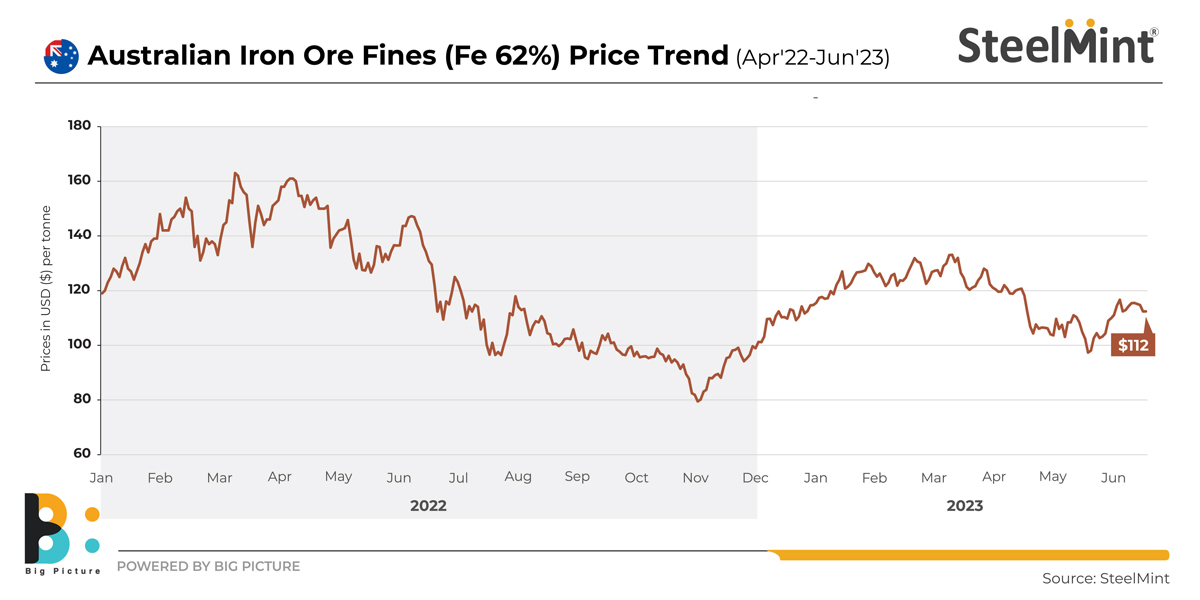
    Low global iron ore prices: Indian mills remained favourably inclined towards imports, with iron ore prices falling quickly since the second half of April as expectations of a rapid Chinese recovery faded. Prices of mainstream Australian fines (Fe 62%) dropped below the psychological $100/t CNF China level in the last week of May. Although prices have climbed in the first week of June on China interest rate cuts and stimulus hopes, the low- to medium-grade fines cargoes had been booked by Indian mills when prices had sunk. Also, given the steep freight charges and hassles involved in transporting domestic iron ore from, say, Odisha to the western part of India, mills showed preference for imports.

    Quality issues: Domestic iron ore has a higher gangue content compared with imported ore. The level of alumina + silica in domestic ore is markedly higher than Australian material and is obviously better suited for sintering purposes and leads to higher efficiency in the blast furnace.

    Logistical bottlenecks: Over and above high domestic freight charges, logistical hurdles such as unavailability of rakes pose a major problem for mills. Logistical difficulties intensify during the monsoon season, which tilts the balance in favour of imports for some coast-based mills.

    6th Indian Iron ore & Pellet Summit

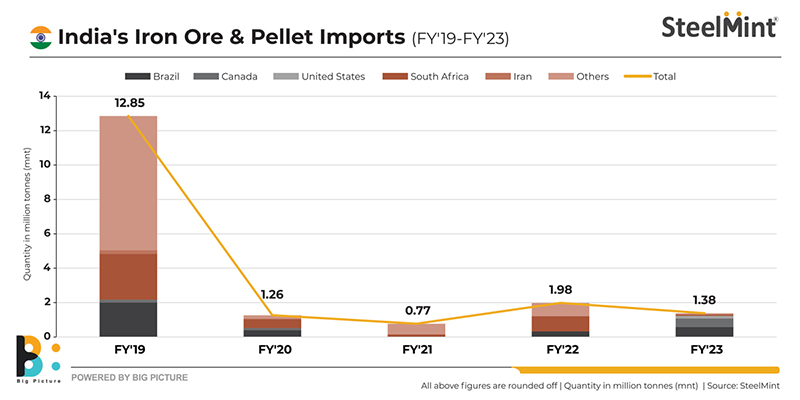
    India’s iron ore consumption is slated to rise to 360 mnt by 2030, as per SteelMint estimates, in tandem with fast-paced growth in crude steel production. While domestic iron ore capacity expansion has gathered momentum, especially after the transition to the auctions regime, it is believed that imports may increase. This may be due to probable changes in the policy landscape or with depletion of high-grade domestic reserves, with the requirement for higher grades increasing amid the decarbonisation wave sweeping across the industry.

    For in-depth insights into these issues and more, register for SteelMint Events’ 6th Indian Iron ore & Pellet Summit to be held at JW Marriott, Kolkata, from 24-26 August, 2023.

  • India’s iron ore mine auctions gain traction in FY23; what to expect next?

    India’s iron ore mine auctions gain traction in FY23; what to expect next?

    • Competitive bidding route gains traction from FY20
    • Odisha tops auctions chart since FY16
    • Odisha and Karnataka eye further auctions

    India’s mineral block auctions showed a marked upturn in 2022-23 (FY23) with successful bids more than doubling y-o-y. Madhya Pradesh led the competitive bidding route with 29 non-coal blocks allotted for auction last fiscal, followed by Chhattisgarh with 20 and Odisha with 10.

    It may be mentioned, the country has successfully auctioned off 267 mineral blocks since the Minerals Development & Regulation (MMDR) Act was amended in 2015, with the process gathering speed sharply in FY23, reveals data maintained with SteelMint.

    Two iron ore blocks auctioned in 2019-20 — Guali and Jilling Langalota, which had been bagged by Jindal Steel & Power and Shyam Ores Jharkhand respectively, were later forfeited because the high premiums rendered these unviable for the winners. They surrendered the same, which were awarded to OMC.Therefore, in total, 269 mineral blocks were auctioned but in actuality, the net figure had been 267.

    MMDR Act paves way for auctions

    It may be recalled that the auctions regime in India had received the green signal from the amended MMDR Act. Prior to this, mineral blocks were dispensed on a first-come-first-serve basis. However, the amended Act cleared the way for the more transparent competitive bidding route. And, since 2016, India has been awarding mineral blocks only through this platform.

    Section 8(A) of the Act was further amended, allowing any lessee of a captive mine to sell minerals up to 50% of the total mineral produced in a year after meeting the requirement of the end-use plant linked with the mine. This, however, required an additional amount to be paid to the concerned state government. Similarly, government companies or corporates whose mining lease has been extended after the commencement of the MMDR Amendment Act, 2015, shall also pay such additional amount for the mineral produced after the commencement of MMDR Amendment Act, 2021.

    All the amendments were made with an eye on raw material security for domestic steel mills.

    However, it was only from financial year 2019-20 (FY20) that this route started gaining traction when 43 blocks were auctioned off. This was also the year when 25 key working iron ore leases in Odisha were put under the hammer. The year 2020-21, being a Covid one, saw a subdued response. But the pace again gained momentum from 2021-22, when 46 blocks were bagged, reaching a peak of 105 in 2022-23.

    State-wise auctions break-up

    Odisha has topped the auctions charts with a leading 48 blocks having come under the hammer and successfully finding takers till date. Madhya Pradesh came a close second with 46, followed by Karnataka in third slot with 36.

    Other states that played an active role were Maharashtra (34) and Chhattisgarh (29).

    Mineral-wise break-up

    Of the 105 non-coal mineral blocks auctioned off in 2022-23 (including mining leases and composite licenses), the share of iron ore was at a leading 35 (including two iron ore and manganese). This was followed by limestone (20) and manganese (18).

    Auctions highlights

    Goa auctions take off last year: Goa started the auctions last year after much proactive deliberations. The state auctioned four blocks last year (three in north Goa and one south). The successful bidders for the north blocks were Vedanta (Bicholim), Salgaoncar Shipping (Sirigao Mayem), Rajaram Bandekar (Monte de Sirigao) while Fomento Resources bagged Kalay in south Goa. Together, these have around 139 mnt of reserves.

    The state has put auctioning of mining leases on the fast track.

    Auctions gain pace in Maharashtra, Karnataka: Active auctions were seen in Maharashtra and Karnataka last year too. Five blocks were auctioned in Maharashtra over 2022-23. Of these, four were composite leases and one, a mining lease.

    In Karnataka, the Supreme Court, ten years after it clamped down on illegal mining in the state, relaxed its order on production and sale of iron ore. Post-this order in August last year, auctions activity escalated, with six taking place from September last year till late March, 2023.

    Update on auctions held so far this fiscal

    So far in 2023-24 (till 19 May), around 8 blocks have gone successfully under the hammer, reveals data.

    Outlook

    Some more iron ore blocks are lined up for auction in Odisha. The auction may offer 5 new iron ore and manganese mines.

  • India’s iron ore and pellet exports fall m-o-m in May; further drops likely in June

    India’s iron ore and pellet exports fall m-o-m in May; further drops likely in June

    • Decreased imports from China drag down total volumes
    • Shipments seen from Lloyds as EC increases to 10 mntpa
    • Weak global steel demand weighing on near-term exports

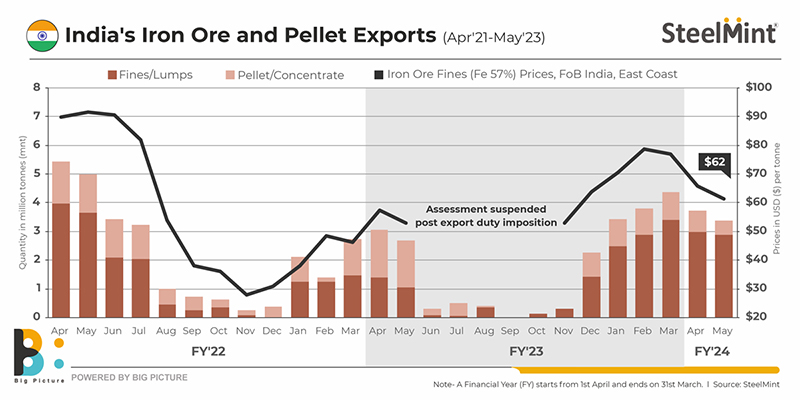
    Both iron ore and pellet exports fell m-o-m in May, reveals data maintained with SteelMint.

    Iron ore exports fell around 4% to 2.88 million tonnes in May, 2023 against 2.99 mnt notched up in April. Pellets exports fell a steeper over-30% to 0.51 mnt in the month under review compared to April’s 0.74 mnt.

    Country-wise exports

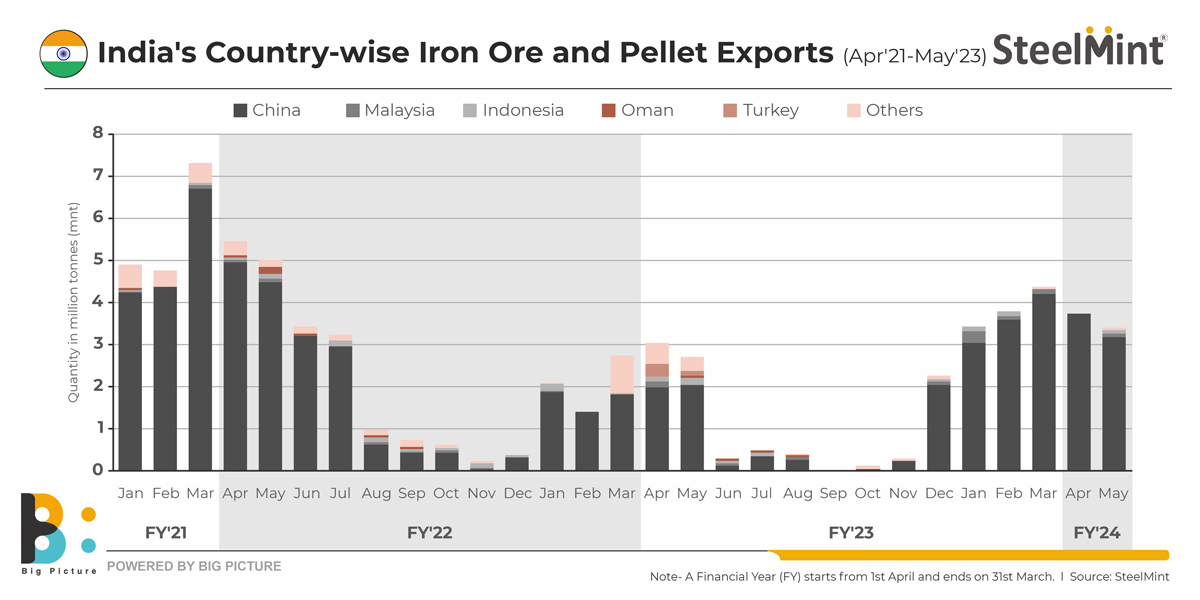
    Export shipments of both iron ore and pellets to China registered a m-o-m fall in May.

    Iron ore: Data reveals that China was the lone importer of India’s iron ore in April and May. Naturally, India’s total iron ore exports drop coincided with China’s imports drop m-o-m in May.

    Pellets: China was also the largest pellets importer in May. However, its volumes declined a sharp 60% to 0.29 mnt in May against a heftier 0.74 mnt in April.

    Other countries which resumed pellet imports from India after a two-month gap were Indonesia with 75,000 tonnes (t) and Malaysia (over 89,000 t). However, these countries do not import on a regular basis. Korea entered the charts with a mere 54,000 tonnes.

    Company-wise exports

    Iron ore: Vedanta was the largest exporter in May with 0.64 mnt, which was a 28% m-o-m increase against 0.48 mnt in April. Rungta Mines followed with a 12% rise at 0.62 mnt (0.57 mnt in April).

    Pellets: Rungta Mines edged past other players to first position with 0.24 mnt in the export kitty, a significant 52% increase against 0.16 mnt in April. AM/NS was relegated to second rank with 0.13 mnt (up 19% from 0.11 mnt in the previous month).

    Market highlights

    • Export shipments were seen from Lloyds in May as its environmental clearance (EC) has increased from 3 mntpa to 10 mntpa.
    • Exports from Karnataka have also picked up post-clarity in the Supreme Court order.
    • JSW exported nearly 240,000 t of iron ore from Odisha to China last month.
    • NMDC, in its recently-concluded investors call, informed that it has no plans to enter the exports market in the near future.

    Factors that dragged down May volumes

    Drop in global iron ore prices: Prices of iron ore hit a 6-month low and the monthly average prices of the benchmark Fe62% fell by $12/t m-o-m. This had an adverse impact on global iron ore export offers, much to the discomfort of the miners. Iron ore prices were dragged down by the overall decline in global steel prices and the weak demand signals from China.

    Pellet export realisations drop vs domestic: Pellet export realisations eroded by INR 2,000/t compared to domestic. This fall was a function of the demand drop in China and consequent decrease in export offers globally — for finished steel and raw materials.

    Fall in Chinese demand: The decline in China’s imports was a key factor that dragged down India’s overall exports of both metallics. In iron ore, China was the lone importer last month. In pellets, its volumes were more than treble of Indonesia’s or Malaysia’s. The expected upswing in steel demand is eluding China with the construction segment still not showing adequate recovery.

    Outlook

    India’s exports of iron ore and especially pellets are likely to drop further in June, considering the persistent weak global steel demand scenario.