SteelMint Events

Category: India Coal Outlook Conference

  • Analysis: Sponge iron producers switch to alternate coal blends amid shrinking margins, resilient import prices

    Analysis: Sponge iron producers switch to alternate coal blends amid shrinking margins, resilient import prices

    Depressed sponge iron demand in the Indian domestic market, coupled with elevated South African coal prices and limited availability of domestic coal for the non-power sector, has compelled Indian DRI producers to experiment with coal from Mozambique, Russia, and even Australia.

    In fact, diversion of high-grade South African coal to Europe have already pushed sponge iron units in India to switch from the most popular RB2 (5500 kcal/kg NAR) grade coal from the country to low-CV RB3 (4800 kcal/kg NAR) since the past few months.

    As 4800 NAR has lower fixed carbon content vis-a-vis 5500 NAR, a higher quantity of the former is required to produce one tonne of DRI.
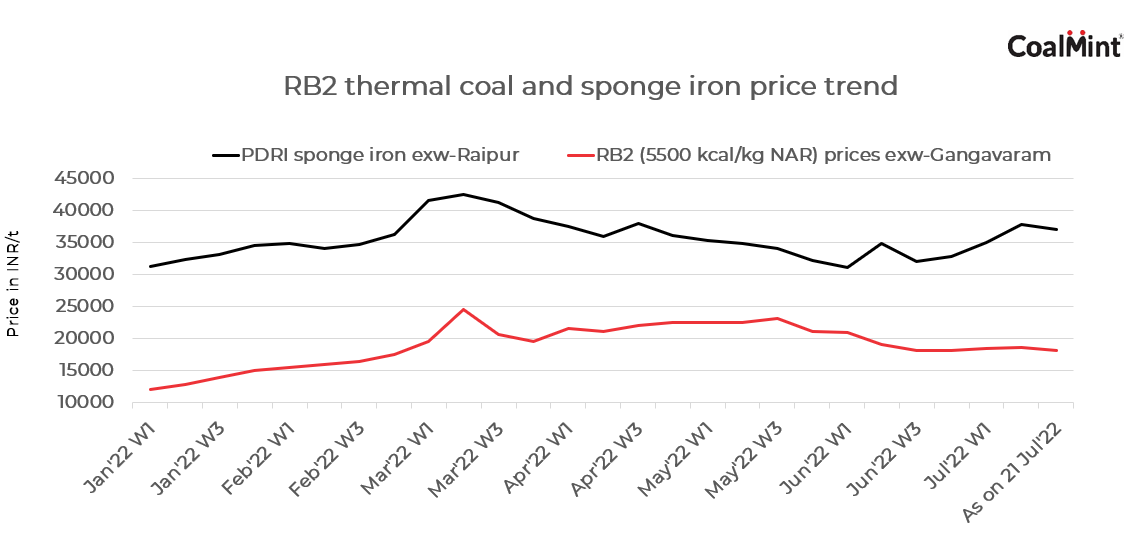
    Shrinking margins of DRI producers due to high South African coal prices have compelled them to look for alternate blends. Although sponge iron prices have picked up since the sharp decline following the government’s introduction of an export duty on steel, any major fall in coal prices has remained limited due to elevated global prices.

    CoalMint learnt from various mill sources that DRI producers are experimenting with various blends of Russian, Mozambican and Australian coal; any blend that fits the bill should have to be one that helps manufacturers tide over sluggish domestic demand and optimise costs of production that have more than doubled in one year.

    Mozambican coal: Steelmaker JSPL, after some initial experiments, has come up with certain findings pertaining to Mozambican VT 1 grade coal (from Vulcan Energy), which is a suitable alternative to South African RB2. About 0.8 t of this coal will be required to produce 1 tonne of sponge iron.

    However, some sponge iron producers in Chhattisgarh informed that while Mozambican coal seems a suitable alternative for DRI, it is low in volatile matter as compared to South African coal, which fails to make it an exact replacement for the latter. In fact, a blend of the two might give sponge iron units the desired results, sources informed. Very low-VM coal affects sponge metallisation rate.

    Russian coal: High-CV Russian thermal coal that is making its way to India at quite cheaper rates has also attracted the attention of sponge iron manufacturers. Although not used widely, experiments by a few indicate that it has South African RB1 grade coal qualities and its good FC and low sulphur content would make it an ideal choice for sponge producers. However, users are not very sure of the exact results and are of the opinion that a blend of South African and Russian coals could give desired outcomes.

    Australian coal: Interestingly, Australian thermal coal, not usually preferred by sponge iron plants because of its very high VM, is now being experimented with by few sponge iron units in south India as they are completely import-dependent.

    While Australian thermal coal is not coming into India in huge volumes since the past few months, a reputed importer, having its own mine in Australia, is heard to be bringing 4400-4600 NAR grade coal with low VM and FC, which is being used in a ratio of 70:30 (5500 NAR S. African: 4600 NAR Australian) for one tonne of sponge iron.

    Concerns persist

    While various blends are a ray of hope for the sponge iron sector, market participants have also highlighted a key concern that these blends make sense against the backdrop of sluggish demand in which plants do not have to function at full capacity and lower yield is expected.

    However, it would be interesting to see if any of these coals or blends can give higher yields during a period of buoyant demand. If successful, this could be a game changer for the sector as better realisations coupled with lower cost of production would help producers improve margins in the long run.

  • Russian coal finds new home in China, India as Europe cuts off trade

    Russian coal finds new home in China, India as Europe cuts off trade

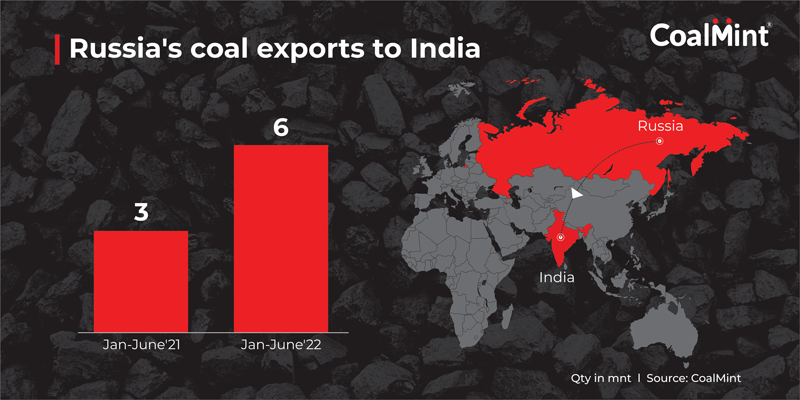
    • Exports to India rise to 6 mnt in first six months of 2022
    • Logistical hurdles may force Russian miners to cut production
    • Recent RBI policy to facilitate coal trade with Russia

    Four months have slipped past since Russia invaded Ukraine and the NATO countries slapped sanctions on Russia, thereby directly hurting the country’s export prospects. In the meantime, however, coal exports from Russia have increased manifold.

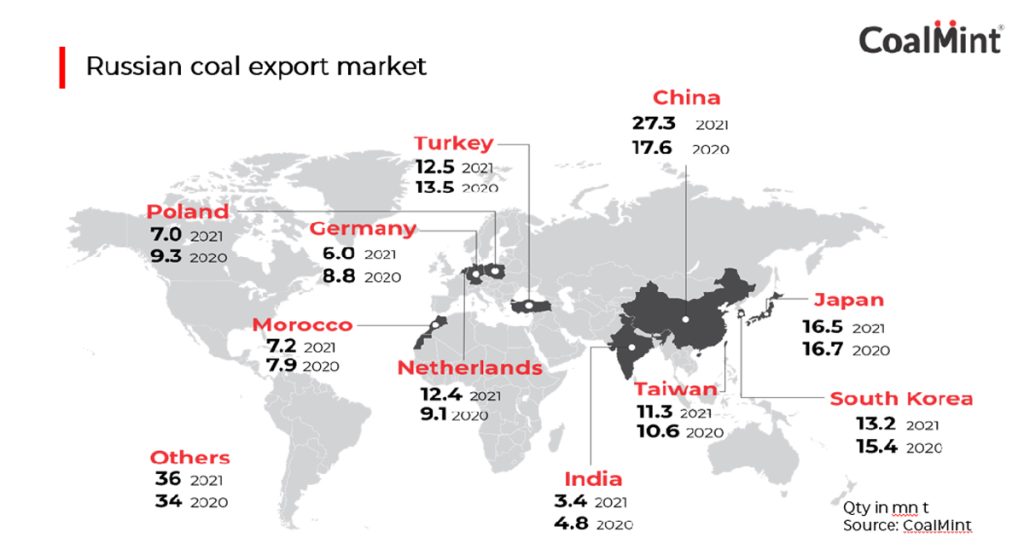
    Russian coal exports totalled a whopping 108.7 million tonnes (mnt) in the first six months of the year, up 4% on a year-over-year basis, as per data gleaned by CoalMint from various sources.

    Shipments to India have risen to 6 mnt in the first six months of the year, as agaisnt 3.1 mnt during Jan-June’21, CoalMint data bear out.

    Russian coal exports during January-June this year have largely been indicative of a shift in global trade flows, as the loss of markets in Europe and Japan was more than offset by increased purchases by Indian and Turkish buyers.

    Despite a steady decline in Russian coal exports to Europe following the sanctions, shipments to major Asian markets are seen rising going ahead as buyers bet big on high-CV coal from Russia, which comes at a discount vis-?-vis other origins.

    Buyers of Russian coal

    Among the major countries showing interest in Russian coal, China tops the list. Russia exported 44 mnt of coal to China in 2021, making up 21% of its total export of the fuel, customs data show.

    Despite record-high coal output in China this year, Russian deliveries have increased significantly as Chinese buyers have snapped up discounted fuel ahead of anticipated strong demand in summer.

    India, the world’s second-leading coal importer, is also Russia’s best hope in the Asian market, as the Indian government has refrained from condemning the attack on Ukraine and remains open about securing cheaper energy supplies from Russia.

    Despite just a 3% share for the Indian market in 2021 from Russia’s total exports, shipments to India have risen to 6 mnt during Jan-Jun’22 and continues to rise, CoalMint data bear out.

    To Vietnam, Russia delivered a total of 4 mnt of coal last year; the emerging South East Asian steel powerhouse accounted for 10% of Russia’s coal exports.

    Turkey is also emerging as a major buyer of Russian coal going ahead, with reports of it having increased shipments from February this year.

    Several small buyers such as Pakistan and Bangladesh are also inclined towards Russian coal. However, weak economic conditions and investors pulling out funds from coal projects hinder buying appetite.

    New routes for exports to India

    To cater to India’s coal demand, Russian companies have launched regular chartered ships to India to ensure uninterrupted supply. Both countries are in talks to revive the Vladivostok-Chennai shipping corridor as part of a partnership in the Indo-Pacific region.

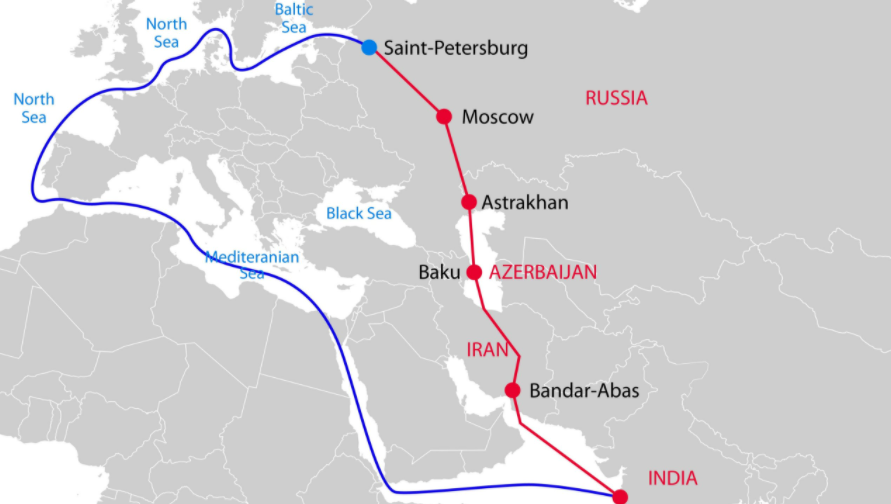
    Russian consignments via Iran are making their way to Indian ports, following the operationalisation of the International North South Transport Corridor (INSTC). Indian authorities have urged Iran to facilitate regular use of the 7,200-km long INSTC.

    Despite higher freight costs between Russia and India, coal transportation is unlikely to be a hurdle given the attractive prices, an expert informed CoalMint.

    Elevated prices of traditional coal imports from South Africa and Australia are likely to make way for Russian shipments.

    While the cement and power sectors prefer buying Russian coal, several other coal-consuming sectors such as the sponge iron industry in India are experimenting with Russian coal, and assessing its impact on productive volumes, the expert added.

    Coal production

    Coal output in Russia continues to remain strong amid resilient demand from the new markets in Asia.
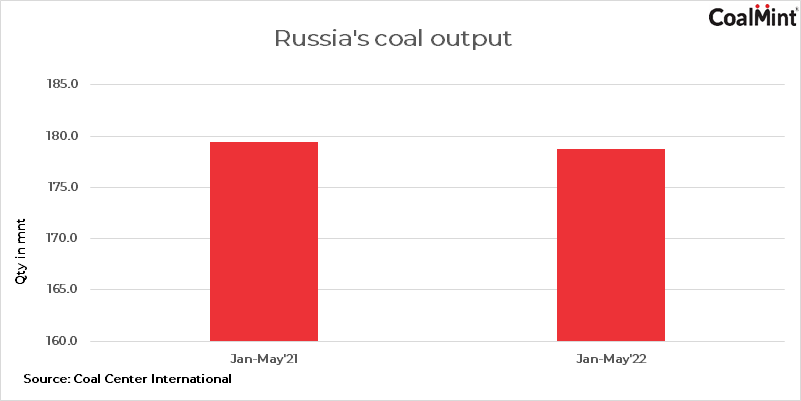
    As per data from Coal Center International, a Russian weekly, coal output in the country fell slightly by 0.4% on a y-o-y basis to 179 mnt during Jan-May 2022.

    A major fall in output that was largely anticipated this year with the loss of markets in Europe was more than compensated by elevated global prices, wherein it was possible to offer discounts without impacting margins of Russian miners, CoalMint learnt from sources.

    Large-scale safety checks at underground and open-pit mines after the explosion at Listvyazhnaya mine (SDS) led to operations being suspended at more than 20 mines since January this year.

    Dispatch scenario

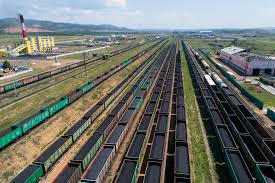
    Coal transportation via the Russian railways, on the other hand, remains steady. However, the exodus of European investors from Russian port and rail development projects is an ominous sign.

    Apart from the limited throughput capacity of the eastern range of the railways, coal suppliers are also facing difficulty in redirecting all unclaimed volumes from the north-western terminals to the far eastern ports, which may likely force a number of mining companies to cut coal production in H2 2022.

    Issues with Baikal-Amur Mainline (BAM) and the TransSiberian Railway (TSR) have been a key factor hindering the growth of transshipment volumes to the far eastern ports.

    Russian news agency Interfax reported recently, citing the energy ministry, that the country’s coal production in 2022 could fall 17%, y-o-y, to 365.1 mnt, while exports could decrease 30% to 156 mnt.

    Demand prospects in H2

    Russia, the world’s third-largest coal exporter, is trying to carve out a market share, as elevated coal prices delivered from other origins make Russian coal an attractive option for Asian countries confronting a supply squeeze, particularly India.

    To know more about the Russian coal market and its changing course of trade dynamics for the second half of the year join us at India Coal Outlook Conference. CoalMint will be hosting the India Coal Outlook Conference on 3-4 August 2022 at The Lalit, New Delhi, to discuss the key issues pertaining to domestic coal production and supply, the government’s objective of controlling imports and domestic supply gap affecting many industries, the need to increase the purchasing power of Indian steel companies in the volatile global coking coal market as well as issues related to decarbonization of the coal value chain.

  • India’s coal production set to breach 900 mnt-mark in FY’23 – Coal Minister

    India’s coal production set to breach 900 mnt-mark in FY’23 – Coal Minister

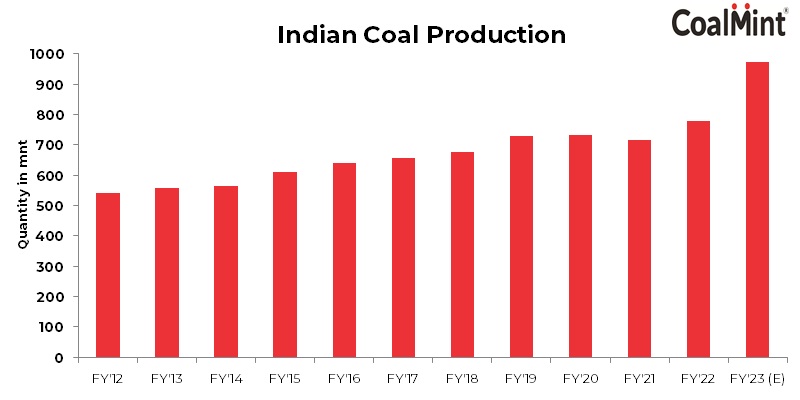
    The Minister for Coal, Mines & Parliamentary Affairs, Pralhad Joshi, said on Tuesday that India’s coal production is set to cross the 900 million tonnes (mnt)-mark in financial year (FY)’23, as the country ramps up efforts to meet a phenomenal surge in power demand.

    Speaking at the 6th National Conclave on Mines and Minerals, the minister stated: “Coal production in FY’22 was around 777 mnt. In the current fiscal we are trying to increase production to 900-920 mnt. Challenges are multifold but the government’s affirmative policies have boosted coal output from around 570 mnt in 2014-2015 to over 760 mnt in 2021.”

    Joshi underlined the fact that international geopolitical disruptions have fuelled energy prices to historic highs and supply and price of natural gas has been gravely affected due to the ongoing turmoil in Russia.

    This, coupled with sanctions on Russian exports, are driving energy prices higher at a time when domestic coal supplies are falling short of satisfying the exponential growth in industrial and domestic electricity demand.

    Production outlook

    The minister, however, had earlier pointed out that state-owned Coal India Ltd. (CIL) has the potential to jack up output to around 760-780 mnt, while the captive power producers could increase production to around 120-130 mnt, with additional production expected from the mines auctioned under the commercial auctions – which should be around 5 mnt.

    The policy enablers have mainly been the amendments that the government brought about as regards revising the MMDR Act, with respect to erasing the end-user distinction for allocation of blocks, and also enabling 50% of sales of minerals after satisfying end use requirements and relaxing exploration norms.

    Further relaxations have been mooted in the form of allocating mines to the private sector, especially the coking coal blocks. Measures to enhance production are in place, the minister said, with the abandoned coal blocks being sought to be operationalised.

    Production climb 32% in Q1

    India’s coal production increased by 32% y-o-y to 205.56 mnt in the first quarter of FY’23 (Apr-Jun’22) against 155.85 mnt in the corresponding period of FY’22.

    CIL produced 159.75 mnt of coal during Q1FY’23, thereby registering a steep rise of 29% y-o-y.

    Notably, this is the highest output recorded by the company in the first quarter of a fiscal – a period during which it usually tends to lower production in view of surplus inventory available at mines.

    However, in order to keep pace with soaring power demand, the company has recorded production in excess of 50 mnt in each of the first three months of FY’23. In contrast, the production mark of 50 mnt was first touched in November of last fiscal.

    In addition, a substantial growth was witnessed from the captive and commercial mines that have been allocated. Overall production from these blocks jumped 79% y-o-y to 27.7 mnt in Q1FY’23, supported by operationalisation of new mines.

    At present, a total of 36 mines are operational. The Ministry of Coal has informed that 12 additional mines will start production this fiscal year.

  • India: Sponge iron producers eye alternative Mozambican coal amid tight domestic supply

    India: Sponge iron producers eye alternative Mozambican coal amid tight domestic supply

    At a time when sponge iron manufacturers in India continue to deal with domestic coal shortage, quality issues regarding imported coal, and rampant volatility in prices, a new alternative is likely to emerge in the form of coal shipments from Mozambique.

    Mozambican coal is heard to be of good quality and cost-competitive against South African coal.

    One of India’s leading steel manufacturers, Jindal Steel and Power Ltd. (JSPL) has taken the initiative to experiment with Mozambican VT 1 grade coal (from Vulcan Energy formerly Vale Mozambique), which has shown positive results in sponge iron kilns of 500 TPD (tonnes per day), 350 TPD and 100 TPD capacities, wherein no mixing or blending is required.

    The coal that has already been used has resulted in average consumption of 800 kg/tonne (t) of sponge iron.

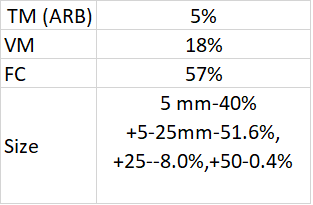
    VT 1 grade specifications:

    The advantages of VT 1 grade over South African RB2 (5500 kcal/kg NAR) used for sponge-making are as under:

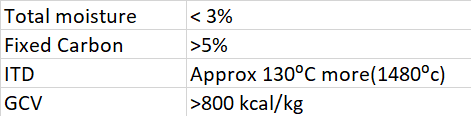
    The trial data for 100% usage of VT 1 grade coal in different designs of sponge iron kilns are as follows:

    According to market participants, Mozambican coal is likely to gain more significance in the domestic sponge iron industry as Europe’s strong demand continues to keep South African coal prices high.

    Coal sourced from other origins such as Australia and Russia, however, are unlikely to be utilised as a full substitute for South African or Mozambican stocks.

    JSPL has proposed to maintain approximately 300,000 t of Mozambican coal at key ports around the country including Paradeep, Dhamra, Haldia, Kandla, Gandhi Dham, Raigarh, Angul and Ranchi from where sponge iron manufacturers can buy the coal in their local currency.

    This would mitigate the risk of opening LCs, handling bulk imports, inventory management, etc. The proposal has been suggested till the time coal supplies from domestic miner Coal India normalises.

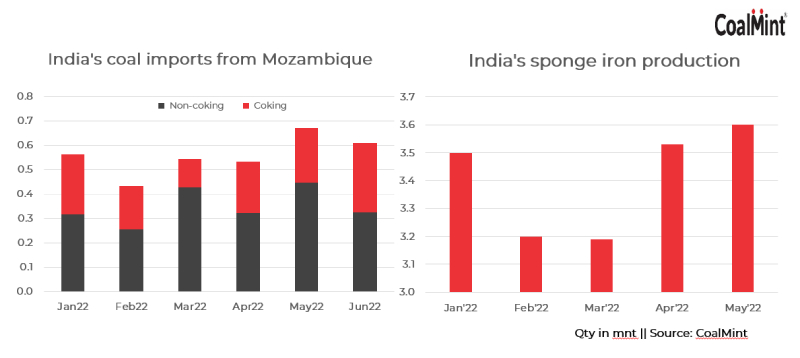
    India’s coal imports from Mozambique

    Major steel and cement companies are the biggest buyers of coal from Mozambique, with the share of thermal coal standing at around 2% and that of coking coal at 1% of India’s total imports in June.

    As per data maintained with CoalMint, the country’s total thermal coal imports from Mozambique was 2 mnt during the first six months of the year, up 109% y-o-y, while coking coal imports stood at 1.3 mnt, up 40% y-o-y.

    To know more about the changing trend of coal usage in the domestic sponge iron industry join us at India Coal Outlook Conference. CoalMint will be hosting the India Coal Outlook Conference on 3-4 August 2022 at The Lalit, New Delhi, to discuss the key issues pertaining to domestic coal production and supply, the government’s objective of controlling imports and domestic supply gap affecting many industries, the need to increase the purchasing power of Indian steel companies in the volatile global coking coal market as well as issues related to decarbonization of the coal value chain.

  • South Africa: Thermal coal exports to India falls 31% in June, overall exports rise marginally

    South Africa: Thermal coal exports to India falls 31% in June, overall exports rise marginally

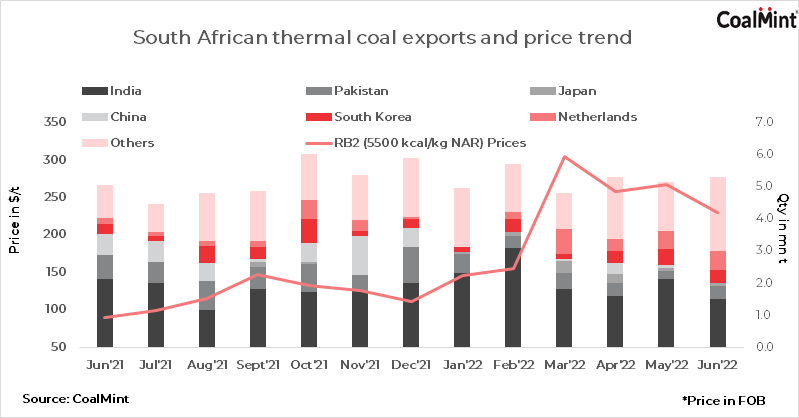
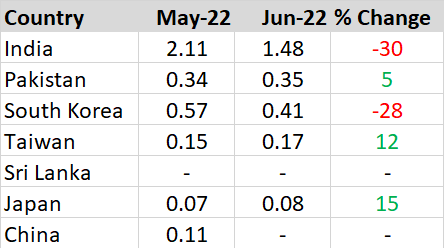
    South African thermal coal exports to India have recorded a steep decline of 30% m-o-m to 1.5 mnt in June, CoalMint vessel line-up data revealed.

    This fall in exports came as the demand from its top consuming sector, sponge iron had turned sluggish after the Indian government announced its decision to impose a hike in export duty on steel in the last week of May.

    While this decision has come with an intention to curb inflationary pressure in the domestic market, the same has made Indian steel less competitive in the export market.

    The domestic sponge iron prices in India, since then have eased by INR 3,000/t and again recovered and are currently assessed at INR 33,300/t exw-Raipur.

    The country’s overall thermal coal exports, however, rose marginally by 2% m-o-m to 5.3 mnt last month as increased demand from Europe offset lower exports to the Asian market.

    Shipments to the European market

    *Qty in mnt

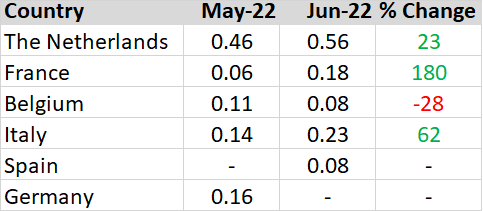
    With the approaching deadline for Russian sanctions to come into effect on Aug 10, European countries have increased their usage of thermal coal wherein South Africa forms a major destination for imports.

    Shipments from the country to Europe have seen a significant rise as exports to The Netherlands have risen by 23%, while that to France by a whopping 180%.

    Shipments to the Asian markets

    *Qty in mnt

    South African coal exports to most Asian markets have remained under pressure over its elevated coal prices.

    Shipments to South Korea fell sharply by 28% last month, while there were no exports to China last month. The strong demand for Russian coal in the Chinese market has led to the decline in imports from other origins.

    Exports to Pakistan recorded a slight rise of 5%. However, a major rise was capped as its local industry focused on importing coal from its neighboring country, Afghanistan.

    Shipments to Taiwan, however, rose by 12% due to their rising demand for coal following Russian sanctions.

    Short-term outlook

    Low-CV (4800 nar) South African coal demand has emerged strongly in the Indian market owing to its competitive prices over mid-to-high CV grades (5500 NAR) that may result in increased vessel arrival in the country in July.

    European demand, on the other hand, remains strong as several countries within the bloc including Germany, Austria, and The Netherlands have announced their plans to increase their coal usage for power generation. This may lead to an increase in South African total coal exports in the near-term.

    To know more about South African coal demand in India and its overall coal export trajecotry for the second half of the year join us at India Coal Outlook Conference. CoalMint will be hosting the India Coal Outlook Conference on 3-4 August 2022 at The Lalit, New Delhi, to discuss the key issues pertaining to domestic coal production and supply, the government’s objective of controlling imports and domestic supply gap affecting many industries, the need to increase the purchasing power of Indian steel companies in the volatile global coking coal market as well as issues related to decarbonization of the coal value chain.