SteelMint Events

Category: Blog

  • South Africa: Thermal coal exports to India falls 31% in June, overall exports rise marginally

    South Africa: Thermal coal exports to India falls 31% in June, overall exports rise marginally

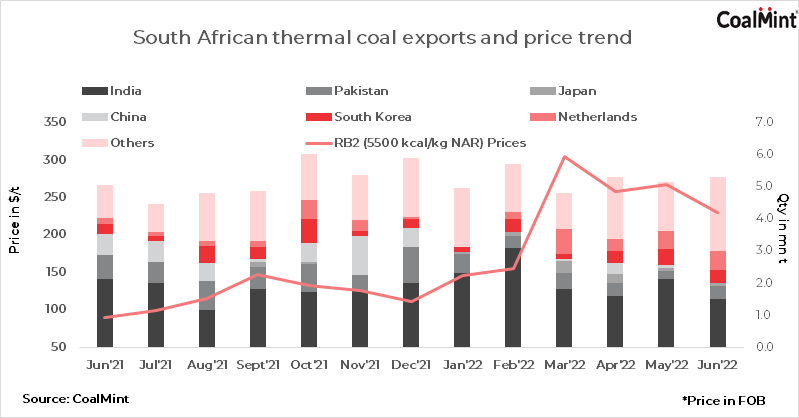
    South African thermal coal exports to India have recorded a steep decline of 30% m-o-m to 1.5 mnt in June, CoalMint vessel line-up data revealed.

    This fall in exports came as the demand from its top consuming sector, sponge iron had turned sluggish after the Indian government announced its decision to impose a hike in export duty on steel in the last week of May.

    While this decision has come with an intention to curb inflationary pressure in the domestic market, the same has made Indian steel less competitive in the export market.

    The domestic sponge iron prices in India, since then have eased by INR 3,000/t and again recovered and are currently assessed at INR 33,300/t exw-Raipur.

    The country’s overall thermal coal exports, however, rose marginally by 2% m-o-m to 5.3 mnt last month as increased demand from Europe offset lower exports to the Asian market.

    Shipments to the European market
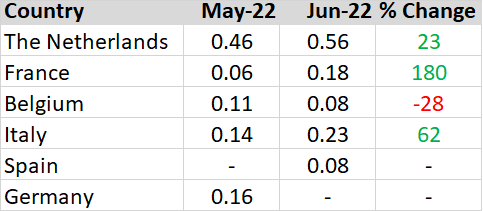
    *Qty in mnt

    With the approaching deadline for Russian sanctions to come into effect on Aug 10, European countries have increased their usage of thermal coal wherein South Africa forms a major destination for imports.

    Shipments from the country to Europe have seen a significant rise as exports to The Netherlands have risen by 23%, while that to France by a whopping 180%.

    Shipments to the Asian markets
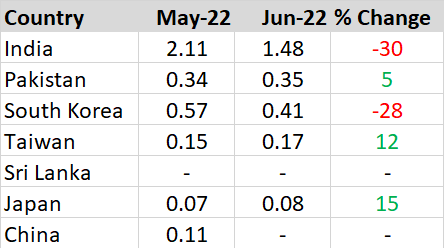
    *Qty in mnt

    South African coal exports to most Asian markets have remained under pressure over its elevated coal prices.

    Shipments to South Korea fell sharply by 28% last month, while there were no exports to China last month. The strong demand for Russian coal in the Chinese market has led to the decline in imports from other origins.

    Exports to Pakistan recorded a slight rise of 5%. However, a major rise was capped as its local industry focused on importing coal from its neighboring country, Afghanistan.

    Shipments to Taiwan, however, rose by 12% due to their rising demand for coal following Russian sanctions.

    Short-term outlook

    Low-CV (4800 nar) South African coal demand has emerged strongly in the Indian market owing to its competitive prices over mid-to-high CV grades (5500 NAR) that may result in increased vessel arrival in the country in July.

    European demand, on the other hand, remains strong as several countries within the bloc including Germany, Austria, and The Netherlands have announced their plans to increase their coal usage for power generation. This may lead to an increase in South African total coal exports in the near-term.

    To know more about South African coal demand in India and its overall coal export trajecotry for the second half of the year join us at India Coal Outlook Conference. CoalMint will be hosting the India Coal Outlook Conference on 3-4 August 2022 at The Lalit, New Delhi, to discuss the key issues pertaining to domestic coal production and supply, the government’s objective of controlling imports and domestic supply gap affecting many industries, the need to increase the purchasing power of Indian steel companies in the volatile global coking coal market as well as issues related to decarbonization of the coal value chain.

  • Bangladesh: Bulk ferrous scrap imports up 72% in H1 CY’22, US exports surge

    Bangladesh: Bulk ferrous scrap imports up 72% in H1 CY’22, US exports surge

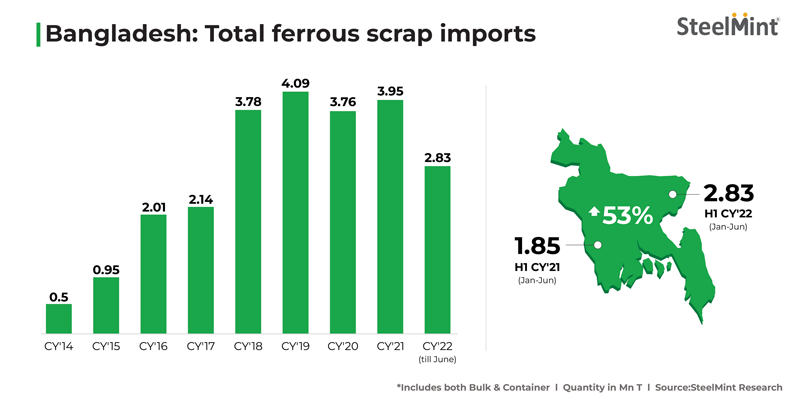
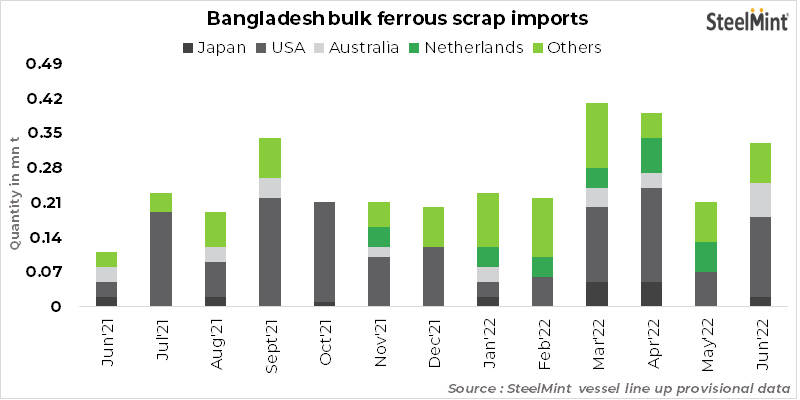
    Imported scrap volumes into Bangladesh, a major bulk ferrous scrap buyer, imports bulk ferrous scrap 1.76 mnt in H1 CY2022 (January-June, 2022) vis-a-vis 1.09 mnt in H1 CY2021.

    The country’s imports rebounded in June 2022 by 57% to 0.33 million tonnes (mnt) from 0.21 mnt in May 2022, as per SteelMint’s vessel line-up data.

    Stocking by Bangladesh’s leading steel mills gained momentum in June through bookings of bulk cargoes ahead of the holy festival of Eid. They could restock material at lower price levels due to lower freights. The country imported a total of 4.42 lacs tonnes of ferrous scrap in June 2022, which comprised 70% in bulk and 30% in containers, as per SteelMint sources.

    Country-wise data:

    • Imports from US skyrocketed: Imports from the US, the largest supplier of bulk scrap to Bangladesh, witnessed a sharp rise m-o-m as freight rates of bulk material were low in comparison to that for containers. Shipments of 0.16 mnt were recorded in June, up a whopping by 129% from 0.07 mnt in May.
    • Imports from Japan resume: Interestingly, Bangladesh’s scrap imports from Japan resumed in June. The country imported 0.05 mnt in June, compared to nil in the previous month.

    Price trend: SteelMint’s monthly average price assessment for US-origin bulk HMS (80:20) scrap stood at $543/t CFR Chittagong in May as against $655/t CFR in April.

    Setting up of new furnaces: A few steel mills in Bangladesh are planning capacity expansion or to set up new furnaces. However, these projects are still underway and may be completed by CY2023. Once completed, this will increase the steel mills’ scrap consumption in the years to come.

    Outlook

    Bulk imported scrap buyers are observing the market closely before resuming the next round of bookings. Not many offers for bulk US scrap for July shipments were heard.

    Join our event to know more on whether Bangladesh’ scrap imports will touch 6 mnt by 2025.

    SteelMint Events will be hosting the 3rd Steel & Raw Material Conference, Emerging Bangladesh on 20-21 September, 2022 at Hotel Radisson Blu, Chittagong, Bangladesh. The conference will explore key issues like the country’s steel production and demand outlook, global scrap trade flow changes, especially post-the Russia-Ukraine war, the ship recycling scenario, key emerging sectors, price trends and a lot more.

  • Europe switching back to coal as energy crisis looms large; aggressively seeks non-Russian supplies

    Europe switching back to coal as energy crisis looms large; aggressively seeks non-Russian supplies

    Amid concerns surrounding Russian gas supplies post-the August sanctions, several parts of Europe have been relying upon coal-fired power generation as the only viable option.

    Germany, Austria, Poland, the Netherlands, and Greece are among the first European nations to have reopened coal-powered plants in a bid to secure energy supply in the upcoming winter.

    The use of coal attains higher significance at a time Russian energy firm Gazprom announced plans to cut down 60% of its LNG flow via the Nord Stream 1 pipeline to Germany recently.

    European countries are now looking at ways to replace the LNG supply gap with alternate sources, mainly coal.
    Coal demand in Europe is likely to remain higher going ahead as it gears up for the 10 August deadline to implement a complete ban on Russian energy imports.

    Coal exports to EU in 2022

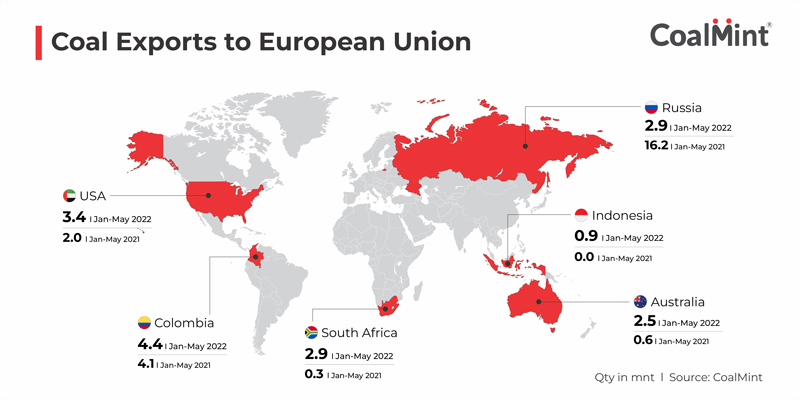
    Europe has emerged as a major export destination for coal by countries such as Australia, South Africa, the US, and Indonesia owing to its strong demand for high-CV coal, prices of which have remained sharply higher since last year amid limited supply.

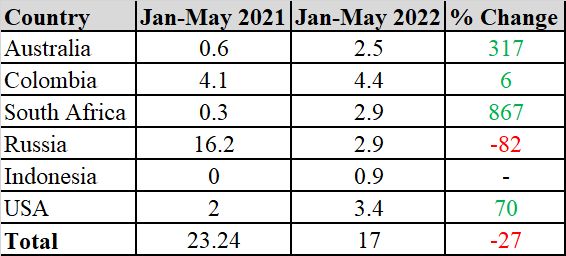
    As per data compiled by CoalMint, exports by six major countries – Australia, Colombia, Russia, the US, South Africa, and Indonesia – have risen to 17 mnt during January-May, 2022 as against 23.24 mnt during the same period last year.

    *Qty in mnt

    As per the data, the decline in total exports is evident from the gap in shipments from Russia this year. However, the extent of demand is being observed from the hefty rise in imports from Australia, South Africa, and USA so far this year.

    Restarting coal-powered stations

    So far, Germany and Austria have announced an emergency restart of coal-powered stations. Germany’s capital Berlin has been working on a new law to temporarily bring back up to 10 gigawatts (GW) of idled coal-fired power plants for up to two years, which would account for just under 5% of total German production capacity.

    Austria, which depends on Russia for 80% of its LNG imports, is also set to restart the Merrach coal plant which was shut down in 2020.

    The Netherlands, on the other hand, has activated the “early warning” phase of an energy crisis plan by lifting restrictions on generation from coal-fired power stations to 2024, making the power stations run at full capacity as against the previous maximum of 35%.

    Other EU countries, including Italy, are expected to start up their old coal-fuelled power stations too as the energy crisis worsens.

    To know more about the key drivers in the coal economy join us at India Coal Outlook Conference. CoalMint will be hosting the India Coal Outlook Conference on 3-4 August 2022 at The Lalit, New Delhi, to discuss the key issues pertaining to domestic coal production and supply, the government’s objective of controlling imports and domestic supply gap affecting many industries, the need to increase the purchasing power of Indian steel companies in the volatile global coking coal market as well as issues related to decarbonization of the coal value chain.
  • Nickel producers, processors and buyers conference

    Nickel producers, processors and buyers conference

    The government is currently studying the possibility of imposing progressive export tax on nickel metal products such as nickel pig iron and ferronickel in a bid to further push the development of the downstream industries in the country, the world’s largest nickel producer.

    Minister of Investment Bahlil Lahadalia previously said that the government was considering banning the export of nickel metals with nickel content of less than 70 percent, namely NPI and ferronickel, to conserve the country’s nickel reserves and promote the expansion of domestic nickel industry into stainless steel, EV battery and other higher value-added industries.

    The conference would explore among others:

    • The government’s key strategies to bolster new investments in nickel industry and smelting facilities.
    • Indonesian government’s grand policy on the future of the Indonesian Battery Industry and electric vehicles (EV).
    • What is the projection of global supply demand of nickel, pricing forecasts and insights from key analysts?
    • Update on domestic nickel smelter capacity and the future production of NPI, Ferronickel and HPAL.
    • What is the future role of Indonesia in the global stainless-steel production and market?

    Register button

  • Indian buyers lapping up cheaper Russian coal, imports exceed 2 mn t in June

    Indian buyers lapping up cheaper Russian coal, imports exceed 2 mn t in June

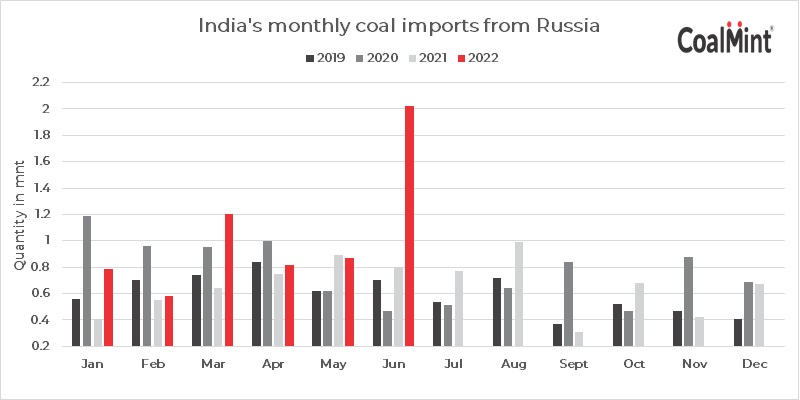
    The Russia-Ukraine conflict that commenced in end-February, 2022 has been altering coal trade dynamics in more ways than one. India, whose coal imports from Russia rarely touched the 1 million tonne (mnt) mark in the past, imported about 2.02 mnt of coal from Russia in June.

    The reason, of course, was that Russian coal was available at discounted rates to India buyers after the USA, EU and Asian countries such as South Korea, Japan and Taiwan slapped sanctions on Russia.

    Of all types of coal coming in from Russia in June, thermal coal had the highest share at 1.03 mnt, followed by PCI (0.45 mnt), coking coal (0.28 mnt) and anthracite at 0.25 mnt.

    Thermal coal

    An analysis of the buying pattern of thermal coal shows that the power and cement sectors accounted for the majority of imports. India hardly imported thermal coal from Russia previously as evidenced by data gathered in previous years, with the highest imports standing at 0.87 mnt in January, 2020.

    According to market participants, Russian coal is suitable for the cement and power sectors in India given its high GCV and low sulphur content. With thermal coal prices from Indonesia, Australia and South Africa trending at very high levels, cheaper Russian coal provides cost benefit to Indian users.

    Coking coal

    Coking coal imports of 0.28 mnt, however, are similar to pre-war levels. In fact, looking at past data, India imported very little Russian coal. In 2021, the country’s monthly average Russian coal imports stood at 0.12 mnt. Top buyers of Russian coal were JSW Steel and Visa Steel.

    Australian coking coal prices, trending at an average of $400/t on FOB basis in June, have pushed a select few Indian steel mills to opt for Russian coal, which is available at just half the price compared to Australian material. However, Indian steel major Tata Steel has shunned imports from Russia due to the war and thus no vessels for the company arrived from that country in June.

    PCI coal

    India has been a regular buyer of Russian PCI coal and its monthly average in 2021 stood at 0.22 mnt, whereas in January-May 2022 imports stood at 0.46 mnt; about 0.45 mnt of PCI is expected to be imported in June. The top buyer in June is JSW Steel followed by JSL, Rawmet and AM/NS India.

    Anthracite

    Like PCI coal, India imported anthracite coal from Russia in the past but in small quantities, with the monthly average standing at around 0.10-0.12 mnt. But June has recorded the highest imports thus far of 0.21 mnt from Russia amid low prices. Rawmet and Carbon Resources were the top buyers of Russian anthracite coal during the month.

    Outlook

    CoalMint vessel data shows that Russian coal imports will be around 0.52 mnt between 1-12 July. While the next quarter may see a decline in imports due to bearish sentiments in the steel and cement sectors during the monsoon, after the rainy season the share of Russian shipments in India’s total coal imports is likely to rise.

    Will Russian coal imports rise further in H2 2022?

    Learn more from the experts at India Coal Outlook Conference 2022 on 3-4 Aug, at The Lalit, New Delhi (India).