SteelMint Events

Category: Blog

  • Increase in Tax Structure Pulled Down Bangladesh Scrapped Vessel Imports in 2019 – PHP

    Increase in Tax Structure Pulled Down Bangladesh Scrapped Vessel Imports in 2019 – PHP

    Mr Zahirul Islam is a Director at PHP Family and MD of PHP Ship Breaking and Recycling Ind. Ltd. and PHP Ispat Ltd, overseeing the operations of the Long Steel and Recycled steel divisions of the PHP family. He shared his views about the outlook on ship recycling market in Bangladesh, Hong Kong convention for ship recyclers and PHP’s green ship recycling yard. Below is an edited excerpt from his recent interview to SteelMint.

    Q1. Import of scrapped vessels to Bangladesh for ship recycling witnessed a sharp fall in H2 2019, after record high imports in H1 2019. What were the major policy reasons in 2019 budget, responsible such a fall?

    Ans 1. In 2019 budget, the government has increased Advance Income Tax (AIT) from BDT 300  to BDT 1000 per tonne, and has also imposed 5% Advance Tax. This has increased cost of buying vessel and at the same time we witnessed the local demand for steel drop. These are the main reasons why we saw a sharp fall in scraped vessel import in second half of 2019.

    Q2. How do you see the Bangladesh’s ship-recycling market to perform in 2020?

    Ans 2. Shipping industry is going through a tough time. The China-USA tension and Corona virus risks are some of the reasons why such a situation is being observed. Many ships are being sent for scrapping as ship owner are not getting order.

    This is an ideal situation for the ship recycling industry. Prices of scrap vessels are also coming down now. I think we will see a lot of activities in the recycling industry in 2020.

    Q3. Can you put some light on the Green recycling yard of PHP family and how is it different than normal ship-breaking yards in Bangladesh ?

    Ans 3. PHP Family has invested 6 million USD to transform its traditional yard into a green one. Class NK (the Japanese Classification Society) has recently given statement of compliance to Hong Kong Convention to PHP.

    This is a huge achievement for PHP as Class NK SO is regarded as the best certificate in the world. We ensure environmental and workers safety throughout the recycling process. Our workers get regular training on various safety topics and we bring trainer from abroad to carry out specialized training.

    Q4. What criteria does a ship recycler needs to fulfil to be certified as a Green ship recycler and is there any timeline for the same issued by authorities?

    Ans 4.  A facility needs to meet the requirements of Hong Kong Convention to be certified as green ship-recycler, ensuring that end-of-life ships do not pose any unnecessary risks to human safety and to the environment when recycled.

    The rules cover the design, construction, operation and preparation of ships for dismantling; the operation of ship recycling facilities in a safe and environmentally friendly manner; and the establishment of an appropriate enforcement mechanism for ship-recycling.

    Realistically, a facility may need 2 to 4 years to become green recycler.

    Q5. Does volatile imported scrap price trend impact ship-yard melting scrap prices?

    Ans 5. No, usually, imported scrap market trend does not have an impact on ship-yard melting scrap prices, which generally depend on local demand and supply tightness/availability.

    Q6. Are ship-plates from cutting of scrapped vessels a good alternative to billets for stand-alone rolling mills in Bangladesh? 

    Ans 6. Ship plate cannot be an alternative to billets as their grades are different from each other. Although many manual or hand rolling mills use ship plates for rolling, the grades are not of the same quality.

    Founded in 1969, PHP Family is one of the major conglomerates in Bangladesh comprising of over 30 companies in sectors ranging from Steel, ship recycling power and textiles.  PHP Ship Breaking and Recycling Industries Ltd was incorporated into PHP Family in March 2000 and spread over a total area of 20.2 acres, the PHP’s recycling yard has processed over 140 ships and 1.7 MLDT of ship-breaking volume in total as of 2019, remaining the only ship recycling facility at Bangladesh which complying the requirements of Hong Kong International Convention as of yet.

    To know more about vessel imports and price trends of the ship recycling industry in Bangladesh, book your seat at SteelMint’s 3rd Steel and Raw Material Conference, Bangladesh and get a chance to hear views of renowned industry participants from across the globe. The conference is being organized on 23rd-24th March 2020 in Chittagong, Bangladesh.

  • How Barapukuria Can Address Bangladesh’s Rising Coal Demand

    How Barapukuria Can Address Bangladesh’s Rising Coal Demand

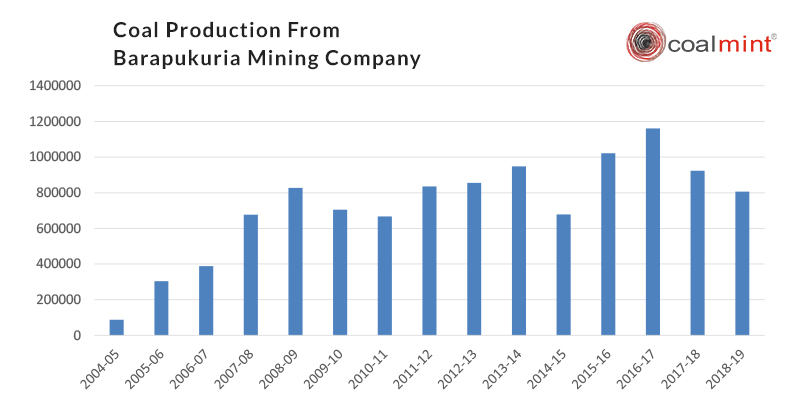
    Barapukuria Coal Mining Company (BCMCL), operator of the first and sole coal mine of Bangladesh, has reported a decrease of 13% in annual coal production during FY19. The company recorded 805,695.63 MT coal output in FY19 as against 923,276.08 MT in FY18, thus attaining its lowest total in past 4 fiscals.

    Primarily envisaged to cater the coal requirement of thermal plant set up by Bangladesh Power Development Board (BPDB), Barapukuria coal was also sold to local buyers at approved price by the board keeping consistency with the international market.

    However, in order to augment coal supplies to the thermal plant, Bangladeshi government has ceased selling of Barakupuria coal to local buyers since 19 Mar’18.

    The gradual affect of the decision resulted in a 5% increase in coal supplies to BPDB’s plant to 828,736.77 MT in FY19, while sale to local industries was merely reduced to 894.19 MT in FY19 as against 274,144.79 MT in FY18, because no supplies were made to them ever since the official order was inflicted.

    At the same time, non-power sector of the country were compelled to cater their coal demand from the overseas market, which had brought significant amount of coal via imports in the period.

    Up till now, BCMCL has fallen short to meet the rising coal demand in Bangladesh amid limited resources; however, it had claimed that its role would be pivotal in national economy by ensuring that the country saves huge foreign currency on coal imports.

    Let us take a look on the short comes and future plans of BCMCL which it would be executing in the coming years.

    Challenges Faced

    The coal deposit at Barapukuria in Dinajpur was found by the Geological Survey of Bangladesh (GSB) in 1985. After undertaking various feasibility studies on the coal site the government had decided to set up the coal mine.

    Upon completion of the development of mine work, BCMCL started commercial seamless production from the mine on 10 Sep’05. Since then, a total quantity of 10,969,690.455 MT has been procured from the mine up to FY19.

    BCMCL has stated that it had faced uphill task to extract coal from underground in an environment friendly manner, which was highly laborious and difficult. The company has faced continuous challenges for coal extraction such as roof fall, coal bump, water inrush, spontaneous combustion, high temperature and humidity etc.

    At present, BCMCL is mining coal from the third slice of central part of Barapukuria coal basin, which has been reported a highly risky job from safety point of view.

    Apparently, it was the root cause for the decline in coal output seen during FY19, as all precautionary measures had to be taken to mitigate the risk and ensure safety at the mine.

    Future Projects:

    BCMCL has completed the feasibility study work for extension of the central part of the Barakupuria mine towards the north-south section.

    The recommendation of the study project reports have suggested that suggests that 3.8 MnT coal could be extracted from Northern part for 6 years and 6.9 MnT from Southern part for 7 years, for which all necessary measures are under process to extract coal from that extended mining area.

    At present natural gas is the main indigenous energy source of Bangladesh that accounts 54% of the total electricity generation. But depletion of natural gas resources provides an uncertainty over its sustainable supply over a long time.

    Therefore, the Bangladeshi government is taking prudent decision to diversify the primary energy sources in the form of coal reserves.

    Apart from expansion of North-South extension part of Barapukuria Coal Mine, the government has also taken suitable measures to extract coal from discovered coalfields at Dighipara, Jamalgonj, Fulbari and Khalaspir.

    Different study reports have revealed that the quality standard of Bangladeshi coal is very good due to its high calorific value and low sulfur content. The astute measures taken to extract coal from these projects would apparently play an important role in meeting up the ever increasing demand of coal.

    (Bangladeshi fiscal year runs for a 12-month period starting from 1st July to 30th June)

    To know more, participate in the Bangladesh Coal Conference 2020.

  • India: Odisha’s Iron Ore Mine Auction Bid Premiums Go Above 100%

    India: Odisha’s Iron Ore Mine Auction Bid Premiums Go Above 100%

    Last week to this week, the state government auctioned four mines (two captive and two merchant). The auctions received aggressive bids. The first block that was auctioned on 29th January for Nuagaon mines (reserves 792.93 MnT), was won by JSW Steel Ltd which bid 95.2% for the block.

    The second block was auctioned on 30th January for Narayanaposhi mines (reserves 190.6 MnT), and was also won by JSW Steel with its bid at 98.55 %.

    The third block, Thakurani(reserves 180 MnT), fetched highest premium at 107.55% and was won by ArcelorMittal. The fourth block, Balda iron ore (reserves 210.17 MnT) was retained by Serajuddin and Co. at a premium of 118.05%.

    Another 15 mines will be put under the hammer on a daily basis and market expects aggressive bidding for most of them. In addition to the current list of 20 mines, a new list of 7 mines will also be introduced for auctions this month.

    What does the premium signify?

    The premium is the key figure to evaluate the bids. This premium is a percentage of the price of the iron ore that is set by the Indian Bureau of Mines (IBM) each month for different states and grades. The premium will be taken by the state as its tax.So if ArcelorMittal’s winning bid is 107.55%, it means, ArcelorMittal will pay 107.55% of the monthly value of the IBM set price of iron ore to the state government. This will be on per tonne of iron ore sold by ArcelorMittal.

    The premium is not the only tax the new owners will pay to the state government. There will also be a royalty 15% of base price, District Mineral Fund contribution 30% of Royalty and NMET (National mineral exploration trust) 2% of Royalty that will be charged separately on the base price. Premium and royalty will be charged on sales of iron ore and not on production.

    The high premiums are set to put iron ore prices on a different orbit altogether. Since many of the large companies are emerging as the winners, they will become the new price makers in the market.

    Track the results of Odisha mines auction & bids received as on 5th Feb 2020 below:

    Download Pdf

    To learn how the mines auction 2020 unfolds, be a part of SteelMint Events’ 4th Indian Iron ore, Pellet and DRI Summit which is scheduled on 2-3 March 2020, in Hotel LaLiT, New Delhi.

  • Mine Auction 2020: KJS Ahluwalia Nuagaon Iron Ore Mine Fetches Premium of 95.1%

    Mine Auction 2020: KJS Ahluwalia Nuagaon Iron Ore Mine Fetches Premium of 95.1%

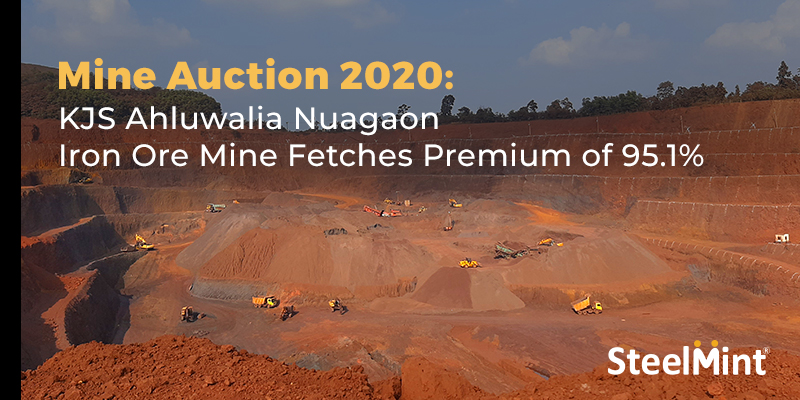
    The much awaited Odisha mine auctions 2020 is well underway. State govt has started technical bidding for Nuagaon iron ore mine block on 29th Jan’20. As per sources, six companies namely – Rungta Sons Ltd, Arcelor Mittal India Pvt Ltd, JSW Steel Limited, Vedanta Ltd, Adani Enterprises Limited and TS Alloys Limited had qualified the technical round.

    The mine fetched the highest premium of 89.4% in the technical round, following which the govt started the 2nd round of auctions. Notably, the highest initial price offer amongst the technically qualified bidders was set as the floor price for the second round of auction. Witnessing an aggressive bidding, the mine fetched highest ‘final price offer’ of 95.1%.

    What does the premium of 95.1% mean? The ‘final price offer’ submitted is a percentage of value of mineral despatched for the mine block and is calculated as a product of mineral despatched in a month and sale price of the mineral (grade-wise and state-wise) as published by Indian Bureau of Mines for such month of despatch. It is to be noted that in accordance with the ‘final price offer’ shall be required to be paid monthly in addition to the payment of royalty or dead rent, as applicable.

    KJS Ahluwalia was the existing lessee of Nuagoan iron ore mine block. The mine has an EC limit of 5.62 MnT pa and has exploration done upto G2 level. The mine has a total geological resource of 792.93 MnT. Its average lumps percentage is 39.1% and fines percentage is 60.89%. Production from the mines was recorded at around 5.61 MnT in FY19 and 4.4 MnT in FY20 (till Nov’19). This mine is reserved for merchant use.

    How will mine auctions impact Indian iron ore demand-supply?

    View Report

    To learn how the mines auction 2020 unfolds, be a part of SteelMint Events’ 4th Indian Iron ore, Pellet and DRI Summit which is scheduled on 2-3 March 2020, in Hotel LaLiT, New Delhi.

  • Bangladesh Scrap Imports Likely to Grow by Over 15% in 2020

    Bangladesh Scrap Imports Likely to Grow by Over 15% in 2020

    Bangladesh steel industry is currently growing at a staggering rate, primarily due to the rising steel demand in the country on account of several large infrastructural projects in the pipeline for this decade. Presently there are several expansion plans underway by various steel manufacturers across the country, to meet the rising steel demand.

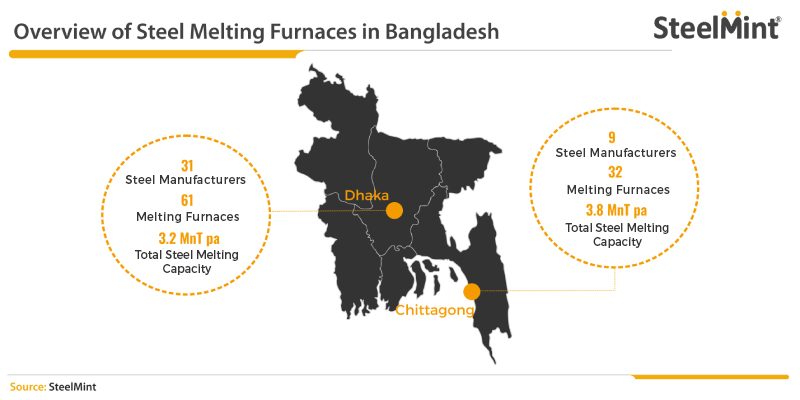
    At present, there are around 97 steel melting furnaces being operated by 42 steel manufacturing companies located mostly in Dhaka and Chittagong regions. Out of 97 furnaces, 94 are induction based furnace and 3 are electric arc furnace.

    Chittagong – home to large steel mills – The Chittagong region primarily houses the larger mills including the top 4 steelmakers of the country, and includes 9 steel manufacturers operating a total of 32 melting furnaces (29 IFs and 3 EAFs) with total annual crude steel capacity of around 3.8 MnT (before GPH Ispat’s new plant’s commencement). The Dhaka region on the other hand comprises of 31 relatively smaller mills operating 61 Induction furnaces with a total melting capacity of around 3.2 MnT per annum, while another 4 induction furnaces are operated by steelmaker in Comilla region.

    Bangladesh steel production to increase by 1-1.5 MnT in 2020: Ongoing expansion in steel melting capacities by existing players will ensure an increment of 1-1.5 MnT of crude steel production in 2020. Recently, GPH Ispat has commissioned its 80 MT (0.86 MnT annual capacity) Quantum EAF and started trial production. Another 8-10 Induction furnaces of around 20 MT capacity each are expected to be commissioned in the next 12 months (this translates to 0.6 MnT capacity per year).

    Bangladesh scrap imports likely to grow over 15% in 2020 – The rising capacities and steel production levels in Bangladesh is expected to ensure a continued growth in imported scrap volumes in coming years.  The annual imported scrap volume (bulk & containers) has shown a sharp rise in recent years and were recorded at 3.6-3.65 MnT in CY 2019. The same is expected to cross 4.2 MnT by end of 2020, with the import volume having a chance to cross the 5 MnT per year mark by 2021 end, given the similar growth rate in production persists.

    Similarly, DRI imports to Bangladesh will also actively increase, in line with the increasing steel production rates. Sponge Iron export from India to Bangladesh may cross 700,000 MT/year mark by 2021 end, from 461,256 MT of exports recorded in CY 2019.

    To know more on the upcoming capacity expansions in the Bangladesh steel industry and its effect on the raw material import dynamics, book your seat at SteelMint’s 3rd Steel and Raw Material Conference, Bangladesh and get a chance to hear views of renowned industry participants from across the globe. The conference is being organized on 23rd-24th March 2020 in Chittagong, Bangladesh.