SteelMint Events

Tag: Bangladesh

  • Bangladesh banking on coal imports as energy demand soars

    Bangladesh banking on coal imports as energy demand soars

    The ever-growing demand for electricity has increased the reliance on coal globally, especially in emerging economies with underdeveloped renewable energy infrastructures and pressing energy security concerns. Bangladesh is a case in point.

    The country has increased procurement of imported coal in a significant way to make up for domestic scarcity of the fuel. Besides, commissioning of new coal-fired power plants has also pushed up demand for coal.

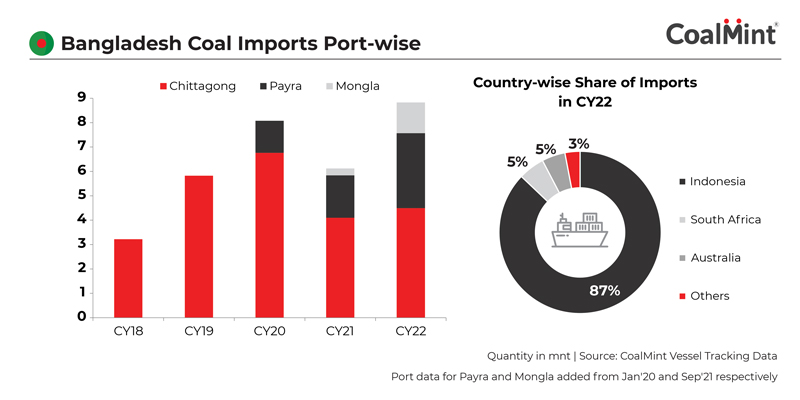
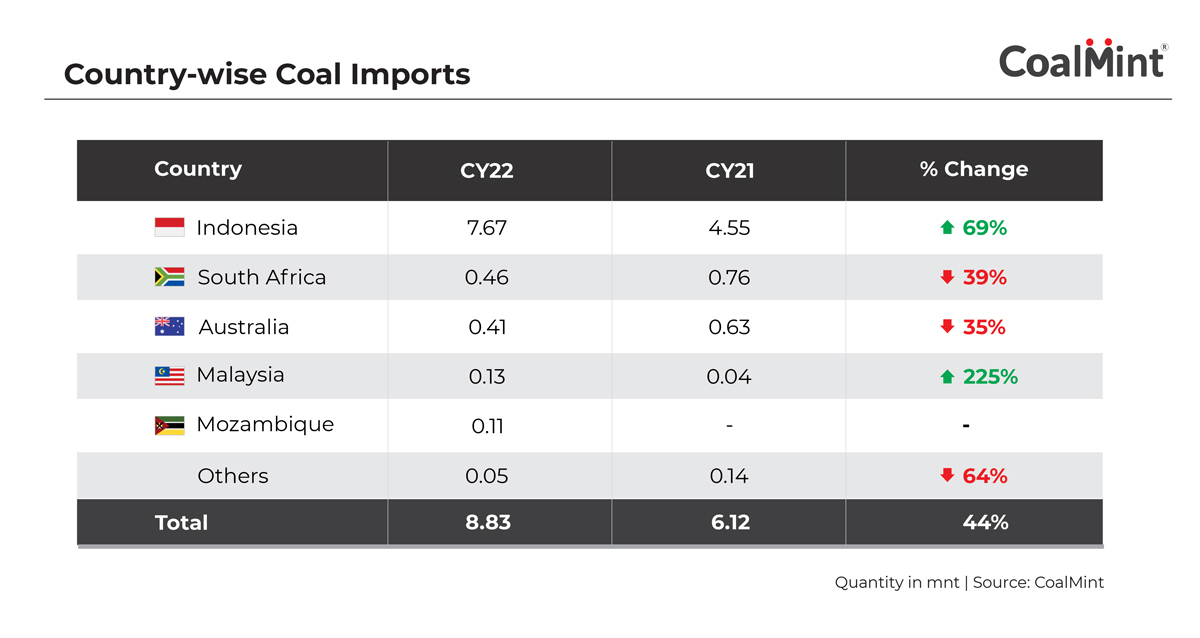
    As per data compiled by CoalMint, the country’s coal imports surged 44% y-o-y to 8.83 million tonnes (mnt) in CY22. Indicating strong demand, the total volume of imports in CY21 was already surpassed during the first 10 months of CY22.

    At the same time, tight supply and high prices of coal in the global market forced Bangladesh to re-work its procurement strategy.

    The sharp growth in imports was mainly driven by higher sourcing from Indonesia in CY22. On the other hand, intake from other traditional markets such as South Africa and Australia plunged 39% and 35%, respectively.
    Inadequate domestic supplies

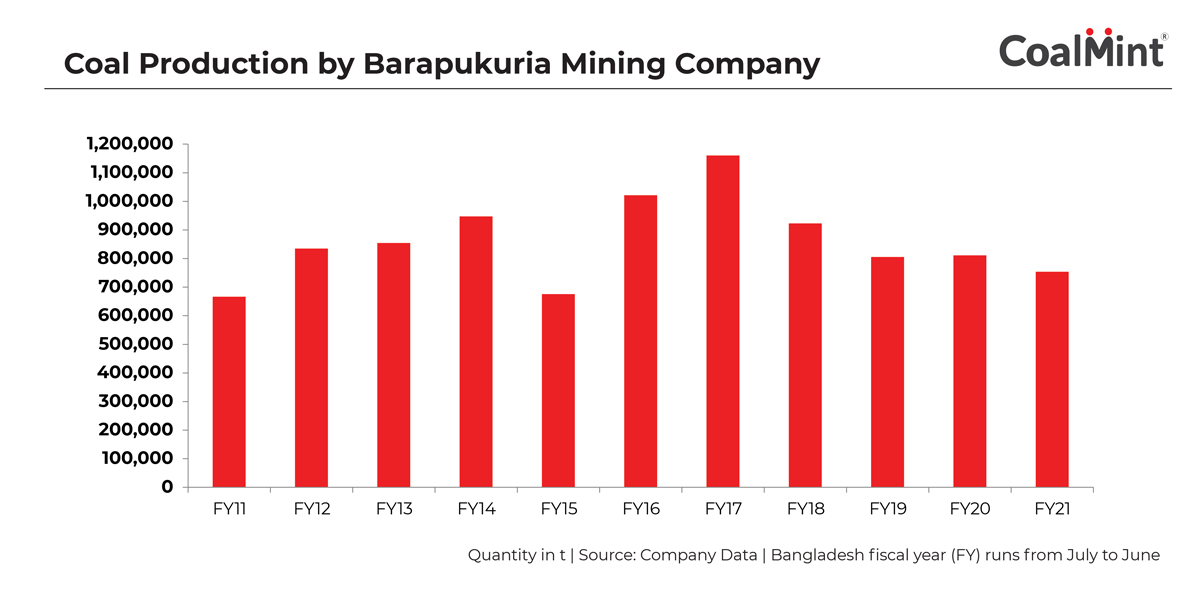
    The Barapukuria Coal Mining Company (BCMCL), operator of the first and sole coal mine in Bangladesh, reported a decrease of 7% in annual coal production in FY21 (July 2020-June 2021). The company recorded 753,973 t of output in FY21 as against 811,137 t in FY20, thus attaining its lowest output in the past six fiscals.
    Given this subdued performance, the company suspended sales to local buyers from 19 March, 2018, in order to secure supplies for the power units of the state-run Bangladesh Power Development Board (BPDB).

    Of the total output, almost the entire volume was delivered to BPDB, while a nominal 610 t was supplied externally during FY21, as per the company’s report.

    In a fresh setback to the fuel security of power plants, the company is mulling to increase its coal pricing to compensate for the upward revision in royalty payable on coal. Moreover, the price hike was also necessitated to adhere to the proposed mining agreement that will require additional land acquisition to extract coal from the northern part of the mine.

    It is important to note that BCMCL has been selling coal at a fixed price of $130/t to BPDB since May 2015.

    Coal: A cheap option

    Due to availability of gas reserves, the gas-based plants in Bangladesh hold a majority share in total power generation capacity.

    Total installed capacity of BPDB-owned plants was 22,482 MW in FY22, of which gas-based plants’ capacity was 11,476 MW, whereas capacity of coal plants stood at a mere 1,768 MW. Plants based on diesel, furnace oil, renewables, etc. made up for the remaining share of power capacity.
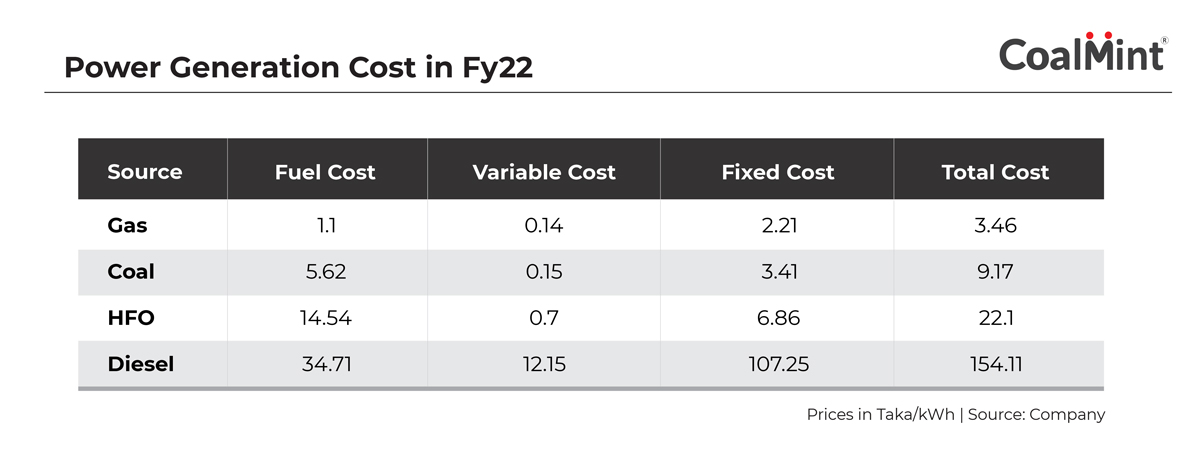
    A comparative cost analysis indicates that gas is the cheapest source of power generation. However, coal was still economical than other

    alternative power sources – another reason for the country’s growing reliance on coal.

    Coal demand accelerates

    Fuelled by the commissioning of the two 660 MW units of the Payra power station, coal imports have started increasing at Payra port, which was established in order to facilitate coal imports for the power sector.

    Meanwhile, at least six other coal-fired power projects are expected to be commissioned, three of which, with a total capacity of 2,800 MW, are expected to be completed soon.

    As per a study by the International Energy Agency (IEA), coal consumption in Bangladesh declined by 0.8 mnt to 3.8 mnt in CY21 but is expected to grow by 2.8 mnt in CY22.

    The report suggests that the country’s coal power fleet would increase to around 5,000 MW by CY25, boosting annual coal demand to 19 mnt.

    2nd Asia Coal Outlook & Trade Summit

    Is Bangladesh’s energy security at a crossroads with the withdrawal of foreign investments from the country’s power sector? Does the country share this predicament with other emerging economies in Asia that are grappling with energy security concerns amid global inflation and depleting investments in coal-based assets? Want to be a part of the discussion? Check out registration details for CoalMint’s 2nd Asia Coal Outlook & Trade Summit to be held at Grand Hyatt Erawan in Bangkok, Thailand on 24-25 April, 2023.

  • Bangladesh’s sponge iron imports from India to rise further on expanding steel melting capacities

    Bangladesh’s sponge iron imports from India to rise further on expanding steel melting capacities

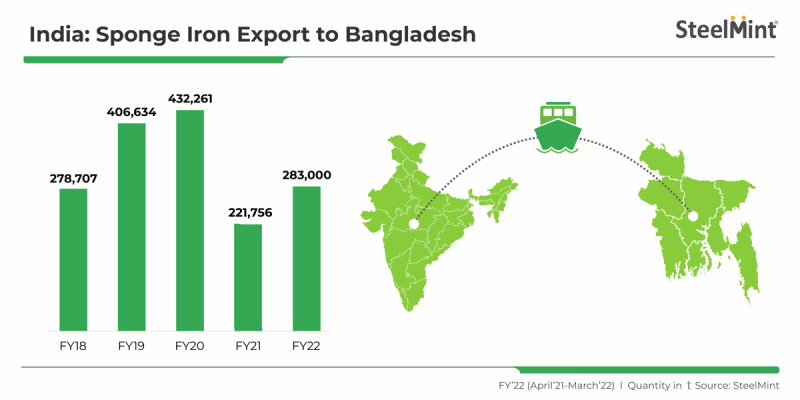
    Sponge iron imports by Bangladesh from India stood at 283,000 tonnes (t) in FY’22 (April’21-March’22). Although Bangladesh’s imports increased sharply from FY’21, volumes were still lower compared to the previous couple of fiscals. Imports, however, are expected to edge up in the coming time on account of rising steel melting capacities in Bangladesh and infrastructure projects in the pipeline.

    Notably, Bangladesh’s financial year starts on 1 July and ends on 30 June. The country’s sponge iron imports were recorded at a meagre 221,756 t in the Indian fiscal year 2021 (FY’21) due to the impact of the COVID-19 pandemic. Meanwhile in the first six months (January-July) of CY’22 the country imported 443,092 t of sponge iron from India, indicating a surge in demand. However, due to LC issues and the liquidity crisis buyers booked limited material during June-July.

    Bangladesh accounts for 41% of Indian sponge exports: Bangladesh has a share of 41% in India’s total sponge exports, with export volumes in FY’22 being recorded at 690,287 t. While Nepal accounts for the largest share – 53% – of India’s exports, Bhutan holds a share of 5%.

    Bangladesh’s sponge import prices: Imported sponge iron prices to Bangladesh stood at an average level of $494/t CNF Chittagong in FY’22.

    Market updates

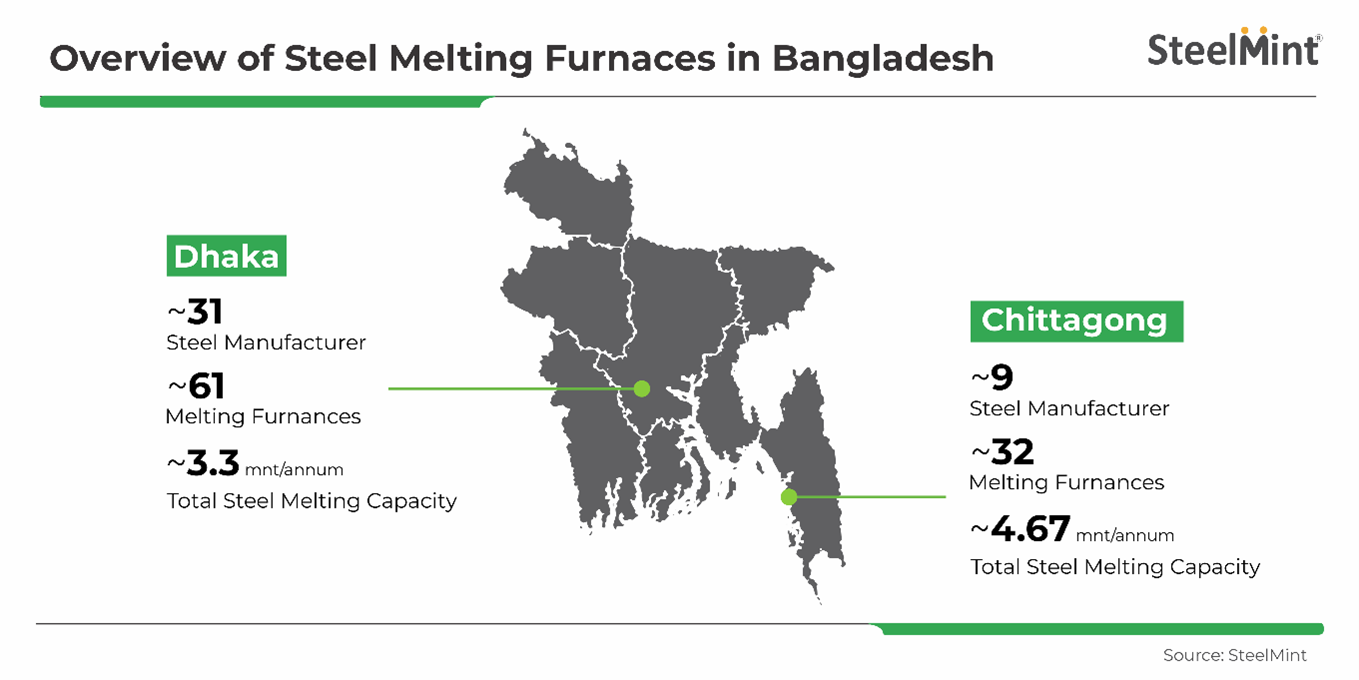
    • Chittagong – home to steel mills: The Chittagong region is the hub of the largest mills in the country, including the top four steelmakers and nine steel companies in all. Mills in the region operate 32 melting furnaces (29 IFs and three EAFs) with a total crude steel capacity of 4.67 mnt (including GPH Ispat’s Quantum EAF).
    • IF mills in Dhaka:  On the other hand, Dhaka has 31 mills in all which are relatively small in size, operating 61 induction furnaces (IF) with a total melting capacity of around 3.3 mnt per annum, while another four induction furnaces are operated by steelmakers in the Comilla region.
    • Furnace sponge-scrap ratio: The ratio of sponge iron in the steelmaking feed depends upon scrap quality. However, the percentage mix of sponge iron in the furnace hovers around 5%.

    As many steel manufacturers in Bangladesh are planning to expand their steel capacities, DRI imports from India are poised to rise further.

    To know more on Bangladesh’s sponge iron imports, book your seat at 3rd Steel & Raw Material Conference, Emerging Bangladesh on 20-21 September, 2022 at Hotel Radisson Blu, Chittagong, Bangladesh, and get a chance to hear renowned industry participants from across the globe on “How are Indian mills managing feed mix of Scrap/DRI/Pig Iron in Induction Furnaces (IF)”.


  • SteelMint analysis: Bangladesh likely to improve scrap imports to raise steel melting capacity by 2025

    SteelMint analysis: Bangladesh likely to improve scrap imports to raise steel melting capacity by 2025

    • Bangladesh set to increase steel melting capacity around 13 mnt by 2025
    • BSRM, AKS, GPH and many other mills are setting up additional capacity
    • Bashundhara, Meghan & Akij entering steel business

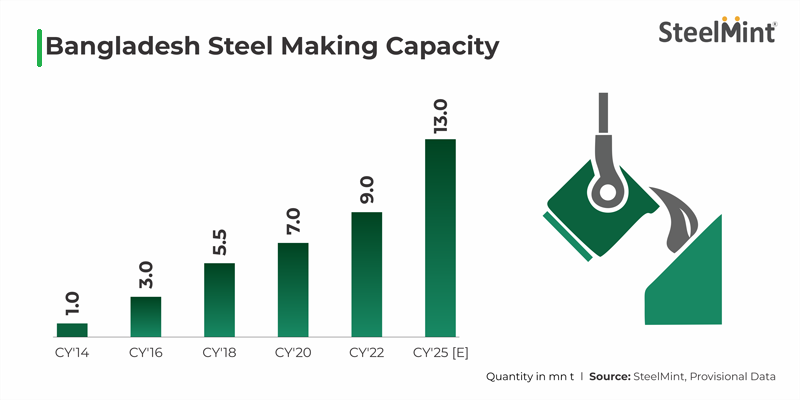
    Bangladesh, one of the largest ferrous scrap importers in South Asia, is likely to witness an increase in steel melting capacities from 9 million tonnes (mnt) per annum currently to around 13 mnt by 2025 due to the growing demand for steel, cement, power and upcoming infra projects.

    Renowned steel producers in Bangladesh like BSRM, AKS, GPH, and many other mills are setting up additional capacity and facilities to cater to government-funded infrastructure projects in the coming years.

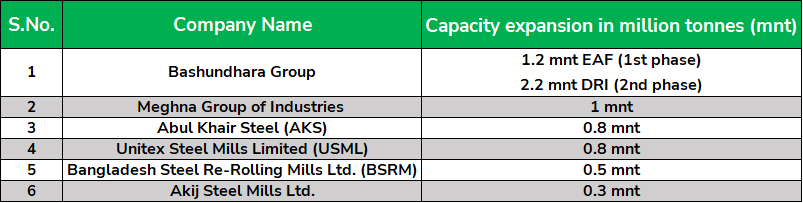
    Bashundhara Group is expanding its capacity to 1.2 mnt (EAF) in the 1st phase and 2.2 mnt (DRI) in the 2nd phase; Meghna by 1 mnt (EAF); AKS and Unitex by 800,000 t; BSRM by 500,000 t; and Akij by 300,000 t.

    Why is Bangladesh an emerging economy?

    • GDP growth rate: The economy of Bangladesh has a projected GDP growth rate of 6.4% for FY’23 as an emerging and fastest growing economy after India in South Asia.
    • Increasing steel demand for govt-funded projects: Steel demand in Bangladesh may remained supported mainly due to the government-funded infrastructure projects which were launched to stimulate the economy hit by COVID-19. Projects such as the Ashrayan Project, Metro Rail, Karnafuli Tunnel and elevated expressway from Dhaka Airport to Kutubkhali are expected to boost infrastructure construction. Hence, scrap demand is also likely to remain supported this year as well as in 2023.
    • Development of port facilities: Due to inadequate port facilities in the country, large ships were unable to enter Chittagong port. However, the Bangladeshi government has started working on projects such as the Matarbari Deep Seaport, which is estimated to be completed by 2026. Once these projected ports are completed, steel manufacturers will be able to import scrap more easily, which will ultimately speed up their production.

    Expert opinion

    Over the past five years, Bangladesh has become an integral part of the ferrous scrap trade in the South Asian region. As new steel capacities come onstream, scrap suppliers are looking forward to continuing the close relationship with the country in the years ahead,” stated Zain Nathani, Director, Nathani Group of Companies, India.

    Sanjoy Ghosh, Head of Supply Chain, BSRM, said: “Steel industries in Bangladesh are entering into a new phase amid higher demand forecast in line with projected economic growth. Despite the current global economic turmoil, all major plants are into enhancing their capacity and also new plants are trying to create a footprint in the market in order to cater to future demand. So, it is challenging time ahead for entire steel industry.”

    Scrap import scenario

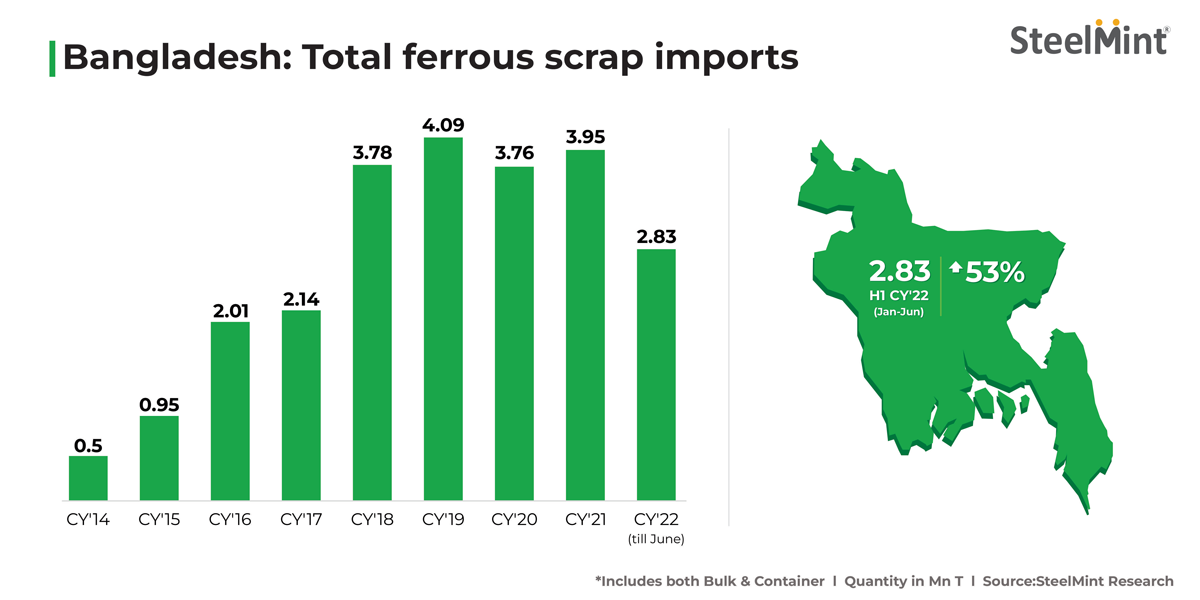
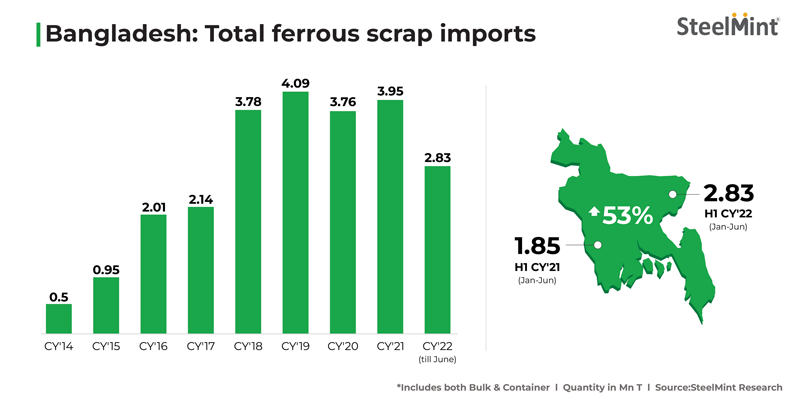
    Bangladesh is a country which is entirely dependent on scrap for steelmaking. The volume of imported ferrous scrap (both bulk and container) into Bangladesh stood at 2.83 million tonnes (mnt), up 53% in the first half (H1) of 2022 as against 1.85 mnt seen in the same period in 2021.


    Bangladesh: Total ferrous scarp imports

    As Bangladesh is eying over 6% GDP growth in the current year, the South Asian nation is making a concerted effort to spearhead infrastructure spending, which is expected to increase steel consumption going forward. However, it will be interesting to see if demand remains supportive against the backdrop of rising steel capacity.

    Join our event to know more on whether Bangladesh’ scrap imports will touch 6 mnt by 2025.

    SteelMint Events will be hosting the 3rd Steel & Raw Material Conference, Emerging Bangladesh on 20-21 September, 2022 at Hotel Radisson Blu, Chittagong, Bangladesh. The conference will explore key issues like the country’s steel production and demand outlook, global scrap trade flow changes, especially post-the Russia-Ukraine war, the ship recycling scenario, key emerging sectors, price trends and a lot more.

  • Bangladesh: Bulk ferrous scrap imports up 72% in H1 CY’22, US exports surge

    Bangladesh: Bulk ferrous scrap imports up 72% in H1 CY’22, US exports surge

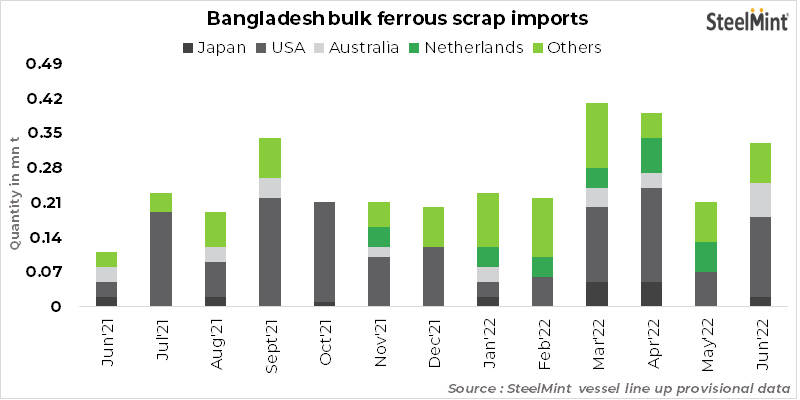
    Imported scrap volumes into Bangladesh, a major bulk ferrous scrap buyer, imports bulk ferrous scrap 1.76 mnt in H1 CY2022 (January-June, 2022) vis-a-vis 1.09 mnt in H1 CY2021.

    The country’s imports rebounded in June 2022 by 57% to 0.33 million tonnes (mnt) from 0.21 mnt in May 2022, as per SteelMint’s vessel line-up data.

    Stocking by Bangladesh’s leading steel mills gained momentum in June through bookings of bulk cargoes ahead of the holy festival of Eid. They could restock material at lower price levels due to lower freights. The country imported a total of 4.42 lacs tonnes of ferrous scrap in June 2022, which comprised 70% in bulk and 30% in containers, as per SteelMint sources.

    Country-wise data:

    • Imports from US skyrocketed: Imports from the US, the largest supplier of bulk scrap to Bangladesh, witnessed a sharp rise m-o-m as freight rates of bulk material were low in comparison to that for containers. Shipments of 0.16 mnt were recorded in June, up a whopping by 129% from 0.07 mnt in May.
    • Imports from Japan resume: Interestingly, Bangladesh’s scrap imports from Japan resumed in June. The country imported 0.05 mnt in June, compared to nil in the previous month.

    Price trend: SteelMint’s monthly average price assessment for US-origin bulk HMS (80:20) scrap stood at $543/t CFR Chittagong in May as against $655/t CFR in April.

    Setting up of new furnaces: A few steel mills in Bangladesh are planning capacity expansion or to set up new furnaces. However, these projects are still underway and may be completed by CY2023. Once completed, this will increase the steel mills’ scrap consumption in the years to come.

    Outlook

    Bulk imported scrap buyers are observing the market closely before resuming the next round of bookings. Not many offers for bulk US scrap for July shipments were heard.

    Join our event to know more on whether Bangladesh’ scrap imports will touch 6 mnt by 2025.

    SteelMint Events will be hosting the 3rd Steel & Raw Material Conference, Emerging Bangladesh on 20-21 September, 2022 at Hotel Radisson Blu, Chittagong, Bangladesh. The conference will explore key issues like the country’s steel production and demand outlook, global scrap trade flow changes, especially post-the Russia-Ukraine war, the ship recycling scenario, key emerging sectors, price trends and a lot more.

  • Bangladesh: Payra Port Authority Invites Bids for Developing Coal Terminal

    Bangladesh: Payra Port Authority Invites Bids for Developing Coal Terminal

    Government of Bangladesh has intended to develop a coal terminal at Payra port to facilitate coal movement for its upcoming power station, by appointing private participants to carry out the expansion work.

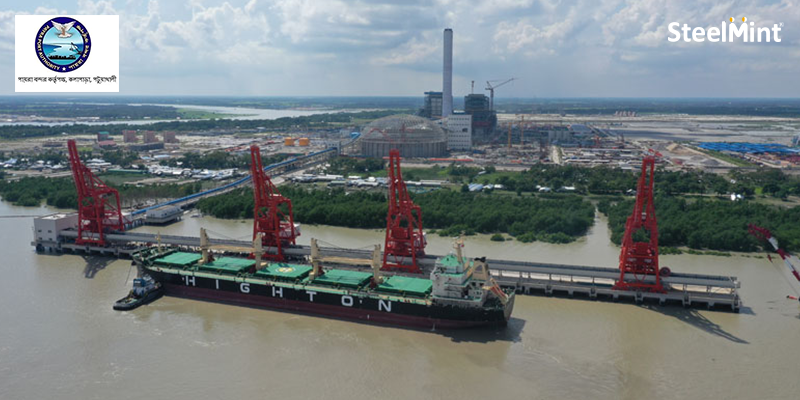
    Payra, the third sea port of Bangladesh situated on the bank of Rabnabad channel under Kalapara, is located in the sub-district of Patuakali. The port was inaugurated 19 Nov’13 to assist in transportation of various commodities including food grain, cement, fertilizer and other bulk containers to Dhaka and other destinations through internal waterways.

    However, in order to cater the anticipated rise in coal demand of the power station proposed by Bangladesh-China Power Company, the government has planned expansion of the port by envisaging a dedicated coal terminal.

    The selection of the private partners for developing the terminal would be carried on the basis of International Competitive Bidding (ICB), for which interested bidders have been asked to give their consent.

    The Payra port authority has stated that the bidders are supposed to design, build, finance, operate and maintain the coal/bulk terminal. In addition, it was specified that the pertaining job should be transferred back to the owner based on the terms and conditions set out in the contract.

    The port authority has highlighted that that bids are to be submitted on or before 1200 hours BST, 17 Feb’2020, and should be accompanied by a bid security amount of BDT 240 Million.

    Recent Development:

    Payra port had received its coal consignment on 19 Sep’19, where a vessel laden with 20,000 MT coal reached the jetty of the Payra port.

    The coal was bought from Indonesia by the Payra power plant which has been build under the flagship of Bangladesh-China Power Company (BCPCL). Incidentally, it was the first ever shipment for coal-based power plant in the history of Bangladesh.

    Officials from the Payra power plant have reported that the first unit of the 1320 MW power station would be commissioned on 27 Jan’2020. The plant is likely to import 40 Lakh Tonnes of coal annually through the Payra port.

    Bangladesh is more dependent on gas for its power generation but are energy equations changing? To know, participate in the Bangladesh Coal Conference 2020.