SteelMint Events

Tag: coal

  • India: Record coal production in FY23 fails to rein in imports

    India: Record coal production in FY23 fails to rein in imports

    • Govt mandates imports to meet peak power demand
    • Shipments from Indonesia, Russia increase sharply
    • Imports likely to remain high in Q1FY24

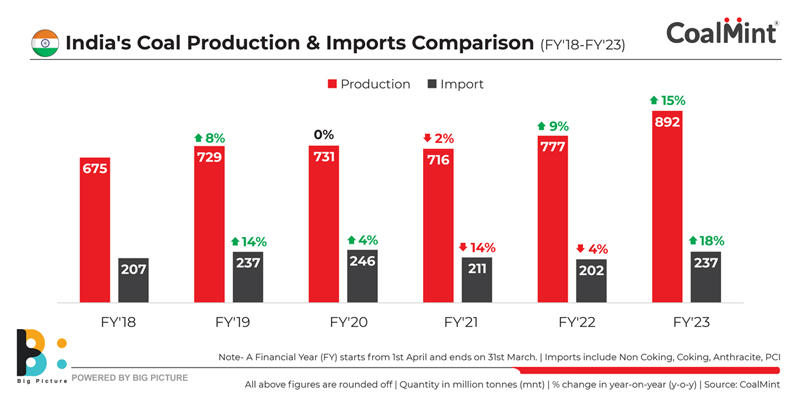
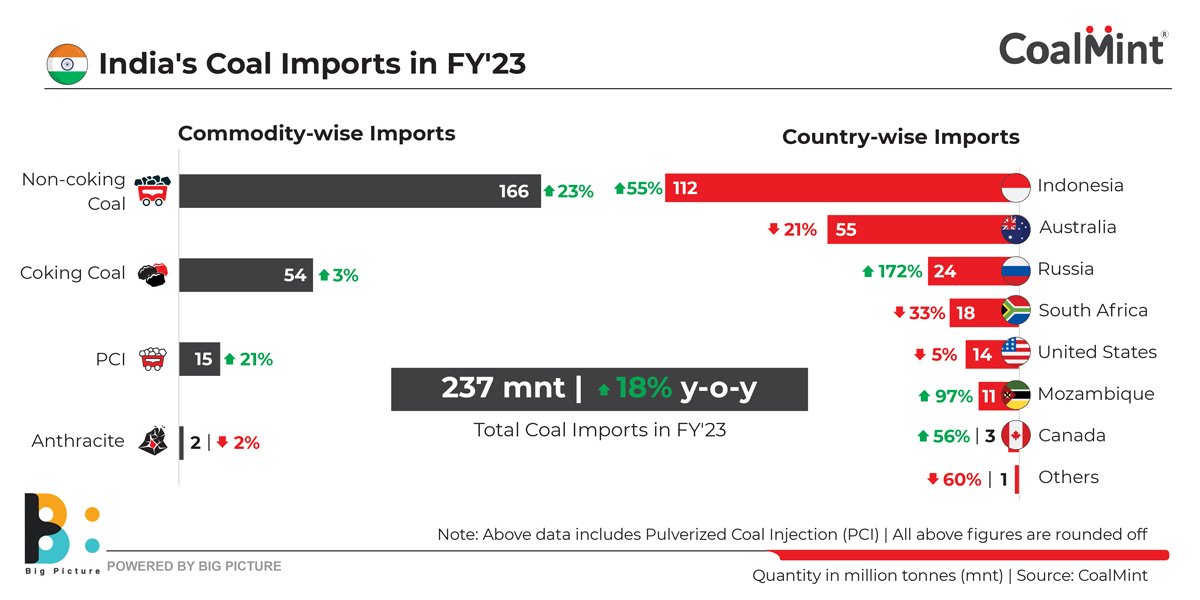
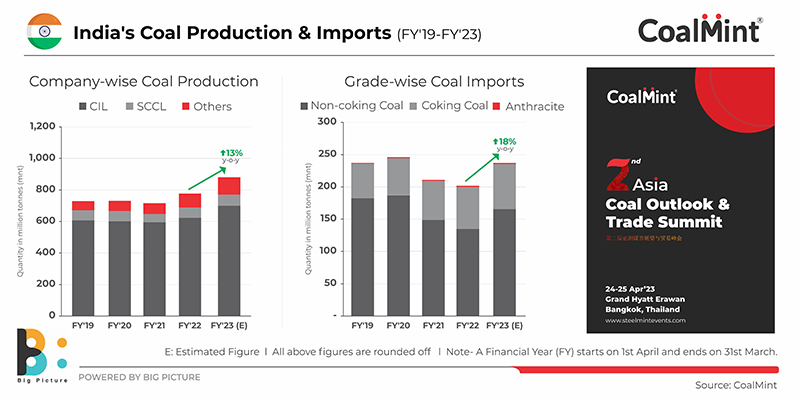
    India’s coal imports increased sharply by around 18% y-o-y to over 237 million tonnes (mnt) in financial year 2022-2023 (FY23) from 202 mnt in FY22, data maintained with CoalMint reveals.

    Interestingly, imports surged despite record domestic coal production in FY23. The country recorded historic growth in its coal output at 892.21 mnt in FY23, Union Coal Minister Pralhad Joshi informed recently. Total coal production was 15% higher from 777 mnt in FY22.

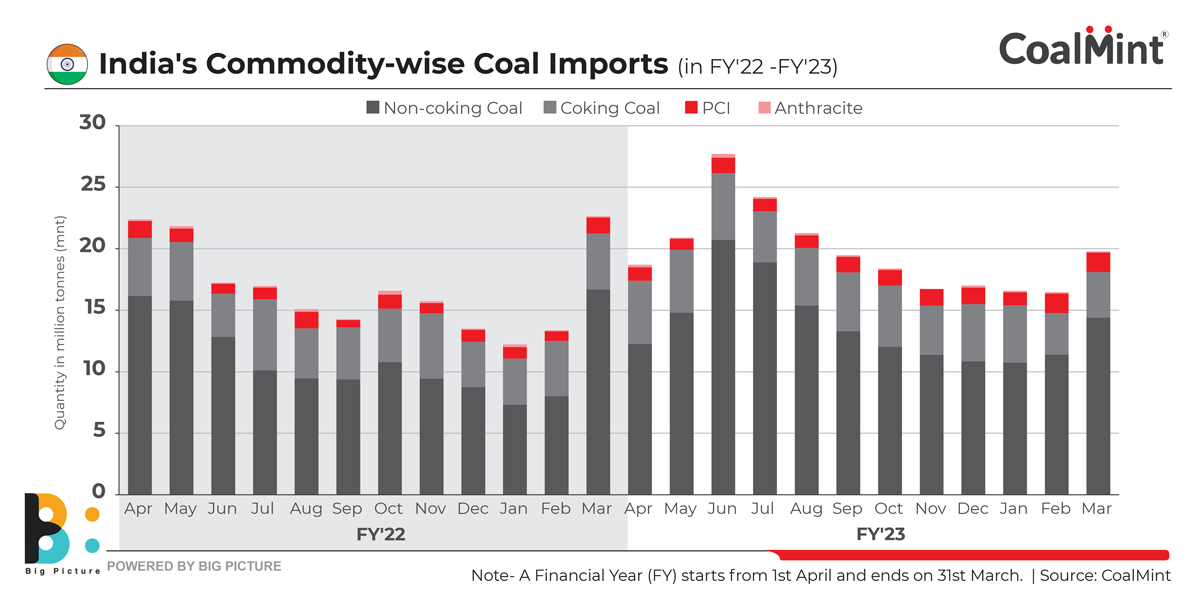
    Out of total import shipments in the recently concluded fiscal, those of non-coking or thermal coal stood at over 166 mnt, which is roughly 70% of total imports. Non-coking coal imports edged up by 23% y-o-y on higher demand from power producers and with the government mandating imports to meet peak power demand.

    On the other hand, total imports in FY23 of coking coal and PCI coal stood at over 69 mnt compared with 65 mnt in FY22. While hard coking coal imports increased by just around 3% y-o-y, imports of PCI coal for usage mainly in blast furnace steelmaking rose sharply by 22% on the year.
    Why imports increased?

    *High power demand: Government data shows India’s power consumption surged 10% to 1,375.57 billion units (BU) during the April-February period in FY23, thereby already surpassing the level of electricity supplied in FY22.

    Power consumption in April-February of FY22 stood at 1,245.54 BU. In FY22, power consumption was 1374.02 BU, which is less than 1,375.57 BU recorded during the April 2022- February 2023 period. So, the imported coal-based power plants had to raise imports.

    *Govt mandates imports: To ensure adequate power availability, the Ministry of Power (MoP) has instructed power plants to import 6% (by weight) of their coal needs for blending purposes till September, 2023. A similar mandate had been issued last year too. That time, the blending ratio was kept at 10%. As a result, India’s State-owned power producers as well as major miners raised coal imports till June-July 2022 although shipments fell post September as peak summer demand subsided along with monsoon-related logistical disruptions.

    This year, too, the government has asked the imported coal-based (ICB) power plants to carry on operations at full capacity. In addition, a tender has been floated to procure electricity from ICB plants for April-May when power availability is expected to be less than demand.

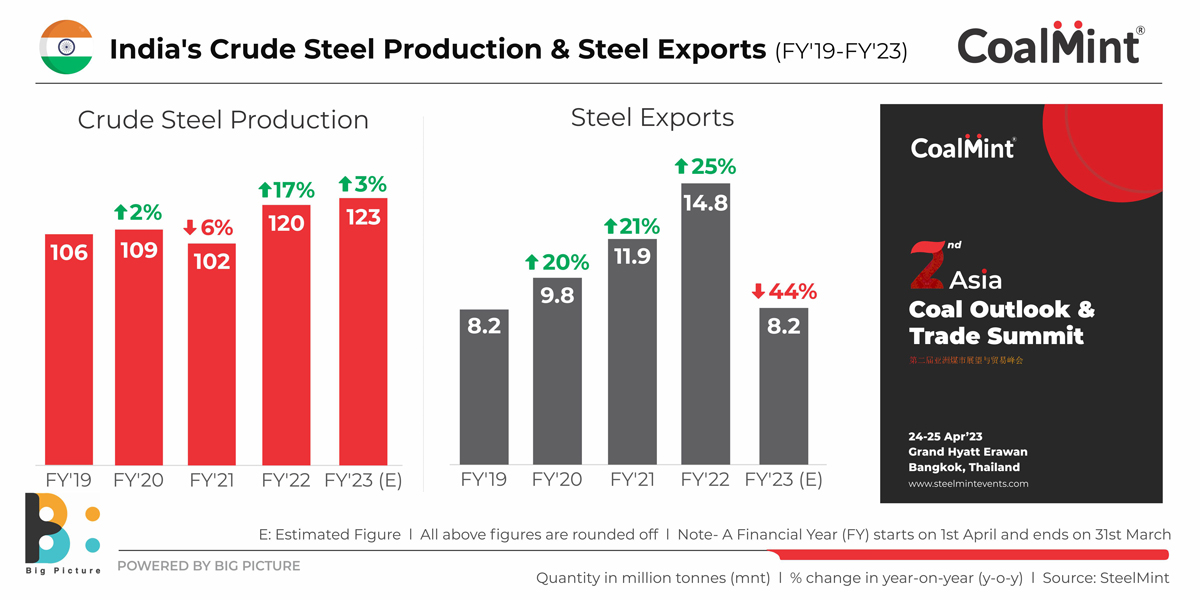
    *Steel production rises: India’s steel production edged up to nearly 125 mnt in FY23, as per government data, from around 118 mnt in FY22, an increase of 6% on the year. In the absence of quality domestic coking coal reserves, imports naturally increased. Besides diversifying import sources amid historic-high coking coal prices, Indian steelmakers also ramped up usage of PCI coal to increase furnace efficiency even while reducing the usage of costly metallurgical coke. This saw volumes from Russia increasing sharply y-o-y.

    Trade flows

    The top exporter to India was Indonesia, with total shipments standing at 112 mnt -up 55% on the year. Indonesia is the world’s largest seaborne exporter of coal, accounting for 32.3% of the global seaborne coal market in 2022. The country has set an export target of over 500 mnt of coal in 2023. India purchases mainly high-to-low-CV non-coking coal from Indonesia.
    With the rise in Russian supplies, it is expected that only low-CV Indonesian coal will henceforth be attractive for Indian buyers, said a miner source based in Indonesia. After persistent pandemic disruptions and temporary export bans, Indonesian exports surged in FY23.

    Imports from Australia, however, fell by over 20% to around 55 mnt, out of which over 36 mnt was coking coal. Even coking coal imports from Australia dropped 13% on the year as a result of India’s efforts to diversify coking coal sourcing amid record-high global prices following the outbreak of the Russia-Ukraine war in February last year.

    Similarly, India increased its met coal imports from the US and Canada sharply to around 10 mnt from less than 5 mnt in FY22. Marked growth in Canadian coal production and easing of disruptions in key US coal terminals supported higher shipments.

    Notably, imports from Russia surged by over 170% on-year as the country stepped up shipments of cheaper cargoes to Asian consumers to amid sanctions imposed by the EU and US as well as G7 allies. Imports from South Africa, on the other hand, decreased by 33% as Mozambican and Russian exports to India surged. Imports from Mozambique rose by 97% y-o-y to nearly 11 mnt in FY23, with Indian DRI producers ramping up sourcing due to record-high South African coal prices amid global energy inflation.

    However, with subsequent correction in global coal prices, trade flows seem to be returning to settled patterns.

    Outlook

    Experts say power consumption is expected to grow in double digits in the coming months in view of forecasts of unprecedented high demand, especially in summer. The power ministry has estimated peak power demand in the country at 229 GW during April this year, which is higher than 215.88 GW recorded in the same month a year ago.

    Following the government’s mandate, NTPC, India’s largest power producer, has decided to import around 5.4 mnt of coal during the first half of FY24. So, imports are expected to remain high through till July-August this year.

    Interestingly, India’s coal imports have returned to the pre-Covid levels of around 240 mnt seen in FY19 and FY20.

    Despite the government’s aim of augmenting domestic washery capacity and achieving coking coal production of 140 mnt by FY30, imports are likely to grow parallelly with India’s fast-expanding steelmaking capacity. Imports are projected to reach 75-80 mnt by 2025-2026.

    Logistical bottlenecks and high freight rates have increased dependency on imports by impeding pit to plant coal transport. Total coal loading by the Indian Railways in FY23 increased by over 11% to 653.36 mnt and total freight earned rose by 22% y-o-y. The allocation of more rakes, special lines and dedicated freight corridors for coal transportation and rationalization of freight rates are expected to increase domestic availability of coal.

    2nd Asia Coal Outlook & Trade Summit

    There has been no let-up in India’s coal imports of late and 2023 may be another year likely to witness sustained growth. How is the government planning to rein in imports by 2025-26? To follow the discussion, book your seat at CoalMint’s 2nd Asia Coal Outlook & Trade Summit in Bangkok, Thailand, on 24-25 April, 2023.

  • India’s coal imports to surge again on peak summer demand?

    India’s coal imports to surge again on peak summer demand?

    The massive surge in coal consumption led by ever-expanding power demand has left India scrambling to secure adequate supplies despite a significant push seen towards increasing domestic production.

    In FY2022-23, the country scaled new heights in coal production. Till February, total coal production increased by 15% to 784.41 million tonnes (mnt), thereby surpassing the previous high of 777.26 mnt recorded in the previous fiscal.

    Leading from the front, state-run miner-Coal India Ltd (CIL) has maintained higher production and is well on course to meet the fiscal target of 700 mnt. In addition, gradual opening of new captive mines has also provided remarkable contribution in production growth.

    India’s dependency on coal imports, particularly of thermal coal, hit a low on the backdrop of Covid-induced demand disruption. However, improvement in economic activities paved the way for higher imports last year, and there is an increasing likelihood that the pattern would be followed again in a situation where present demand outstrips domestic coal supply.

    Govt intervenes to ensure energy security 

    Reinstating its stance towards imports, the Ministry of Power (MoP) has instructed power plants to resort to imports by procuring 6% (by weight) of their needs for blending with domestic coal till September, 2023 failing which curtailment in domestic supply has been proposed.

    The decision has been taken to ensure smooth operations at thermal power stations. Interestingly, similar provision was also introduced last year. That time, the blending ratio was kept at 10%.

    In this regard, India’s largest power producer, NTPC, has decided to import around 5.4 mnt of coal during first half of next fiscal (FY2023-24). The company has already floated two separate tenders seeking a total of 2 mnt of imported coal. The due date for bid submission is 18 April, 2023.

    Also, for the second time, the ministry has asked imported coal-based (ICB) power plants to resume operation at full capacity this year by invoking the emergency law under Section 11 of the Electricity Act, 2003.

    In addition, a tender has been floated to procure electricity from ICB plants for April-May when power availability is expected to be less than demand.

    These provisions would provide ICBs an avenue for power sale, due to which these utilities will need to explore the global market for running their operations.

    Challenges facing non-power sector

    In India, the power sector accounts for a lion’s share of domestic coal supply. Hence, at a time when coal demand from the power plants had increased this year, domestic miners were left with no choice than to lower the supplies meant for the non-power sector.

    Incidentally, CIL had diverted additional production volumes towards sales against Fuel Supply Agreements (FSA), which refers to long-terms contracts initiated with the power utilities. On the other hand, allocations via regular e-auctions, which constitute 20% of CIL’s sales, were curtailed.

    Under these circumstances, CIL’s coal dispatches to the non-power sector are set to decline for the second straight year in FY23.

    Moreover, CIL’s decision not to renew long-term contracts for coal supplies under linkage auctions meant for the non-power sector, has further escalated the supply crunch for this sector at a time the demand for power is showing no signs of slowing down.

    Price factor 

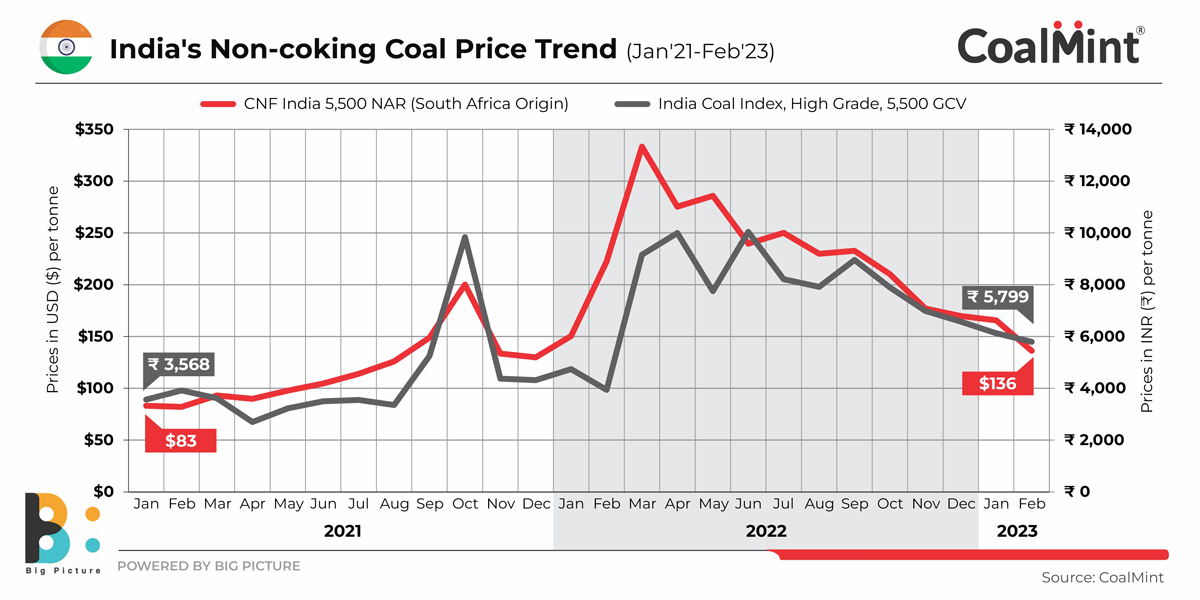
    In the aftermath of the Russia-Ukraine war, coal supply chains had altered which resulted in prices touching record highs. However, prices have started to decline since the second half of 2022 amid reduced appetite from China and rise in production seen from the major exporter Indonesia.

    Meanwhile, reduced Russian coal exports to Europe were balanced by hike in supplies from Colombia and South Africa.

    In India, domestic prices touched unprecedented levels due to factors arising from geopolitical turmoil and prevailing supply cuts. Notably, healthy competition was seen amongst the buyers to procure the limited material offered at auctions. In addition, the introduction of the single window auction, which brought the entire gamut of customers on to a common platform, also pushed bid prices higher.

    Upon improvement in supplies, prices have seen significant correction, but still are assessed above year-ago levels. In the scenario where both global and domestic prices have come down, but the latter is still overpriced given its low energy-content, the Indian buyer will be banking more on seaborne material as it provides greater value in terms of quality.

    Thrust on steel production 

    Augmenting steel production is essential to supporting economic growth. At the same time, the government’s thrust on import substitution in the steel sector has resulted in the Performance-Linked Incentive Scheme (PLI) being introduced.

    Moreover, there is a strong case for increasing output after the government had lifted the 15% export duty imposed on finished steel. This move might prompt the steelmakers to explore the export market to fetch higher price realisations.

    Therefore, the dependence on coking coal as well as PCI imports is bound to increase with the higher generation of liquid steel through the primary route. Given that India has scarce coking coal reserves, of which only a meagre portion has low ash content, the big steel companies are not in a position to reduce their dependence on imports in the foreseeable future.

    Outlook 

    Stepping up the plan to increase domestic coal availability, the government has introduced several policy reforms to support the mining sector. These include extension of mining lease period, eliminating prior approval required for capacity expansion, along with creation of a single window system.

    Moreover, regular auctions are being conducted for allocation of coal blocks under the commercial mining scheme. In view of the dwindling response from the prospective bidders, the sale was made lucrative by providing relaxation in payment terms and improving the feature of blocks offered in the lot.

    These measures paid off as a total of 25 blocks were sold in the recently concluded sixth tranche, marking the highest allocation recorded for a single tranche.

    CIL is also exploring opportunities to re-open abandoned mines which had been closed mainly on account of difficult mining conditions and financial losses.

    With elections round the corner and the pressing need to avert a power crisis, imports are likely to play a key role in satiating rising demand.

    2nd Asia Coal Outlook & Trade Summit 

    There has been no let-up in India’s coal imports of late and 2023 may be another year likely to witness sustained growth. Will imports continue on an upward trajectory or will government intervention and the projected rise in domestic coal output help to rein in imports? To follow the debate, make sure you attend CoalMint’s 2nd Asia Coal Outlook & Trade Summit in Bangkok, Thailand, on 24-25 April, 2023.
  • Will China’s coal imports from Australia rise post lifting of ‘unofficial’ ban?

    Will China’s coal imports from Australia rise post lifting of ‘unofficial’ ban?

    In a significant development, Chinese authorities have allowed all domestic companies to import Australian coal, thereby putting an end to ‘informal’ trade restrictions imposed in late 2020. Ports and customs offices have been told to allow Australian coal cargoes.

    Earlier this year, the authorities had given four State-owned companies permission to resume purchases of Australian coal. Of the four, State-owned Baowu Group was the lone steel producer, while the rest were power companies.

    It is believed that more than 1 million tonnes (mnt) of Australian coal cargoes are set for Chinese shores in March. Due to the rise in global coal prices after Russia’s invasion of Ukraine, the price difference between China’s domestic coal and Australian coal had substantially decreased. As a result, the withdrawal of the ‘unofficial’ ban on Australian coal will bring marginal economic benefit to China.

    Imports from Australia

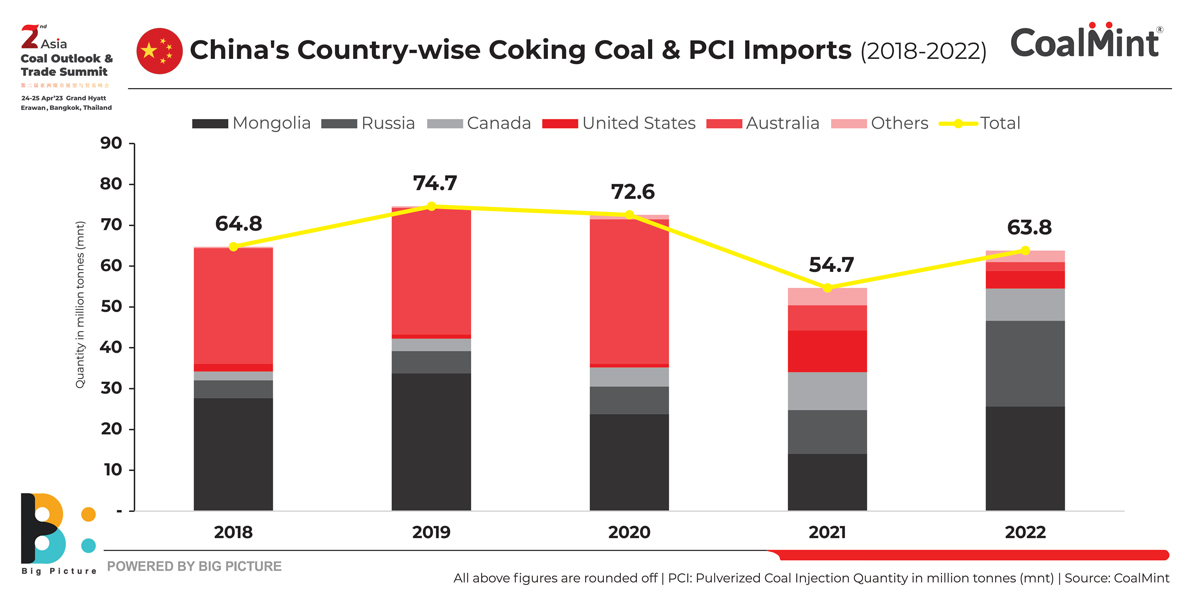
    CoalMint data reveal that China’s imports of non-coking coal from Australia, mainly high-energy coal, decreased by about 90% in 2021 from 2020. China’s imports fell to 5.5 mnt from over 42 mnt in the previous year. Imports were recorded at zero in 2022.

    As regards coking coal, China’s imports from Australia declined sharply by over 80% y-o-y in 2021 to just about 6 mnt compared with more than 35 mnt in 2020.

    However, volumes are sure to surge after China’s move to resume imports. The decision to resume coal imports from Australia is partly driven by the need to tame domestic coal prices amid global volatility.

    But China’s coal imports from Mongolia and Russia increased significantly on-year in 2022, as Covid restrictions were slowly eased along the China-Mongolia border allowing for free vehicular movement, as well as cheap Russian coal offers amid global energy inflation.

    Impact on coking coal market 

    Sources believe that with the full reopening of Australian coals into China, the increase in supply of seaborne imported material will exert some downward pressure on the coking coal market. China’s domestic raw coal production in Jan-Feb’23 also increased by around 6% y-o-y to 735 mnt, as per NBS data.

    In fact, coking coal and coke futures on China’s Dalian Commodity Exchange (DCE) edged down after news came in of permission being granted to all Chinese companies to resume Australian coal purchases. FOB Australian prices of premium low-volatile coking coal are still higher than CFR China prices by around $6-10/t. In the CFR China market, prices inched lower on weaker sentiments, with the DCE futures market observing May coking coal and coke contracts dropping by 4.53% and 3.04% yesterday.

    Outlook 

    Domestic met coal production in China is set to face hurdles going forward as environmental restrictions push authorities to clamp down on mining activities in coal-rich provinces. At the same time, high steel industry capacity utilisation at times may drive met coke imports from SE Asian countries with surplus capacities.

    Demand for Australian high-energy Newcastle coal may remain rangebound in the near term even though new domestic coal mining capacity is approved.

    In the short term, however, Australian premium low-volatile hard coking coal may continue to attract buying interest, despite competitive offers from Russia, even as uncertainties persist over pricing and logistics from Mongolia.

    CoalMint’s 2nd Asia Coal Outlook & Trade Summit

    China’s coking coal imports increased by over 15% on the year in 2022. Will imports increase in 2023, too, with the resumption in inflow of Australian cargoes? Would Chinese buyers have appetite for Australian thermal coal given other low-priced alternatives?

    Follow the discussion at CoalMint’s 2nd Asia Coal Outlook & Trade Summit to be held at the Grand Hyatt Erawan, Bangkok, Thailand on 24-25 April, 2023, where Mr. Jiyuan Wang, Marketing Manager, Shaangu Group from China, will share his insights.

  • China may reduce coking coal consumption in steelmaking by 20-25% by 2030

    China may reduce coking coal consumption in steelmaking by 20-25% by 2030

    China, the world’s top steel producer, is seeking to cut down on its consumption of coking coal for steel production in sync with its ‘dual carbon’ goal of peaking emissions by 2030 and attaining carbon neutrality by 2060.

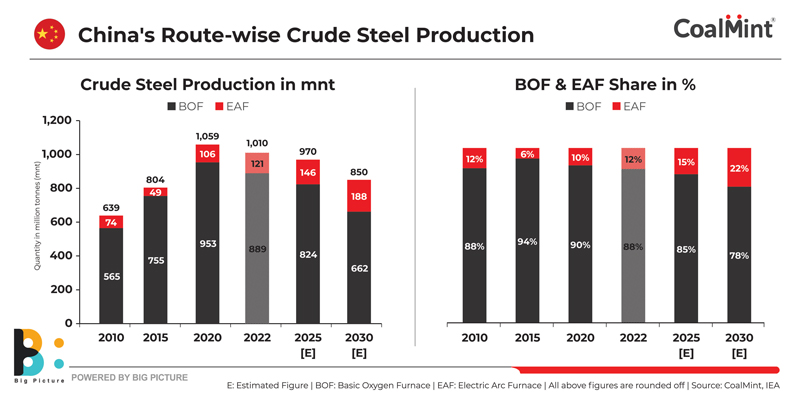
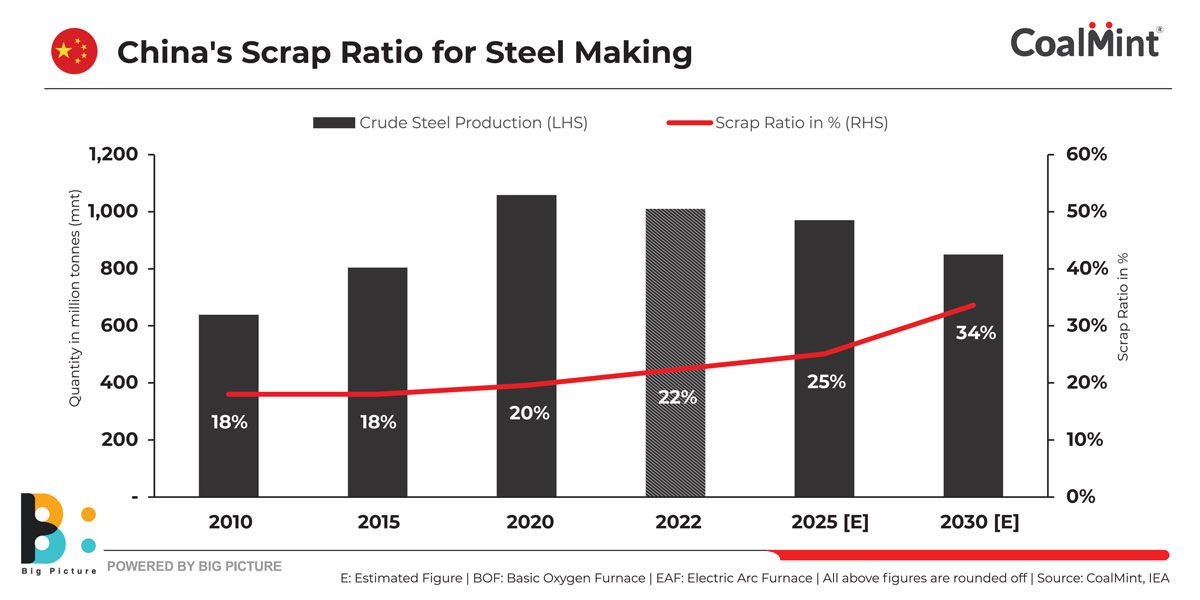
    In line with this objective, the steel industry in China is expected to reduce consumption of coking coal by 20-25% by 2030, reports indicate. It is predicted that the share of predominantly scrap or green DRI-based electric arc furnaces (EAF) in China’s total crude steel production will rise to 22% by 2030 from 12% at present.

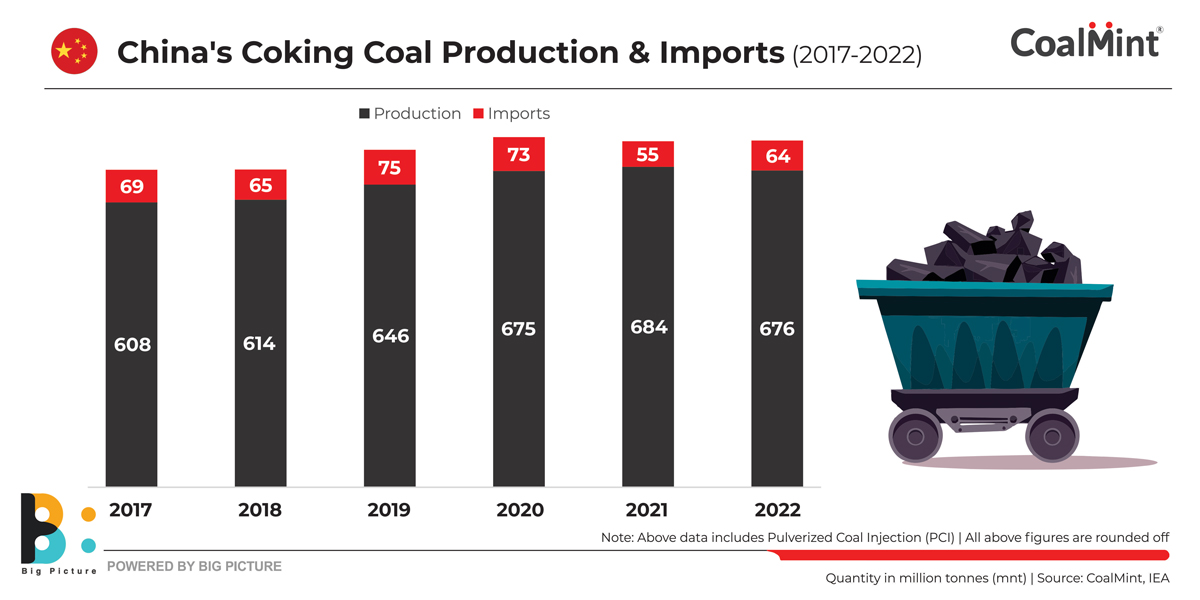
    However, the task is huge, considering the fact that the Chinese steel industry is predominantly coal-based. As per CoalMint data, out of 1.01 billion tonnes (bnt) of steel produced in China in 2022, 88% was churned out through the BF-BOF route. This required mammoth consumption of coking coal: in 2022 China’s coking coal production stood at 676 mnt, while another 64 mnt was imported, IEA data reveals.

    Due to the heavy reliance on the coal-based BF-BOF route, a polluting steelmaking pathway, steel production accounts for about 20% of the country’s total annual carbon emissions making it the largest industrial emitter, as per Global Energy Monitor (GEM) data. When emissions from electricity used by the sector are included, the share goes up to 24%. Thus, it is a key target in the government’s efforts to curb carbon emissions and improve air quality.

    Why might coking coal consumption fall?

    1. Steel production to drop: It is expected that steel production in China has almost plateaued. Many experts reckon that the 1.059 bnt of crude steel production in 2020 represented the peak. In 2022, crude steel production fell by 2% y-o-y. It is projected that crude steel production will drop to around 850 mnt by 2030.

    The capacity swap scheme is the most important policy intervention in the Chinese steel industry first introduced by the Ministry of Industry and Information Technology (MIIT) in 2014. The 2021 version of the capacity swap scheme revised measures for certain regions, raising swap ratios to 1.5:1 from a previous 1.25:1 in key air pollution control regions.

    The new version was also carefully designed to encourage EAF capacity and non-BF capacity expansions. If new iron ore and steelmaking facilities are environmentally friendly, such as EAFs, Corex, Finex, HIsmelt or hydrogen-based ironmaking plants, capacity can be swapped equally. Thus, coking coal consumption in steelmaking will naturally fall.

    2. Scrap/DRI share in steelmaking to rise: Higher steel scrap usage expectations could eat into coking coal demand. The National Development and Reform Commission (NDRC) sees China’s 2025 steel scrap usage rising to 320 mnt on carbon neutrality goals.
    During the 2021-25 period, Chinese crude steel output could plateau, which would cut molten iron output by 50 mnt and trim 21 mnt of coking coal demand in the period, Baosteel Group’s research arm Hwabao Securities has stated. The scrap ratio in steelmaking is expected to increase to 34% by 2030.

    In 2021, as per GEM data, China approved 39 new EAFs with a total capacity of 28.7 mnt/year through capacity swaps which is more than the sum of 2018-2020. The development of EAF is forecast to play a big role in reducing China’s steel industry carbon emissions.

    3. Hydro gen likely to replace PCI coal: An early use of green hydrogen in the steel industry will be in existing blast furnaces to replace pulverised coal injection (PCI) coal. Experts contend that reducing carbon emissions from blast furnaces will involve the use of higher-grade iron ore and the replacement of PCI coal with hydrogen.

    Therefore, apart from the use of hydrogen in production of fossil-free DRI which is gaining increasing prominence in China, the move towards higher efficiency in BF-BOF steelmaking will see producers transition from low-grade coking coal (PCI coal) to coke oven gas (COG) first and then hydrogen. Therefore, overall coking coal demand is likely to drop.

    Outlook

    At this stage of the global energy transition, high coal prices – as well as energy security concerns – are likely to hasten the transition towards alternative technology, including the replacement of PCI coal with hydrogen. Therefore, the long-term demand scenario for coking coal remains bearish, although it will take another decade or so before the final signs of decline become visible.

    2nd Asia Coal Outlook & Trade Summit

    Want to follow the discussion on how Chinese steelmakers are expected to cut coking coal consumption? Be a part of the discussion on technological breakthroughs in the Chinese steel industry at CoalMint’s 2nd Asia Coal Outlook & Trade Summit to be held at the Grand Hyatt Erawan in Bangkok, Thailand on 24-25 April, 2023

  • Global coking coal trade volumes rise nearly 8% in 2022. Know why?

    Global coking coal trade volumes rise nearly 8% in 2022. Know why?

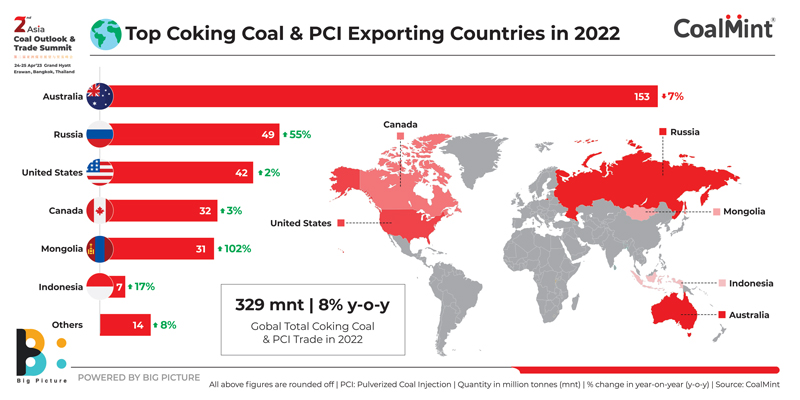
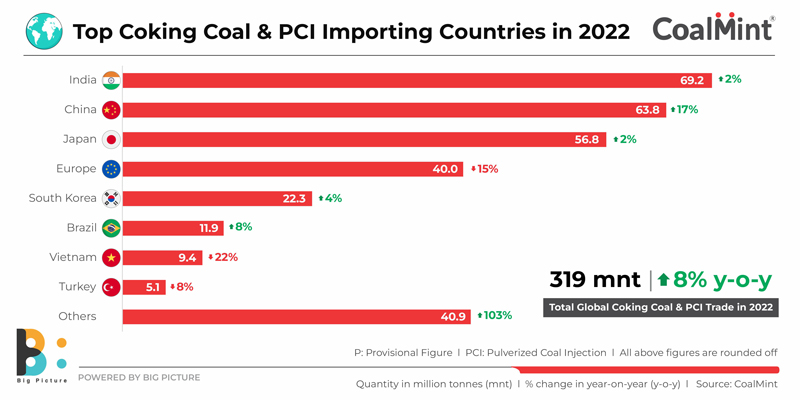
    Despite the slump in world crude steel production in 2022, global seaborne trade in coking coal remained strong with imports of Coking coal and PCI increasing by 8% y-o-y to around 319 million tonnes (mnt) from 295 mnt in 2021, as per provisional data maintained with CoalMint.

    Leading importers

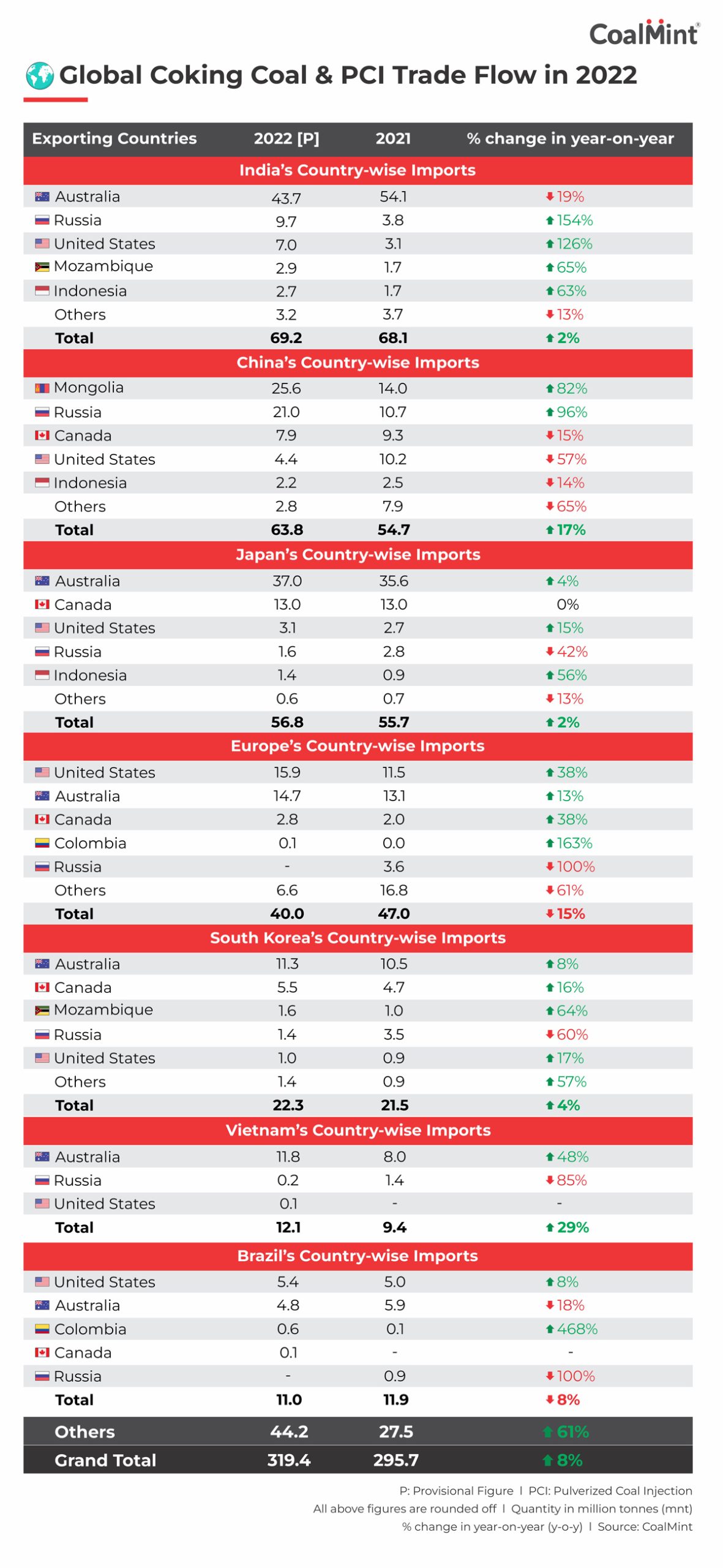
    India was the leading coking coal importer at 69 mnt in 2022, accounting for 22% of total global imports. India’s imports were almost stable y-o-y compared to 2021 China was the second-largest importer at 63 mnt. Imports by China rose 17% y-o-y, although crude steel production fell around 2%. Imports by Japan and South Korea remained largely stable y-o-y at 57 mnt and 22 mnt, respectively. Sentiments remained bearish on a gloomy global steel export outlook amid high inflation, supply chain problems in the auto industry and natural disasters. Europe’s coking coal imports fell by 15% y-o-y due to high energy inflation affecting steel production and demand following the outbreak of the Russia-Ukraine conflict. After Europe imposed a complete ban on Russian coal imports from 10 August global trade flows altered. The EU traditionally sourced 55-60% of its coking coal requirement from Russia and Australian and US coking coal made their way into the continent.

    Top exporters

    Australia was the largest coking coal exporter in CY22, although its share in global exports fell by 8% compared to 2021 due to bad weather. The La Nina event in the country led to heavy rains in the mining regions which affected operations, leading to supply disruptions. In addition, strikes by mine workers and unavailability of labour weighed on production. The US and Canada emerged as an alternative to Australian coal due to supply disruptions. Russia emerged as the second largest exporter with 47 mnt, an increase of 48% y-o-y. The war between Russia and Ukraine affected seaborne trade dynamics of coking coal. As more Russian coal found its way into China and India, Japan and South Korea reduced sourcing of Russian coal in response to Western sanctions.

    Why trade volumes increased?

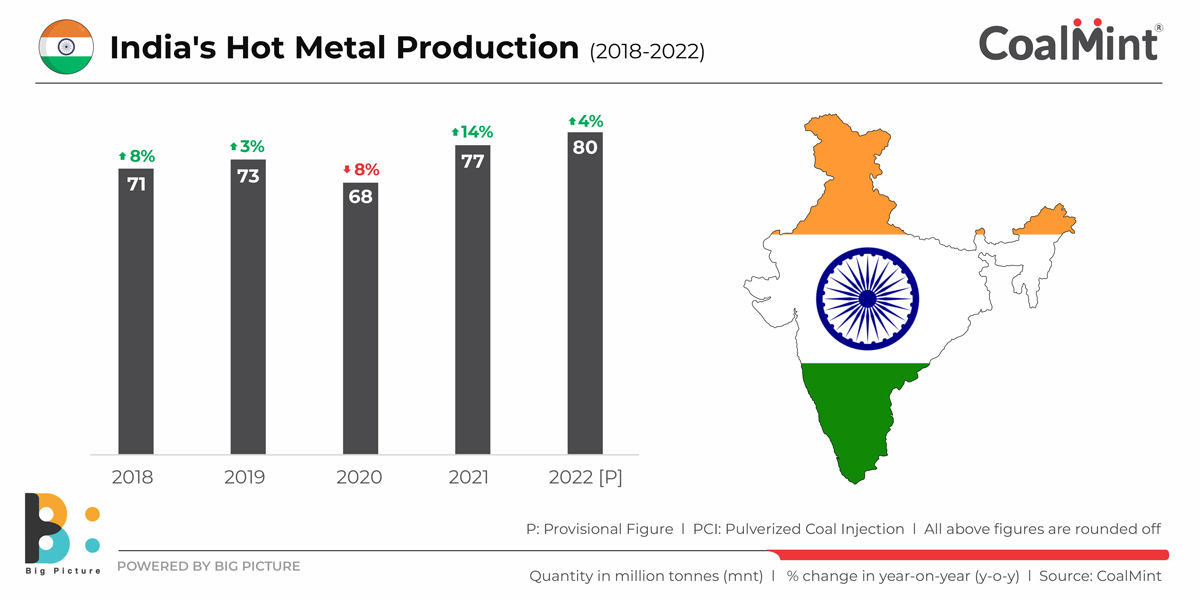
    1. India’s crude steel production increased by around 6% y-o-y to over 124 mnt. Similarly, hot metal production also increased by 4% to 80 mnt from 77 mnt in 2021. For Indian importers of coking coal there was no major change in the demand scenario. Demand did not fluctuate much since the steel export duty fiasco but remained generally steady.

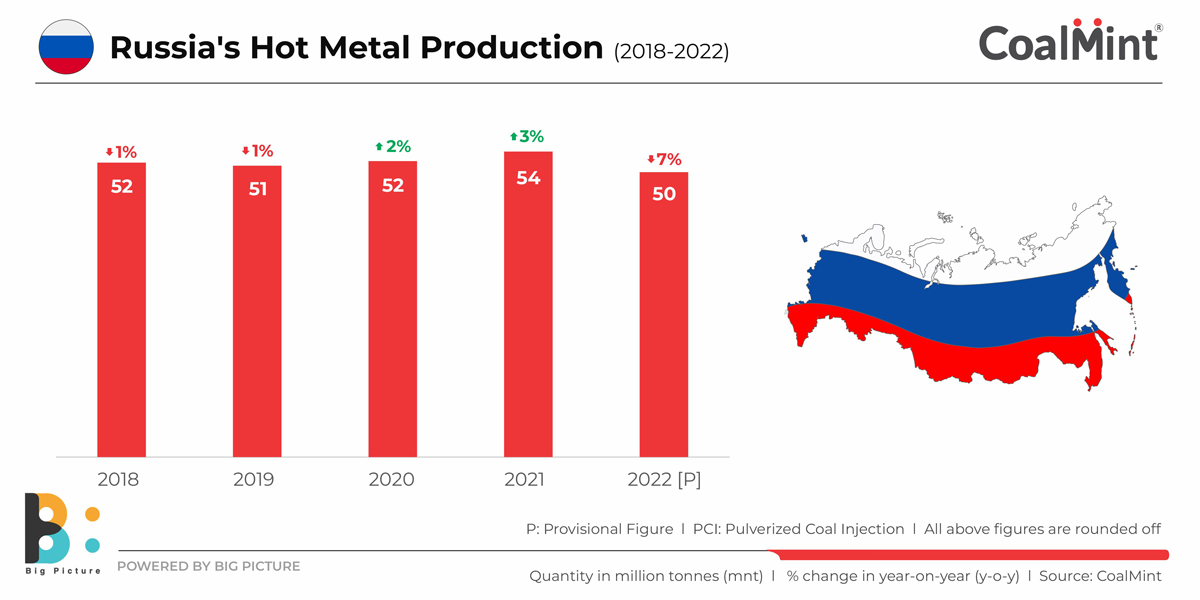
    2. The war with Ukraine took a toll on Russia’s steel production as well as exports. Data show that hot metal production in 2022 decreased by over 7% y-o-y to 50 mnt from 54 mnt in 2021. This left Russian miners with higher volumes for exports. After sanctions were imposed by the European countries on Russia following its invasion of Ukraine, the country started exporting coal at cheaper prices to Asian countries like China and India, resulting in a hike in export volumes. It may be mentioned that India imported 9.7 mnt of Russian coking coal in 2022, up 154% on-year, while China imported 21 mnt, an increase of 90% y-o-y.

    3. Global energy inflation drove steam coal prices to record highs across the globe, while steel production in many parts of the world suffered owing to high inflation and currency volatility. So, thermal coal prices soared way above coking coal prices globally forcing thermal coal users to switch to coking coal in many cases. This, in part, contributed to higher coking coal trade volumes.

    4. Although China’s crude steel production declined 2% 2022, domestic production of coking coal also fell marginally, thereby creating room for exports. Moreover, pandemic restrictions impeded the movement of domestic scrap for steelmaking, impacting EAF steel production. Higher shipments by Russia and Mongolia also account for higher imports by China. Mongolian shipments doubled y-o-y in 2022 as COVID-related restrictions were eased enabling truck movement across the border, while Russian cargoes were available at much cheaper rates since sanctions against Russia came into force in August.

    Outlook

    WSA has predicted steel demand to increase by 1% in 2023 to over 1.8 billion tonnes. Steel markets are expected to normalise in 2023, excluding China. Fitch expects global steel consumption to shrink by 60-65 mnt in 2022, with capacity utilisation dropping from 80% to 77%. China’s targeted reduction of steel production will account for 20-30 mnt of this, with the rest coming from demand destruction outside China. Incremental growth in steel consumption in 2023 is expected in India, Southeast Asia and the US.
    Therefore, coking coal demand will remain stable. Coking coal imports by India from Australia are also expected to remain stable in 2023, with the FTA between the countries leading to duty-free inflow of coal. Prices remained strong after a bumper 2022, driven largely by global energy prices and shortages cause by the Russia-Ukraine war. The other big-ticket item in January was the news that China is set to end its unofficial ban on importing coal from Australia, which is largely positive for global coking coal prices.

    Three central government-backed utilities and China’s top steelmaker would be allowed to resume imports. A recent report in the Australian Financial Review also indicates that Australian coking coal imports might displace lower quality and higher cost Chinese domestic or US coking coal, particularly for Chinese steelmakers in the southern region. Note that China’s proposed import duty on coal leaves Australia and Indonesia unaffected.

    Australia had diversified its coal exports to non-traditional buyers and ramped up supplies to traditional ones in the absence of China from the seaborne market. But now Chinese inquiries are expected to rise which may push prices higher. However, the continuing recovery of supplies from Australia will lead to an eventual correction, even if not significantly.

    Interestingly, Mongolia’s recent move to auction coal through the country’s stock exchange instead of direct sale by producers and traders at the border will directly impact Chinese buyers of Mongolian coking coal. We have to wait to see whether auction sales by Mongolia result in rationalisation of prices. Also, easing coal supplies via road from Mongolia after the withdrawal of pandemic restrictions and new investments in railway infrastructure are expected to reduce logistics costs and, therefore, coal prices.