SteelMint Events

Tag: cokingcoal

  • Will China’s coal imports from Australia rise post lifting of ‘unofficial’ ban?

    Will China’s coal imports from Australia rise post lifting of ‘unofficial’ ban?

    In a significant development, Chinese authorities have allowed all domestic companies to import Australian coal, thereby putting an end to ‘informal’ trade restrictions imposed in late 2020. Ports and customs offices have been told to allow Australian coal cargoes.

    Earlier this year, the authorities had given four State-owned companies permission to resume purchases of Australian coal. Of the four, State-owned Baowu Group was the lone steel producer, while the rest were power companies.

    It is believed that more than 1 million tonnes (mnt) of Australian coal cargoes are set for Chinese shores in March. Due to the rise in global coal prices after Russia’s invasion of Ukraine, the price difference between China’s domestic coal and Australian coal had substantially decreased. As a result, the withdrawal of the ‘unofficial’ ban on Australian coal will bring marginal economic benefit to China.

    Imports from Australia

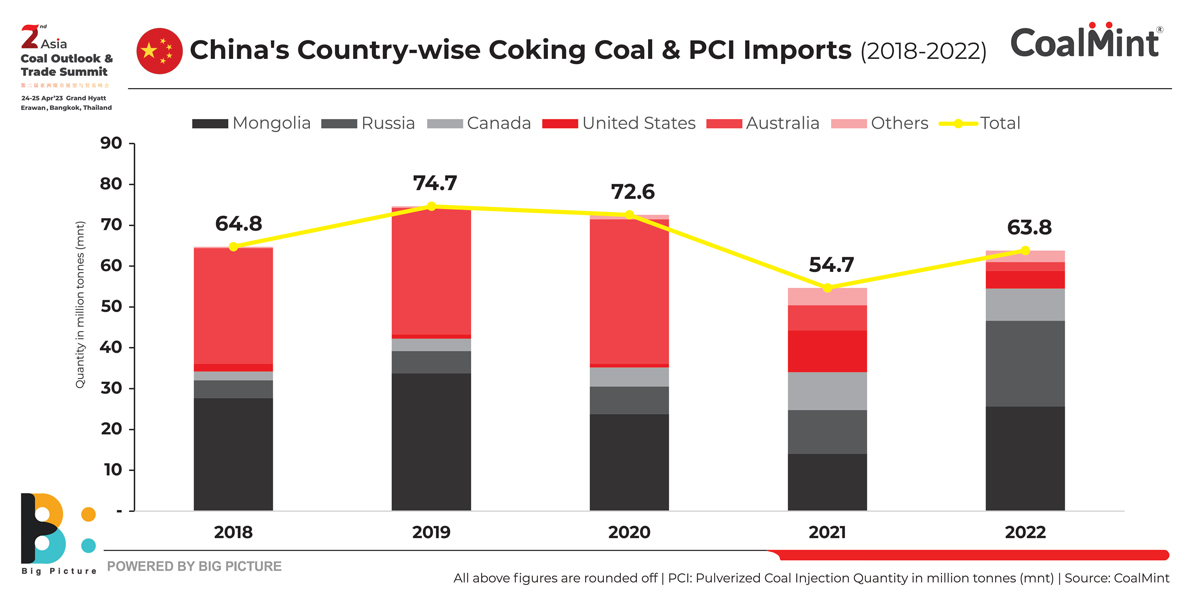
    CoalMint data reveal that China’s imports of non-coking coal from Australia, mainly high-energy coal, decreased by about 90% in 2021 from 2020. China’s imports fell to 5.5 mnt from over 42 mnt in the previous year. Imports were recorded at zero in 2022.

    As regards coking coal, China’s imports from Australia declined sharply by over 80% y-o-y in 2021 to just about 6 mnt compared with more than 35 mnt in 2020.
    However, volumes are sure to surge after China’s move to resume imports. The decision to resume coal imports from Australia is partly driven by the need to tame domestic coal prices amid global volatility.

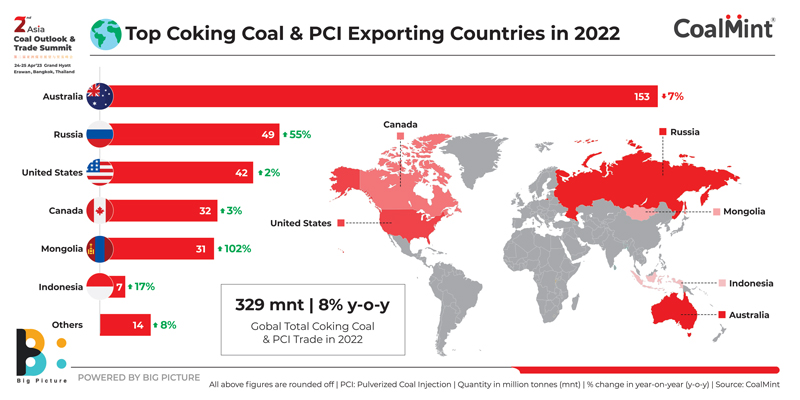
    But China’s coal imports from Mongolia and Russia increased significantly on-year in 2022, as Covid restrictions were slowly eased along the China-Mongolia border allowing for free vehicular movement, as well as cheap Russian coal offers amid global energy inflation.

    Impact on coking coal market 

    Sources believe that with the full reopening of Australian coals into China, the increase in supply of seaborne imported material will exert some downward pressure on the coking coal market. China’s domestic raw coal production in Jan-Feb’23 also increased by around 6% y-o-y to 735 mnt, as per NBS data.

    In fact, coking coal and coke futures on China’s Dalian Commodity Exchange (DCE) edged down after news came in of permission being granted to all Chinese companies to resume Australian coal purchases. FOB Australian prices of premium low-volatile coking coal are still higher than CFR China prices by around $6-10/t. In the CFR China market, prices inched lower on weaker sentiments, with the DCE futures market observing May coking coal and coke contracts dropping by 4.53% and 3.04% yesterday.

    Outlook 

    Domestic met coal production in China is set to face hurdles going forward as environmental restrictions push authorities to clamp down on mining activities in coal-rich provinces. At the same time, high steel industry capacity utilisation at times may drive met coke imports from SE Asian countries with surplus capacities.

    Demand for Australian high-energy Newcastle coal may remain rangebound in the near term even though new domestic coal mining capacity is approved.

    In the short term, however, Australian premium low-volatile hard coking coal may continue to attract buying interest, despite competitive offers from Russia, even as uncertainties persist over pricing and logistics from Mongolia.

    CoalMint’s 2nd Asia Coal Outlook & Trade Summit

    China’s coking coal imports increased by over 15% on the year in 2022. Will imports increase in 2023, too, with the resumption in inflow of Australian cargoes? Would Chinese buyers have appetite for Australian thermal coal given other low-priced alternatives?

    Follow the discussion at CoalMint’s 2nd Asia Coal Outlook & Trade Summit to be held at the Grand Hyatt Erawan, Bangkok, Thailand on 24-25 April, 2023, where Mr. Jiyuan Wang, Marketing Manager, Shaangu Group from China, will share his insights.

  • China may reduce coking coal consumption in steelmaking by 20-25% by 2030

    China may reduce coking coal consumption in steelmaking by 20-25% by 2030

    China, the world’s top steel producer, is seeking to cut down on its consumption of coking coal for steel production in sync with its ‘dual carbon’ goal of peaking emissions by 2030 and attaining carbon neutrality by 2060.

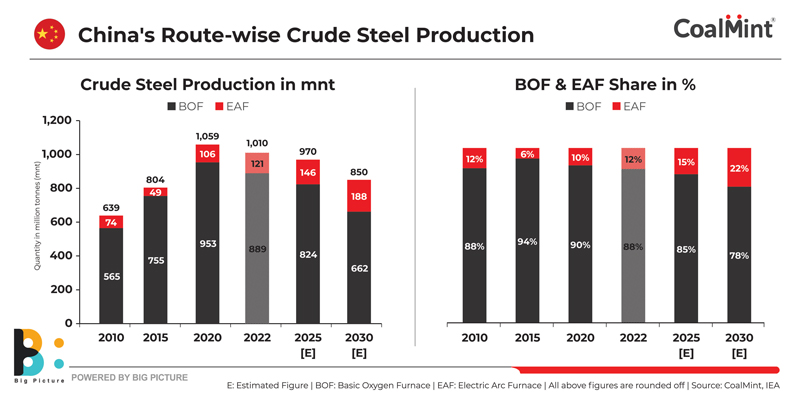
    In line with this objective, the steel industry in China is expected to reduce consumption of coking coal by 20-25% by 2030, reports indicate. It is predicted that the share of predominantly scrap or green DRI-based electric arc furnaces (EAF) in China’s total crude steel production will rise to 22% by 2030 from 12% at present.

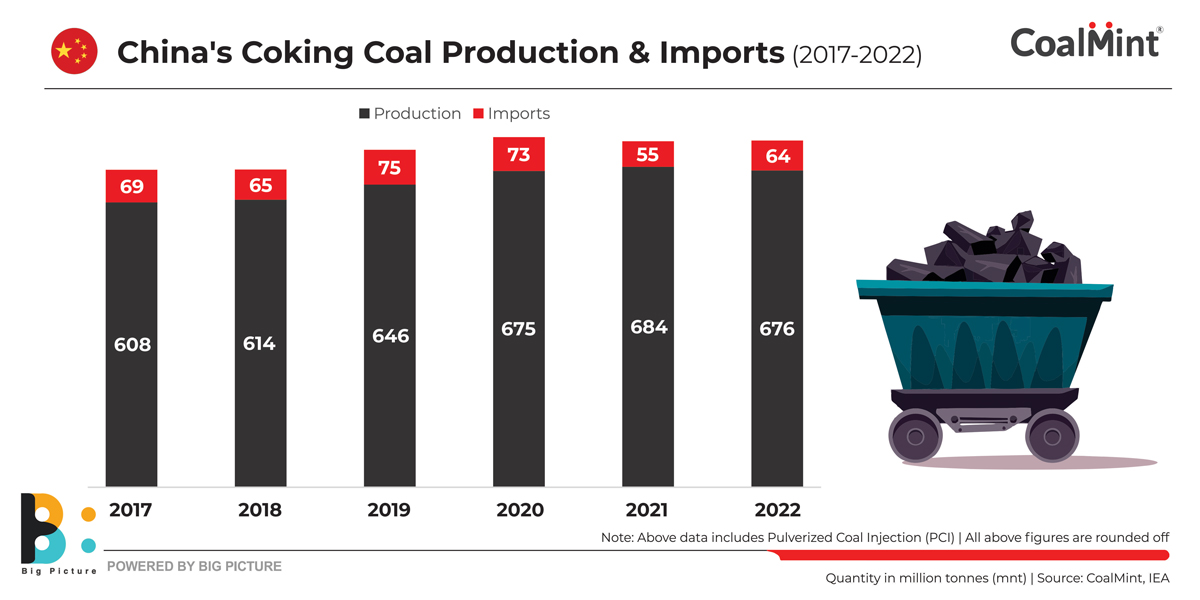
    However, the task is huge, considering the fact that the Chinese steel industry is predominantly coal-based. As per CoalMint data, out of 1.01 billion tonnes (bnt) of steel produced in China in 2022, 88% was churned out through the BF-BOF route. This required mammoth consumption of coking coal: in 2022 China’s coking coal production stood at 676 mnt, while another 64 mnt was imported, IEA data reveals.

    Due to the heavy reliance on the coal-based BF-BOF route, a polluting steelmaking pathway, steel production accounts for about 20% of the country’s total annual carbon emissions making it the largest industrial emitter, as per Global Energy Monitor (GEM) data. When emissions from electricity used by the sector are included, the share goes up to 24%. Thus, it is a key target in the government’s efforts to curb carbon emissions and improve air quality.

    Why might coking coal consumption fall?

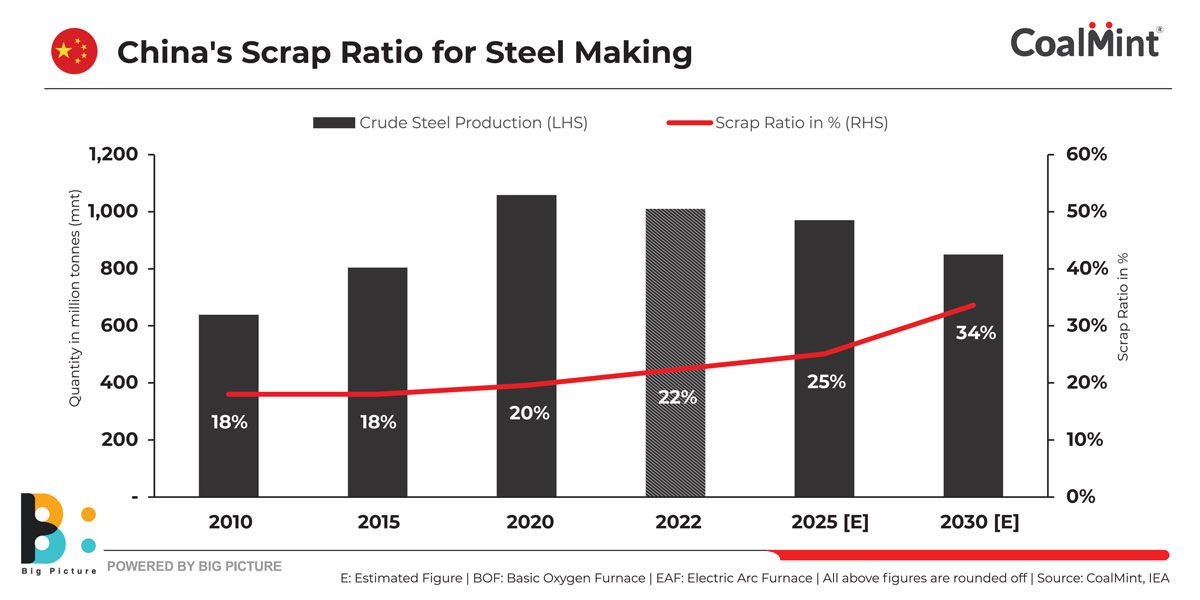
    1. Steel production to drop: It is expected that steel production in China has almost plateaued. Many experts reckon that the 1.059 bnt of crude steel production in 2020 represented the peak. In 2022, crude steel production fell by 2% y-o-y. It is projected that crude steel production will drop to around 850 mnt by 2030.

    The capacity swap scheme is the most important policy intervention in the Chinese steel industry first introduced by the Ministry of Industry and Information Technology (MIIT) in 2014. The 2021 version of the capacity swap scheme revised measures for certain regions, raising swap ratios to 1.5:1 from a previous 1.25:1 in key air pollution control regions.

    The new version was also carefully designed to encourage EAF capacity and non-BF capacity expansions. If new iron ore and steelmaking facilities are environmentally friendly, such as EAFs, Corex, Finex, HIsmelt or hydrogen-based ironmaking plants, capacity can be swapped equally. Thus, coking coal consumption in steelmaking will naturally fall.

    2. Scrap/DRI share in steelmaking to rise: Higher steel scrap usage expectations could eat into coking coal demand. The National Development and Reform Commission (NDRC) sees China’s 2025 steel scrap usage rising to 320 mnt on carbon neutrality goals.
    During the 2021-25 period, Chinese crude steel output could plateau, which would cut molten iron output by 50 mnt and trim 21 mnt of coking coal demand in the period, Baosteel Group’s research arm Hwabao Securities has stated. The scrap ratio in steelmaking is expected to increase to 34% by 2030.

    In 2021, as per GEM data, China approved 39 new EAFs with a total capacity of 28.7 mnt/year through capacity swaps which is more than the sum of 2018-2020. The development of EAF is forecast to play a big role in reducing China’s steel industry carbon emissions.

    3. Hydro gen likely to replace PCI coal: An early use of green hydrogen in the steel industry will be in existing blast furnaces to replace pulverised coal injection (PCI) coal. Experts contend that reducing carbon emissions from blast furnaces will involve the use of higher-grade iron ore and the replacement of PCI coal with hydrogen.

    Therefore, apart from the use of hydrogen in production of fossil-free DRI which is gaining increasing prominence in China, the move towards higher efficiency in BF-BOF steelmaking will see producers transition from low-grade coking coal (PCI coal) to coke oven gas (COG) first and then hydrogen. Therefore, overall coking coal demand is likely to drop.

    Outlook

    At this stage of the global energy transition, high coal prices – as well as energy security concerns – are likely to hasten the transition towards alternative technology, including the replacement of PCI coal with hydrogen. Therefore, the long-term demand scenario for coking coal remains bearish, although it will take another decade or so before the final signs of decline become visible.

    2nd Asia Coal Outlook & Trade Summit

    Want to follow the discussion on how Chinese steelmakers are expected to cut coking coal consumption? Be a part of the discussion on technological breakthroughs in the Chinese steel industry at CoalMint’s 2nd Asia Coal Outlook & Trade Summit to be held at the Grand Hyatt Erawan in Bangkok, Thailand on 24-25 April, 2023

  • How might Asian coal trade dynamics change if China lifts ban on Australian coal?

    How might Asian coal trade dynamics change if China lifts ban on Australian coal?

    Australia’s Foreign Minister Penny Wong met with her Chinese counterpart Wang Yi in Beijing on 21 December, 2022, as the trading partners seek to stabilise their diplomatic relationship. Wong’s visit is the first by an Australian minister since 2019 and the first formal talks in Beijing since 2018.

    It is widely expected that a thaw in the bilateral relationship will have a positive outcome for trade. If market chatter is anything to go by, the possibility of China lifting its informal embargo on a host of Australian exports, most prominently coking coal, is by no means remote.

    China had levied an informal ban on its top coal sourcing destination in the latter half of 2020 as tensions escalated between the two trading partners over a series of issues. China was one of the leading coal importers from Australia till 2019 with the latter exporting about 25% of its total coal (both thermal and coking) exports to China.
    As relations between the two countries are heard to be improving, speculation is rife that coal trade might resume once again.

    China-Australia trade dynamics: how it changed?

    Australia accounts for 58% of global seaborne trade in metallurgical coal, while China, the world’s largest steelmaking hub, accounts for 55% of global steel production.

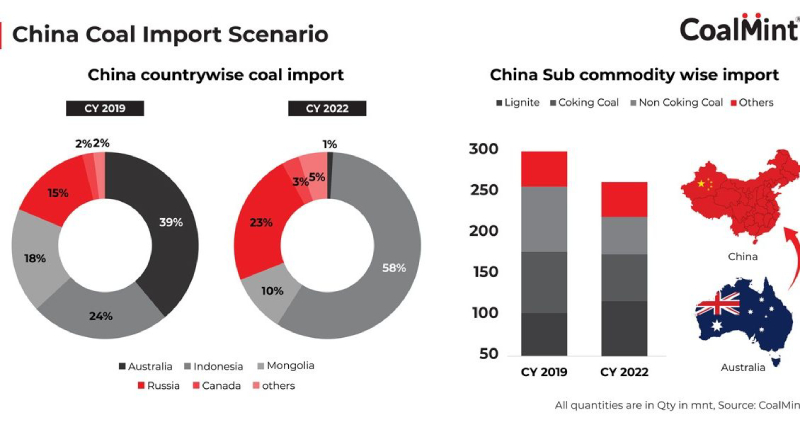
    China imported 197 million tonnes (mnt) of coal in 2019 (before the informal ban), of which 40% was imported from Australia. Commodity-wise, Australia’s share in China’s coking coal imports stood at 40%, while for thermal coal it was 60%.

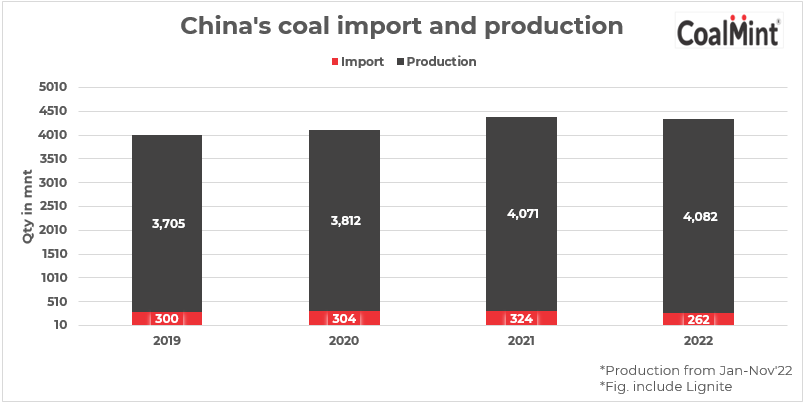
    Post 2020, China focused on increasing its domestic coal production. Compared to 2019, China’s domestic coal production jumped 20% to 4,452 mnt in 2022.

    While imports continue to arrive in China, the absence of Australian cargoes has been filled by met coal imports from the US, Canada and Russia. For thermal coal, imports from Indonesia, Russia and Colombia increased substantially.

    Interestingly, the share of Russian coal in Chinese imports increased noticeably after the Russia-Ukraine war earlier this year and subsequent sanctions imposed by European countries.

    Russia’s share in China’s total coal imports have gone up to 22% this year against 10% in 2019 and 12% in 2022. Chinese buyers favour Russian coal for its high quality and low prices.

    What might happen if China-Australia trade resumes?

    As per CoalMint analysis, even if trade resumes between the two countries the situation is unlikely to revert to what it was in 2019.

    This is because the Russia-Ukraine war has changed global coal trade flows. With sanctions on Russia by a majority of western countries and a few Asian ones too, Russian coal is being diverted to China at much cheaper rates.

    On the other hand, Australian coal has found favour in key economies such as Europe, Japan, and South Korea. This has resulted in Australian coking and thermal coal prices trending at high levels. Australian thermal coal prices are still elevated by about 24% as against January this year.

    While global steel and thermal coal demand remains slow at present due to Covid and recessionary pressure, in the long run if Australian coal miners are hoping for Chinese buyers to make a return to the market, their hopes are likely to be dashed. Given the fact that Australian coal is massively uncompetitive against its rivals coupled with the fact that China is raising its domestic output, it is uncertain whether Australian coal exports to China will resume in a big way.

    Asia Coal Trade Summit 2023

    Keen to attain insights on Asian coal trade flows and the emerging demand-supply dynamics in the continent? How may China’s coal demand pan out in the near term and what factors are likely to shape met coal trade flows in 2023? Sign in for CoalMint’s Asia Coal Trade Summit to be held at Bangkok, Thailand, in April 2023

  • 2023 Indonesia Coal Outlook Conference

    2023 Indonesia Coal Outlook Conference

    The government is committed to achieving net zero emission target by 2060 by reducing its dependency on coal and at the same time developing renewable energy generation.

    The government has prohibited the construction of new coal power plants and will terminate the operation of coal power plants in stages that will make coal demand in the general electricity sector start to decline to only 150.0 Mt in 2040 and only 19.0 Mt in 2050 before down to zero in 2060.

    In 2022, Indonesia is eying to produce 663 million tons with domestic coal use up to 165.7 million tons. Most of coal for the domestic utilization, around 100 million tons, is dedicated for electricity generation.

    Many still believe that during energy transition period, coal as reliable and affordable energy source is still required to generate electricity for most emerging countries in Asia, including Indonesia. The government encourages domestic coal utilization for industrial purposes, such as local smelter and cement industries and the development of domestic coal downstream projects such as coal to dimethyl ether (DME) and coal to methanol to support domestic gas and chemical industries.

    In the meantime, Indonesia’s coal export to traditional export market of China and India continue to increase this year.

    The Central Statistics Agency (BPS) reported Indonesia’s coal export to Europe also jumped by 143.7 percent to US$191.2 million in the second quarter of this year compared to $78.4 million in the first quarter with the largest coal export destinations of Italy, the Netherlands, Poland and Switzerland.

    The conference would explore the critical factors on will the coal survive amid global energy transition?

    The conference would also highlight the future of traditional markets of China, India, Japan, Taiwan and Korea as well as the European countries as well as the issues that will shape the future of metallurgical and coking coal.

    Register button