SteelMint Events

Tag: ferrous scrap imports

  • SteelMint analysis: Bangladesh likely to improve scrap imports to raise steel melting capacity by 2025

    SteelMint analysis: Bangladesh likely to improve scrap imports to raise steel melting capacity by 2025

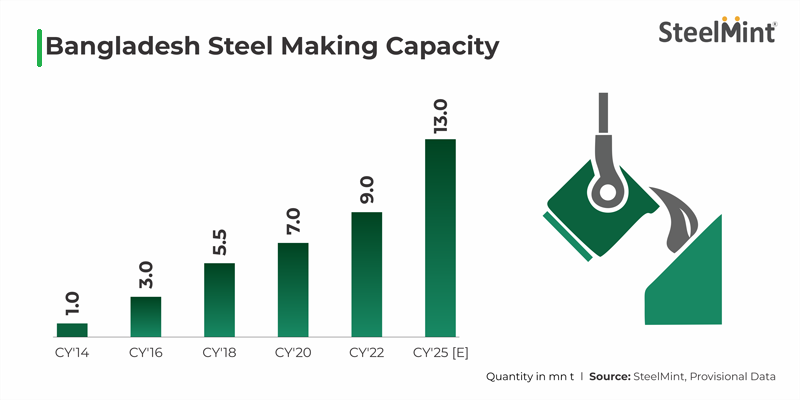
    • Bangladesh set to increase steel melting capacity around 13 mnt by 2025
    • BSRM, AKS, GPH and many other mills are setting up additional capacity
    • Bashundhara, Meghan & Akij entering steel business

    Bangladesh, one of the largest ferrous scrap importers in South Asia, is likely to witness an increase in steel melting capacities from 9 million tonnes (mnt) per annum currently to around 13 mnt by 2025 due to the growing demand for steel, cement, power and upcoming infra projects.

    Renowned steel producers in Bangladesh like BSRM, AKS, GPH, and many other mills are setting up additional capacity and facilities to cater to government-funded infrastructure projects in the coming years.

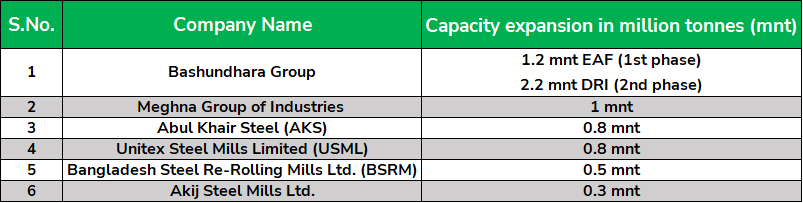
    Bashundhara Group is expanding its capacity to 1.2 mnt (EAF) in the 1st phase and 2.2 mnt (DRI) in the 2nd phase; Meghna by 1 mnt (EAF); AKS and Unitex by 800,000 t; BSRM by 500,000 t; and Akij by 300,000 t.
    Why is Bangladesh an emerging economy?

    • GDP growth rate: The economy of Bangladesh has a projected GDP growth rate of 6.4% for FY’23 as an emerging and fastest growing economy after India in South Asia.
    • Increasing steel demand for govt-funded projects: Steel demand in Bangladesh may remained supported mainly due to the government-funded infrastructure projects which were launched to stimulate the economy hit by COVID-19. Projects such as the Ashrayan Project, Metro Rail, Karnafuli Tunnel and elevated expressway from Dhaka Airport to Kutubkhali are expected to boost infrastructure construction. Hence, scrap demand is also likely to remain supported this year as well as in 2023.
    • Development of port facilities: Due to inadequate port facilities in the country, large ships were unable to enter Chittagong port. However, the Bangladeshi government has started working on projects such as the Matarbari Deep Seaport, which is estimated to be completed by 2026. Once these projected ports are completed, steel manufacturers will be able to import scrap more easily, which will ultimately speed up their production.

    Expert opinion

    Over the past five years, Bangladesh has become an integral part of the ferrous scrap trade in the South Asian region. As new steel capacities come onstream, scrap suppliers are looking forward to continuing the close relationship with the country in the years ahead,” stated Zain Nathani, Director, Nathani Group of Companies, India.

    Sanjoy Ghosh, Head of Supply Chain, BSRM, said: “Steel industries in Bangladesh are entering into a new phase amid higher demand forecast in line with projected economic growth. Despite the current global economic turmoil, all major plants are into enhancing their capacity and also new plants are trying to create a footprint in the market in order to cater to future demand. So, it is challenging time ahead for entire steel industry.”

    Scrap import scenario

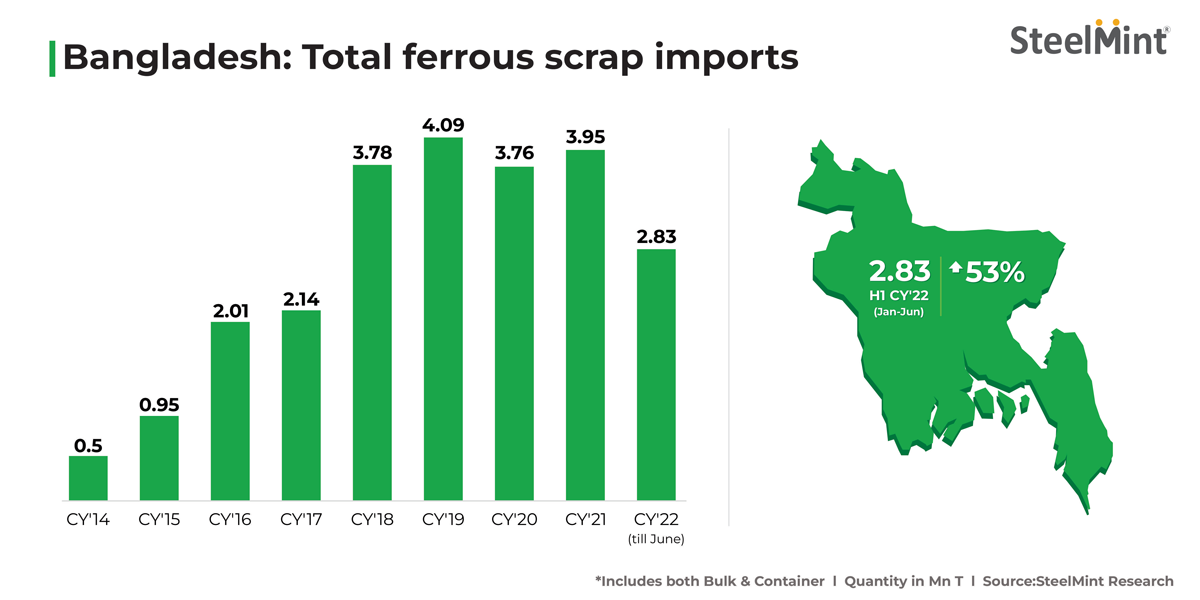
    Bangladesh is a country which is entirely dependent on scrap for steelmaking. The volume of imported ferrous scrap (both bulk and container) into Bangladesh stood at 2.83 million tonnes (mnt), up 53% in the first half (H1) of 2022 as against 1.85 mnt seen in the same period in 2021.
     

    Bangladesh: Total ferrous scarp imports

    As Bangladesh is eying over 6% GDP growth in the current year, the South Asian nation is making a concerted effort to spearhead infrastructure spending, which is expected to increase steel consumption going forward. However, it will be interesting to see if demand remains supportive against the backdrop of rising steel capacity.

    Join our event to know more on whether Bangladesh’ scrap imports will touch 6 mnt by 2025.

    SteelMint Events will be hosting the 3rd Steel & Raw Material Conference, Emerging Bangladesh on 20-21 September, 2022 at Hotel Radisson Blu, Chittagong, Bangladesh. The conference will explore key issues like the country’s steel production and demand outlook, global scrap trade flow changes, especially post-the Russia-Ukraine war, the ship recycling scenario, key emerging sectors, price trends and a lot more.

  • South Asian Ferrous Scrap Market – Outlook

    South Asian Ferrous Scrap Market – Outlook

    Guest speaker – Mr Zain Nathani, Managing Director at Nathani Steels & Vice President of MRAI & Ferrous Board, Bureau of International Recycling (BIR)

    South Asian markets are expected to witness the fastest growth in ferrous scrap imports during this decade. In this podcast by SteelMint Events, Mr Zain Nathani, MD of Nathani Steel, representative of Schnitzer Steel USA to South Asian markets and VP of MRAI & Ferrous Board, Bureau of International Recycling (BIR). shared insights about the trends of ferrous scrap import to South Asia and its growth over the years, how the global ferrous scrap market is responding to the ongoing covid-19 pandemic, as well as the potential of these markets for ferrous scrap import in the coming years.


    Points of Discussion:

    • Growth of scrap Imports to South Asia over the last decade
    • Expectation of Scrap import volume to South Asia this year
    • Global scrap price outlook in the near term
    • Impact of Covid-19 on shipments of previous orders and future bookings
    • Container vs Bulk scrap import trends in South Asia

    Listen the Podcast to Know all the answers
    – Interview by Akshay Sharma and Shreya Divakaran


  • Bulk Ferrous Scrap Imports to Bangladesh Surge 39% in Jan-Oct 2019

    Bulk Ferrous Scrap Imports to Bangladesh Surge 39% in Jan-Oct 2019

    Bangladesh, an emerging steel market and one of the growing importers of ferrous scrap in Asia, has witnessed a sharp increase in bulk ferrous scrap imports in 2019.

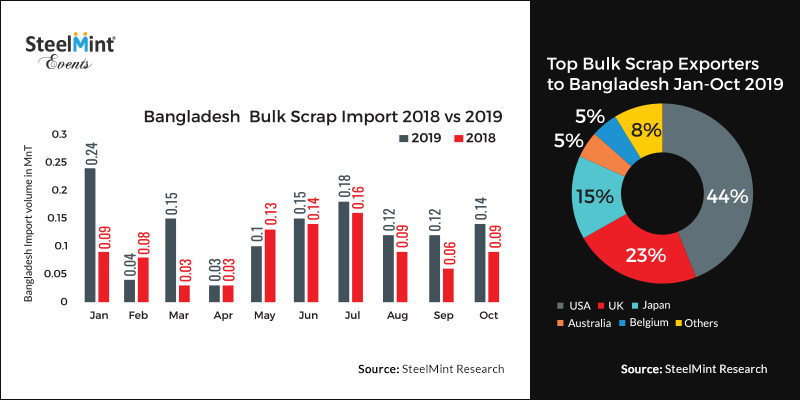
    During the period of Jan-Oct’19, bulk scrap imports to Bangladesh have been recorded at 1.25 MnT, witnessing a significant increase by 39% Y-o-Y as compared to 0.90 MnT during the same period Jan-Oct’18.

    Rising melting capacities and expansion plans of major steelmakers in the country has led to an increased ferrous scrap demand, while even more steelmakers are now turning active in booking scrap through bulk cargo vessels, as compared to only two major steelmakers booking bulk scrap till last year.

    46 bulk scrap vessels arrived at berth – So far in 2019, a total of 46 bulk vessels of ferrous scrap arrived on berth in Bangladesh’s sea port, which is again a sharp increase against 31 bulk vessels last year (Jan-Oct’18).

    USA remained the largest bulk scrap supplier – In terms of preferred origins for bulk scrap to Bangladesh, USA has remained the largest supplier in 2019 as well with 0.55 MnT as yet, however its share in total bulk scrap imported to Bangladesh has come down to 44% in 2019 (Jan-Oct) from 68% during Jan-Oct’18. However share of origins like UK, Japan and Australia considerably increasing their share this year.

    Increased preference for UK & Japanese scrap cargoes – In particular, bulk scrap imports share from UK has increased from 13% in Jan-Oct’18 to 23% in Jan-Oct’19. Interestingly, out of the 47 bulk vessels with scrap that have come to berth at Chittagong port this year, Japan has a contribution of 13 bulk vessels with nearly 0.2 MnT, recording a two-fold jump against same time span last year.

    In Oct 2019, bulk scrap imports to the country witnessed an increase by 19% M-o-M.

    After govt imposed import duty made billet imports to Bangladesh non viable since 2015, scrap imports gradually went on to completely replace billet imports to Bangladesh by 2018. Further, the share of bulk vessels in the total scrap imports to the country has also been observing an increase since then.

    To know more on Bangladesh scrap imports, book your seat at SteelMint’s 3rd Steel and Raw Material Conference, Bangladesh and get a chance to hear views of renowned industry participants from across the globe. The conference is being organized on 23rd-24th March 2019 in Chittagong, Bangladesh.

    Explore

  • South Korea: Ferrous Scrap Imports from US Rise Sharply in Q1 2019

    South Korea: Ferrous Scrap Imports from US Rise Sharply in Q1 2019

    South Korea – world’s 2nd largest ferrous scrap importer after Turkey has witnessed sharp rise in ferrous scrap imports from US in Q1’2019. South Korean ferrous scrap imports hit a record volume of more than 4 years high in the first quarter of 2019, the customs data maintained with SteelMint showed.

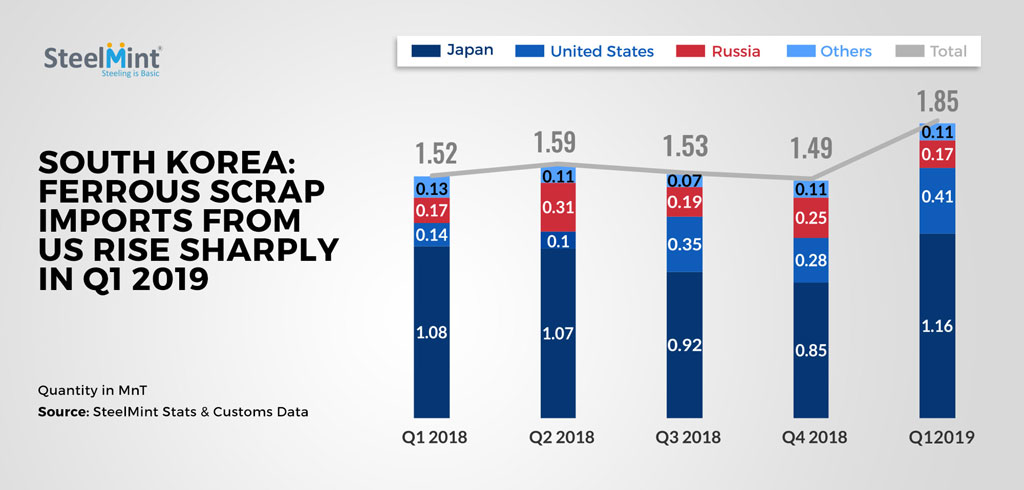
    South Korean ferrous scrap imports stood at 1.85 MnT ferrous scrap in Q1’2019, up 24% Q-o-Q against 1.49 MnT in Q4’2018 while jumped 22% against 1.52 MnT ferrous scrap in Q1’2018 on yearly premises. Scrap imports recorded in Feb’19 hit 53-month high against earlier highest was at 671,974 MT in Sept’14.

    Notably, US has supplied 0.41 MnT ferrous scrap to South Korea in Q1-2019, up 46% Q-o-Q against Q4’2018 while exports multiplied almost three folds against just 0.14 MnT recorded in the same quarter last year.

    Why was a shift in preference towards US scrap?

    Japanese domestic scrap prices remained on higher side in March ahead beginning of Golden Week holidays. Amid expectation of hike in prices, South Korean steel mills had booked bulk cargoes in previous months from US and Russia.

    Hyundai’s bidding for Japanese scrap is considered to be the benchmark for East Asian scrap market. The steelmaker has resumed open bidding in Mar’19 after a gap of two months. It had discontinued bidding amid high inventories and comparatively higher Japanese prices during Jan-Feb’19.

    Also Hyundai Steel had planned maintenance activities at its factories including Incheon steel mill during 3rd-19th February. Company officials had plans to reduce local scrap prices ahead of facility repair.

    Japan continues to remain the largest scrap supplier in Q1 2019

    Despite observing marginal fall in total scrap exports in Q1 2019, Japan exported 1.16 MnT ferrous scrap to South Korea, observing a rise of 36% Q-o-Q against 0.85 MnT ferrous scrap in Q4’2018 and a rise of 7% Y-o-Y against 1.08 MnT in Q1’2018. Japan occupied the highest 63% share in total scrap imports in Q1’2019 followed by US and Russia occupying 22% and 9% share.

    US stepped up as second largest supplier position surpassing Russia amid less clarity on scrap export ban from the Russian government. Russia supplied 0.17 MnT ferrous scrap to South Korea down 32% Q-o-Q against 0.25 MnT in Q4’2018. Russian scrap yards continued attracting higher prices domestically resulting in remaining on the higher side in Q1’2019 in comparison with Japan & US.

    Hyundai Steel aims at 3.5 MnT ferrous scrap imports in CY19

    The largest ferrous scrap consumer in South Korea- Hyundai Steel aims to bolster its ferrous scrap consumption to around 10 MnT in CY19. Out of total around 3.5 MnT scrap is anticipated to be imported in 2019. The company is likely to bolster its overseas ferrous scrap procurement lineup by strengthening the long term relationship with supplying scrap yards globally in 2019.

    According to World Steel Association, the country’s crude steel output stood at 18.10 MnT during Q1’2019 marginally up 2% against 17.81 MnT produced during same quarter last year. South Korean finish steel prices are driven by imported scrap prices. Country’s finish long exports remained stable at around 0.6 MnT in Q1’2019 while finish flat exports jumped 12% Q-o-Q to 6.14 MnT in Q1’2019 against that of Q4’2018.

    To know more on Japanese scrap supply-demand, book your seat at SteelMint’s 4th Steel Scrap, Billet & DRI Summit and get a chance to hear views of Mr Arshdeep Singh, Director Vital Solutions. The conference is being organized during 27-29’th Aug’19 in Bangkok, Thailand.

    Know More

  • Vietnam’s Surging EAF Capacities to Bring in More Scrap Imports?

    Vietnam’s Surging EAF Capacities to Bring in More Scrap Imports?

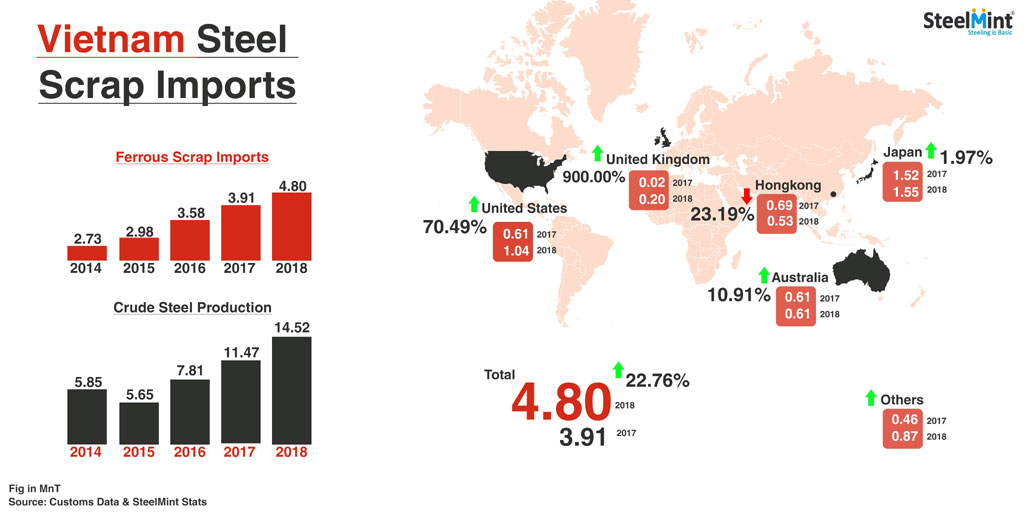
    Vietnam – one of the fastest growing steel markets in South East Asia has continued uptrend in crude steel production and ferrous scrap imports in 2018. As per released customs data, Vietnam imported 4,800,891 MT ferrous scrap in 2018 up 23% Y-o-Y against 2017.

    What makes Vietnam a sweet spot in steel industry?

    Vietnam’s government is optimistic with its projection of growth in construction sector and is expected to expand in long run with upcoming infrastructure projects of the government. Vietnam’s steel demand is learned to be around 21-22 MnT. Vietnam exported around 6.26 MnT steel in 2018 and steel imports recorded at 13.5 MnT.

    Japan remained the largest scrap supplier to Vietnam

    Japan supplied 1.55 MnT ferrous scrap occupying almost 32% share in total imports in Vietnam. Japanese scrap exports climbed marginally by 2% Y-o-Y against 1.52 MnT in 2017. USA scrap exports surged 70% Y-o-Y crossing 1 MnT mark the first time while that from UK jumped 900% to 0.20 MnT in 2018 to Vietnam against 0.02 MnT in 2017.

    Amid rising EAF crude steel production, Vietnam witnessed a fifth successive rise in yearly ferrous scrap imports in 2018.

    According to World Steel Association, Vietnam produced 14.52 MnT crude steel in CY18, up 27% Y-o-Y as against 11.47 MnT crude steel production recorded in CY17. Rising EAF steel output which comprises of almost 65-70% of total production in Vietnam has led the country to become fourth largest scrap importer surpassing USA in 2018.

    Concerns looming on Vietnam ferrous scrap imports

    In Aug’18, Vietnamese government tightened control over scrap imports and said that going forward it will only issue import licenses if the importers can prove that their shipments meet the environmental standards.

    However later in Aug’18, the Vietnam Steel Association (VSA) proposed to extend licenses of existing importers if they meet the environmental standards. Furthermore, as the domestic supply of metal scrap only meets 40% of the industry demand, imports are a major source for steel producers.

    Upcoming steel capacities in pipeline

    A series of steel plants are expected to ramp up capacities in two years down the line including Hoa Phat Steel, Hoa Sen Steel, the Vietnam Steel Corporation, the SMC Steel Company, and the VSC – Posco Steel Corporation (VPS). Surging EAF capacities are likely to push more scrap imports.

    To know more on steel scrap scenario of world’s emerging markets, be a part of 4th Scrap, Billet and DRI Summit during 27-29th Aug’19 in Bangkok, Thailand.

    Know More