SteelMint Events

Tag: Karnataka

  • Karnataka iron ore exports to resume after 10 years

    Karnataka iron ore exports to resume after 10 years

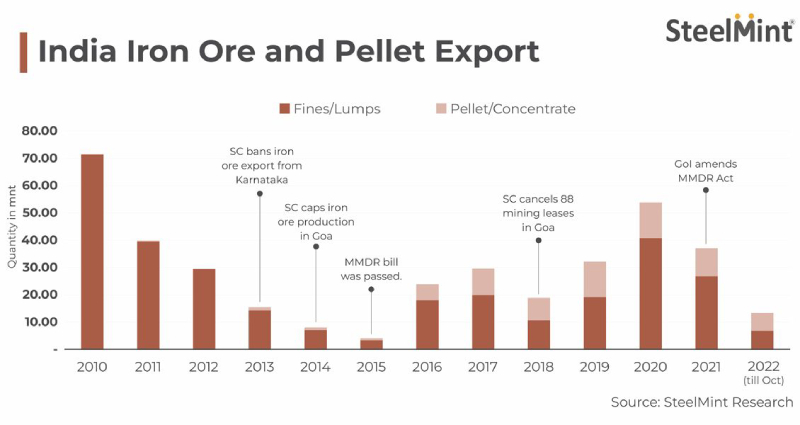
    Iron ore exports from Karnataka are about to resume after a gap of 10 years, SteelMint heard from market sources. Exports from Karnataka were banned in 2012 by the Supreme Court, which was in effect till May this year, with the aim of preventing environmental degradation and to ensure that the mineral resources of the state were preserved for the domestic industry and for future generations as part of the concept of inter-generational equity.

    The Supreme Court on 20 May this year lifted curbs on exports of iron ore from Karnataka and eased all restrictions on sales from the districts of Bellary, Chitradurga and Tumkur where mining activity had been prohibited following rampant environmental transgressions in 2011.

    As per a recent update received by SteelMint, a leading miner in the state is planning to export a capesize vessel of iron ore fines for which the material is already in the process of being transported to Krishnapatnam Port. Market chatter is revolving around the near-term prospects for iron ore and pellet exports by Karnataka-based miners.

    Factors which may drive exports

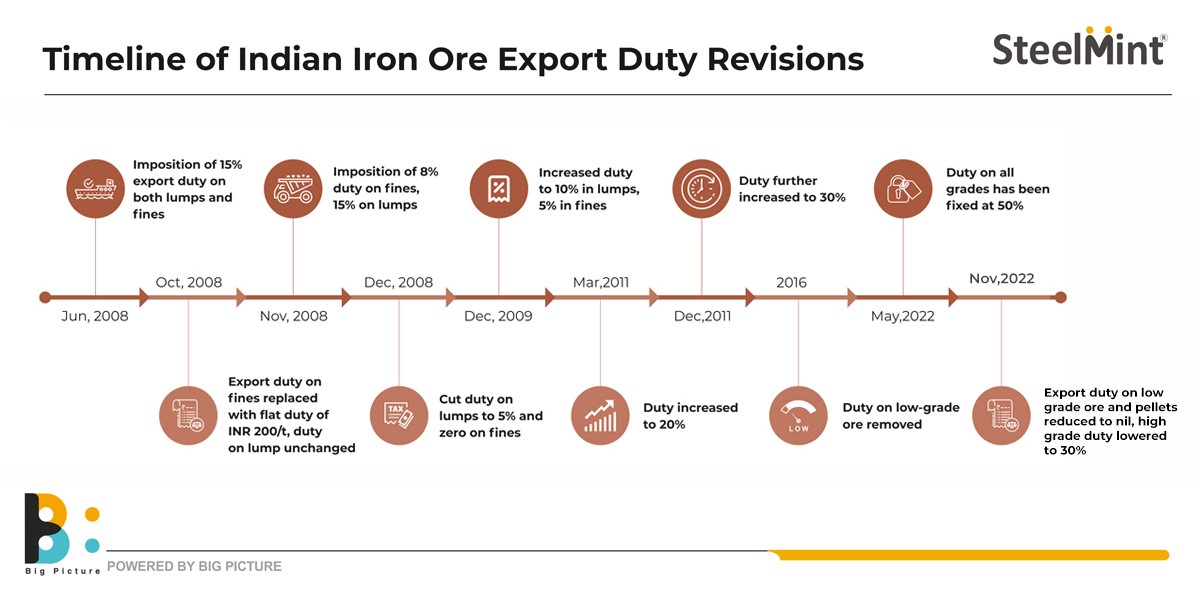
    • Lifting of export curbs: The apex court lifted curbs on iron ore exports and allowed iron ore operators in the state to sell excavated ore through direct sales as against just through e-auctions. This is a win-win for merchant miners and steel companies. By lifting the ban on exports of iron ore, the court opened an avenue for sale of surplus ore, which the industry had been pleading for. Also, the export duties on pellets and iron ore (except high-grade) have been rolled back recently. It should be noted that there is a possibility of existing low-grade iron ore stocks at mine pitheads in the state to come for exports in the short term. These are estimated at around 6 mnt, as per sources. Additionally, some volumes of seized material around 20-30 mnt are yet to be lifted, which may also come up for exports, as per sources. Besides, some small volumes of fines with sponge iron (CDRI) producers in the state might well get earmarked for exports.
    • China demand: After a long lull induced by Covid-related restrictions, the Chinese market is showing some positive sentiments due to the 16-point stimulus package announced by the government for the real estate sector, which accounts for around 35% of China’s steel demand. The possibility of a turnaround in the property sector has been driving iron ore prices higher over the past month, along with loosening of Covid restrictions. A weaker dollar, optimism about China’s economic recovery and positive developments in the real estate sector boosted market sentiment, as iron ore futures on the Dalian Commodity Exchange (DCE) have hit a 6-month high. As global iron ore fines Fe 62% prices have recovered from $80/t in the beginning of November to over $110/t currently, the incentive for exports is always present.
    • Production ramp up: The Supreme Court has raised the iron ore production ceiling in Karnataka from 35 mnt to 50 mnt from the A and B category mines. The production cap in Bellary has been raised to 35 mnt from 28 mnt, while in Chitradurga the ceiling has been raised to 15 mnt from the erstwhile 7 mnt. Therefore, the total cap has been increased to 50 mnt. The apex court had lifted the five-year-old ceiling on production from 30 mnt to 35 mnt for A and B category mines in 2018. There was no cap on the C category mines. It has been generally observed that total iron ore demand in the state stands at around 38 mnt annually. Therefore, following the possible production ramp up in the state, there is always the possibility that surplus material would be left for exports.

    Karnataka road show

    How is Karnataka’s iron ore and pellet industry shaping up post SC verdict? What is the potential in terms of production, demand, exports, and sales? Are you an industry stakeholder keen to find answers to these and several other queries? Book your seat at SteelMint’s Road Show-cum-Conference on Karnataka’s Mining Sector to be held on 19-21 January, 2023.
  • Karnataka may add up to 9 mnt iron pellet capacities in next few years

    Karnataka may add up to 9 mnt iron pellet capacities in next few years

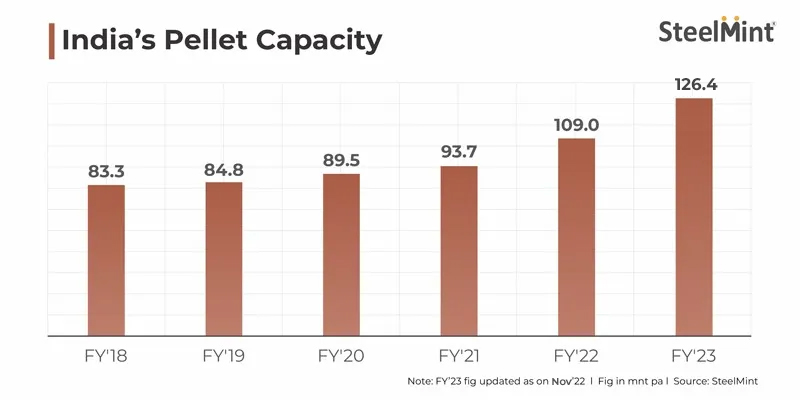
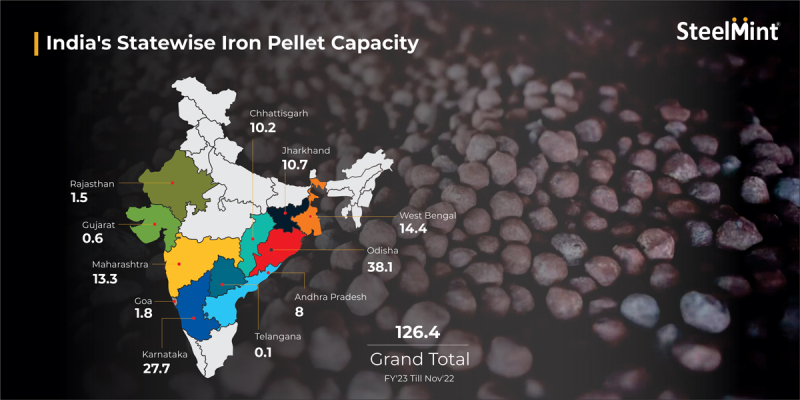
    India’s pellet-making capacity has expanded rapidly in recent years along with the steady rise in crude steelmaking capacity. SteelMint estimates that the country’s pellet production capacity currently stands at 126 million tonnes (mnt), which is 16% higher than 109 mnt in FY22.

    Karnataka’s share in India’s total pellet capacity is around 21% at 27.7 mnt currently. It has the second-largest pellet production capacity among Indian states, with Odisha topping the list at over 38 mnt. Karnataka emerged as the second-largest iron ore producing state in India in FY22 with production of about 40 mnt – roughly 16% of the country’s total production.

    Pellet capacity expansion

    SteelMint data shows that there are a few pellet capacity expansion projects in the pipeline in Karnataka. These are the following:

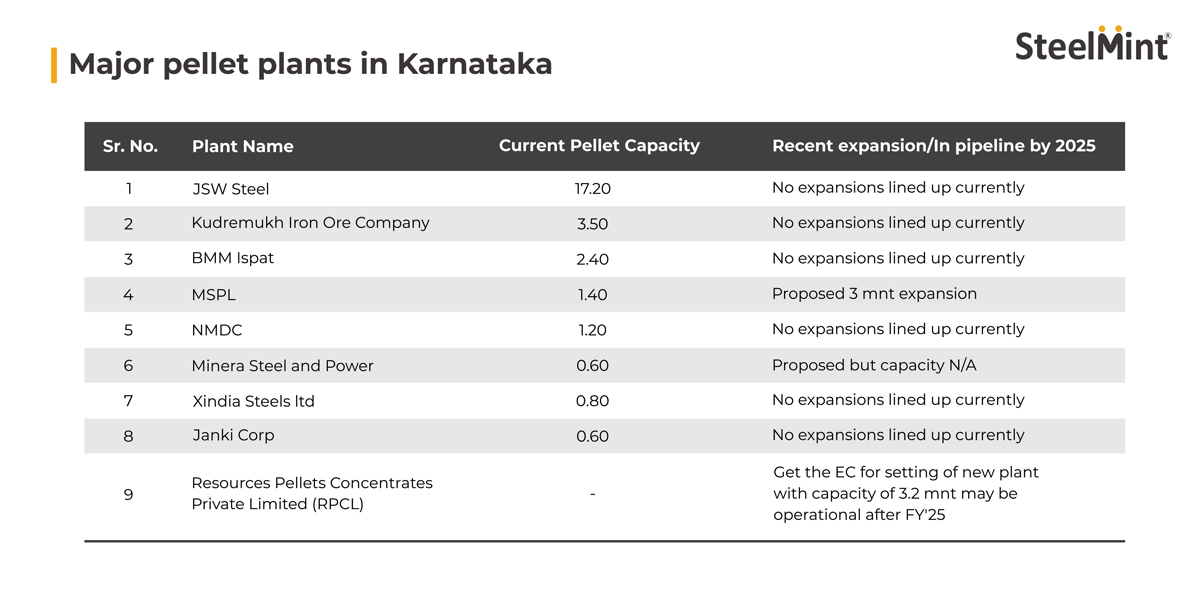
    • MSPL is looking to expand its plant capacity to 3 mnt by 2025 from around 1.4 mnt at present.
    • Minera Steel and Power has proposed to raise its pellet capacity. The company’s current capacity is 600,000 t per annum.
    • Vedanta Limited has invited expressions of interest (EoI) from competent Indian and international business partners for establishing a 3 mnt per annum pellet plant in the state supported by captive iron ore supply. The Sesa Goa iron ore mine in Karnataka has an operational capacity of 6 mnt/year.
    • Resources Pellets Concentrates Private Ltd. has received EC for setting up a 3.2 mnt/year pellet plant, which is expected to start operations after 2025.
    • Steel major JSW Steel’s present pellet plant capacity in Vijaynagar is 17.2 mnt. The company increased its capacity by about 8 mnt from 9.2 mnt previously.

    Why are pellet capacities increasing?

    Rising crude steel capacities to boost pellet usage – In conjunction with rising crude steel capacity in India, DRI (sponge iron) production is growing simultaneously. The country’s DRI output, which was a little under 40 mnt in FY22, is expected to rise to 50 mnt by 2030. Likewise, pellet usage in sponge iron production is increasing fast. The share of pellet-based DRI in India has increased to around 65% against 35% for iron ore lump-based sponge iron. One key reason is that iron ore lump availability and deliveries remain tight, and so sponge players are shifting towards pellets for quicker deliveries.

    Lower coke consumption – Use of pellets in blast furnace steelmaking is also gaining traction. This is because increased use of pellets enables permeability in the furnace and seamless gas flow within it, as well as smooth descent of the ferrous burden. This facilitates energy efficiency by way of reduced coke consumption and chemistry control. The primary mills have increased the pellet burden in BF to around 25% at present, which is expected to go up to 30-35% in the coming time, SteelMint estimates. With India’s steelmaking capacity projected to climb to over 250 mnt by 2030 and with production from the BF-BOF route expected to be around 55% of the total at around 140 mnt, pellet usage in primary steelmaking is set to increase.

    Benefits over sinter usage – Pelletisation is a cleaner process than sintering with a substantially reduced carbon footprint. With the massive push for decarbonisation and green steel, India’s targeted 300 mnt/year crude steel capacity by 2030 will have to be supported by pellets. Unlike sinter, pellets give mills the flexibility to handle low-grade ore. Higher grade reserves are getting depleted over time, making sintering costly and less environment friendly.

    Increased iron ore availability in Karnataka post lifting of mining caps – Karnataka’s iron ore production stood at around 40 mnt in FY22, while total demand is estimated at around 35-38 mnt. India’s Supreme Court has raised the iron ore production ceiling in Karnataka from 35 mnt to 50 mnt from the A and B category mines. The production cap in Bellary has been raised to 35 mnt from 28 mnt, while in Chitradurga the ceiling has been raised to 15 mnt from 7 mnt. Going forward, the production cap may be relaxed further ensuring increased supply of ore for pellet production.

    Ease of export restrictions – The Supreme Court has recently lifted curbs on exports of iron ore and pellets from Karnataka and eased restrictions on sales from the districts of Bellary, Chitradurga and Tumkur. This has gone a long way in opening up the market for producers and has given an edge to pellet-makers to enhance capacity in the years to come.

    What may happen?

    India’s crude steelmaking capacity is projected to increase to around 200 mnt by 2025 from around 150 mnt at present, as per SteelMint estimates. Likewise, iron ore demand is estimated to rise to nearly 250 mnt by 2025 from around 200 mnt at present. Therefore, the prospects of pellet capacity expansion in the short term are bright not just in Karnataka but across the country.

    Karnataka Road Show

    How is Karnataka’s iron ore and pellet industry shaping up post SC verdict? What is the potential in terms of production, demand, exports, and sales? Are you an industry stakeholder keen to find answers to these and several other queries? Book your seat at SteelMint’s Road Show-cum-Conference on Karnataka’s Mining Sector to be held on 19-23 January, 2023.