SteelMint Events

Tag: Mineral Blocks

  • India: What is the status of iron ore blocks auctioned since 2015?

    India: What is the status of iron ore blocks auctioned since 2015?

    • Over 60% of auctioned blocks in Odisha, Karnataka since the MMDR Amendment Act, 2015
    • Average auction premium at over 100%
    • Production to increase as many auctioned mines may come onstream

    Around 100 iron ore mine blocks have been successfully auctioned in India since the historic amendment of the Mines and Minerals Development & Regulation Act (MMDR Act) in 2015, as per SteelMint data.

    MMDR Amendment: Key facts

    The landmark MMDR Amendment Act, 2015 paved the way for the introduction of the auctions regime in India’s mining and minerals sector by replacing the older first-come-first-serve system in a bid to ensure transparency in allocation of mineral blocs.

    The reforms undertaken in 2015 have resulted in successful auctions of 273 mineral blocks in different states of the country since 2016. Importantly, the pace of mineral auctions has quickened since the MMDR Amendment Act of 2021, with around 105 iron ore blocks getting auctioned in FY’23.

    This has been possible due to radical reforms in the 2021 Amendment such as the abolition of the ‘end-use’ restriction for auctions and uninterrupted transfer of valid old environmental clearances to the preferred bidder.

    It bears recall that the 2015 MMDR amendment had set forth specific clauses as regards renewal of mine leases. While merchant mines had their leases extended till 2020, the captive iron ore mines were given a timeline till 2030 after which those mines must come under the auction hammer.

    In order to augment domestic iron ore supplies, Section 8(A) of MMDR Act was further amended allowing any lessee of a captive mine to sell minerals up to 50% of the total mineral produced in a year after meeting the requirement of the end-use plant linked with the mine. This, however, would require an additional amount to be paid to the concerned state government.

    Similarly, government companies or corporations whose mining leases have been extended after the commencement of the MMDR Amendment Act, 2015, shall also pay such additional amount for the mineral produced after the commencement of MMDR Amendment Act, 2021.

    The additional amount for extension of mining leases is 1.5 times the prevailing rate of royalty for iron ore mines.

    Auctioned blocks

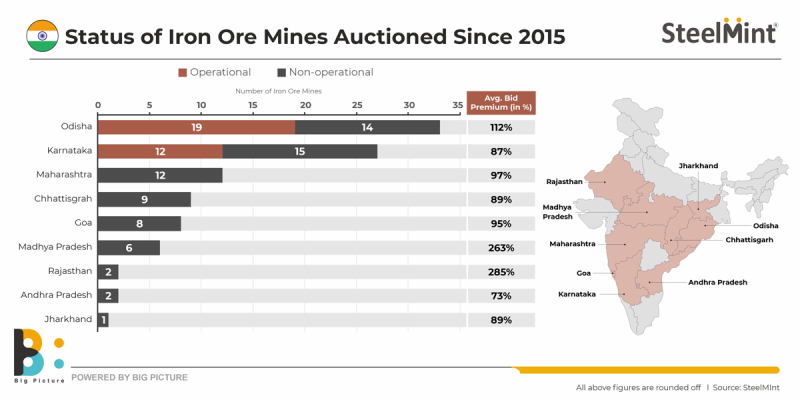
    Notably, out of the 100 iron ore blocks auctioned thus far, 33 are in Odisha and 27 in Karnataka – India’s leading iron ore producing states. Among the other key producers, 12 blocks are in Chhattisgarh, 9 in Maharashtra and 8 in Goa.

    Details of auctioned blocks
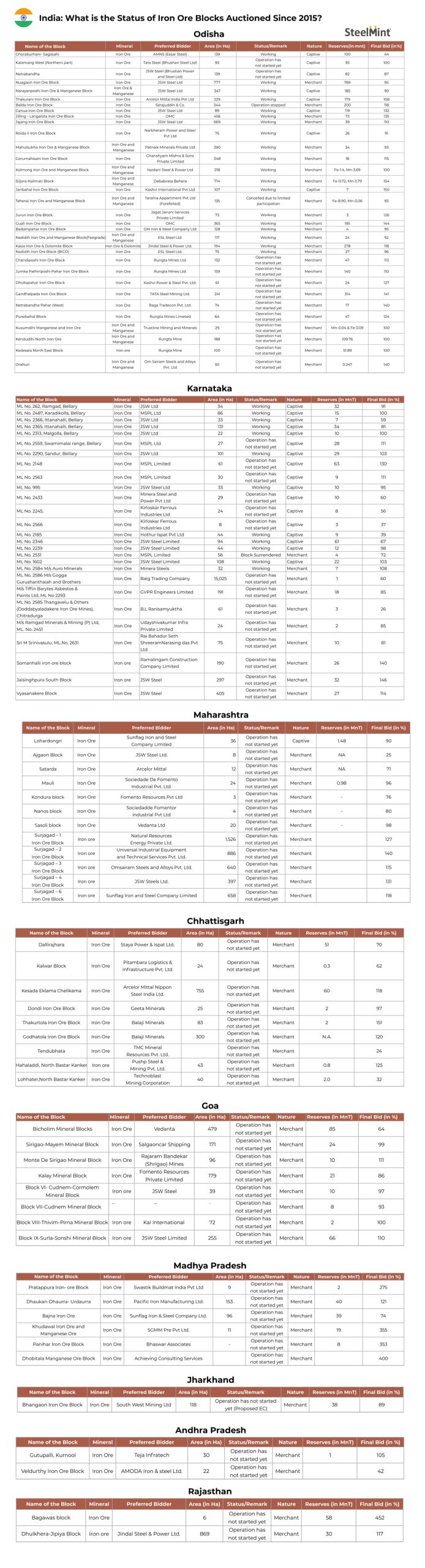
    There are blocks in Madhya Pradesh and Andhra Pradesh, too. However, major iron ore-producing-state Jharkhand has just one block. A lion’s share of that state’s iron ore production is accounted for by captive steel producers.

    In an indicator of over-enthusiastic participation in iron ore auctions – mainly by steel players eager to secure long-term supplies in view of surge in capacity – the general average auction premium quoted stands at over 100%, as per SteelMint estimation.

    Outlook

    India’s iron ore production in FY’23 inched towards 260 million tonnes (mnt). Out of the auctioned blocks, just over 30-odd are in working status which shows that many more mines – especially those auctioned since 2021 – will move towards operationalisation sooner rather than later.

    Therefore, SteelMint’s outlook is positive as regards iron ore production even as domestic steelmaking capacity gathers pace.

    What are the key government policies that may reshape the Indian minerals industry and how long might high premiums sustain for mineral block auctions? Gain cutting-edge insights from experts on these issues and much more at SteelMint Events’ flagship 6th Indian Iron Ore & Pellet Summit to be held from 24-26 August at JW Marriot, Kolkata.
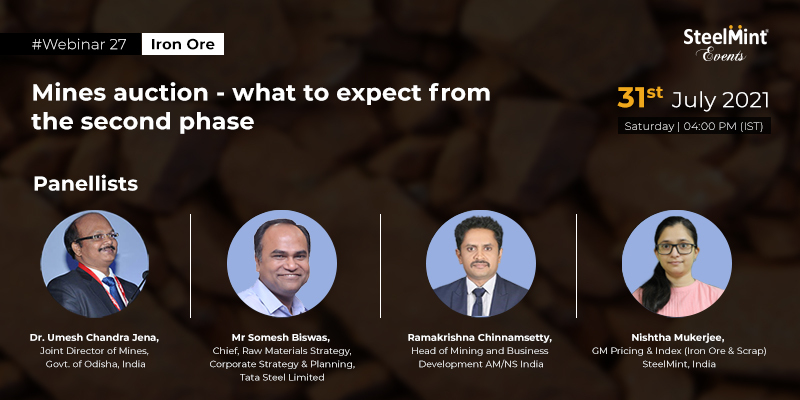
  • Mines auction – what to expect from the second phase

    Mines auction – what to expect from the second phase

    Govt of Odisha has recently invited bids for the grant of 11 mineral blocks. Out of the mineral blocks put up for auction, seven are of iron ore, two iron ore & manganese blocks, one iron ore & dolomite and one bauxite block. The list includes seven virgin blocks. This move will surely enhance the iron ore availability in the country especially in a time when iron ore prices have hit a record high in Odisha. Let’s get insights from industry stalwart on the current scenario and the way forward.

    Key points of discussion

    • Details of the mineral blocks that have been laid out for auction in Odisha
    • What is the auction timeline
    • Any major changes in rules/participation criteria
    • Status of mines auctioned in 2020

    Register button

    Speakers:

    • Dr. Umesh Chandra Jena, Joint Director of Mines, Govt. of Odisha, India
    • Somesh Biswas, Chief, Raw Materials Strategy, Corporate Strategy & Planning, Tata Steel Limited
    • Ramakrishna Chinnamshetty, Head of Mining and Business Development,AMNS India
    • Nishtha Mukerjee, GM Pricing & Index (Iron Ore & Scrap), SteelMint, India

    Date: Saturday, 31st July, 4:00 PM (IST), 6:30 PM (Singapore time), 2:30 PM (Dubai time)

  • Odisha to Notify Auctions of Nine Virgin Blocks in February

    Odisha to Notify Auctions of Nine Virgin Blocks in February

    The Odisha government will issue Notice Inviting Tenders (NITs) in respect of nine virgin or freehold mineral blocks tentatively towards the second week of February. The said blocks will be offered for electronic auctions after the successful completion of auction formalities of 20 merchant mine blocks.

    “We will initiate the process of auctioning the nine virgin mineral blocks sometime in February. Their auctions will be taken up after we are done with the online auction of 20 merchant mine leases”, Deepak Mohanty, director of mines with the Odisha government said here on the sidelines of a workshop on Gemstones in Odisha – Exploration and Exploitation Strategy.

    Which are these blocks?

    The virgin blocks in question include seven iron ore deposits; one exclusive manganese block and one block with co-existence of iron ore and manganese. The seven iron ore blocks listed are Purheibahal, Chandiposhi, Rengalaberha North East, Gandhalpada, Netrabandha Pahar (West), Dholtapahar and Jhumka Pathriposhi. Unchabali has mixed iron ore and manganese reserves while Kalimati is the sole manganese block.

    The delay in auctions

    Auctions of virgin mineral blocks are being delayed as the state government first prioritised the offer of merchant mines whose lease validity ceases by March 31, 2020. January 3 is the deadline for submission of technical and financial bids for the 20 blocks. The blocks are expected to witness frenzied bidding as they being operative mines are explored and are equipped with the attendant infrastructure to ensure smooth extraction and dispatch of minerals.

    The conduct of ascending forward electronic auctions and submission of final price offer on the auction platform will be done between January 31 and February 21, 2020 while the Letter of Intent (LoI) is to be issued from February 10 to February 29, 2020.

    Additional conditions for expiring merchant mine leases

    The state government has inserted some additional conditions in the tenders for the expiring merchant mine leases. A successful bidder after obtaining all statutory clearances needs to produce in the first two years at least 80 per cent of what the mine actually produced in the preceding two years. This clause will be inserted in the Mine Development and Production Agreement (MDPA). Failure to achieve this production benchmark will debar the successful bidder from participating in future auctions for three years. And, in case of blocks reserved for end use, the consumption should be limited to the plant of the bidder located within the country.

    To learn about the latest advancements in the mines auction 2020, be a part of SteelMint Events’ 4th Indian Iron ore, Pellet and DRI Summit which is scheduled on 2-3 March 2020, in Hotel LaLiT, New Delhi.