SteelMint Events

Tag: Scrap Generation

  • How Indian Majors are Gearing up for Billion Dollar Auto Recycling Industry ?

    How Indian Majors are Gearing up for Billion Dollar Auto Recycling Industry ?

    New Delhi — India is talking clean-ups. India is talking environment. India is talking recycling.

    While the government is expected to bring in new laws on scraping and end-of-life vehicles soon, some corporate houses have already taken the first steps into the USD 10 billion scrap market.
    Mahindra MSTC Recycling Pvt Ltd, a joint venture between Mahindra group and state-owned MSTC Ltd set up a plant in Greater Noida last year and aims to have 30 plants by 2021-22. Tata Steel Ltd is in a planning stage for a similar venture.

    “Recycling is going to be a big thing… I would say in the next 4-5 years there is going to be a struggle in the sector,” Sumit Issar, managing director, Mahindra Intertrade Ltd said in a telephonic interview, referring to the competition with the existing players.

    “We would like to bring some change in the way recycling is done in India. That’s what we are focusing on.”
    With foreign technology and equipment, Mahindra MSTC has authorizations from the government and is processing automobiles and household appliances in an environment friendly way, selling the output to steel furnaces.

    Tata Steel is planning to build a scrap processing facility in Gurgaon and plans to replicate the same in Pune, Sanand and other automotive hubs, Anand Sen, president TQM and steel business, Tata Steel was quoted as having said in an Economic Times report last year.
    “We are currently exploring this space and would be in a position to share once our plans are firmed up,” a spokesperson from Tata Steel said in reply to an email seeking further details of their plans.
    “In more developed countries, scrap is a well-established industry with a robust ecosystem… The Indian government has recognized this challenge.”

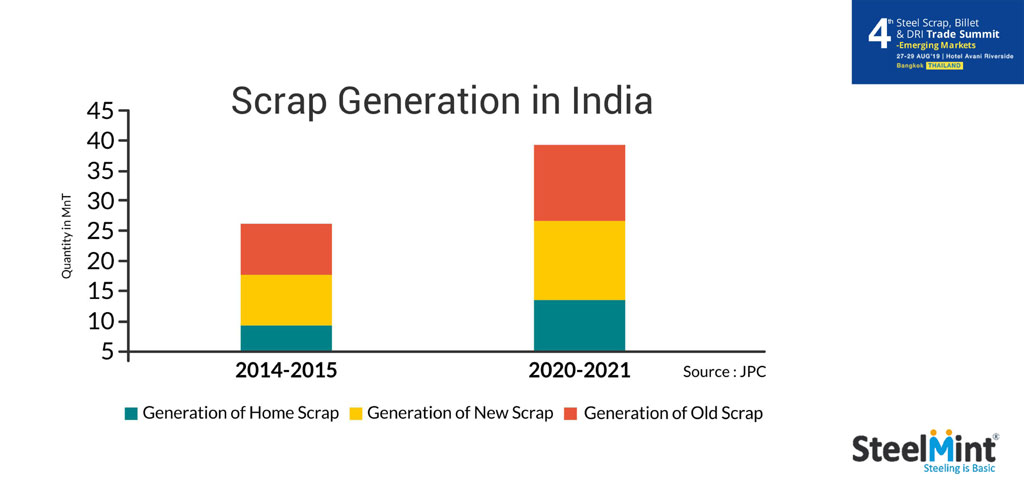
    The demand for scrap in India is 30 MnT per annum where domestic generation is 25mt and the balance 5 MnT is imported, according to data from Tata Steel.
    It is small as compared to India’s steel production of around 100mt, but supply is likely to increase due to the impending government policies, rapid urbanization and economic activity.

    Competitor is a giant – But recycling is unlikely to be a cakewalk for these large corporate. The massive unorganized and fragmented market is seen continuing to dominate the business and be a hard bargain for the corporate recyclers who would have to struggle to break even.

    “The challenge is that the informal sector is so big across the country that very little comes into the organised sector,” Issar said.
    Companies like Mahindra and Tata Steel are banking on the fact that they could introduce greater degree of processing and value addition to the scrap and have higher safety standards and environmental concerns.

    Other companies being named as likely entrants to the recycling business are Maruti Suzuki India Ltd and Toyota Kirloskar Motor Pvt Ltd. The spokesperson of Maruti said the company didn’t wish to comment while the spokesperson for Toyota Kirloskar said there were no such plans at the moment.

    Social change

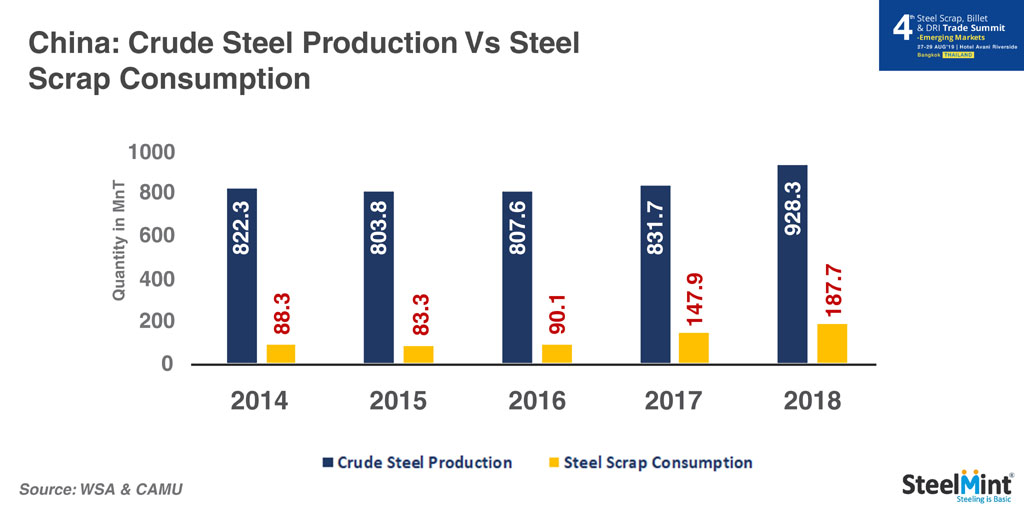
    As the economy matures, the call for environmental protection rises. China is an example of this – on the government’s directive, more scrap is being used by steel mills to reduce pollution. India too is following suit.

    “The (scrap) policies are in the draft stage… it can be safely assumed that they would address some of the challenges faced by the steel scrap industry,” Tata Steel’s spokesperson said.
    “They might stipulate some governance mechanisms like authorizations and de-authorizations, environmentally compliant processes, safety practices and more… they may look at ways to create and nurture the ecosystem for recycling including training and skilling of work force.”

    What’s happening with India auto recycling industry?

    To know more about Indian recycling scenario do attend 4th Steel Scrap, Billet & DRI Trade Summit to be organised by SteelMint Events in Bangkok, Thailand from 27-29th Aug’19. The event will attract around 550+ delegations including ferrous scrap consumers, traders and processors in the steel industry across the globe. Wherein one can also explore more on What’s happening with India auto recycling industry? in the session scheduled for Mr. Vijay Arora, Vice President – Strategy, Operations And Business Development, Mahindra Group Accelo, India.

    Know More

  • China’s Scrap Generation to Increase by 10 MnT in 2019 – CAMU

    China’s Scrap Generation to Increase by 10 MnT in 2019 – CAMU

    Mr. Tao Jiangshan, deputy secretary general of China Association of Metalscrap Utilization (CAMU) – DRI Working Committee, has been engaged in DRI production and consultation for 23 years. Mr. Jiangshan set up Tianjin Overworld Technology Consulting Co Ltd and also worked at Tianjin Pipe Group, in charge of technical and process work and head of new project. His early days were at pellet plant of Minmetals Luzhong  Metallurgical Mining where he got familiar with the DRI process. He was also chief editor of China CCM.com taking care of information on steel raw materials and compilation of field reports.

    Mr Jiangshan graduated from China Central South University, majoring in pellet/sinter DRI of mineral processing department. Here are excerpts from an e-mailed interview

    Q: What is CAMU’s forecast for steel scrap usage in Chinese domestic steel mills in 2019 versus actual use in 2018?

    A: The quantity of scrap steel usable in the market will be more and more, scaling up by 10 million tons each year, while crude steel output will shrink. Secondly, steel mills will have more incentive to use scrap steels and the proportion of scrap will be higher. Thirdly, short route smelting will take up more proportion and the scrap ratio in EAF smelting as well we EAF steel ratio in output of crude steel will be higher. These three points highlight the optimistic trend in the course of scrap steel utilization and a promising future.

    Q: What is CAMU’s forecast for scrap generation in China in 2019 versus 2018 actual generation?

    A: The usable steel scrap in the market will become more and increase at pace of 10 million tonnes each year. The output of steel scrap in 2018 was 220 million tonnes and is expected to reach 230 million tonnes in 2019.

    Q: Will China have enough scrap to export? What is your forecast on steel scrap exports both near term and long term?

    A: Given that the fast increase in EAF steel output in recent years, coupled with gradual consumption by blast furnaces, the scraps are expected to be mainly consumed by domestic mills.

    Q: What are the government policies or incentives coming up that could encourage the setting up of more electric arc furnaces?

    A: By way of environmental protection and production limit as well as phase-out of outdated capacity, China’s government is taking the policy leverage to encourage legitimate steel mills to set up new EAF mills through capacity replacement.

    Q: What is the current price of steel scrap in China and what is the average price likely to be this year? At this price is it cheaper to produce steel via electric arc furnace than blast furnace?

    A:  The average price of HMS1 during Jan-Mar 2019 was at RMB2,320/ton while HMS2 at RMB 2,120. In China, the production cost by blast furnace is more economical.

    Q: Going forward, what is your outlook for steel scrap industry in China and the world?

    A: With the further deepening of structural de-capacity on supply side, steel mills especially scrap processing enterprises are set to embrace promising opportunities.
    The “Green Industry Development Plan (2016-2020)” issued by The Ministry of Industry and Information Technology proposed that “by year 2020, the utilization of scraps recycled will reach 150 million tonnes” and this target will most probably be met in this October.

    And the provision “by year 2025, steel made of scrap should account for 30% of the total” proposed in “Steel Industry Adjustment Policy” is also achievable. “The 13th five-year plan for Steel Scrap” enacted by CAMU has proposed that by year 2020, the steel made of scrap will take up 20% of total output, which doubled the target as proposed in “the 12th five-year plan” and is achievable before this year end.  All those achievements have signaled that an era of mass utilization of steel scrap has come.

    To know more on China’s rising scrap generation, consumption and growth of EAF in steel making, be a part of 4th Steel Scrap, Billet & DRI Trade Summit in Bangkok, Thailand, to be held from 27-29th August 2019.

    ~ Inputs from Ruchira Singh with the help of Arthur Li

    Know More