SteelMint Events

Tag: sponge iron imports

  • Nepal’s sponge iron imports to hit all-time high in CY’22. What’s next?

    Nepal’s sponge iron imports to hit all-time high in CY’22. What’s next?

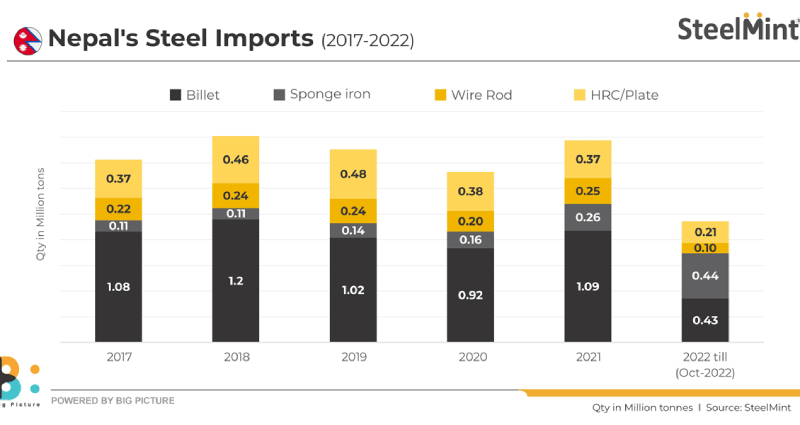
    Nepal, a landlocked nation, has registered significant growth in its metallics (sponge iron and pig iron) imports, as per data maintained with SteelMint. The country’s sponge iron imports rose by 120%, while pig iron imports rallied by 390% during January-October 2022 compared to the same period in the preceding year.

    The country registered about 440,000 t of sponge iron imports and around 41,000 t of pig iron imports during the first 10 months of 2022. Rising melting capacities in the nation is the key factor behind the constant rally in imports.

    Will imports rise further?

    SteelMint, in conversation with several industry leaders, learned that Nepal’s sponge iron imports is likely to reach over 500,000 t in CY’22, which will be a nearly two-fold rise against 260,000 t in CY’21.

    Along with this, pig iron imports are also expected to cross 45,000 t in CY’22, which will be over three-times higher than 12,600 t in CY’21.

    Who are benefitting?

    India is the largest producer of DRI in the world and in terms of imports Nepal has become a major importer of Indian DRI (sponge iron) after Bangladesh in CY22.

    With the rapid expansion in melting capacities in the neighbouring nations, sponge iron producers based in the eastern region (Odisha, Jharkhand and West Bengal) are largely benefiting from this, due to the advantage of logistics via rail, road and sea routes.

    Out of India’s total sponge iron exports, about 90-95% is from eastern India, while the remaining is from the central and southern regions depending on price competitiveness.

    Competitive Indonesian billet, wire rod offers

    With 15% export duty on Indian finished steels including wire rods, Indian wire rod producers of both the IF and BF routes are worried and hardly any deals have been concluded to Nepal due to competitive offers from Indonesia.

    Roughly, the landed cost to Nepal of Indonesian wire rods and billets are cheaper by $100/t compared to Indian material.

    Recently, Nepalese mills have placed another order for wire rods (size 6.5 to 7.0 mm) to Indonesia for a total of around 25,000 t for December or early-January shipments, SteelMint learned from trade sources.

    The deals took place at around $560/t CFR Haldia basis (east Indian port), which is equivalent to $600-605/t CPT Nepal. Earlier, mills in Nepal had booked a total of around 50,000 t of wire rods and around 25,000-30,000 t of billets.

    What’s next?

    Nepal’s steel industry is growing significantly in terms of capacity. The total annual capacity of the industry is about 3.5-4 million tonnes (mnt) per annum and annual steel demand is about 2-2.5 mnt.

    To know more about Nepal’s steel trade dynamics and changing import preferences, book your seat at the 2nd Nepal Steel & Trade Summit on 1-2 March, 2023 at Hotel Soaltee Crown Plaza, Kathmandu and get to hear from renowned industry participants from across the globe.
  • Bangladesh’s sponge iron imports from India to rise further on expanding steel melting capacities

    Bangladesh’s sponge iron imports from India to rise further on expanding steel melting capacities

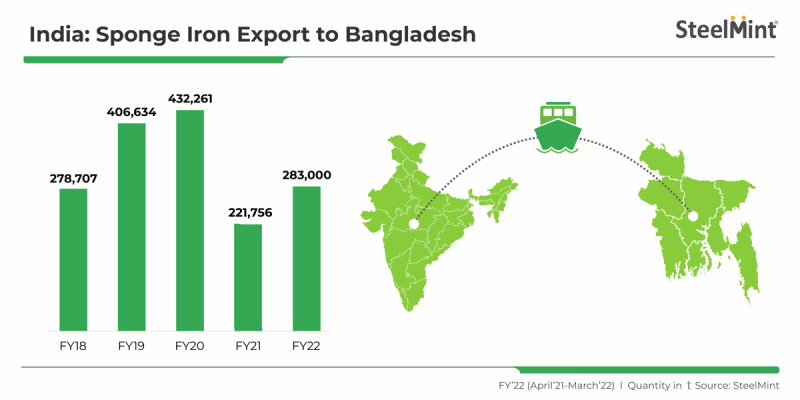
    Sponge iron imports by Bangladesh from India stood at 283,000 tonnes (t) in FY’22 (April’21-March’22). Although Bangladesh’s imports increased sharply from FY’21, volumes were still lower compared to the previous couple of fiscals. Imports, however, are expected to edge up in the coming time on account of rising steel melting capacities in Bangladesh and infrastructure projects in the pipeline.

    Notably, Bangladesh’s financial year starts on 1 July and ends on 30 June. The country’s sponge iron imports were recorded at a meagre 221,756 t in the Indian fiscal year 2021 (FY’21) due to the impact of the COVID-19 pandemic. Meanwhile in the first six months (January-July) of CY’22 the country imported 443,092 t of sponge iron from India, indicating a surge in demand. However, due to LC issues and the liquidity crisis buyers booked limited material during June-July.

    Bangladesh accounts for 41% of Indian sponge exports: Bangladesh has a share of 41% in India’s total sponge exports, with export volumes in FY’22 being recorded at 690,287 t. While Nepal accounts for the largest share – 53% – of India’s exports, Bhutan holds a share of 5%.

    Bangladesh’s sponge import prices: Imported sponge iron prices to Bangladesh stood at an average level of $494/t CNF Chittagong in FY’22.

    Market updates

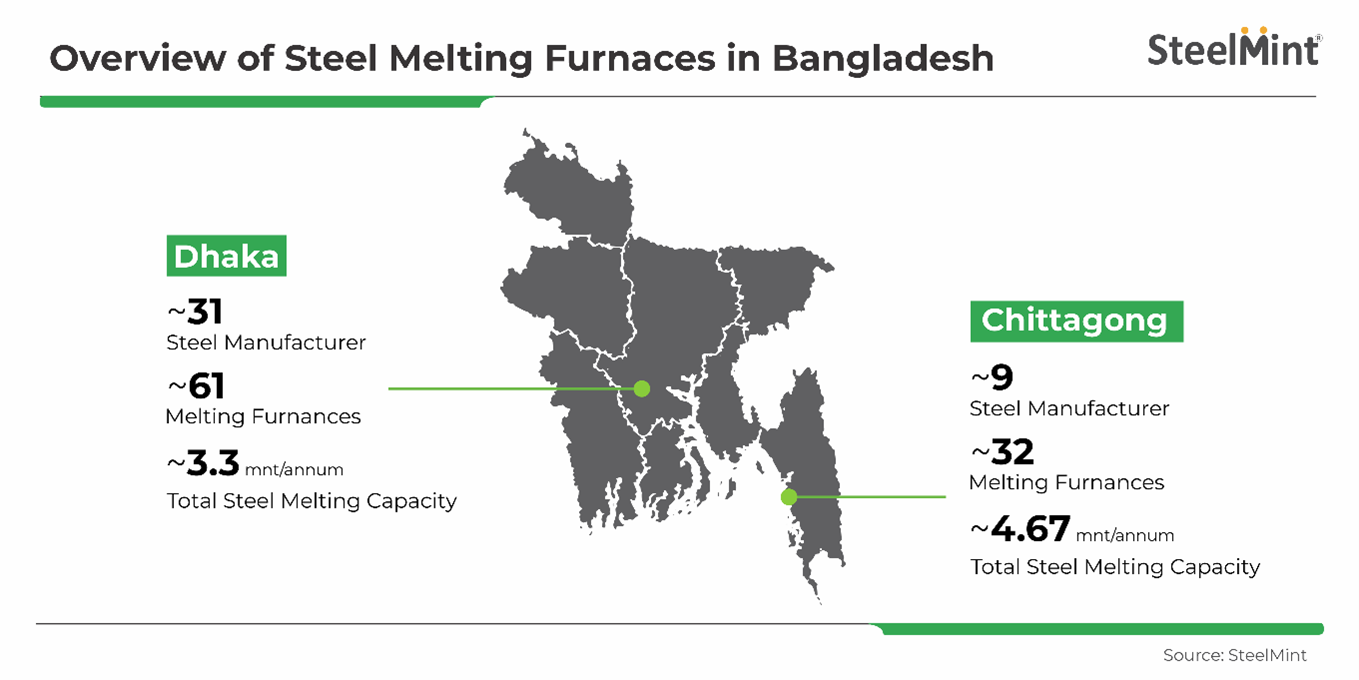
    • Chittagong – home to steel mills: The Chittagong region is the hub of the largest mills in the country, including the top four steelmakers and nine steel companies in all. Mills in the region operate 32 melting furnaces (29 IFs and three EAFs) with a total crude steel capacity of 4.67 mnt (including GPH Ispat’s Quantum EAF).
    • IF mills in Dhaka:  On the other hand, Dhaka has 31 mills in all which are relatively small in size, operating 61 induction furnaces (IF) with a total melting capacity of around 3.3 mnt per annum, while another four induction furnaces are operated by steelmakers in the Comilla region.
    • Furnace sponge-scrap ratio: The ratio of sponge iron in the steelmaking feed depends upon scrap quality. However, the percentage mix of sponge iron in the furnace hovers around 5%.

    As many steel manufacturers in Bangladesh are planning to expand their steel capacities, DRI imports from India are poised to rise further.

    To know more on Bangladesh’s sponge iron imports, book your seat at 3rd Steel & Raw Material Conference, Emerging Bangladesh on 20-21 September, 2022 at Hotel Radisson Blu, Chittagong, Bangladesh, and get a chance to hear renowned industry participants from across the globe on “How are Indian mills managing feed mix of Scrap/DRI/Pig Iron in Induction Furnaces (IF)”.