SteelMint Events

Tag: Steel Exports

  • SteelMint analysis: An overview of Turkiye’s steel sector

    SteelMint analysis: An overview of Turkiye’s steel sector

    Turkiye is one of the largest ferrous scrap importing countries in the world. Other key industries that contribute to the country’s economy include textiles, chemicals, cement, motor vehicles and construction. The country provides certain leverages for international trading and is a key destination for trade between Europe and Asia.

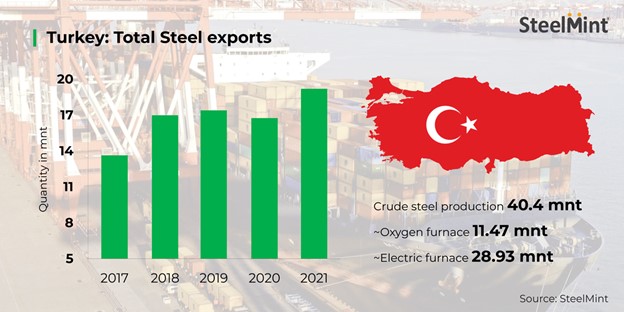
    Turkiye produced 40.4 million tonnes (mnt) of crude steel in CY 2021 out of which 11.47 mnt i.e. 28.4% was churned out from oxygen furnace (BOF) and 28.93 mnt i.e. 71.6% was produced from electric arc furnace (EAF), as per World Steel Association (WSA) report. Higher crude steel output resulted in increased scrap consumption.

    • Pig iron imports up: Turkiye’s pig iron imports stood at 1.2 mnt in 2021 vis-à-vis 1.14 mnt in the corresponding period last year (CPLY), up slightly by 5.3% y-o-y. The country’s entire consumption in 2021 was 11.6 mnt.
    • Steel exports see 15% rise: Total finished steel exports from Turkiye jumped 15% to 19.2 mnt in 2021 compared to 16.75 mnt in 2020.

    Also, according to the Turkish Automotive Manufacturers’ Association (OSD), total car production in CY21 stood at 1,276,140 units wherein exports amounted to 937,005 units, marking an increase of 2% as compared to 916,538 units in CY20.

    Turkiye’s scrap market in 2021

    • Ferrous scrap import shipments increase: Turkiye recorded ferrous scrap imports at 24.37 mnt in 2021, an increase of 10% against 22.18 mnt in 2020, as per SteelMint data. USA accounted for the largest share of 16% in total exports to Turkiye in CY21 followed by the Netherlands at 13% share and the UK at 10%.
      If compared on m-o-m basis, the country’s imports rose by 22% to 2.49 mnt in December 2021 vis-a-vis 2.04 mnt in November. Notably, import volumes in December were the highest in 2021.

    Reasons behind the rise in imports

    • Imported ferrous scrap demand in the Turkish market rebounded in CY21 as mills remained active in booking deep-sea scrap cargoes throughout the year as buying interest picked up slightly.
    • There was an improvement in demand of billets and long steel products in the Turkish market. Market participants believe that strong demand for billets kept scrap bookings active.
    • Freight rates from the US coast to Turkey fell which eased scrap prices, boosting buying interest.

    Imported scrap prices rise in CY21

    SteelMint’s assessment of US-origin HMS 1&2 (80:20) stood at $459/t CFR Turkey in January-December 2021 against $291/t CFR in January-December 2020, up by around $168/t CFR Turkey y-o-y.
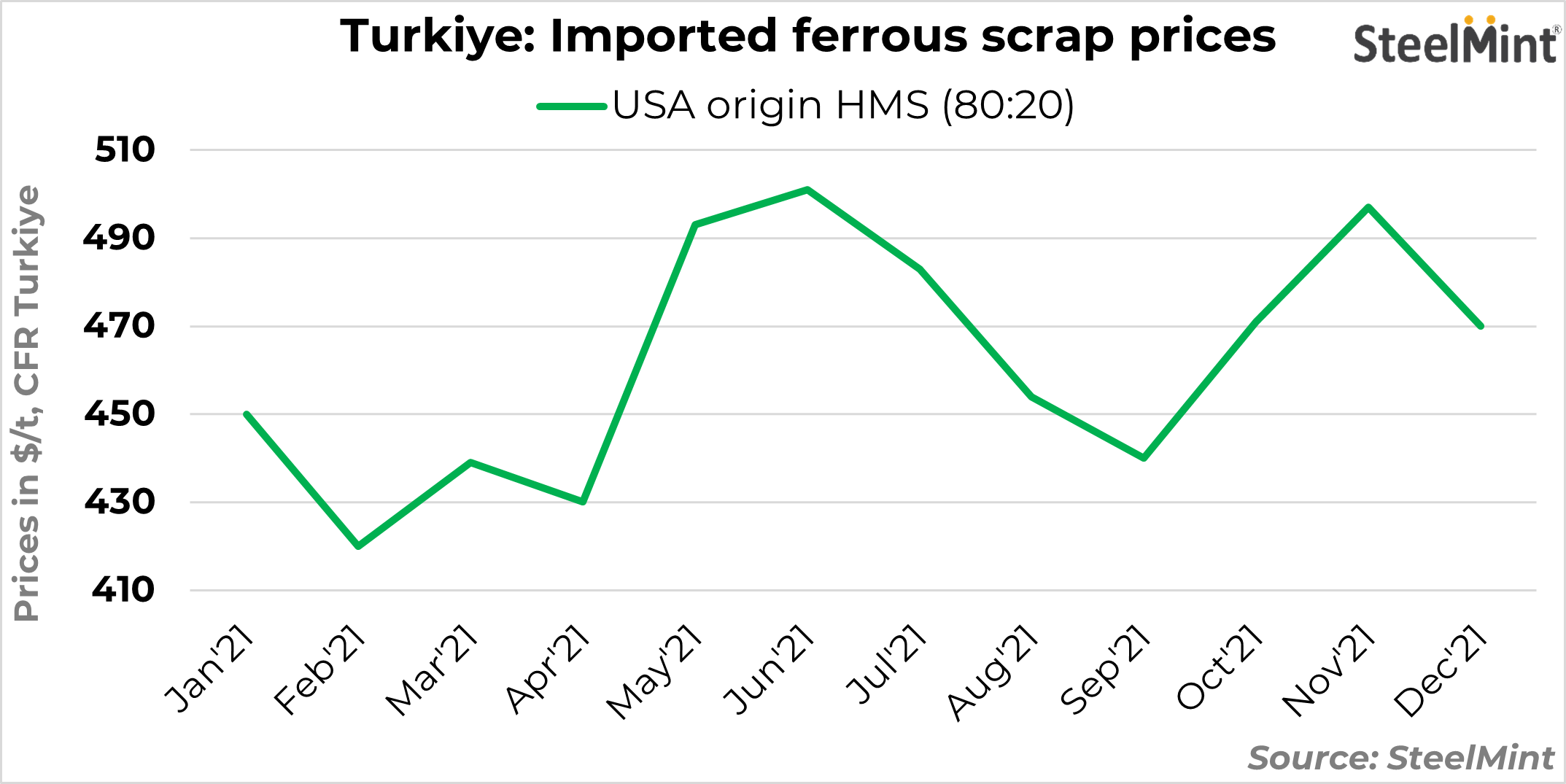
    Prices surged as Lira eroded against the dollar to settle at TRY 13.31 in 2021 which was at 7.37 towards the end of 2020. The volatile market situation and a sharp fluctuation in the national currency put pressure on steel mills to lower their local scrap prices in 2021. Also, sluggish domestic and overseas demand, especially from China amid the winter months kept Turkish market under pressure.

    Hassles in scrap market:

    • Suspension of operations at mills on higher electricity costs: EAF steelmakers announced suspension of crude steel production in the first few months amid increased electricity costs. As a consequence, buying activities in the regional market decreased. The heavy snowfall also caused logistical problems in the market.
    • Russia hikes scrap export duty: Russia approved an almost three-fold hike in the export duty on ferrous scrap, effective 1 May’22, to support domestic raw material availability and control the rise in steel prices. The minimum duty on exports of ferrous metals outside the Eurasian Economic Union was increased from EUR 100/t to EUR 290/t.
    • Government declares surge in energy tariffs: The start of summer season was accompanied by a sharp rise in energy tariffs. Economic factors and the global hike in energy costs are among the reasons behind it. The Turkish Energy Market Regulatory Authority increased prices depending on the customer category.
    • Rising billet imports: Also, the country’s billet imports in H1CY22 increased sharply as its prices were almost at par with those of imported scrap. Russia was the top exporter with 75% share followed by Ukraine with 5%.

    Way forward:

    The input costs of Turkish steel mills are anticipated to increase further after the country’s Energy Market Regulatory Authority elevated electricity prices for industrial use by 50% on 31 August 2022. State gas distributor Botas also raised natural gas prices for industrial use by 50.8% from September 2022. This may lead in Turkish steel mills opting for production cuts or lift prices despite the sluggish market as their margins are lower.

    SteelMint Events will be hosting the 3rd Steel & Raw Material Conference, Emerging Bangladesh, on 20-21 September, 2022 at Hotel Radisson Blu, Chittagong, Bangladesh. The conference will explore key issues like the country’s steel production and demand outlook, global scrap trade flow changes, especially post-the Russia-Ukraine war, the ship recycling scenario, key emerging sectors, price trends and a lot more.

  • India’s steel exports fall 34% in Q1; Q2 looks dull

    India’s steel exports fall 34% in Q1; Q2 looks dull

    • Export tax impact blunts overseas sales’ edge
    • Boron-added exports see sudden spurt
    • Export tax retention may see Q2 volumes go below 2 mnt

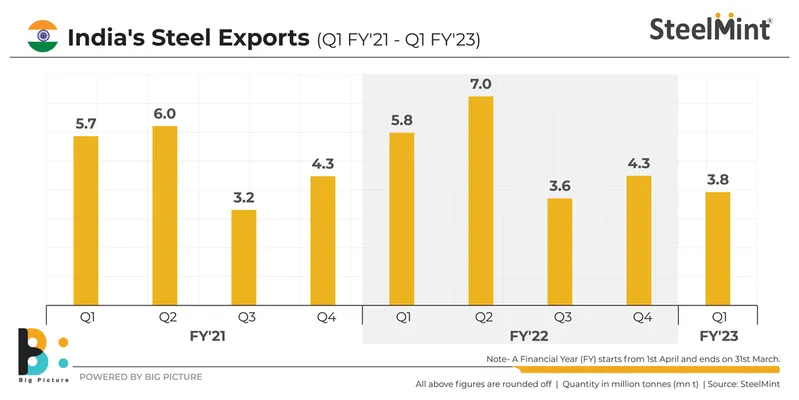
    India’s finished steel exports, including semis, dropped 34% to 3.78 million tonnes (mnt) in the first quarter (April-June, 2022) of the current financial year (FY2022-23) compared to 5.77 mnt seen in the year-ago quarter.

    There was drop across the three categories of flats, longs and billets. Flats exports fell 28% y-o-y to 2.64 mnt (3.68 mnt) in Q1. Longs fell 54% to 0.28 mnt (0.62 mnt) and semi-finished by 41% to 0.86 mnt (1.47 mnt) in this period.

    From a q-o-q perspective, exports were down 13% from 4.33 mnt in Q4 (January-March, 2022)

    On a half-yearly basis too, exports dropped almost 20% to 8.11 mnt in January-June, 2022 against 10.08 mnt in the same period in 2021.

    Reasons for the drop in exports

    1. Export tax impact: The 15% export duty, slapped from 22 May, brought the market to a standstill immediately in its aftermath. After a fortnight’s lull, mills huddled to find a way out of the crisis, in the form of boron-added steel, which escaped the export ambit.
    It is to be noted that while all categories under flats recorded a fall, only “electrical steel” exports skyrocketed by almost 700% albeit on a low base. From as low as 17,650 tonnes in Q1FY22, these rose to 0.14 mnt in Q1FY23. This is an indication that boron-added steel (which falls under electrical steel) category had increased from India and this push had come mainly from June when mills tried to work around the export duty by offering alloy steel. SteelMint’s data reveals that in April 2022, these were at a negligible 2,334 tonnes and in May, 2022, at 7,110 tonnes.

    Under normal circumstances, electrical steel exports constitute barely 10,000 t per month.
    India's steel exports drop 34% in Q1; Q2 looks bleaker

    SteelMint understands that whatever volumes were exported in June, were boron-added with the trade in regular grades of carbon steel having come almost to a standstill.

    Meanwhile, the 3.78 mnt seen in Q1 also includes bookings made prior to the tax imposition. However, all material, including those for which contracts had been signed or those lying at ports – also attracted the export duty.

    2. Vietnam’s imports plunge: Mostly all importing countries showed a y-o-y decline amid tepid home demand, rising energy prices, and inflation. But Vietnam showed the steepest 64% drop in imports from India to a mere 0.14 mnt in Q1FY23 against 0.39 mnt in Q1FY22, mainly for two reasons. One, decline in European demand eroded Vietnam’s exports of value-added steel. Two, its end-users preferred competitively priced domestic material.
    India's steel exports drop 34% in Q1; Q2 looks bleaker

    Outlook


    The export volumes in the second quarter (July-September, 2022) are expected to fall further although, going forward, alloy steel exports from India will increase further.

    SteelMint forecasts that exports in Q2 will be even lower from that in Q1, for two reasons. Very few bookings have happened so far into the second quarter and it looks unlikely that many deals will take place in the remaining portion of the quarter if the export tax continues. In such a scenario, volumes can even drop below 2 mnt.

    Secondly, overseas demand has been lacklustre on the back of the outbreak of the Russia-Ukraine war, energy crisis, inflation, debt crises, Covid lockdowns and supply chain bottlenecks.

    Please click here for the India Steel Conference brochure

  • Will India’s steel exports hit an all-time high in FY 22?

    Will India’s steel exports hit an all-time high in FY 22?

    With the world’s top steel producer China removing export tax rebates for 23 steel products from Aug 1, the second adjustment in three months as it seeks to ensure domestic supply while controlling output to curb emissions, experts are upbeat about demand for India’s steel exports for the current financial year. China’s move has paved the way for India to enter into the new global markets where the former has dominant market share. India’s total steel exports stood at around 19.15 million tonnes (MT) in FY 21 and in the first half of FY 22 itself, steel exports have breached the 10 million tonnes mark.

    Speakers:

    Mr. Rajeev Vyas, Founder & MD Vinar Overseas Pvt. Ltd

    Date: Tuesday, 19th Oct, 3:30 PM (IST), 6:00 PM (Singapore time), 2:00 PM (Dubai time)

    Key points of discussion:

    • Impact of China’s removal of steel exports tax rebate on Indian Steel Industry
    • Europe Quota – Current scenario and outlook for H2 FY’22
    • Update on South East Asian markets
    • Russian exports offers and its impact on Indian steel exports prices
    • New markets and upcoming challenges in H2 FY’22


    Register button

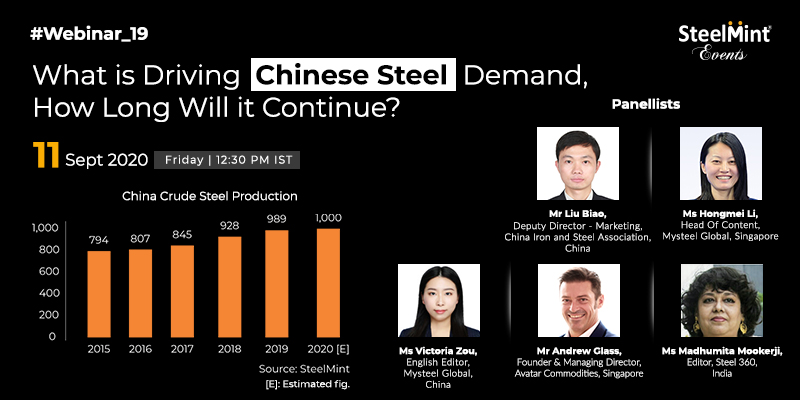
  • What is Driving Chinese Steel Demand, How Long Will it Continue?

    What is Driving Chinese Steel Demand, How Long Will it Continue?

    Connect with us on Friday, 11th Sept, 12:30 PM (IST), 3:00 PM (Singapore time), 11:00 AM (Dubai time) as we gain insights from our panellists to understand the effect of COVID-19 on the Iron & Steel Industry.

    Panellists :

    • Mr Liu Biao, Deputy Director – Marketing, China Iron & Steel Association, China
    • Ms Hongmei Li, Head Of Content, Mysteel Global, Singapore
    • Ms Victoria Zou, English Editor, Mysteel Global, China
    • Mr Andrew Glass, Founder & Managing Director, Avatar Commodities, Singapore
    • Ms Madhumita Mookerji, Editor, Steel 360, India


    Register button

    ×[formidable id=20]

    An unusual period in history, the coronavirus pandemic has unleashed a series of unprecedented events affecting every industry. Staying on top of trends and accurate analysis is paramount now more than ever to manage uncertainty, change and continuously adapt to new and evolving market conditions.

    According to July’s custom data, China’s iron ore imports have surged up by 24% making it a record from a year earlier. This is driven by shipments from miners and buoyant demand as the economy bounced back after disruptions from the coronavirus pandemic. China steel output is set to rise by 4%, rupturing 1 Billion MT for the first time. How has China’s steel production and demand managed to stay ahead during these unprecedented times when the rest of the world is still recovering from the COVID-19 hit?

    Amid the growing push for decoupling and economic distancing, the changing relationship between China and the rest of the world will influence competition and opportunities in the Steel market. Continuous monitoring for emerging signs of a possible new world order post-COVID-19 crisis is a must for aspiring businesses and their astute leaders seeking to find success in the now changing Iron & Steel market landscape.

    Let’s explore the viewpoints from influencers in the market and learn the various opportunities this new normal presents.

    Key points of discussion:

    • What is driving Steel Imports to China, how long it may continue?
    • What is changing the daily business operations globally?
    • Prospects for Iron & Steel market in terms of Hedging & Trading
    • Indian steel exports at an all-time high, what is the future outlook?
    • What new businesses have been triggered globally and will it benefit steel or not?