SteelMint Events

Tag: Steel Scrap

  • Supply Tightness Pushes Chinese Steel Scrap Prices to New High

    Supply Tightness Pushes Chinese Steel Scrap Prices to New High

    China, the world’s largest ferrous scrap consumer, has witnessed a jump in its domestic ferrous scrap prices to above USD 400/MT, a record new 2019 high following supply tightness amid seasonal issues, high utilisation rates for electric arc furnaces (EAFs) and new restrictions on scrap imports that took effect from July 1.

    Shagang Jiangsu price hike

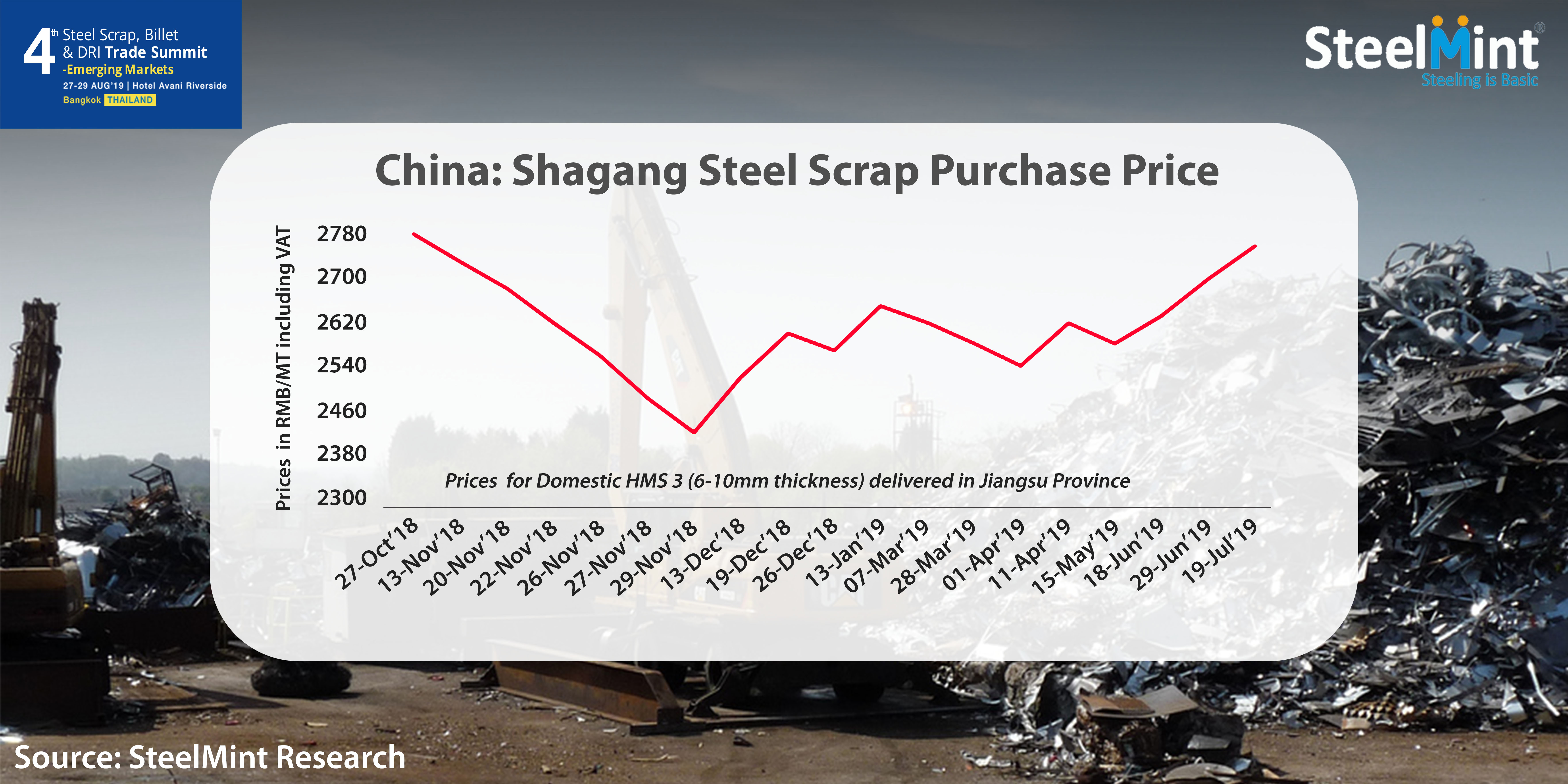
    Eastern China’s largest private ferrous scrap consumer and EAF steelmaker, Shagang Jiangsu Steel Group, announced the price hike for all grades of domestic steel scrap procurement by RMB 60/MT (USD 9) effective from July 19, 2019. The new price of HMS 3 scrap stands at RMB 2,760/MT (USD 403) delivered to headquarter works situated in Zhangjiagang, north of Shanghai, in China, inclusive of 13% VAT. Shagang Steel’s total annual production capacity crossed the 100-MnT mark with 31.9 MnT iron, 39.2 MnT steel and 37.2 MnT rolled products.

    Deterring demolitions

    The Chinese government has continued new rounds of investigations at all major steelworks to ensure environmental protection policies deter demolition of buildings and vessels that generate scrap. Tightening measures on air pollution emphasised on production stoppage for sintering machines. Thus, most of the steelmakers are looking to increase the use of steel scrap in steelmaking.

    On the other hand, scrap supplies have been reduced due to high temperatures while the rainy weather is reducing scrap collection and transportation. Higher demand and scant supplies have sent scrap inventories at processing plants to low levels, leading to a general anticipation that local scrap prices in China will remain firm over the second quarter of 2019.

    Chinese scrap prices jump

    According to prices maintained with SteelMint, it has been observed that Chinese steel scrap prices have jumped by RMB 210/MT (USD 31) or around 7-8% since mid-May. Prices have climbed the highest so far since November 2018.

    Rising costs of BF steelmaking encourage EAF use. Currently, China’s EAF steel mills are producing steel with considerable margins against BF steelmakers. Rising costs of competing feedstocks like iron ore and metallurgical coke have encouraged use of scrap. China’s iron ore prices remained in the range USD 115-120/MT as the main cost increase for BFs. On the other hand, increasing scrap prices also raise the costs of BF mills that use 10-20% scrap.

    Steel scrap imports fall 86% in Jan-May: Sharp fall in imports of ferrous scrap into China has impacted supplying countries to divert their flow to other countries. China’s ferrous scrap imports fell by 86% to 111,507 MT during January-May, 2019 against 776,133 MT during the same period last year. Total imports in 2018 were recorded at just 1.34 MnT, the lowest since 2010. The trend is expected to continue as China reclassified certain categories of scrap steel as restricted raw materials from July 1, 2019.

    Steel scrap exports nosedive in 2019: During January-May, 2019, China’s ferrous scrap exports were recorded at just 2,023 MT, down 99% Y-o-Y against 323,941 MT recorded in 2018.

    To know more on Chinese steel, scrap & the EAF market 2020, book your seat at SteelMint’s 4th Steel Scrap, Billet & DRI Summit and get a chance to hear views of Hongmei Li, Head of Editorial, Mysteel Global. The conference is being organised over 27th-29th August, 2019 in Bangkok, Thailand.

    Know More

  • Mughal Steel to Raise Output, Eyes Infrastructure Growth

    Mughal Steel to Raise Output, Eyes Infrastructure Growth

    Mughal Iron & Steel Industries Ltd. is Pakistan’s largest steel producer and perhaps the largest importer of scrap as well. From a modest beginning as a trading company in 1950, it moved to steel production and today it plays a significant role in the region’s economic development. One of the people at its helm is Mr Fahad Javaid Mughal, a director in the company, who holds a bachelor’s degree in international business from Australian National University, Australia.

    Here follows excerpts from a telephonic interview with Mr Mughal:

    1. How is the global steel scrap market looking this year?

    The US halved its 50% tariff on Turkish steel imports this month and the market spiked up instantly. But I’m thinking, demand is not going to stay very high for Turkish steel because I see US fulfilling its demand for steel domestically and it might take some time for Turkey to establish itself in the US market after a lull.

    2. What is your price forecast for steel scrap?

    I see prices in Pakistan under $330-335/tonne, CFR, in the next few months as against $320-325/tonne at present. Currently, Turkish scrap prices have been at $295-297/tonne on average, though variations do occur because of demand. However, I can see Turkish scrap rates staying over $290/tonne, CFR. Turkish rebars are seen around $490/tonne. Pakistan’s buying price is approximately $25-30/ tonne higher than that of Turkey due to freight.

    3. How is the local market for steel doing in Pakistan?

    Demand in Pakistan might rise in two month’s time as the government is to release funds for some projects. There could be an upward impact on prices to the extent of $10-15/tonne. Turkey may start buying aggressively and that might also have an impact on prices. Once US starts to to buy, the market dynamics will change.

    4. How are the China Pakistan Economic Corridor (CPEC) and Silk Road projects shaping up? How much of a boost will these projects mean for Pakistan’s steel producers?

    The premier of both China and Pakistan had a meeting recently and we are expecting new tenders for the projects. Four new MoUs were signed. The new tenders would be modified tenders. Demand is expected to arise by the end of this year. The local industry is working along with CPEC even though it is not supporting all the steel mills. It depends on the brand and prices.

    5. How is the demand for steel in Pakistan’s home market?

    At present, the per capita consumption of long-rolled steel products in Pakistan is 24kg which is the lowest in the Asia-Pacific region. Our neighbouring country, India, has per capita consumption of long-rolled steel products of 50kg. So in the coming years, Pakistan steel market will definitely grow and our expectation is that the per capita consumption will increase to 35kg. Demand from commercial and home sectors are doing good. Now government has to allocate a good amount of funds for new projects like dams, flyovers, motorways and others. As per the new budget announced in June, Government has imposed a Federal Excise Duty of 17% and abolished special sale tax procedures on scrap and billet import. This is favourable for the steel industry as a whole, as tax net will expand and it will make a level playing field for all the manufacturers in steel sector.

    6. How is the Pakistani government protecting the industry from the onslaught of Chinese exports?

    There is protection. For instance, there is a 43% tariff on rebars especially from China. Steel industry is happy and has invested in furnaces.

    7. How much steel will Pakistan produce in 2019-20?

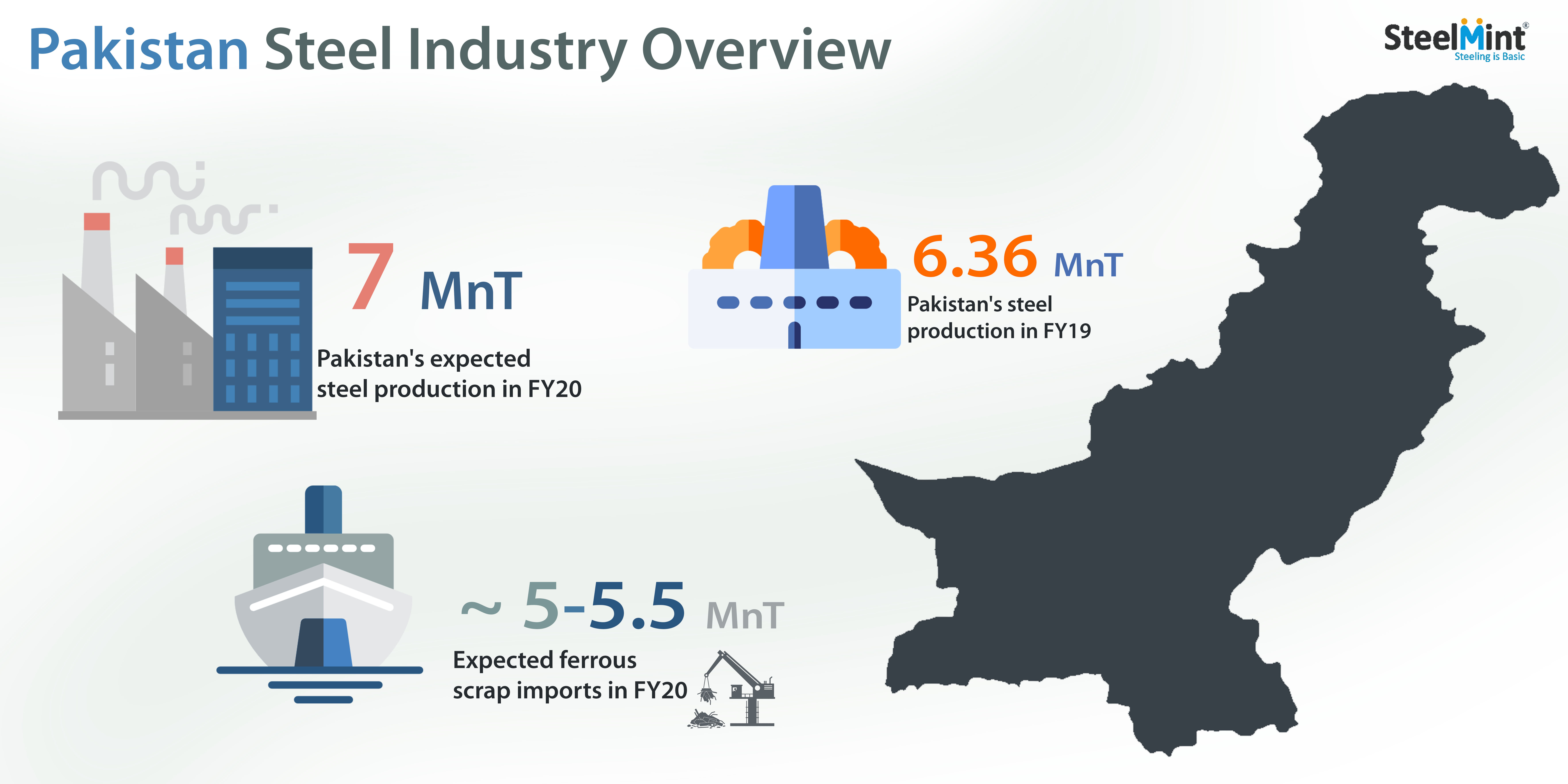
    Pakistan is expected to produce 7 MnT of all steel products this year. In 2017-18, Pakistan produced 7 MnT of steel, but in 2018-19, it fell by 9.2% owing to the depreciation of the local currency. Pakistan’s rupee depreciated by 40%, scrap prices went up and duties also went up. The industry could not pass on the cost to the customer. From 2020 onwards, we expect a steady rise from current levels.

    8. What are the expansion plans of Mughal Iron & Steel Industries?
    We are the largest producers of steel in Pakistan with a capacity of 0.7MnT. In another two months our capacity will rise to 1.1 MnT. We also have a 60 megawatt coal-based power plant coming up which is expected to be ready in one and half to two years from now.

    9. How much of steel scrap will Pakistan buy this year (2019-2020)?

    Pakistan will buy tentatively 5 MnT of steel scrap this year, but this can further increase if the upcoming steel capacities become operational in 2019-20.

    In order to know more on Pakistan steel and scrap trade markets, book your seat at SteelMint’s 4th Steel Scrap, Billet & DRI Trade Summit. The conference is being organized during 27-29’th Aug’19 in Bangkok, Thailand.

    ~ Inputs by Ruchira Singh

    Know More

  • Tata Steel Invites Bids for 20,000 MT Imported Steel Scrap

    Tata Steel Invites Bids for 20,000 MT Imported Steel Scrap

    Tata Steel Ltd issued a RFQ (Request for Quotation) for procurement of 20,000 MT imported steel melting scrap for its newly acquired plant Bhushan Steel Limited on Tuesday, SteelMint came to learn from sources who received the RFQ.

    Out of the total issued quantity, 15,000 MT is HMS 1 and 5,000 MT Shredded on CIF Vizag port (India east coast) and will be sourced through e-auction.

    According to the RFQ, scrap packaging should be done in sealed 20ft containers and the origin could be Australia/New Zealand/UK/ Europe/US/North America/South Africa/Malaysia/Singapore/Middle East.

    This is the second tender floated by the company for purchase of imported scrap.

    A month back, the company concluded a tender for 15,000 MT imported scrap. Out of this, 10,000 MT was HMS, which was booked at USD 355-360/MT, CIF Vizag port, and 5,000 MT Shredded, which was booked at around USD 365-370/MT, CIF Vizag port.

    Tata Steel BSL

    In 2018, Tata Steel acquired the Tata Steel BSL Limited (formerly Bhushan Steel Limited) through its wholly-owned subsidiary with a steel production capacity of 5.6 MnTPA located in Odisha.

    4th Steel Scrap, Billet & DRI Trade Summit

    Don’t miss the opportunity of meeting global buyers and sellers at the 4th Steel Scrap, Billet & DRI Trade Summit in Bangkok, Thailand, to be held from 27-29th August 2019.

    Know More