SteelMint Events

Tag: SteelMint Events

  • Bangladesh’s sponge iron imports from India to rise further on expanding steel melting capacities

    Bangladesh’s sponge iron imports from India to rise further on expanding steel melting capacities

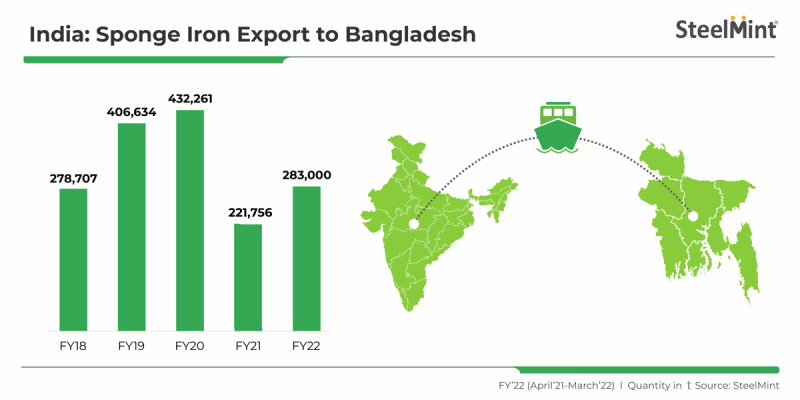
    Sponge iron imports by Bangladesh from India stood at 283,000 tonnes (t) in FY’22 (April’21-March’22). Although Bangladesh’s imports increased sharply from FY’21, volumes were still lower compared to the previous couple of fiscals. Imports, however, are expected to edge up in the coming time on account of rising steel melting capacities in Bangladesh and infrastructure projects in the pipeline.

    Notably, Bangladesh’s financial year starts on 1 July and ends on 30 June. The country’s sponge iron imports were recorded at a meagre 221,756 t in the Indian fiscal year 2021 (FY’21) due to the impact of the COVID-19 pandemic. Meanwhile in the first six months (January-July) of CY’22 the country imported 443,092 t of sponge iron from India, indicating a surge in demand. However, due to LC issues and the liquidity crisis buyers booked limited material during June-July.

    Bangladesh accounts for 41% of Indian sponge exports: Bangladesh has a share of 41% in India’s total sponge exports, with export volumes in FY’22 being recorded at 690,287 t. While Nepal accounts for the largest share – 53% – of India’s exports, Bhutan holds a share of 5%.

    Bangladesh’s sponge import prices: Imported sponge iron prices to Bangladesh stood at an average level of $494/t CNF Chittagong in FY’22.

    Market updates
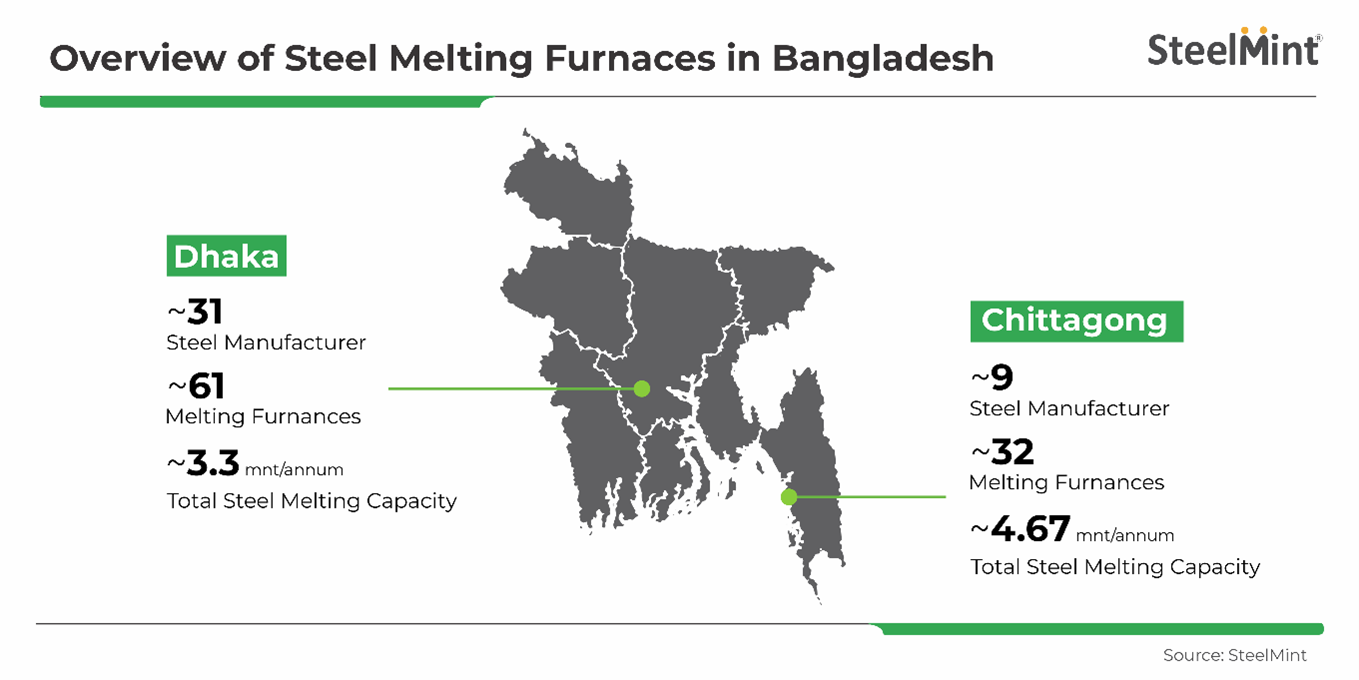
    • Chittagong – home to steel mills: The Chittagong region is the hub of the largest mills in the country, including the top four steelmakers and nine steel companies in all. Mills in the region operate 32 melting furnaces (29 IFs and three EAFs) with a total crude steel capacity of 4.67 mnt (including GPH Ispat’s Quantum EAF).
    • IF mills in Dhaka:  On the other hand, Dhaka has 31 mills in all which are relatively small in size, operating 61 induction furnaces (IF) with a total melting capacity of around 3.3 mnt per annum, while another four induction furnaces are operated by steelmakers in the Comilla region.
    • Furnace sponge-scrap ratio: The ratio of sponge iron in the steelmaking feed depends upon scrap quality. However, the percentage mix of sponge iron in the furnace hovers around 5%.

    As many steel manufacturers in Bangladesh are planning to expand their steel capacities, DRI imports from India are poised to rise further.

    To know more on Bangladesh’s sponge iron imports, book your seat at 3rd Steel & Raw Material Conference, Emerging Bangladesh on 20-21 September, 2022 at Hotel Radisson Blu, Chittagong, Bangladesh, and get a chance to hear renowned industry participants from across the globe on “How are Indian mills managing feed mix of Scrap/DRI/Pig Iron in Induction Furnaces (IF)”.

     

  • India’s coal production set to breach 900 mnt-mark in FY’23 – Coal Minister

    India’s coal production set to breach 900 mnt-mark in FY’23 – Coal Minister

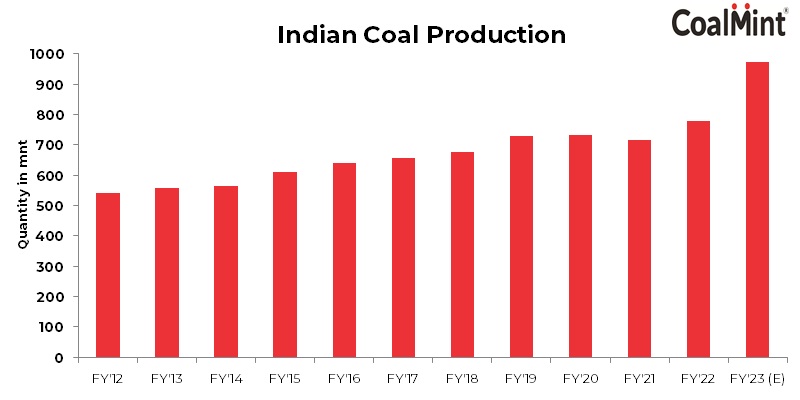
    The Minister for Coal, Mines & Parliamentary Affairs, Pralhad Joshi, said on Tuesday that India’s coal production is set to cross the 900 million tonnes (mnt)-mark in financial year (FY)’23, as the country ramps up efforts to meet a phenomenal surge in power demand.

    Speaking at the 6th National Conclave on Mines and Minerals, the minister stated: “Coal production in FY’22 was around 777 mnt. In the current fiscal we are trying to increase production to 900-920 mnt. Challenges are multifold but the government’s affirmative policies have boosted coal output from around 570 mnt in 2014-2015 to over 760 mnt in 2021.”

    Joshi underlined the fact that international geopolitical disruptions have fuelled energy prices to historic highs and supply and price of natural gas has been gravely affected due to the ongoing turmoil in Russia.

    This, coupled with sanctions on Russian exports, are driving energy prices higher at a time when domestic coal supplies are falling short of satisfying the exponential growth in industrial and domestic electricity demand.

    Production outlook

    The minister, however, had earlier pointed out that state-owned Coal India Ltd. (CIL) has the potential to jack up output to around 760-780 mnt, while the captive power producers could increase production to around 120-130 mnt, with additional production expected from the mines auctioned under the commercial auctions – which should be around 5 mnt.

    The policy enablers have mainly been the amendments that the government brought about as regards revising the MMDR Act, with respect to erasing the end-user distinction for allocation of blocks, and also enabling 50% of sales of minerals after satisfying end use requirements and relaxing exploration norms.

    Further relaxations have been mooted in the form of allocating mines to the private sector, especially the coking coal blocks. Measures to enhance production are in place, the minister said, with the abandoned coal blocks being sought to be operationalised.

    Production climb 32% in Q1

    India’s coal production increased by 32% y-o-y to 205.56 mnt in the first quarter of FY’23 (Apr-Jun’22) against 155.85 mnt in the corresponding period of FY’22.

    CIL produced 159.75 mnt of coal during Q1FY’23, thereby registering a steep rise of 29% y-o-y.

    Notably, this is the highest output recorded by the company in the first quarter of a fiscal – a period during which it usually tends to lower production in view of surplus inventory available at mines.

    However, in order to keep pace with soaring power demand, the company has recorded production in excess of 50 mnt in each of the first three months of FY’23. In contrast, the production mark of 50 mnt was first touched in November of last fiscal.

    In addition, a substantial growth was witnessed from the captive and commercial mines that have been allocated. Overall production from these blocks jumped 79% y-o-y to 27.7 mnt in Q1FY’23, supported by operationalisation of new mines.

    At present, a total of 36 mines are operational. The Ministry of Coal has informed that 12 additional mines will start production this fiscal year.

  • Indian buyers lapping up cheaper Russian coal, imports exceed 2 mn t in June

    Indian buyers lapping up cheaper Russian coal, imports exceed 2 mn t in June

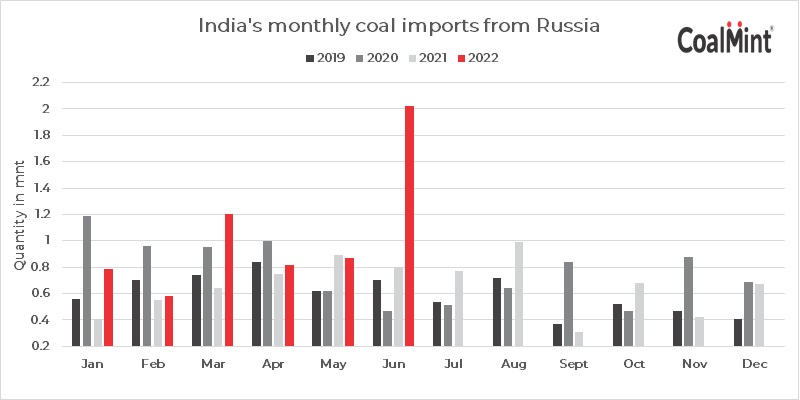
    The Russia-Ukraine conflict that commenced in end-February, 2022 has been altering coal trade dynamics in more ways than one. India, whose coal imports from Russia rarely touched the 1 million tonne (mnt) mark in the past, imported about 2.02 mnt of coal from Russia in June.

    The reason, of course, was that Russian coal was available at discounted rates to India buyers after the USA, EU and Asian countries such as South Korea, Japan and Taiwan slapped sanctions on Russia.

    Of all types of coal coming in from Russia in June, thermal coal had the highest share at 1.03 mnt, followed by PCI (0.45 mnt), coking coal (0.28 mnt) and anthracite at 0.25 mnt.

    Thermal coal

    An analysis of the buying pattern of thermal coal shows that the power and cement sectors accounted for the majority of imports. India hardly imported thermal coal from Russia previously as evidenced by data gathered in previous years, with the highest imports standing at 0.87 mnt in January, 2020.

    According to market participants, Russian coal is suitable for the cement and power sectors in India given its high GCV and low sulphur content. With thermal coal prices from Indonesia, Australia and South Africa trending at very high levels, cheaper Russian coal provides cost benefit to Indian users.

    Coking coal

    Coking coal imports of 0.28 mnt, however, are similar to pre-war levels. In fact, looking at past data, India imported very little Russian coal. In 2021, the country’s monthly average Russian coal imports stood at 0.12 mnt. Top buyers of Russian coal were JSW Steel and Visa Steel.

    Australian coking coal prices, trending at an average of $400/t on FOB basis in June, have pushed a select few Indian steel mills to opt for Russian coal, which is available at just half the price compared to Australian material. However, Indian steel major Tata Steel has shunned imports from Russia due to the war and thus no vessels for the company arrived from that country in June.

    PCI coal

    India has been a regular buyer of Russian PCI coal and its monthly average in 2021 stood at 0.22 mnt, whereas in January-May 2022 imports stood at 0.46 mnt; about 0.45 mnt of PCI is expected to be imported in June. The top buyer in June is JSW Steel followed by JSL, Rawmet and AM/NS India.

    Anthracite

    Like PCI coal, India imported anthracite coal from Russia in the past but in small quantities, with the monthly average standing at around 0.10-0.12 mnt. But June has recorded the highest imports thus far of 0.21 mnt from Russia amid low prices. Rawmet and Carbon Resources were the top buyers of Russian anthracite coal during the month.

    Outlook

    CoalMint vessel data shows that Russian coal imports will be around 0.52 mnt between 1-12 July. While the next quarter may see a decline in imports due to bearish sentiments in the steel and cement sectors during the monsoon, after the rainy season the share of Russian shipments in India’s total coal imports is likely to rise.

    Will Russian coal imports rise further in H2 2022?

    Learn more from the experts at India Coal Outlook Conference 2022 on 3-4 Aug, at The Lalit, New Delhi (India).

  • Role of Pellet Industry in achieving the target of 300 MT of Steel Production by 2030

    Role of Pellet Industry in achieving the target of 300 MT of Steel Production by 2030

    PMAI is organizing a webinar on ‘Role of Pellet Industry in achieving the target of 300 MT by 2030’ on Thursday 3 March 2022 from 11.00 AM onward .

    Smt Rasika Chaube, Additional Secretary, Ministry of Steel will be giving the keynote address.

    Captains of India’s steel industry and experts in the area of pelletisation and beneficiation will share their experience on the technological aspects . In order to give an insight into the Policy aspects of pellets industry, senior Govt officials from department of steel, mines, and NITI Aayog will join in the panel discussions.

    Register button

  • What to expect from the Indian steel market in the short to medium term?

    What to expect from the Indian steel market in the short to medium term?

    India’s crude steel output stood at around 57.28 million tonnes (MT) and finished steel consumption 48.95 million tonnes (MT) in H1 FY 22, up by around 30% and 34% CPLY respectively. Looking at the investment push in FY22 by GoI, the Indian steel industry would be a major beneficiary in terms of generation of demand. However, the Indian steel industry is now facing an unprecedented coal shortage crisis and the global semiconductor chip supply shortage is also impacting the demand from the automobile and white goods sector.

    Speakers:

    • Mr. Ranjan Dhar, Chief Marketing Officer, Arcelor Mittal Nippon Steel India

    Date: Wednesday, 20th Oct, 3:30 PM (IST), 6:00 PM (Singapore time), 2:00 PM (Dubai time)

    Key points of discussion

    • Upcoming production capacities
    • Outlook on domestic steel prices and demand drivers
    • Coal shortage crisis and its impact on Indian steel industry
    • Indian steel exports – Opportunities & Challenges

    Register button