SteelMint Events

Author: SteelMintEvents

  • Increasing Coated Steel Capacities to keep Bangladesh HRC Imports Strong

    Increasing Coated Steel Capacities to keep Bangladesh HRC Imports Strong

    One of the emerging steel markets – Bangladesh is rising up to be a major importer of bulk steel coil for raw material in its cold rolling and galvanizing industries. According to data maintained with SteelMint, in Nov’19, Bangladesh’s bulk steel coil import has witnessed a sharp surge with a flurry of Bulk cargoes arriving at berth, leading its monthly imports to reach the highest volume in the last 10 months.

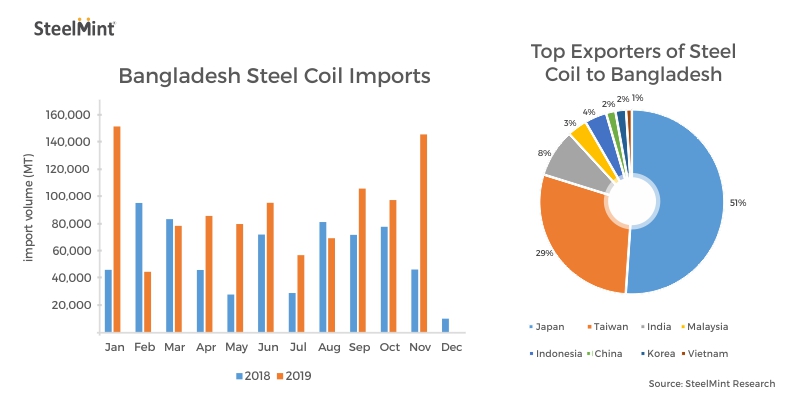
    The bulk HRC imports by the country rose by 50% M-o-M as Bangladesh imported 145,795 MT of of Steel coil in Nov’19 as compared to 97,463 MT on Oct’19. Prior to this, the highest import volume was observed in Jan’19 when the steel coil imports were recorded at 151,628 MT. It is to be noted that Nov’19 HRC import volume was 2nd highest in over 4 years since Aug’15.

    Japan continues to remain the largest HRC exporter to Bangladesh

    Among the major exporters of steel coil to Bangladesh, Japan has continued to retain the pole position, exporting 98,438 MT of material alone in Nov’19, with a share of just under 68% in the total imports by Bangladesh. Taiwan, India and Malaysia with one bulk vessel each stood at the other top exporters to Bangladesh.

    In a Y-o-Y comparison for the period of Jan-Nov, Bangladesh has registered a staggering growth of around 49% Y-o-Y, with its imports in 2019 (Jan-Nov) being reported at 1,008,054 MT, breaching the 1 MnT mark in annual import volume for the first time ever, in comparison to 678,145 MT in 2018 (Jan-Nov)

    In 2019 (till Nov’19), Japan stood as the largest supplier of Steel coil to Bangladesh with a 51% of share in its total imports this year, as it supplied 514,767 MT of material during Jan-Nov’19, up by 7% y-o-y in comparison to the same period in 2018. The other top suppliers to Bangladesh in 2019 were Taiwan, India, Indonesia and Malaysia with a share of 29%, 8%, 4% and 3% respectively in Bangladesh’s total imports this year as of yet.

    Interestingly, Taiwan has increased its export volume to Bangladesh by more than six folds in 2019, registering a 652% Y-o-Y and supplying 289,735 MT this year as compared to just 38,528/MT in 2018, thus looking to compete with Japan as the top supplier in the coming years.

    Overview of Bangladesh flat steel industry

    Major players in Bangladesh’s flat steel industry include PHP Steel Complex, Abul Khair and KDS Group.

    PHP Steel Complex is now operating 4 separate industries that are; PHP Cold Rolling Mills Ltd., PHP Continuous Galvanizing Mills Ltd., PHP NOF Continuous Galvanizing Mills Ltd., and the captive power plant- PHP Power Generation Plant Ltd. The current total production capacity is 0.25 MnTPA.

    Abul Khair has renowned flat steel products, namely ‘Goru Marka Dhew Tin’, ‘Cow Brand Colour Coated Steel’ & ‘Zinkalum’ with a production capacity of over 750000 MTPA.

    KDS Group has monthly capacity of 3,000 MT of color coated steel, 8,000 MT for galvalume and 6,000 MT for GI.

    Outlook

    In recent visit to Bangladesh, SteelMint learned that steel mills are completely reliant on imported HRC for their coated & color coated units. Existing players are eyeing for capacity enhancement in coming years. This will surely keep HRC import volumes to Bangladesh on higher side.

    To know more about the finished flat steel industry in Bangladesh book your seat at SteelMint Events’ 3rd Steel and Raw Material Conference, Emerging Bangladesh and get a chance to hear views of renowned industry participants from across the globe. The conference is being organized on 23rd-24th March 2020 in Chittagong, Bangladesh.

    Explore

  • India Iron Ore Supply-Demand Dynamics: Let’s do the Math Again

    India Iron Ore Supply-Demand Dynamics: Let’s do the Math Again

    With the dates of 2020 auction edging closer, Indian iron & steel industry is drawing up plans to make up for iron ore supply disruption. India’s largest iron ore producing state – Odisha has lined up auction for 20 iron ore & manganese ore mines and Karnataka has put 6 iron ore mines by March 2020. Let us analyse what would be the shortfall and how would it be compensated.

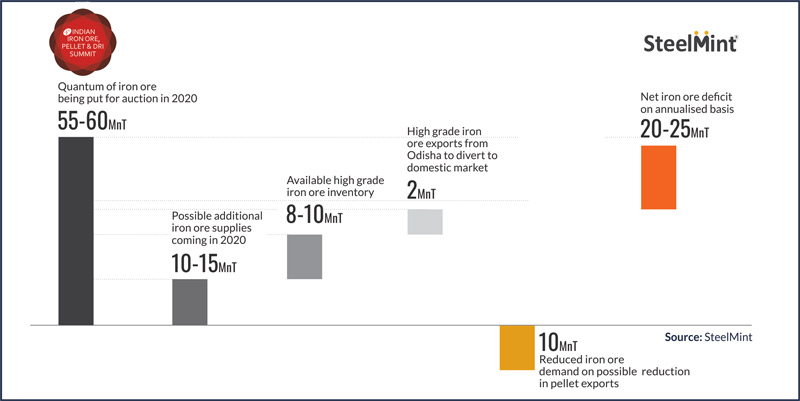
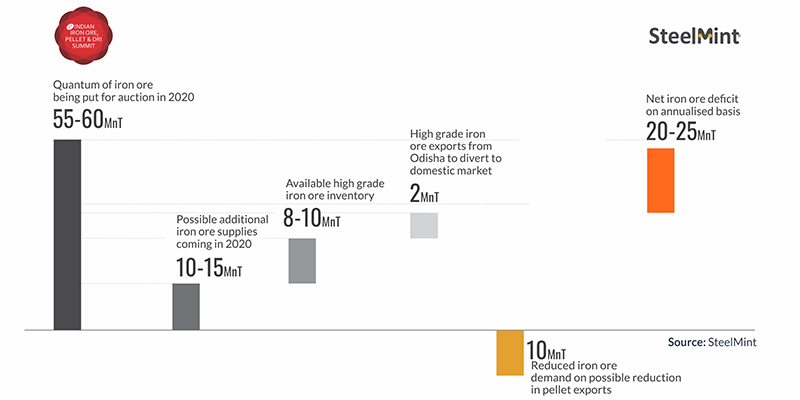
    Quantum of Iron ore being put for auction

    According to SteelMint analysis, government of Odisha and Karnataka have put together 26 operational mines for auction. These mines produce around 55 MnT iron ore annually, against an EC limit of around 80-85 MnT. There are few merchant mines coming for auction in Jharkhand but they are relatively small (total production would be less than 2 MnT). It is fair to assume that about 55-60 MnT of iron ore will be put for auction across India.

    What are possible additional supplies coming in 2020?

    Additional iron ore supplies are likely to come up from other existing leases like NMDC, SAIL, OMC, etc. It is believed that total around 10-15 MnT additional iron ore supply is expected to come up post-2020 auctions.


    India Iron Ore Supply-Demand Dynamics

    NMDC’s production limit increased by 3 MnT: Indian Bureau of Mines (IBM), Ministry of Mines, approved the mining plan of NMDC to enhance the production of iron ore from Kumaraswamy (Karnataka) iron ore mines from present level of 7 MnT pa to 10 MnT pa for the years 2020-21 and 2021-22.

    SAIL allowed to sell 25% of annual production: Indian govt. allowed SAIL to sell 25% of its annual production in the merchant market from their captive mines. This translates to around 7 MnT per annum. Although looking at offered quality and logistics issues, we expect around 3-4 MnT ore can actually come to the market.

    OMC should increase production: Odisha Mining Corporation also plans to raise its EC limit from its Daitari & Koira mines

    JSW to add some supplies in 2020: JSW Steel has started iron ore operations at its four ‘C’ category mines out of six mines it won earlier in Karnataka. The other two mines are expected to come into operation soon which would add up further to country’s iron ore supply.

    • Export volumes will divert to domestic market: We expect higher realisations in domestic market will result in lowering of    iron ore export volumes from India. As per the study of SteelMint, around 20-25 MnT net iron ore deficit on annualized basis  still needs to be addressed.

    Why is mines auction a concern for Indian steel industry?

    The key factor that is expected to play an important role is the transition phase from existing lessess to the new ones. This will depend on the outcome of ongoing discussions between state and central govt. regarding EC, FC and other clearance issues. Expediting the auctions and the subsequent approval processes for mining operations to be undertaken by new leases will be critical to avoid any long term supply shortages.

    India produced around 207 MnT iron ore in FY19 (Apr’18-Mar’19). Estimated consumption reported was 195-200 MnT, where as exports were reported at 7 MnT and imports at 12 MnT.

    To learn about the latest advancements in the mines auction 2020, be a part of SteelMint Events’ 4th Indian Iron ore, Pellet and DRI Summit which is scheduled on 2-3 March 2020, in Hotel LaLiT, New Delhi.

  • Indian Government Enhances NMDC Production Limit by 3 MnT in Karnataka

    Indian Government Enhances NMDC Production Limit by 3 MnT in Karnataka

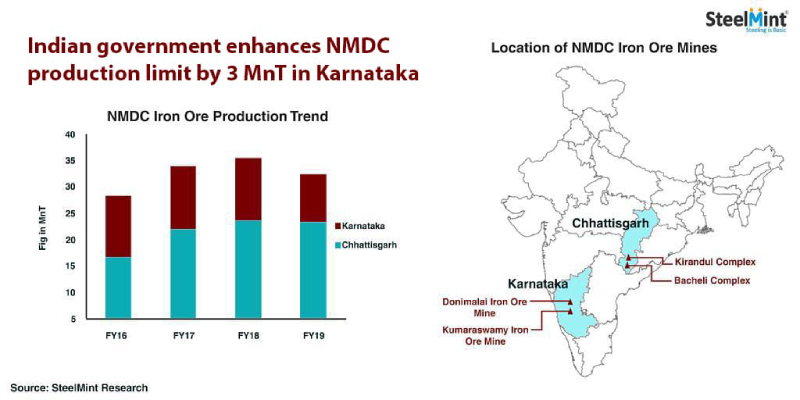
    The Indian Bureau of Mines (IBM), Ministry of Mines, Government of India approved the Mining Plan of NMDC to enhance the production of iron ore from Kumaraswamy Iron Ore Mines from present level of 7 million tonnes per annum to 10 million tonnes per annum for the years 2020-21 and 2021-22. The said notification was issued by the Regional Control of Mines, Indian Bureau of Mines, Bangalore.

    This is an achievement of one milestone towards enhancement of production from Kumaraswamy mines of NMDC from the existing EC capacity to 10 MTPA. This is another big boost to NMDC immediately after obtaining the extension of four mining leases of NMDC in the State of Chhattisgarh.

    The public sector mining major, which has been in the business of mining iron ore for over six decades, operates three iron-ore complexes in the country producing about 33 million tonnes per annum. Two are in Dantewada district of Chhattisgarh and one is located in Ballari District of Karnataka.

    NMDC Chairman-cum-Managing Director Shri N Baijendra Kumar, IAS said “this will not only enhance the production of NMDC but also cater to the likely shortage of iron ore supply in the country post March 2020”.

    To learn how the mines auction 2020 unfolds, be a part of SteelMint Events’ 4th Indian Iron ore, Pellet and DRI Summit‘ which is scheduled on 2-3 March 2020, in Hotel LaLiT, New Delhi.

  • Timeline: How are Odisha Iron Ore Mines Auction Lined Up in 2020?

    Timeline: How are Odisha Iron Ore Mines Auction Lined Up in 2020?

    The Odisha government has called to start afresh the process of mineral block auctions on 06 Dec’19 and it is expected to restore sanity in the system of online bidding. Moreover, the revised tender rules are set to promote equal competition for all iron ore and manganese blocks on offer as opposed to frenetic bidding for a single coveted block.

    The state government has also inserted some additional conditions in the tenders for the expiring merchant mine leases. A successful bidder, after obtaining all statutory clearances, needs to produce in the first two years at least 80% of what the mine actually produced in the preceding two years.

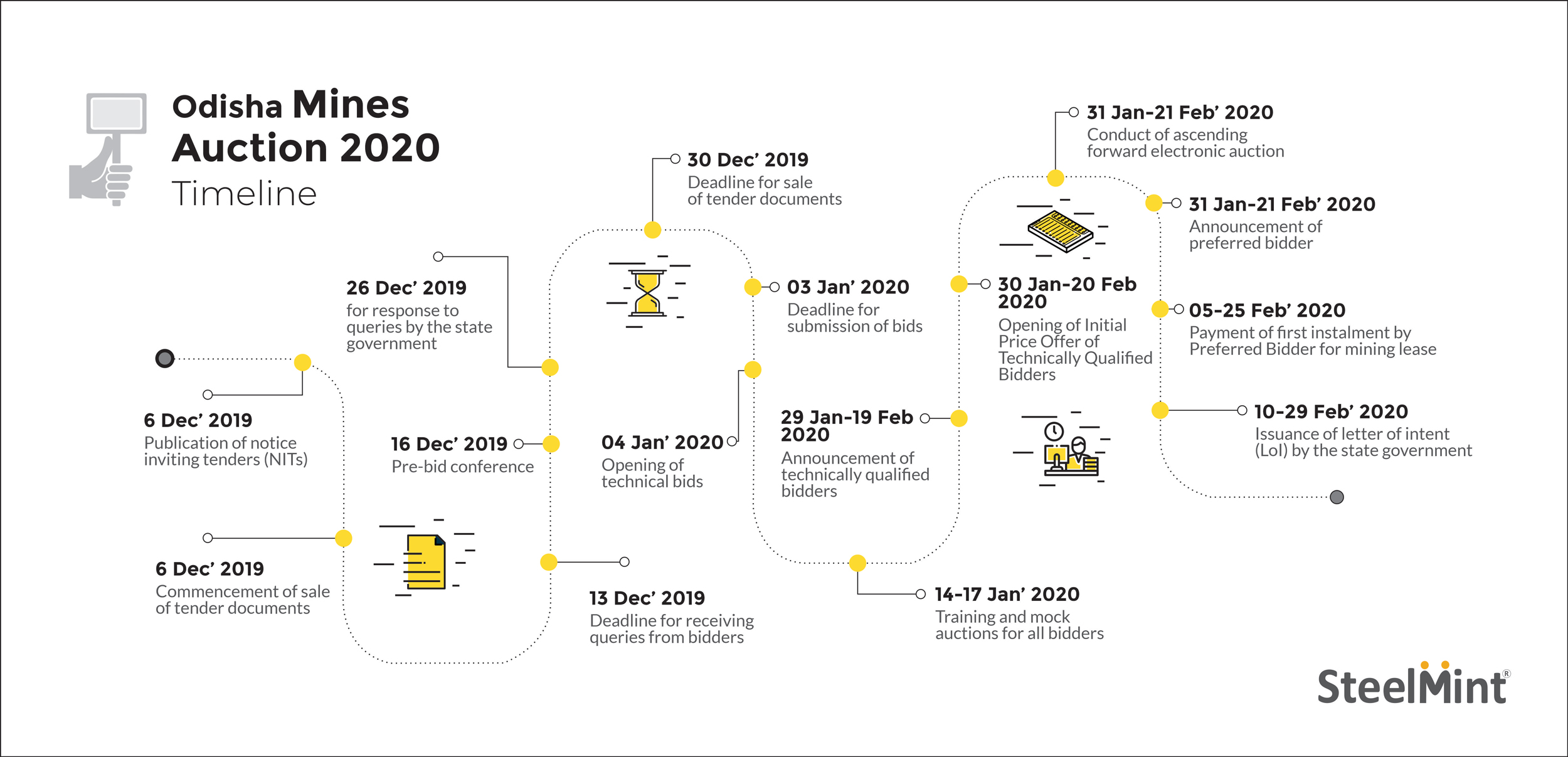
    Here is the timeline for Odisha mine auctions –

    Timeline of Odisha Mines Auction - 2020

    Breakdown of 20 mining blocks notified for auctions

    A. Iron ore mines reserved for captive use
    Mine Present lessee Area
    (in ha)
    Resources
    (in MnT)
    Mine capacity
    (in MnT/annum)
    Thakurani Kaypee Enterprises 228.04 180 5.5
    Gonua P K Ahluwalia 86.88 119.2 0.36
    Narayanposi AMTC 349.25 190.6 – Iron Ore, 0.05- Manganese 6
    Jaribahal Patnaik Minerals 106.53 8.15 0.9
    Tanto, Roida-II K N Ram & Company 74.86 29.38 2.2


    B. Blocks set aside for merchant miners
    Mine Present lessee Area
    (in ha)
    Resources
    (in MnT)
    Nuagaon KJS Ahluwalia 767.28 792.93
    Siljora-Kalimati ML Rungta 715.63 4.02- Mn, 0.72- Iron
    Jiling Essel Mining 456.1 79.12
    Jurudi Kalinga Mining 73.22 4.79
    Mahulsukha AMTC 399.83 32.81- Iron, 0.77- Mn
    Gorumahisani GS Mishra 349.5 18.4
    Badampahar Lal Traders 129.61 6.16
    Jajang Rungta Mines 666.15 58.5
    Katasahi Rungta Mines 196.86 0.66 (Mn)
    KanthorKoira Rungta Mines 73.65 0.06 (Mn)
    Nadidihi BICCO 73.85 27.04
    Nadidihi Feegrade 121.4 23.69- Iron, 0.05- Mn
    Teherai BICCO 137.46 11.52- Iron, 0.07- Mn
    Kolomong Rungta Mines 218.53 1.39- Iron, 3.73- Mn
    Balda Serajuddin 335.59 210.17
    Will India See a Major Iron Ore Disruption?

    To learn how the mines auction 2020 unfolds, be a part of SteelMint Events’ 4th Indian Iron ore, Pellet and DRI Summit‘ which is scheduled on 2-3 March 2020, in Hotel LaLiT, New Delhi.

    4th Indian Iron-Ore, Pellet and DRI Summit

  • Indian Govt Issues Directive on Environmental Clearance, Will India See a Major Iron Ore Disruption?

    Indian Govt Issues Directive on Environmental Clearance, Will India See a Major Iron Ore Disruption?

    Odisha govt finds fresh EC (Environmental Clearance) directive unacceptable. Miners feel transition delay will be only of six months

    A new directive, issued on November 29, by the Union Ministry of Mines, seems to have whipped up a controversy. As per the new proposals, successful bidders in the upcoming mineral auctions will have to apply for fresh environmental clearances (ECs) against the earlier anticipation that the same would be extended for two years. While on the one hand, Odisha is bracing to seek modifications in the new proposals, merchant and captive miners do not seem too perturbed, saying the delay in the transition process will not be anything to write home about. The new lessee has to apply afresh to the environmental advisory committee (EAC) of the Ministry of Environment & Forests (MoEF).

    Unacceptable to Odisha Govt.

    Speaking to SteelMint, a high ranking official at ministry of mines, Odisha, said that the state had “reservations” on this new November 29 directive. He said, a Union Ministry of Mines meeting has been slated on December 10, which he will be attending, and where he intends to take up some of the key issues.

    He said: “We feel the existing EC should be made valid for at least another two years so that the new successful bidder can immediately take up the lease operations. The new directive is not acceptable to us. We had sought extension of the present EC validity for at least two years, in the name of the new lessee. The present directive does not indicate that. Nothing has been said on that.”

    He further said: “We will put forward our points and then let us see if the government can clarify, make some modifications in the proposals. Our key point is that the new bidder has to be supported in taking up operations immediately after the expiry of the lease. The present directive does not support that because of the fresh EC hurdle. “

    He emphasised that there is another point on which he needs clarity. “…The application shall be appraised accordingly for grant of environmental clearance subject to the same validity period as was initially granted…”

    Speaking on the above point, official said: “I do not know what the environmental advisory committee (EAC) of the ministry would mean here because all the leases expire by March 2020.”

    Officials in the Odisha state government indicated that earlier there was a consensus between state and Centre that the EC will be extended for a period of two years but after this notification, successful bidders have to apply for an EC, which will go through a process of due diligence. Even if the government works efficiently, it will take at least six months to get the new EC cleared (against a normal period of two years).”

    EIMP, public hearing exemptions

    Sources in leading merchant miners say they do not think there will be a huge delay because the government, under the new proposals, has exempted the new bidder from preparing a new environmental impact assessment (EIA) study and environmental impact management plan (EIMP), “which takes up a lot of time” along with the public hearing.

    But, importantly, the new successful bidder has to continue working with the same production capacity of the previous lessee. He cannot increase from the existing production volume.

    The EIMP has to cover a monsoon and a summer season study which a lessee has to submit along with the EC application. The lessee has to give the two-season study of the mine area and the periphery, which takes almost one year. Then the report is prepared. Subsequently, the bidder has to submit the study along with the application. This entire process takes more than a year.

    However, under the new directive, the new bidder has to apply afresh and the old EIMP cleared by the earlier lessee will be considered by the committee, in what is being regarded as a big plus-point.

    Another aspect that has been exempted is the public hearing. The State Pollution Control Board organises and conducts the public hearing. This report is then submitted to the EAC of the MoEF. The entire process takes six months to get completed.

    In fact, there is a two-stage process to the EC application. First the bidder has to apply for the terms of reference (TOR). Then the public hearing and EIMP reports are taken into consideration. “The two stages of the EC application process normally take one-and-a-half to two years,” reiterated an industry source.

    “The time taken to issue an EC is actually because of these two aspects, the EIMP and the public hearing,” added the source.

    But the exemption for both is applicable only when the mines are put to auction and a new successful bidder comes in, and takes over the existing mine.

    Possible delay of six months

    When asked about the most worrisome aspect – whether the new directive would delay resumption of mining operations after the new lessee takes over, sources feel there is really nothing to be concerned about. A source said there will definitely be a lapse between the time the new lessee takes over and production resumes, because there will be discontinuation of mining operations till the new EC is in place. “The new bidder will not immediately be able to start mining until he gets the new EC.

    But he added that since the hurdle of a new EIMP and public hearing are being dispensed with, it will take 2-3 months for a fresh EC to be issued and six months at best on the higher side from the time of the application, instead of the usual one-and-a-half to two years,” reasoned the source..

    “So, the transition will not be delayed too much since it will only entail the process of applying for the new EC and making a presentation before the MoEF EAC. This committee takes the hearing and recommends to the government whether the EC should be granted or not,” explained another source.

    Importantly, if the new bidder subsequently wants to increase production further than the previous lessee’s volume, then he has to undergo the old process – apply afresh, go through the public hearing and prepare a fresh EIA and EIMP and present the same before the committee.

    Corroborating, a source from a large steel company which is also a participant, said: “For a 2020 expiring mine having EC (after 2006), the new lessee would be able to get fresh clearances easily provided the production plan is within the EC limit of earlier lessee.”

    The source added that only after “filling a Form 1, clearances would be given… So, there will be ease for new lessees after winning in the auctions, provided they do not increase their production target.”

    Will India See a Major Iron Ore Disruption?

    To learn how the mines auction 2020 unfolds, be a part of SteelMint Events’ 4th Indian Iron ore, Pellet and DRI Summit‘ which is scheduled on 2-3 March 2020, in Hotel LaLiT, New Delhi.