SteelMint Events

Author: SteelMintEvents

  • Mughal Steel to Raise Output, Eyes Infrastructure Growth

    Mughal Steel to Raise Output, Eyes Infrastructure Growth

    Mughal Iron & Steel Industries Ltd. is Pakistan’s largest steel producer and perhaps the largest importer of scrap as well. From a modest beginning as a trading company in 1950, it moved to steel production and today it plays a significant role in the region’s economic development. One of the people at its helm is Mr Fahad Javaid Mughal, a director in the company, who holds a bachelor’s degree in international business from Australian National University, Australia.

    Here follows excerpts from a telephonic interview with Mr Mughal:

    1. How is the global steel scrap market looking this year?

    The US halved its 50% tariff on Turkish steel imports this month and the market spiked up instantly. But I’m thinking, demand is not going to stay very high for Turkish steel because I see US fulfilling its demand for steel domestically and it might take some time for Turkey to establish itself in the US market after a lull.

    2. What is your price forecast for steel scrap?

    I see prices in Pakistan under $330-335/tonne, CFR, in the next few months as against $320-325/tonne at present. Currently, Turkish scrap prices have been at $295-297/tonne on average, though variations do occur because of demand. However, I can see Turkish scrap rates staying over $290/tonne, CFR. Turkish rebars are seen around $490/tonne. Pakistan’s buying price is approximately $25-30/ tonne higher than that of Turkey due to freight.

    3. How is the local market for steel doing in Pakistan?

    Demand in Pakistan might rise in two month’s time as the government is to release funds for some projects. There could be an upward impact on prices to the extent of $10-15/tonne. Turkey may start buying aggressively and that might also have an impact on prices. Once US starts to to buy, the market dynamics will change.

    4. How are the China Pakistan Economic Corridor (CPEC) and Silk Road projects shaping up? How much of a boost will these projects mean for Pakistan’s steel producers?

    The premier of both China and Pakistan had a meeting recently and we are expecting new tenders for the projects. Four new MoUs were signed. The new tenders would be modified tenders. Demand is expected to arise by the end of this year. The local industry is working along with CPEC even though it is not supporting all the steel mills. It depends on the brand and prices.

    5. How is the demand for steel in Pakistan’s home market?

    At present, the per capita consumption of long-rolled steel products in Pakistan is 24kg which is the lowest in the Asia-Pacific region. Our neighbouring country, India, has per capita consumption of long-rolled steel products of 50kg. So in the coming years, Pakistan steel market will definitely grow and our expectation is that the per capita consumption will increase to 35kg. Demand from commercial and home sectors are doing good. Now government has to allocate a good amount of funds for new projects like dams, flyovers, motorways and others. As per the new budget announced in June, Government has imposed a Federal Excise Duty of 17% and abolished special sale tax procedures on scrap and billet import. This is favourable for the steel industry as a whole, as tax net will expand and it will make a level playing field for all the manufacturers in steel sector.

    6. How is the Pakistani government protecting the industry from the onslaught of Chinese exports?

    There is protection. For instance, there is a 43% tariff on rebars especially from China. Steel industry is happy and has invested in furnaces.

    7. How much steel will Pakistan produce in 2019-20?

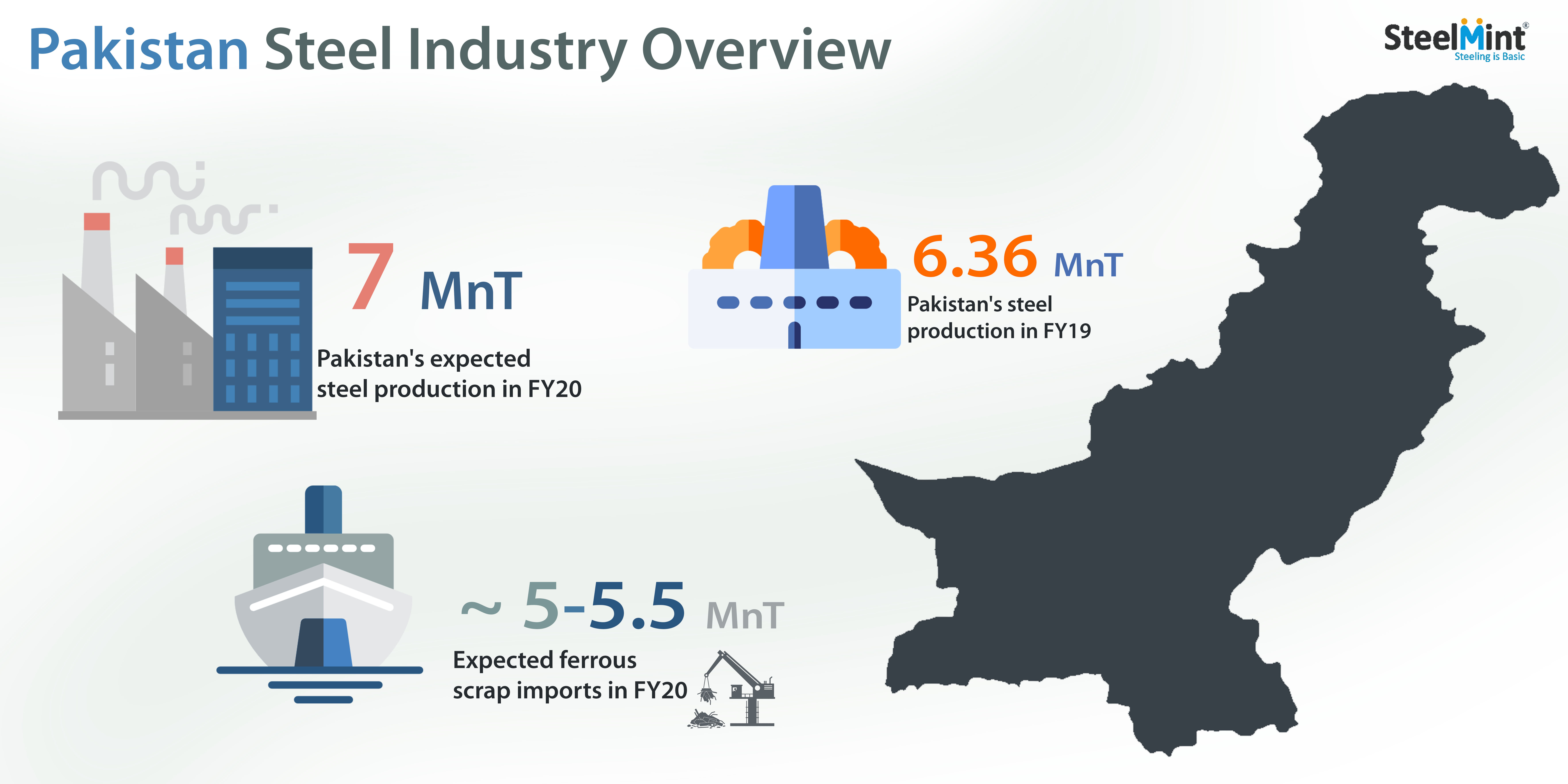
    Pakistan is expected to produce 7 MnT of all steel products this year. In 2017-18, Pakistan produced 7 MnT of steel, but in 2018-19, it fell by 9.2% owing to the depreciation of the local currency. Pakistan’s rupee depreciated by 40%, scrap prices went up and duties also went up. The industry could not pass on the cost to the customer. From 2020 onwards, we expect a steady rise from current levels.

    8. What are the expansion plans of Mughal Iron & Steel Industries?
    We are the largest producers of steel in Pakistan with a capacity of 0.7MnT. In another two months our capacity will rise to 1.1 MnT. We also have a 60 megawatt coal-based power plant coming up which is expected to be ready in one and half to two years from now.

    9. How much of steel scrap will Pakistan buy this year (2019-2020)?

    Pakistan will buy tentatively 5 MnT of steel scrap this year, but this can further increase if the upcoming steel capacities become operational in 2019-20.

    In order to know more on Pakistan steel and scrap trade markets, book your seat at SteelMint’s 4th Steel Scrap, Billet & DRI Trade Summit. The conference is being organized during 27-29’th Aug’19 in Bangkok, Thailand.

    ~ Inputs by Ruchira Singh

    Know More

  • Poor Steel Demand and Rising Raw Material Prices are Playing Havoc on Indian Graphite Electrodes Prices

    Poor Steel Demand and Rising Raw Material Prices are Playing Havoc on Indian Graphite Electrodes Prices

    It seems that the tables have turned for the global graphite electrodes manufacturers including that of India as after enjoying the price buoyancy for almost two years, the same are falling freely without any restraint.

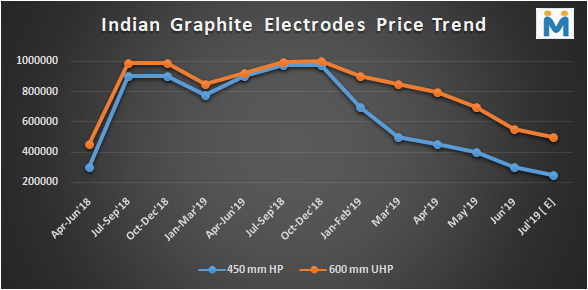
    Now as per the latest information that various sources have shared with SteelMint, UHP grade GEs have registered a plunge of INR 100,000 – 150,000 (USD 1,500- 2,100/MT) against last month and the price of electrodes of size 600-650mm are in the range of INR 550,000-500,000/MT (USD 7,900 – 7,100/MT) whereas that of smaller size, 450mm are herd to be in the range of INR 225,000-250,000/MT (USD 3,200 – 3,500/MT).

    The domestic GE manufacturers that used to have only 10-12 days inventory are currently sitting on the stock of about 1-2 months as the steel mills are delaying their procurement in the hopes of further fall in the GE prices. On the other hand, GE manufacturers are already dealing with the pressure of rising raw materials, needle coke (NC) costs. The contracts for the petroleum-based needle coke for the second half of 2019 have been settled at USD 4,000-4,500/MT. Now if the GE prices fall further, it is likely that electrodes producers margins may see sharp fall in coming months of the ongoing year.

    The key reasons for GE plunge

    The positive sentiments in India’s electrodes market turned negative when the GE prices in China started plunging towards the end of 2018 amid sluggish domestic downstream demand and increase in the electrodes supplies. When GE prices had surged two years back due to supply side structural changes in the Chinese market, which led to the closure of polluting GE units and subsequent supply shortage, many Chinese GE companies invested either in capacity expansion or building new manufacturing facilities. Over a span of two years, sufficient electrode supply eased concerns in the domestic market subsequently impacting both domestic and global GE prices.

    As India has removed anti-dumping duties on electrode imports from China in August last year, the Chinese GE are entering into India without any restrictions. As per the customs data, India’s electrode imports in the first three months of 2019 have registered an increase of 53% y-o-y basis. Although majority of imports in India are that of non-UHP grade electrodes, still there is a fear in the market that if Indian manufacturers does not lower their UHP grade GE prices, they may face tough competition from their Chinese counterparts in this segment also.

    Apart from this, the GE prices are also plunging from the fact that the steel demand across the globe has turned sluggish over past few months as a result of trade war between U.S. and China and rising protectionism measures amongst key EAF-dominated countries such as U.S., Turkey, and Iran. In fact in case of Iran which was one of the key export destinations, the Indian electrodes manufacturers are not supplying to the country due to the U.S. sanctions imposed on the former last year. This combined with tepid steel demand in various other countries has compelled the Indian GE producers to lower down their electrodes prices and maintain high inventories.

    Will Global GE Prices Bounce Back?

    So, will global GE prices bounce back and can Indian exporters hope for better days ahead? To keep track of the subtle changes in the global GE market make sure you attend the 2nd Global Graphite Electrode Conference to be organized by SteelMint Events from 27-29 August, 2019 in Thailand.

    Know More

  • Russia’s Graphite Electrodes Major Energoprom Invests in Plant Modernisation

    Russia’s Graphite Electrodes Major Energoprom Invests in Plant Modernisation

    SteelMint has learnt that Russian electrodes major, Energoprom (EPM) Group along with the Ministry of Industry and Trade of the Russian Federation and Government of the Rostov Oblast has signed a special investment contract for the modernization of production of graphite electrodes at the site of the EPM – Novocherkassk Electrode Plant. This agreement has been signed within the framework of SPIEF (St Petersburg International Economic Forum), an event in which Russia made efforts to appeal to international businesses and investors.

    As part of the project, it is planned to invest more than 2.7 billion Roubles into the development of the production of large cross-section graphite electrodes by the end of 2023. Taxes and other payments into the treasuries at all levels will amount to around 900 million Roubles, manufactured and sold products over 5 years will amount to more than 20 billion Roubles, about 70% of which will be sold in the domestic market.

    EPM Group’s Novocherkassk plant is already undergoing upgradation for capacity enhancement. In April this year, a robot-assisted nipple center was launched at the EPM – Novocherkassk Electrode Plant, which will increase the machining accuracy by 5 times, thereby bringing the level of production at the plant up to par with that of other global producers. At the end of the year, it is planned to commission a RIEDHAMMER furnace – this is a key investment project, designed to increase the quality and output of graphite electrodes with a diameter of 610 mm.

    The CEO of the EPM Group highlighted that the company has signed a very important agreement that clearly defines the program of the further modernization of the company’s key GE plant. Is it backed not only by a new level of equipment, but also by a marked growth in production volumes. It is expected that investment into the modernization program will result in meeting more than half of the demand of the Russian metallurgy industry in large cross-section graphite electrodes. Following the implementation of the investment program, the output of large cross-section graphite electrodes will double, he pointed out. EPM Group is the single electrodes manufacturer in the country with a GE capacity of 60,000 tonnes per year.

    Russia is one of the major electrodes exporters as it exported about 47,568 tonnes of GE in 2018, registering a growth of 21% y-o-y basis with highest exports being made to U.S. followed by Kazakhstan, Belarus and Germany. In first four months of 2019, Russia has exported about 13,995 tonnes of graphite electrodes.

    Know More

  • How Are Steel Markets Aligned For 2020?

    How Are Steel Markets Aligned For 2020?

    The Global events have continued to affect Price dynamics of Steel Industry in 2019. There prevails turbulence and uncertainty as we face the big question of how will the market pan out in 2020?

    Amidst Trade Wars caused by US Protectionism and High imports tariff has compelled China to seek new markets, increasing its Steel Exports. This coupled with China’s oversupply has naturally bothered other major markets and they wary about China Flooding the Steel Markets in 2020?

    Iran also is coerced by US sanctions to sell its Billet Cargos at discounted prices altering the dynamics of Billet Markets.

    In the other part of the world, Emerging Markets of South and South East Asia (Bangladesh, India, Indonesia, Pakistan & Vietnam) have increased their sea-borne scrap imports manifolds in the last few years. This has created new and encouraging opportunities for suppliers across the globe. This potentially might put Asia as the new benchmark for sea-borne scrap.

    Iron-ore prices are on a 5 year high after the tragic Vale dam collapse in Brazil facilitating many buyers to take the steel scrap route of Steel-making.

    China’s emissions standards tightening further in 2017 led to hundreds of smaller mills to shut under stricter enforcement. This invited a sudden traction in EAF route of steel-making that in-turn catapulted the Graphite Electrode prices, GE being the essential raw material involved in there which has no other substitute. Just as the prices seem to be normalizing now, China increased its GE production further that instills some fear in GE producers if this act could further pull down the prices of Graphite Electrode and upset the global markets, yet again.

    There’s a lot that will be discussed and deliberated upon by the Global Buyers, Suppliers, Steel Mills, GE Producers & Analysts who are gearing up to attend the 4th Steel Scrap, Billet and DRI Trade Summit alongside the 2nd Global Graphite Electrode Conference by SteelMint Events. The conference is scheduled to be organized during 27-29th Aug 2019 at Hotel Avani Riverside, Bangkok

    Know More

  • Japan’s Graphite Electrodes Major Showa Denko to upgrade its European Production Sites

    Amid the increased graphite electrodes supplies from China and subsequent fallin global GE prices, Japan’s key electrodes manufacturer, Showa Denko has decided to improve its Carbon division’s production facilities in Europe with a planned investment of 5 billion yen.

    The company has in total seven production sites located in Japan, Europe, U.S. and rest of Asia with the largest share in world’s production capacity of UHP grade electrodes. Showa Denko has launched a medium term plan this year‘TOP 2021’ and under this plan, it plans to achieve the synergy effect of business integration while ensuring stable supply and optimizing supply cost at respective graphite electrode production sites.

    In line with its aim of business integration, it is essential for SDK to establish a global system for supplying graphite electrodes with the same high quality. Thus, the company has decided to improve facilities at its three production sites in Europe, in Germany, Spain and Austria, for the purpose of improving quality and stabilizing production. These sites are controlled by SDK’s consolidated subsidiary SHOWA DENKO CARBON Holding GmbH, which is based in Germany. The construction work and quality improvement efforts are scheduled to begin in 2019 for completion in 2020. This upgradation work is anticipated to reduce SDK’s total production capacity by around 5% during this period. The company aims to achieve its target of being best in terms of quality for its customers and keep on improving the profitability of electrodes business.

    Recently the company’s top management have expressed their opinion that despite the increased supplies from China, the bullish conditions will continue in case of the UHP grade large size electrodes market.

    SDK anticipates surge in large-diameter GE demand

    The graphite electrodes can be majorly divided into two. These are large-diameter graphite electrodes, which are used for melting scrap steel to create electric furnace steel, and small-diameter graphite electrodes, which are used to maintain the molten state of iron that has been melted in a blast furnace or electric furnace. The production of large diameter GE requires both technological expertise and high-quality raw materials (needle coke) and Showa Denko is amongst the few three companies globally that manufactures good quality large-diameter GE.

    Now, as per the company’s top management, with the growing EAF facility around the world especially in North America and East Asia amid environmental concerns to reduce pollution, the demand for large-diameter electrodes will continue to rise whereas their supply will remain tight which is set to support the GE prices.

    Company undeterred by current fall in GE prices

    In its own earnings forecast for calendar 2019, Showa Denko has projected that its inorganics segment – which includes graphite electrodes – will generate 148 billion yen in operating profit (USD 1.36 billion), up by 11.8% year-on-year. Figures from the first quarter show that the company’s graphite electrode sales stayed at largely the same level as that seen last year.

    While another Japanese GE major, Tokai Carbon has made a downward revision in its earnings forecast for second half of 2019 based on the current market situation, Showa Denko didn’t change its existing prediction of continued high sale prices for graphite electrodes, expecting the average price here for 2019 to be around five times that seen in 2017. The company’s GE price contracts with Japanese and other East-Asian customers for Apr-Jun quarter have been finalised at prices 5-10% more against corresponding quarter of last year.

    Apart from this, the capacity additions in China’s GE sector are majorly going to be focused on small diameter GEs resulting which no major impact on the demand-supply balance of large-diameter is expected. The strong growth prospects of North American steel sector the general expectation is that demand for graphite electrodes will be steady in the medium term.

    Know More