SteelMint Events

Category: Blog

  • India: Ferro Chrome Prices Remain Stable as Market Awaits Upcoming Auctions

    India: Ferro Chrome Prices Remain Stable as Market Awaits Upcoming Auctions

    • Bids for some grades drop in OMC’s auction
    • Tsingshan’s June’24 tender prices stable m-o-m
    • European benchmark prices to be discontinued from June

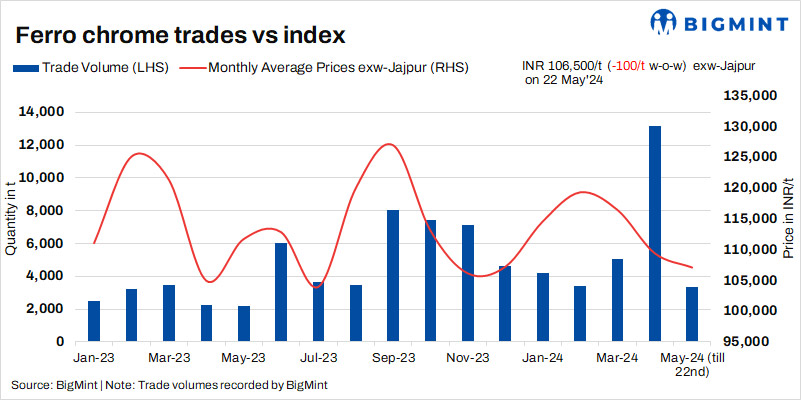
    Indian high-carbon ferro chrome (HC60%, Si:4%) prices remained steady w-o-w, decreasing slightly by INR 100/t ($1/t) w-o-w compared with the previous assessment on 15 May 2024. Prices stayed stable because the market did not show any significant improvement in demand.

    As per BigMint’s assessment on 22 May, high-carbon ferro chrome (HC60%, Si:4%) prices were INR 106,500/t ($1,279/t) exw-Jajpur. Last week, around 600 t of trades were finalised in the price range of INR 104,000-108,000/t ($1,249-1,297/t).

    With a slight increase of INR 100/t ($1/t) w-o-w to INR 114,300/t ($1,373/t) exw-Jajpur, prices of high-carbon low-silicon ferro chrome (HC60%, Si:2%) also stayed stable. Low-carbon (C:0.1%) ferro chrome prices, however, decreased by INR 2,000/t ($24/t) w-o-w to INR 235,000/t ($2,822/t) exw-Durgapur on 23 May.

    Auctions in domestic market: On 21 May, OMC’s chrome ore auction was concluded, with all 67,300 t of material sold out. For high-grade ore (52 to +54%), premiums increased by 24-55% (INR 4,900-11,700; $59-141) over the base price. However, the bids for the remaining grades decreased by around INR 2,600 ($31).

    Two more ferro chrome auctions are scheduled for 24 May, one by OMC and the other by Vedanta-FACOR. Market participants are keeping an eye on the outcomes of these auctions.

    Taking into account the generally low level of domestic demand, a key producer told BigMint: “We have currently stopped offering in the domestic market and only catering to export orders as realisation is a bit better in exports.”

    Global market conditions: Ferro chrome (HC60%) prices in China inched up by RMB 100/t ($14/t) w-o-w to RMB 9,150/t ($1,263/t) exw-Inner Mongolia. According to reports, rising raw material costs contributed to the price rise.

    Tsingshan has announced its ferro chrome tender prices for June at RMB 8,995/t ($1,242/t), unchanged m-o-m. It could be due to firm domestic prices over the past few weeks.

    Furthermore, a significant South African producer of ferro chrome, Merafe, has declared that it would stop releasing quarterly European benchmark prices from 2024.

    Uptrend in stainless steel sector: Prices for 304 grade stainless steel went up by INR 5,000/t ($60/t) w-o-w, reaching INR 182,000/t ($2,186/t) exw-Mumbai. This resulted from a $1,540/t w-o-w increase in LME nickel prices. Some producers also increased their prices. However, given the recent fluctuations in LME nickel prices, the market is still uncertain.

    Outlook

    The moderate response to OMC’s chrome ore auction may exert additional pressure on prices. However, given the current cost dynamics, a significant fall seems less likely. Further clarity may emerge after the upcoming auctions.

  • India: Ferro Molybdenum Prices Surge Due to Limited Supply

    India: Ferro Molybdenum Prices Surge Due to Limited Supply

    • Growing demand from Europe, China
    • LME prices maintain stability

    In comparison to the previous assessment on 15 May, ferro molybdenum prices in India experienced a rise of INR 61,000/t ($733/t) w-o-w. Prices increased as there were reports of material shortage across the globe which got boosted by the rise in demand.

    Indian ferro molybdenum prices were at INR 2,681,000/t ($32,197/t) exw-Nagpur on a 60% pro rata basis, as per BigMint’s assessment on 22 May. In the previous week, around 10 t of material was sold within the price bracket of INR 2,650,000-2,690,000/t ($31,825-32,305/t).

    Weekly market movement

    Supply limitations, growing demand: Global markets experienced molybdenum oxide shortages, which restricted the availability of finished materials. As a result, prices increased in both the domestic and international markets due to a surge in inquiries, mainly from China and Europe.

    “The market is bullish right now, but bulk deals at higher prices are yet to be concluded as the market needs few days to absorb these prices,” a well-known domestic producer told BigMint.

    Global price trajectories: Ferro molybdenum (Mo:60%) prices in China increased by RMB 10,000/t ($1,410/t) w-o-w to RMB 250,000/t ($35,245/t) exw-Inner Mongolia. According to sources, a local mine in China recently sold molybdenum concentrate (50-50%) for around RMB 3,910/t ($551/t). Additionally, there was a shortage of molybdenum concentrate as well.

    While prices in South Korea (Mo:60%) inched up by $0.3/kg w-o-w to $51/kg, they remained stable w-o-w in the US (Mo:70%) at $61/kg.

    The London Metal Exchange (LME) saw little change in pricing w-o-w, with a $0.09/pound increase to $21.89/pound on 21 May.

    Outlook

    If this trend persists, we might see additional price increase in the coming days.

  • Bangladesh Needs to Harness the Potential of Rooftop Solar Energy

    Bangladesh Needs to Harness the Potential of Rooftop Solar Energy

    Bangladesh Needs to Harness the Potential of Rooftop Solar Energy


    Despite challenges, the sector offers a lot of promises

    The Bangladesh government raised electricity tariffs yet again in February 2024, following several adjustments in 2023. The government also increased gas prices for selected categories. Consumers, including industries, are now bearing the brunt of high energy tariffs and looking for a probable way out.

    However, high electricity tariffs make rooftop solar financially more viable now. This is one area that building owners can explore to reduce their soaring power bills. Yet, the pace of rooftop solar implementation is slow. The encouraging sign is that the rooftop solar sector started to gain traction.

    Speakers in a recent webinar titled ‘Scaling up rooftop solar deployment in Bangladesh’ have opined that this momentum needs to be accelerated.

    The webinar was jointly organized by Energy & Power magazine and the global think tank Institute for Energy Economics and Financial Analysis (IEEFA). Mollah Amzad Hossain of the Energy & Power magazine moderated the session.

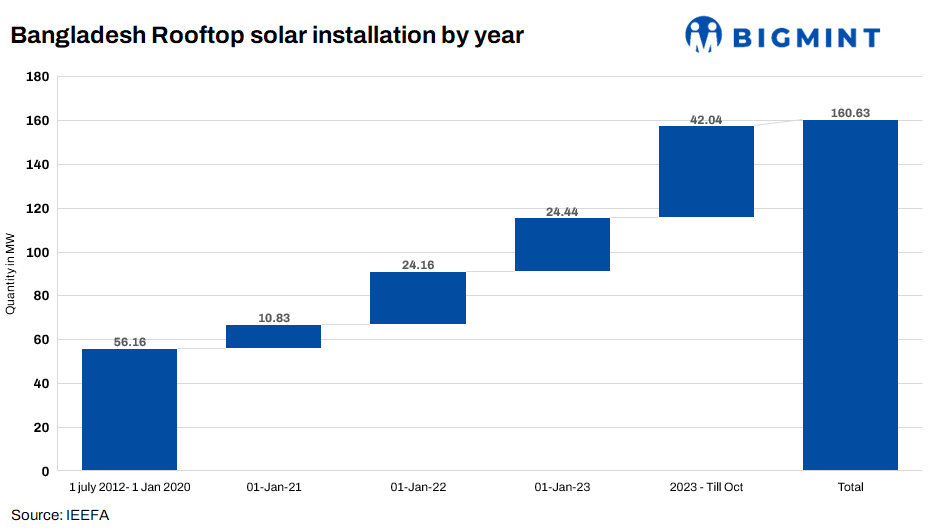
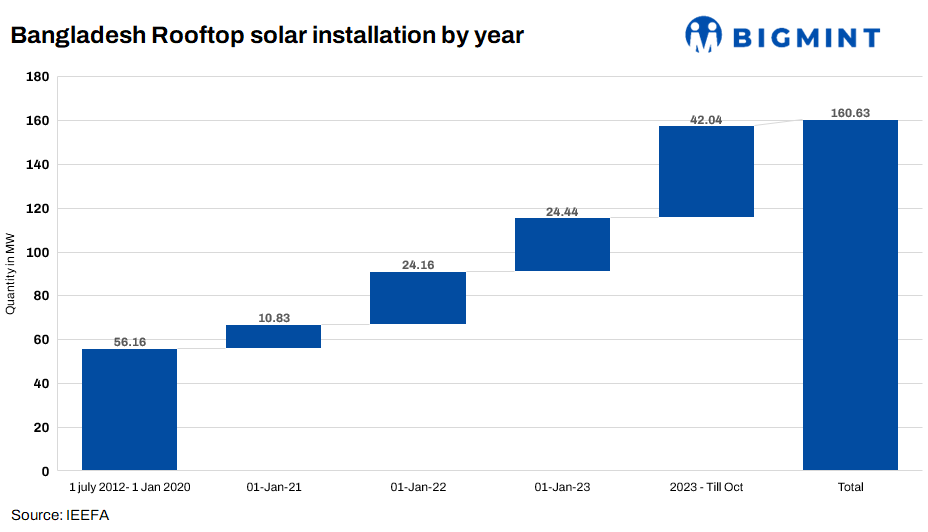
    Delivering the keynote presentation, IEEFA’s lead energy analyst for Bangladesh, Shafiqul Alam provided a snapshot of the rooftop solar sector of Bangladesh which has a combined capacity of 166.28MW as of 1 March 2023. While the combined capacity remains at a paltry level, the sign is encouraging as the installation rate in 2023 surged compared to other years. He shared the key challenges that hinder the quick take up of rooftop solar in Bangladesh. Among other things, lack of awareness, difficulty in accessing finance, high import duties on solar accessories, capacity level of stakeholders, and absence of business models for utilities impact the sector.

    The rooftop solar systems that were installed to obtain grid connection eventually delivered little or no energy. This also negatively impacts people’s motivation to install rooftop systems in the country.

    In the keynote, Alam also highlighted that six key levers can help Bangladesh upscale rooftop solar systems in the foreseeable future.

    These are

      • Raising awareness of the stakeholders on the benefits of rooftop solar and recent changes in regulations. SREDA may enhance its efforts in targeted awareness programmes for different stakeholders.
      • Streamlining finance-A new funding scheme to upscale rooftop solar will be important as the available financing schemes of IDCOL and the central bank have limited funding scope. Risk mitigation instruments like a credit risk guarantee scheme will help reduce financial institutions’ perceived risk in providing loans to rooftop solar.
      • Policy and regulatory intervention-The import duties should be waived at least for a limited period. Additionally, the 70% cap on rooftop solar system capacity should also be lifted. SREDA may work with the ministry to streamline these.
      • Quality assurance-Poor quality accessories, particularly in small systems, are still an issue. BSTI should increase market monitoring to ensure the quality of rooftop solar accessories. Testing lab should also be increased.
      • Capacity development of stakeholders -Different stakeholders demonstrate low capacity. For example, some banks are still not used to lending to rooftop solar. SREDA may organise additional capacity development training for banks and other stakeholders.
      • Business models for utilities -To quickly increase rooftop solar capacity in the country, utilities will need to play an important role. However, they do not have incentives. New business models can allow utilities to earn revenue and thus remain sustainable in the long run.

    Alam further said that a combined rooftop solar capacity of 2,000 MW could help Bangladesh save money between US$ 0.48 billion and US$1.0 billion per annum by reducing expensive fossil-fuel-based power generation during the day peaks.

    Bangladesh should pursue efforts to enhance renewable energy capacity to reduce import dependence and enhance its energy system resilience.

    Speaking at the webinar, Engr. Nurul Aktar, President of Bangladesh Solar and Renewable Energy Association (BSREA) said that high import duties and low awareness level of stakeholders affect rooftop solar implementation. The country needs to multiply efforts to enhance rooftop solar capacity.

    The CEO of IDCOL said: “Rooftop solar is one of the key financing areas of IDCOL”. However, he agreed with the keynote speaker that IDCOL’s facility would not be enough to the demand for financing in the sector. He feels awareness raising on the benefits of rooftop solar is necessary.

    Former Dean of BUET, Prof Ijaz said that due to the Carbon Border Adjustment Mechanism (CBAM) and other international pressure, our export-oriented industries would need to implement rooftop solar. However, only a rooftop will not be enough. Industries will need to implement energy efficiency measures too.

    Responding to a question from the audience, Shafiqul Alam said that the current electricity tariffs in Bangladesh are better than the feed-in tariff that influenced the rooftop solar boom in Vietnam in 2020.

    Attending as the special guest of the webinar and IEEFA South Asia’s director, Vibhuti Garg mentioned that Bangladesh may look into innovative business models such as virtual net metering and peer-to-peer trading. Blended finance instruments can play a big role in transforming the sector. As the cost of solar technology continues to come down, the attractiveness of rooftop solar will increase further.

    Chief guest of the webinar, Director General of Power Cell, Engr Mohammad Hossain said that the solar home systems programme is a success story for Bangladesh. Solar home systems have played their roles. Now, we need to expand rooftop solar as we also have land scarcity. We are internally working on removing the 70% cap on rooftop solar installation capacity. Moreover, we are working on how to initiate corporate power purchase agreements. We are hopeful that we will be able to improve grid quality to accommodate variable rooftop solar systems. In fact, with nuclear power expected to be online soon, the grid will improve by that time.

    Source: Energy & Power, Bangladesh

    4th Bangladesh International Trade Summit

    Bangladesh, a strategically significant country in the Asia Pacific, is emerging as a hotspot of economic growth. The country’s phenomenal economic expansion is fuelled by a buoyant steel sector which is on an expansion spree. This is expected to encourage the participation of more global companies and attract precious foreign reserves for the country.

    BigMint Events will be hosting the 4th Bangladesh International Trade Summit on 14-15 May 2024, at Hotel Pan Pacific Sonargaon, Dhaka, Bangladesh. The two-day conference looks to bring together key stakeholders from the steel, cement, and power sectors, including industry stalwarts, policymakers, traders, and investors. It seeks to provide a network for collaboration and an ideal platform for discussion of prevailing industry trends and challenges.

  • Bangladesh proactively eyeing greener routes in power to achieve emission targets

    Bangladesh proactively eyeing greener routes in power to achieve emission targets

    • Strong emphasis being given to solar energy
    • Setting up of fresh coal-fired plants banned
    • More hydropower imports from Nepal planned
    Bangladesh, a key South Asian player in the steel manufacturing and ferrous scrap import space, is taking a proactive multi-pronged approach in its power sector to reach its emission targets.
    It is not only encouraging renewable energy (RE) expansion but has banned further setting up of coal-fired power plants.

    As per Climate Watch data, Bangladesh’s greenhouse gas emissions nearly doubled in 2018 from a decade ago although it remains a small emitter at a global level.

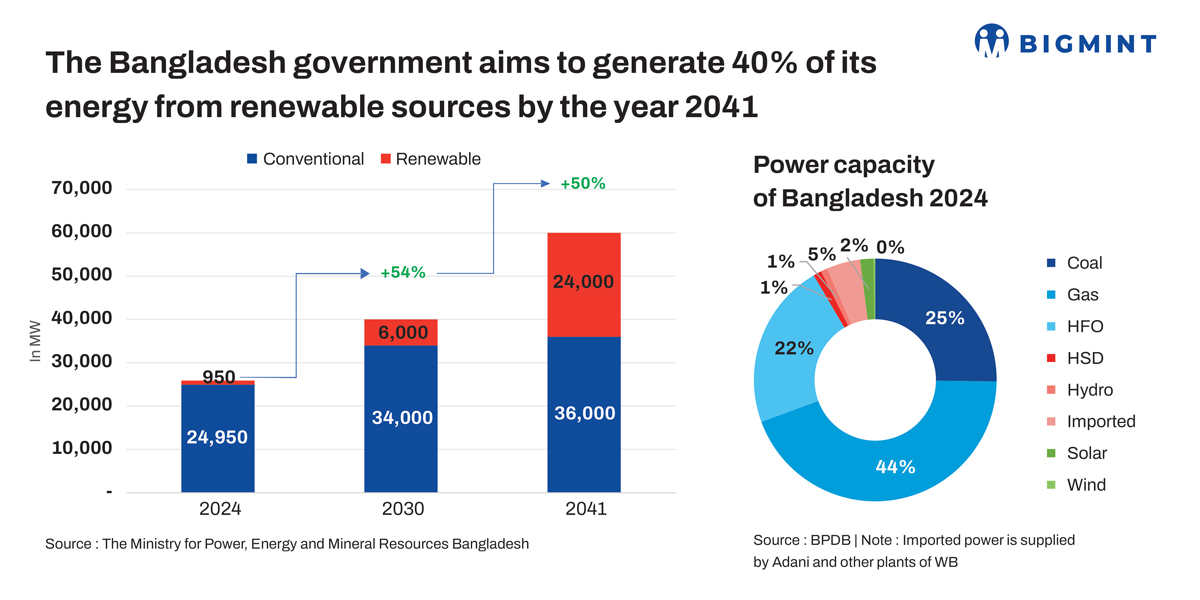
    Its Ministry of Power, Energy, and Mineral Resources announced a few years back that Bangladesh aims to generate 40% of its electricity from clean energy sources by 2041, a key component of the country’s long-term strategy for the power sector.

    State Minister for Power, Energy, and Mineral Resources, Nasrul Hamid, outlined that this plan involves importing about 9,000 MW through regional cooperation with neighboring countries.

    Additionally, the government has set a target to derive 10% of the total power generation from renewable sources by 2041. Currently, Bangladesh’s power generation capacity stands at 25,826 MW, with 1,160 MW being imported, mostly through hydropower from Nepal and Bhutan.

    The installed capacity of renewable energy in Bangladesh has risen to 950.72 MW.The government is confident in achieving a power generation capacity of 40,000 MW by 2030 and 60,000 MW by 2041, with a significant focus on renewable energy and regional energy cooperation.

    Current power sector scenario
    Bangladesh has an installed capacity of around 26,000 MW while its actual generation comprises around 14,300 MW.
    Its power demand varies according to season. In summer, the peak demand season, consumption hovers around 16,000-18,000 MW. Winter, the lean period, sees demand dropping to 9,000-10,000 MW.
    Within the 14,300 MW of current demand, the major chunk of 30-40% is contributed by gas-based power generation while 20-25% is coal based, 18-20% is HSFO (high sulphur fuel oil)-based, and the balance 3-5% comprise of renewables.
    But, due to higher tariffs, HSFO-based power plants are not being encouraged by the government.
    Gas-based plants contribute the highest to power generation essentially because of their comparatively higher efficiency level. The country sources locally from its own gas fields. The deficit in LNG is met through imports from the Middle East and Singapore. At present, the total LNG requirement is 3,500 MMcfd with which domestic production amounts to 2,700 MMcfd and the balance 800 MMcfd are imported.
    HSFO-based power generation comprises around 7400 MW. But tariffs here are quite high compared to gas or solar.

    While the bulk is contributed by gas, the share of coal-fired generation has been increasing steadily since 2019.

    According to Bangladesh Power Development Board (BPDB) official statistics, new power plants that are either already connected to the grid or are in the process of being linked will contribute significantly to the energy supply. The additions include:

    • 1,600 MW from Adani Group’s coal-fired power plant
    • 620 MW from the Rampal Power Plant
    • 1,224 MW from S Alam Group’s coal-fired power plant in Bashkhali, Chittagong
    • 718 MW from Reliance Power’s LNG-based plant in Meghnaghat
    • 590 MW from GE-Summit Meghnaghat-2’s LNG-based power plant
    • 584 MW from Unique Group’s LNG-based power plant, also in Meghnaghat.

    These new power sources represent a diverse mix of energy, with coal-fired plants providing a significant portion, alongside growing contributions from LNG-based facilities.

    How will Bangladesh’s power landscape change by 2030?
    Increased share of solar: The government is aiming to raise the share of RE generation from the present minuscule 3-5% to 15-20% by 2030. To achieve this target, the government is planning to encourage setting up of smaller solar power units along with 100-megawatt (MW) projects wherever land is available. The key challenge here lies in land scarcity. Thus, local power producers are trying to make the best use of available land, a source in Bangladesh informed. The common practice now is to seek around 400 acres of land parcels for setting up 100-MW solar projects. At present, around 100 MW is seen contributed by solar/RE sources.
    A few solar projects are underway. These include the Arabian Company for Water and Power Operations’ 300-MW solar power project and Sumitomo’s solar PP.
    “If we consider the next 5-6 years then solar power plants will be more in focus,” a source in Bangladesh observed to BigMint.
    Offshore wind project viability study underway: The country is also eying offshore wind projects but because of inadequate wind speeds in Bangladesh such projects may not be very viable. However, a feasibility study is under way for an offshore wind power project through the Bangladesh China Power Company Limited (BCPCL), a joint venture between Bangladesh’s North-West Power Generation Company (NWPGCL) and China National Machinery Import and Export Corporation.
    Government halts new coal-fired plants: The government has implemented a pause on the establishment of new coal-fired power plants, with several significant ongoing projects, such as the 1200×2 MW Matarari project, the 1320×2 Rampal project, and the 1320-MW Payra power plant, discontinuing their phase two construction.
    Nuclear plant on way: Bangladesh is also constructing the 3000-MW Rooppur Nuclear Power Plant (RNPP) in Pabna district — a significant infrastructure project currently underway. Once it comes into operation it will help to cover the deficit of 2,400-3,000 MW.
    As per government data, an additional 6,000-7,000 MW would come in, including the nuke plant, by 2026-27.

    Imports of greener source of power to increase: The government is in talks with Nepal for increasing imports of hydropower to broaden the green energy basket and help it reach closer to its emission goals. At present, Bangladesh is importing around 40 MW of hydropower from Nepal and the rest from India (700 MW from Adani Power and around 100 MW from the eastern part of India).

    Outlook
    Bangladesh’s power demand is expected to increase from the current levels to 33,000 MW by 2030, impelled by higher economic growth and further industrialization.

    Emphasis on HSFO-based generation is likely to wane because of the higher tariffs.

    Looking ahead, solar tariffs are likely to be competitive and remain contained in the range of 10-11 cents per unit since many players are jostling for space here. “The lower the tariffs quoted here, the higher the chances of receiving government approval,” informed a source in Bangladesh.

    4th Bangladesh International Trade Summit

    Bangladesh, a strategically significant country for Asia-Pacific, is emerging as a hotspot of growth through sustainable practices. The economic expansion is expected to encourage the participation of more global companies and attract forex for the country.

    BigMint Events will be hosting the 4th Bangladesh International Trade Summit on 14-15 May 2024, at Hotel Pan Pacific Sonargaon, Dhaka, Bangladesh. The two-day conference shall bring together key stakeholders from the steel, cement, and power industries, including industry stalwarts, policymakers, traders, and investors. It shall provide a network for collaboration and an ideal platform for discussion of prevailing industry trends and challenges.

  • Bridging the Energy Gap: Bangladesh’s Strategic Pivot to Imported Coal

    Bridging the Energy Gap: Bangladesh’s Strategic Pivot to Imported Coal

    • Imported coal usage increasing at power plants
    • Scarce natural gas supplies support imports
    • Thermal coal imports may touch 19 mnt by 2026

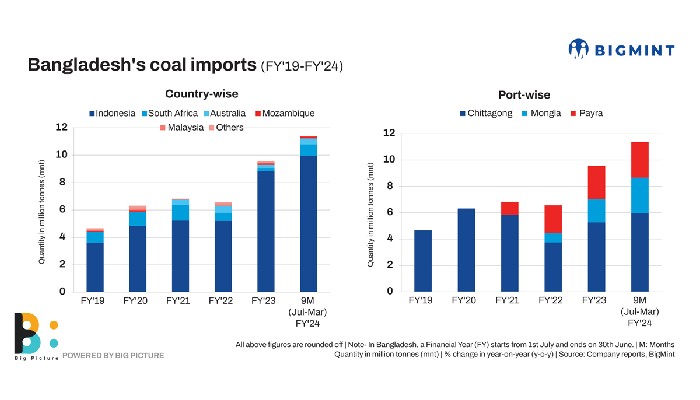
    Morning Brief: In the midst of its escalating energy demand, Bangladesh has witnessed a significant 44% y-o-y increase in coal imports in the Financial year 2023 (FY’23), reveals BigMint data. Volumes surged to nearly 12.75 million tonnes (mnt) last year compared to 8.83 mnt in FY’22, underscoring the nation’s growing reliance on imported coal.

    Factors pushing up coal imports

    Increased demand from power sector: The increase in coal imports can be attributed to several factors. Notably, a key reason lies in the heightened requirement of imported coal for power generation. Inflation-related issues and coal supply shortages have been leading to electricity disruptions. With the addition of the Matarbari power plant in the current fiscal year, demand for coal has experienced a remarkable upsurge. In fact, six power plants across the country are now operational, utilising imported coal as a primary fuel source.

    Natural gas shortfall: Bangladesh has also been experiencing a persistent shortage in domestic fuel supply, notably evident in the natural gas sector. Despite its historical dominance, the country’s natural gas reserves struggle to meet escalating demand, leading to a greater reliance on coal and imported natural gas. In a latest development, Petrobangla has invited bids for oil and gas exploration wherein nine shallow-sea and 15 deep-sea blocks have been put on offer.

    Nonetheless, given the time required to develop these gas blocks, coal appears to be a viable option to meet the growing energy needs of the country in the near term.

    Insufficient domestic coal supplies: In response to the surging energy demands, Bangladesh has witnessed a remarkable increase in domestic coal production, notably facilitated by the Barapukuria Coal Mining Company Limited (BCMCL). Several factors have contributed to this surge, including successful agreements with the Chinese contractor XMC-CMC Consortium, aimed at roadway development and maintenance, alongside continued coal extraction activities from underground mines. To meet the growing demand, BCMCL increased coal production by 57% y-o-y to 767,307 tonnes in FY23.

    However, despite the substantial increase in production, the country’s domestic coal supply still falls short of demand. This demand surge is evident in the country’s Annual Performance Agreement (APA) for the financial year 2022-2023, which aimed to sell 500,000 t of coal to the Bangladesh Power Development Board (BPDB). Due to BPDB’s high demand and BCMCL’s increased production, 0.76 mnt of coal were sold to BPDB in 2022-2023, surpassing the initial target. Notably, BCMCL ceased coal sales to local buyers from 19 March 2018, further accentuating the reliance on imported coal.

    Coal emerges as a cost-effective solution: Despite the availability of gas reserves, gas-based power plants dominate Bangladesh’s total power generation capacity. However, a persistent shortfall in natural gas supply, from as early as 2014, as highlighted by Petrobangla in its annual report, has led to a growing dependence on coal and imported natural gas.

    A comparative cost analysis reveals that while gas remains the cheapest source of power generation, coal emerges as a more economical option compared to alternative power sources.

    Falling prices led to higher imports: Furthermore, declining coal prices have further incentivized imported coal procurement. Prices of RB2 (5500 NAR), South African coal and 4200 GAR Indonesian coal dropped 50% and 27% y-o-y respectively and were assessed at $105.35 FOB Richards Bay and $63.3/t FOB Kalimantan in CY’23. This declining trend encouraged end-users to increase their purchases of imported coal, shaping Bangladesh’s coal import landscape.

    Tightened supply coupled with declining coal prices on the international stage prompted the country to recalibrate its approach to coal procurement. Notably, increased sourcing from Indonesia in CY’22 and a 34% rise in intake from traditional markets like South Africa, fuelled by falling prices, have shaped Bangladesh’s coal import landscape.

    Outlook

    It is anticipated that Bangladesh’s coal imports will likely increase in the near future due to escalating energy demands amidst inadequate domestic supply. Despite challenges like currency devaluation and supply disruptions, coal capacity expansion projects are underway to meet future energy needs. Projected coal consumption is expected to reach 19 mnt by 2026 from the present 13-14 mnt, driven by capacity additions and economic growth. Coal consumption is set to increase with plants like Matarbari and Banshkhali that are nearing commercial operation.

    4th Bangladesh International Trade Summit

    Bangladesh, a strategically significant country in the Asia Pacific, is emerging as a hotspot of economic growth. The country’s phenomenal economic expansion is fuelled by a buoyant steel sector which is on an expansion spree. This is expected to encourage the participation of more global companies and attract precious foreign reserves for the country.

    BigMint Events will be hosting the 4th Bangladesh International Trade Summit on 14-15 May 2024, at Hotel Pan Pacific Sonargaon, Dhaka, Bangladesh. The two-day conference looks to bring together key stakeholders from the steel, cement, and power sectors, including industry stalwarts, policymakers, traders, and investors. It seeks to provide a network for collaboration and an ideal platform for discussion of prevailing industry trends and challenges.