SteelMint Events

Category: Blog

  • Needle Coke Prices Won’t Fall in Next 2 Years: Chinese Needle Coke Manufacturer Tells SteelMint

    Needle Coke Prices Won’t Fall in Next 2 Years: Chinese Needle Coke Manufacturer Tells SteelMint

    EAF steelmaking in China has witnessed considerable capacity enhancements of late mainly due to the surging environmental concerns and the burgeoning demand for higher grades and specifications. From the current 12%, crude steel produced through the EAF route is expected to contribute to around 20% of overall crude steel production in China by 2020. However, UHP grade Graphite Electrodes (GE) of sizes <600mm are still hard to come by owing to the relative scarcity of high-specification needle coke. There is still a prevailing opinion that China lags behind the US, Japan and India when it comes to manufacturing premium quality GEs to run global standard EAF units.

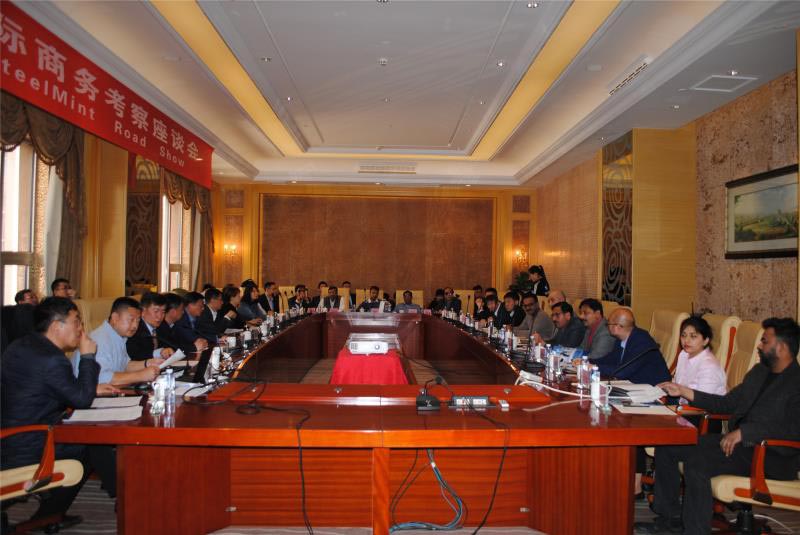
    Amid such doubts in the minds of prospective investors and buyers about the real market scenario in China and also with a view to the fact that China is slowly emerging as a nerve centre of global GE demand and trade, SteelMint came up with a unique idea of organizing the International Graphite Electrode & Needle Coke Roadshow from April 8 to 12, 2019 that included visits to GE and Needle Coke plants to assess the ground reality in China.

    As part of this roadshow, SteelMint visited Jingyang Technology, a needle coke plant located in the Shandong province. The company has a nameplate capacity of 60,000 MTPA of needle coke and is striving to double its output in the next three years. Below are excerpts from an interview with Shen Jianfeng, Deputy General Manager, Marketing and Sales, Jingyang Technology:

    Can you please elaborate on Jingyang Technology’s business and market share in China?

    SJ: Jingyang Technology started its journey in October 2014 and is mainly focused on manufacturing petroleum-based needle coke. We have a market share of 25% in China. At present our plant’s production is about 65,000 tonne for calcined needle coke, 20,000 tonnes for green coke which means about 85,000 tonnes in total. We expect to increase our capacity to 150,000 tonne by October 2019 after much-awaited expansion plans are implemented. With this expansion the needle coke manufactured is suitable for the production of GEs ranging 600mm and above in size.

    Currently the sulphur content of the needle coke we produce is 0.45%. We use hydrogen to remove the sulphur. After expansion, the sulphur content in our GE can reach below 0.4% (roughly 0.35%) which is equal to the level that the US and Japanese needle coke manufacturers maintain.

    Who are your customers in China? Do you also export to India?

    SJ: Currently our major clients in China are Fangda Carbon, Nantong Yangzi Carbon, Jilin Carbon and Xinxing Carbon to name a few. With regard to the anode material segment, our clients include Shan Shan Tech and Zhongke Electric. And there is one renowned GE manufacturer which is located in Sichuan province and is using our product to manufacture 700mm GE.

    Jingyang Tech has been exporting since 2017 and we have regular orders of 2,000 tonne per month from Russia. Last month we exported 500 tonne to Italy. A few months back we signed a supply contract for 300 tonne per month with a Japanese GE producer. Last year we exported 200 tonne to India and plan to ramp up exports to India.

    What is the current needle coke market situation in China? There is talk of large needle coke capacities coming up in China. How much capacity will be added in the next two years?

    SJ: The current needle coke capacity in China is around 280,000 tonne with coal tar pitch-based needle coke and petroleum-based coke having a percentage share of 71% and 29% respectively in the market. The additional capacities (both coal tar pitch-based and petroleum-based) that are expected to be added is around 720,000 tonne by 2020, thus taking the country’s total needle coke capacity to around 960,000 tonnes.

    Will this capacity addition ease the demand-supply imbalance and lower prices in China?

    SJ: The needle coke manufactured in China is used by two sectors: GE and anode materials. The demand for needle coke from both the segments will likely be around 1 MnT by 2020. However, supplies in the next two years will be around 960,000 tonne, which means that the demand-supply imbalance will continue and prices may not fluctuate much in the next two years.

    Is the quality of petroleum coke-based GE different from that manufactured using coal tar pitch-based needle coke? Are these suitable for making UHP electrodes required in big EAF plants?

    SJ: There is no major difference between GE manufactured using petroleum or coal tar but there is always scope for improvement. However, like Japan, China can also make good quality coal tar pitch-based needle coke that can be used to manufacture electrodes of bigger sizes and specifications. For example, a Chinese needle coke manufacturers have made a breakthrough in production of high quality coal tar pitch-based needle coke used to manufacture 700mm UHP GE. At present, petroleum-based coke is expensive than coal tar pitch based, roughly by RMB 2,000-3,000 per tonne.

    What is the current needle coke price scenario in China?

    SJ: Currently the price in China is around RMB 20,000-25,000 per tonne but it is difficult to make any predictions. Judging by the willingness of customers it seems prices have bottomed out since early April and it is likely that the market will be better in the future.

    How does Jingyang Technology maintain its needle coke quality?

    SJ: We regard quality as supreme and have put in place a whole set of measures to strictly control quality with regard to raw material selection, production control, online monitoring, checking prior to dispatch, customer follow-up, third party inspection and appraisal, etc.

    We have a professional team with rich experience in this industry and it accepts only quality raw materials after sample testing. They comprehensively process the raw materials from difference resources to make the finished product. In the warehouse, we maintain around 40,000 to 50,000 tonne of raw material to stay away from market fluctuations. As regards the final product, 20% is earmarked for anode material and the rest is used in GE production.

    What is the ground level progress of EAF in china? How much capacity can come online in the next two-three years?

    SJ: In my opinion to some extent, the development of needle coke banks on the increase in EAF capacity but the EAF output of steel in China is unlikely to exceed 20% in next 2-3 years. At present current EAF route capacity is less than 12% in total.

    What is the lead time of setting up a needle coke plant in China?

    SJ: It takes about 2 years to set up a needle coke plant for others normally but for us only 10 months are sufficient to set up a new needle coke plant given the knowledge and resources we have.

    Do you have any further plans after the capacity expansion?

    SJ: We plan to start manufacturing of nipples used for electrodes of size 600mm to 650mm.

    How the winter production was cut in 2018 and is likely to be in 2019?

    SJ: Last year the production cuts policy not too strict as policy no longer took the approach of ‘One size fits all’. We had production cuts of 30% in winters of 2018 and will make up for the lost capacity most likely during summers. Besides, this our production majorly complies with the environmental protection requirement with water treating systems in place and thus for 2019 winters, production cuts would not have major impact on us.

    Know More

  • SteelMint’s China Roadshow: Precious Insights into Graphite Electrodes and Needle Coke

    SteelMint’s China Roadshow: Precious Insights into Graphite Electrodes and Needle Coke

    Graphite Electrodes is an indispensable part of steel making through the EAF route – and it’s evolving all the time in China. In tandem with Needle Coke quality improvements opening up previously unimaginable trade possibilities.

    SteelMint with delegates from world over hit the road in China to find out all this and more. We immersed ourselves in the production processes and the plant visits helped us clear long-standing doubts.
    China has emerged as the epicentre of the global Graphite Electrode (GE) market as it has the potential to shape global GE demand, prices and trade dynamics. In end-2017, the clampdown on 300,000 tonne of inefficient GE capacity in China triggered severe GE shortage across the globe, which further pushed prices upwards, even as steelmakers scrambled to secure supplies. However, the significance of recent announcements of capacity enhancement in China has been grossly downplayed by a section of the industry, with the prevailing opinion being that Chinese plants, inexperienced newcomers as they are, can’t manufacture UHP electrodes as they do not have the required high-specification needle coke.

    Some of the unanswered questions crowding the minds of industry insiders have been:

    • What is China’s GE and needle coke performance potential?
    • Does Chinese GE and needle coke quality match global standards?
    • Is the needle coke manufactured in China ideal for UHP grade production?
    • What is the current expansionary state of EAF steelmaking in China?

    Despite these pressing queries, the outside world still lacks a coherent understanding of the Chinese GE market. While traders and manufacturers around the world are eager to secure comprehensive, first-hand, ground-zero know how of the Chinese market, their channels of accessing such vital information were, unfortunately, clogged. This bleak scenario, however, used to prevail before SteelMint organised the novel and pleasantly offbeat International Graphite Electrode & Needle Coke Roadshow from 8-12 April, 2019 that included extensive tours of GE and needle coke plants in the country to assess the ground reality. The foremost objective of this tour-de-force of an event was to facilitate interaction between Chinese GE manufacturers and the outside world and to bridge the information gap pertaining to the Chinese GE industry.

    Albeit hectic, the event shone a light on the Chinese GE and Needle Coke market and offered a non-blinkered insight into what the future holds. Here are the key takeaways from the Roadshow:

    China’s GE Production Rising Fast
    Since 2018, the supply of electrodes from China has started to increase. Supply is expected to expand sharply due to new facility investments in 2019 and 2020. In 2018, about 700,000 tonne of GE was produced contributing to a rise of 19%. In 2017, production increased by 16% compared to the previous year. The largest new plant is Baofang Carbon Material Technology, a joint venture between Baosteel Group and Fangda Carbon. It is scheduled to start operations in Lanzhou in 2020 with a nameplate capacity of 100,000 MTPA UHP electrodes.

    Inner Mongolia Emerging as a GE Hub
    With favorable investment policies and low electricity prices, the Inner Mongolia region is emerging as China’s GE hub, with production slated to reach 300,000 tonne this year plus an additional 100,000 tonne in 2020. In 2018, there were about 220,000 tonne of production plans in areas outside Inner Mongolia, but was postponed to 2019. One of them, Baoshan Changdu (40,000 tonne) has started production in Yunnan Province from February.

    Chinese Producers Aggressively Improving GE Quality

    Chinese GE producers are making constant efforts to procure quality needle coke either via imports or through domestic procurement as well as securing technology for quality improvement. Chinese electrode manufacturers are also focusing on producing more of UHP grade GE and that too of sizes higher than 700mm.

    China Market Dominated by Small Diameter Electrodes
    China’s EAFs and refineries are mostly small, with capacities of 50 tonne, essentially dominated by HP and UHP grade manufacturers of sizes under 500mm. More than 200 companies produce electrodes. In particular, it is estimated that there are more than 160 companies in Handan Area, Hebei Province, that specialize in processing and trade. Most companies often produce and sell second-grade electrodes on a very small scale with fake brands, thereby stoking quality concerns.

    Global Non-UHP Grade GE Supply Might Rise
    Chinese GE manufacturers are aggressively increasing the production of HP/RP grade electrodes and amid limited domestic demand they are focusing on exports. With removal of anti-dumping duty on GE imports to India, it is slowly becoming one of the favourite GE export destinations.
     

    GE Prices in China Likely to Remain Stable

    In 2018, the utilization rate of Chinese electrode companies was less than 60%. The expansion of existing suppliers, emergence of new companies and winter production cuts brought down electrode prices in the latter half of the year, subsequently affecting companies’ profit margins. In fact, in Feb 2019, the electrode prices in China fell by 17-20% due mainly to extremely sluggish demand during the New Year holidays. The EAF utilization rate was less than 5% and electrode stocks rose by 27% in preparation for delivery. However, given the fact that domestic as well as imported needle coke prices are surging, electrodes prices are unlikely to fall further in the coming months.

    China’s Needle Coke Demand-Supply Imbalance

    Needle coke imports and domestic production make up for 870,000 tonne in China whereas demand is 940,000 tonne, resulting in demand-supply imbalance. This apart, a majority of needle coke plants in China are pitch coke-based and high-quality coal tar pitch-based needle coke as well as petroleum-based needle coke still need to be imported.

    Needle Coke Demand from Lithium-ion Battery Segment Growing

    The demand for lithium-ion batteries in China is expected to grow at a rapid pace due to increased demand for new energy vehicles, as well as accelerating demand for energy storage batteries for on-grid and off-grid applications. The country’s needle coke demand from the ion-battery segment is surging. It is anticipated that China will have about 1 MnT of total needle coke capacity by 2020 out of which a substantial portion will be dedicated to the lithium-ion battery segment.

    20% Rise in China’s EAF Capacity

    As per market sources, China, which has increased its EAF steelmaking capacity from 6% of total annual production in 2016 to 12% in 2018, is likely to increase EAF steelmaking to 20% of overall crude production by 2025. Regardless of the forecast, virtually all EAFs in China are meant for production of special and stainless steel, while carbon steel accounts for only 60-70% at the moment. Also, low price competitiveness compared to BFs might stall EAF capacity enhancement. GE demand, therefore, will likely soar in the near- and mid-term.

    The International Graphite Electrode & Needle Coke Roadshow organized by SteelMint offered a rare and holistic insight into the Chinese GE industry that market watchers from across the world are tracking attentively. However, market participants who were eager for a direct interaction with Chinese GE and needle coke bigwigs but have unfortunately missed the bus this time around need not lose heart. Not all good things in life come just once. A golden opportunity that slips between the fingers elicits regret but there is always a second chance to look forward to in intense anticipation. Take heart.

    Industry insiders who could not join the SteelMint Roadshow but are anxious to catch up on precious bits of latest information on the Chinese GE market ought forthwith book their seats at the 2nd Global Graphite Electrodes Conference to be held in Bangkok, Thailand’s Hotel Avani Riverside from August 27-29.


    Know More

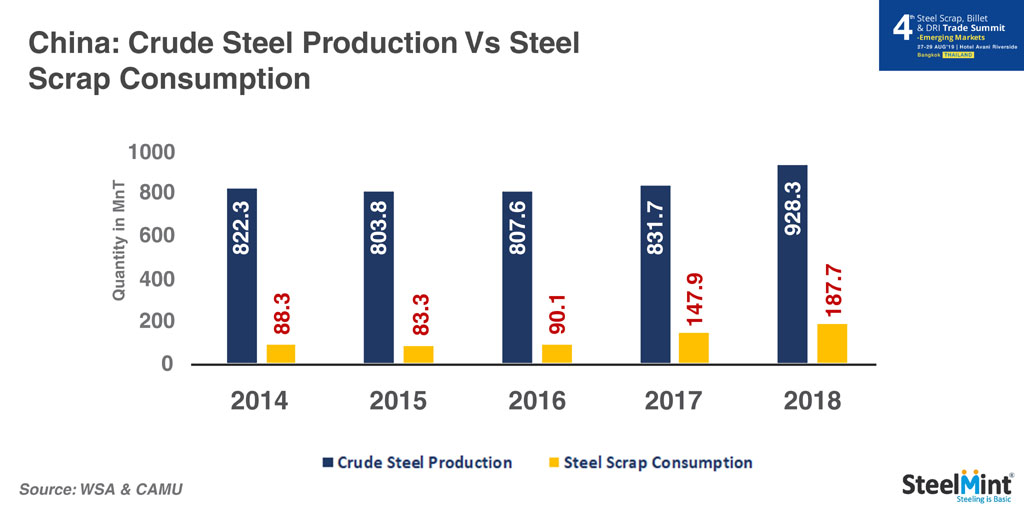
  • China’s Scrap Generation to Increase by 10 MnT in 2019 – CAMU

    China’s Scrap Generation to Increase by 10 MnT in 2019 – CAMU

    Mr. Tao Jiangshan, deputy secretary general of China Association of Metalscrap Utilization (CAMU) – DRI Working Committee, has been engaged in DRI production and consultation for 23 years. Mr. Jiangshan set up Tianjin Overworld Technology Consulting Co Ltd and also worked at Tianjin Pipe Group, in charge of technical and process work and head of new project. His early days were at pellet plant of Minmetals Luzhong  Metallurgical Mining where he got familiar with the DRI process. He was also chief editor of China CCM.com taking care of information on steel raw materials and compilation of field reports.

    Mr Jiangshan graduated from China Central South University, majoring in pellet/sinter DRI of mineral processing department. Here are excerpts from an e-mailed interview

    Q: What is CAMU’s forecast for steel scrap usage in Chinese domestic steel mills in 2019 versus actual use in 2018?

    A: The quantity of scrap steel usable in the market will be more and more, scaling up by 10 million tons each year, while crude steel output will shrink. Secondly, steel mills will have more incentive to use scrap steels and the proportion of scrap will be higher. Thirdly, short route smelting will take up more proportion and the scrap ratio in EAF smelting as well we EAF steel ratio in output of crude steel will be higher. These three points highlight the optimistic trend in the course of scrap steel utilization and a promising future.

    Q: What is CAMU’s forecast for scrap generation in China in 2019 versus 2018 actual generation?

    A: The usable steel scrap in the market will become more and increase at pace of 10 million tonnes each year. The output of steel scrap in 2018 was 220 million tonnes and is expected to reach 230 million tonnes in 2019.

    Q: Will China have enough scrap to export? What is your forecast on steel scrap exports both near term and long term?

    A: Given that the fast increase in EAF steel output in recent years, coupled with gradual consumption by blast furnaces, the scraps are expected to be mainly consumed by domestic mills.

    Q: What are the government policies or incentives coming up that could encourage the setting up of more electric arc furnaces?

    A: By way of environmental protection and production limit as well as phase-out of outdated capacity, China’s government is taking the policy leverage to encourage legitimate steel mills to set up new EAF mills through capacity replacement.

    Q: What is the current price of steel scrap in China and what is the average price likely to be this year? At this price is it cheaper to produce steel via electric arc furnace than blast furnace?

    A:  The average price of HMS1 during Jan-Mar 2019 was at RMB2,320/ton while HMS2 at RMB 2,120. In China, the production cost by blast furnace is more economical.

    Q: Going forward, what is your outlook for steel scrap industry in China and the world?

    A: With the further deepening of structural de-capacity on supply side, steel mills especially scrap processing enterprises are set to embrace promising opportunities.
    The “Green Industry Development Plan (2016-2020)” issued by The Ministry of Industry and Information Technology proposed that “by year 2020, the utilization of scraps recycled will reach 150 million tonnes” and this target will most probably be met in this October.

    And the provision “by year 2025, steel made of scrap should account for 30% of the total” proposed in “Steel Industry Adjustment Policy” is also achievable. “The 13th five-year plan for Steel Scrap” enacted by CAMU has proposed that by year 2020, the steel made of scrap will take up 20% of total output, which doubled the target as proposed in “the 12th five-year plan” and is achievable before this year end.  All those achievements have signaled that an era of mass utilization of steel scrap has come.

    To know more on China’s rising scrap generation, consumption and growth of EAF in steel making, be a part of 4th Steel Scrap, Billet & DRI Trade Summit in Bangkok, Thailand, to be held from 27-29th August 2019.

    ~ Inputs from Ruchira Singh with the help of Arthur Li

    Know More

  • Where are Indian Graphite Electrodes Prices Heading?

    Where are Indian Graphite Electrodes Prices Heading?

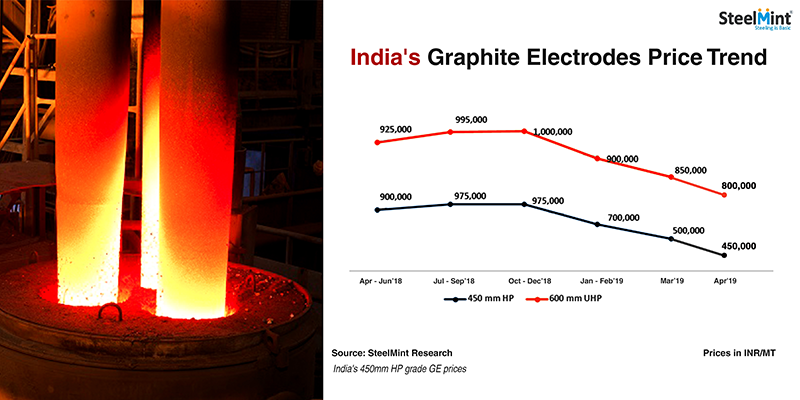
    SteelMint had reported in Mar’19 that the graphite electrodes prices in India registered a fall of INR 50,000 (USD 721/MT) against its prices in Jan and Feb’19 and now if reliable sources are to be believed, it seems that Indian Graphite Electrode manufacturers have further lowered the grade electrode prices by INR 50,000/MT for the April month.

    Subsequently, the price of UHP grade Graphite Electrodes of size 600mm is likely to be around INR 800,000/MT (USD 11,540/MT) and that of lower grade electrodes (HP grade) of size 400-450mm the same is estimated to be around INR 450,000/MT (USD 6,500/MT). Last month the plunge in lower grade electrode price was higher (almost by USD 2,000/MT) compared to higher grade ones. However, this month the fall in case of both the grades GE is same.

    Amid the rapid increase in GE demand and prices in the latter half of 2017, the Indian manufacturers entered into quarterly contracts with the GE consumers. However, the market dynamics changed towards the end of 2018 which led to fall in Chinese GE prices, indirectly impacting Indian graphite electrode market. Market participants have informed us that in the given market situation, instead of entering into the quarterly contracts like before, GE buyers have started negotiating for prices contracts on monthly basis and this is why prices have changed over past two months.

    However, no one has confirmed that if this trend of monthly negotiations will continue in the future also. With GE exports not being made to Iran due to sanctions there is ample availability of graphite electrodes in the Indian market and buyers are maintaining inventory of just 10-12 days which was earlier kept for 30 to 40 days.

    Why the Plunge in Indian Graphite Electrode Prices?

    The fall in Indian Graphite Electrode prices can be attributed to the ongoing downtrend in Chinese Graphite Electrode prices since the start of the winter heating season from mid-November 2018. During this season (Nov-Mar), steel demand in China takes a beating and the country imposes production cuts in the steel sector that indirectly affect Graphite Electrode demand (which is a key raw material in steel production via the electric furnace route).

    China is a major Graphite Electrode producing and exporting country and its price trends usually affect global Graphite Electrode prices. Thus, Indian producers need to take into account the prices in the Chinese market while finalizing their quarterly contracts.

    Another key factor that poses a threat to Indian Graphite Electrode manufacturers is the removal of the anti-dumping duty on Graphite Electrode imports from China announced in August last year. This elimination of trade restrictions on Indian imports of Chinese Graphite Electrodes has increased the risk of Chinese electrodes freely entering the Indian market.

    In fact, Indian EAF steel producers are anticipating further fall in Graphite Electrode prices, as according to them importing China’s UHP grade Graphite Electrodes will be cheaper compared to Indian electrodes. The price of China’s 600mm UHP grade Graphite Electrode is currently RMB 65,000/MT (USD 9,700/MT) and importing the same to India, even including customs duty, still makes it cheaper by USD 800-1,000/MT against India’s domestic Graphite Electrode price.

    Lower Grade Graphite Electrode Prices under more Pressure

    According to market sources, Indian Graphite Electrode manufacturers are facing tough competition from Chinese imports of lower grade HP (High Power) and RP (Regular Power) Graphite Electrodes.

    This is because the production of lower grade electrodes in China is increasing and amid sufficient availability, prices too are falling. In a period of just four months from Nov’18 to Mar’19, China’s HP grade Graphite Electrode price of size 450mm has plunged by 60% and is currently trending at RMB 27,000 (USD 4,023/MT).

    “With the removal of the anti-dumping duty, importing Chinese Graphite Electrode has become quite feasible and given the current HP grade electrodes price in China, importing the same even after including all the duties is still proving to be cheaper for us compared to buying Indian products. Thus, Indian Graphite Electrode producers have no option but to revise their prices,” said a GE buyer from India.

    Indian Producers at the Receiving End

    According to customs data, India imported about 1,030 tonnes of electrodes in January this year against just 395 tonnes in Jan’18 registering a y-o-y growth of more than 150%. Out of this 1,030 tonnes imported, about 98% imports came from China. In December 2018, India had imported 1,404 tonnes of electrodes with only 30% being contributed from China.

    In 2018, India imported 7,242 tonne of Graphite Electrodes out of which imports from China was 55% at 4,018 tonne. In 2017, India’s total Graphite Electrode imports stood at 3,871 tonne and China’s contribution to total imports was only about 14%. This clearly shows the impact of the lifting of the anti-dumping duty on Chinese imports.

    In case of other countries such as Japan and the US, Graphite Electrode contracts are usually locked for six months and prices have been fixed at USD 14,000 per tonne till June 2019.

    Amid falling Graphite Electrode prices, Indian manufacturers are troubled by rising needle coke costs, the contract for which has been fixed at USD 4,200-4,500/MT, an increase of USD 1,000 per tonne. This indicates that Indian manufacturers’ margins may suffer in the upcoming quarter.

    To know more about how the Graphite Electrode market will pan out in the days to come, book your seat at the ‘2nd Global Graphite Electrodes Conference, Bangkok’, from 27 to 29 August 2019.


    Know More

  • Will United States Ferrous Scrap Exports Slow Down in 2019?

    Will United States Ferrous Scrap Exports Slow Down in 2019?

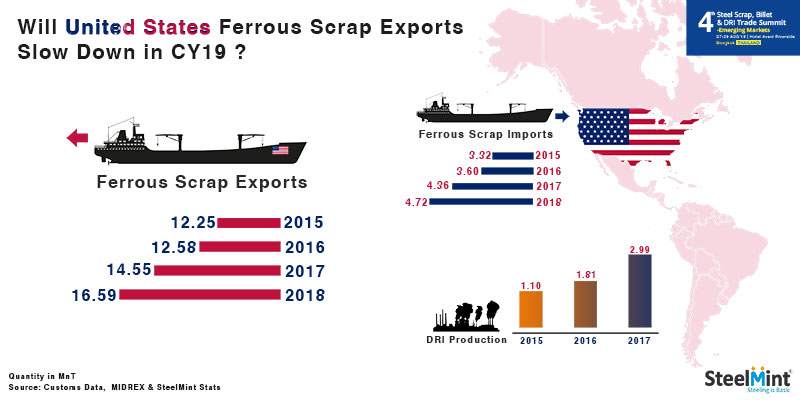
    United States – world’s second largest ferrous scrap exporter after EU-28 has marked successive growth in annual ferrous scrap exports volumes since last three years. But will the same momentum continue taking its EAF ramp up plans into consideration?

    US exported 16.59 MnT ferrous scrap in CY18. Trade participants have already pointed out that CY19 could be the year of significant importance for the global economy considering impact of Trade war and sanctions.

    US scrap consumption to increase in coming years?

    1. Ramping up of EAF capacities and investments in the US – In Jan’19, Nucor Corp. announced a new EAF mill of USD 1.4 billion in the Midwest to produce 1.2 million tons steel per annum. Steel Dynamics, a producer based in Fort Wayne, Ind., plans to build a USD 1.8 billion mill with an EAF in the southwestern U.S. with an annual capacity of 3 million tons. GFG Alliance, a British conglomerate, announced plans in January to expand its U.S. steel production by 800,000 tons a year and restart a second electric arc furnace at a South Carolina plant. In Feb’19, U.S. Steel Company said it would begin construction on an EAF at its Fairfield plant near Birmingham, Ala.

    2. Rise in DRI production – As per Midrex reports, total DRI production in North America (USA & Canada) recorded at 4.60 MnT in CY17 up 44% Y-o-Y against 3.20 MnT in CY16. While that in Latin America recorded at 10.51 MnT in CY17, up 14% Y-o-Y against 9.19 MnT in CY16. These numbers are expected to have increased in CY18 with US turned as a supply merchant with the first HBI plant in the United States, located outside Texas ramped up production in 2017. Also, Cleveland-Cliffs, Inc. had announced in June of 2017, plans to build a 1.6 MnT pa HBI Plant in Toledo, Ohio, USA.

    3. Increasing ferrous scrap imports – US ferrous scrap imports recorded at 4.72 MnT in CY18, up 8% Y-o-Y against 4.36 MnT in CY17. The US exports a lot of low-quality scrap, but imports high-quality raw material. That means there is a shortage of prime grade scrap there.

    4. Rising crude steel production on increasing EAF output – According to world steel association, US crude steel production recorded at 86.60 MnT in CY18, up 6% Y-o-Y as against 81.61 MnT in CY17. US total crude steel production was recorded at 78.47 MnT in CY16 comprising of 67% share of EAF route while 33% share of blast furnace production. Reports suggest that country’s EAF steel output has been constantly increasing since past couple of years resulting in rising domestic scrap demand apart from rising scrap imports which may lead to limit exports in CY19.

    The imposition of tariffs has provided the much-needed protection to American steel producers who have long struggled to cope with a tide of cheap foreign imports. The punitive tariffs appear to be bearing fruit as reflected by a decline in U.S. steel imports in CY18.

    Scrap oversupply situation in Turkey, Brexit dynamics in Europe, Iran driven suffocation, changing dynamics of recycling in India, will keep global scrap demand volatile in CY19. Thus, it seems scrap consumption in US will increase in near term and emerging scrap markets like Vietnam, South Korea, Bangladesh, Pakistan and Indonesia could have to pay high for US scrap in CY19.

    The imposition of tariffs has provided the much-needed protection to American steel producers who have long struggled to cope with a tide of cheap foreign imports. The punitive tariffs appear to be bearing fruit as reflected by a decline in U.S. steel imports in CY18.

    Scrap oversupply situation in Turkey, Brexit dynamics in Europe, Iran driven suffocation, changing dynamics of recycling in India, will keep global scrap demand volatile in CY19. Thus, it seems scrap consumption in US will increase in near term and emerging scrap markets like Vietnam, South Korea, Bangladesh, Pakistan and Indonesia could have to pay high for US scrap in CY19.

    4th Steel Scrap, Billet & DRI Trade Summit

    Don’t miss the opportunity of meeting global buyers and sellers at the 4th Steel Scrap, Billet & DRI Trade Summit in Bangkok, Thailand, to be held from 27-29th August 2019.

    Know More