SteelMint Events

Category: Blog

  • Tata Steel Thailand Plans to Ramp Up Steel Capacity Utilization – Mr. Rajiv Mangal

    Tata Steel Thailand Plans to Ramp Up Steel Capacity Utilization – Mr. Rajiv Mangal

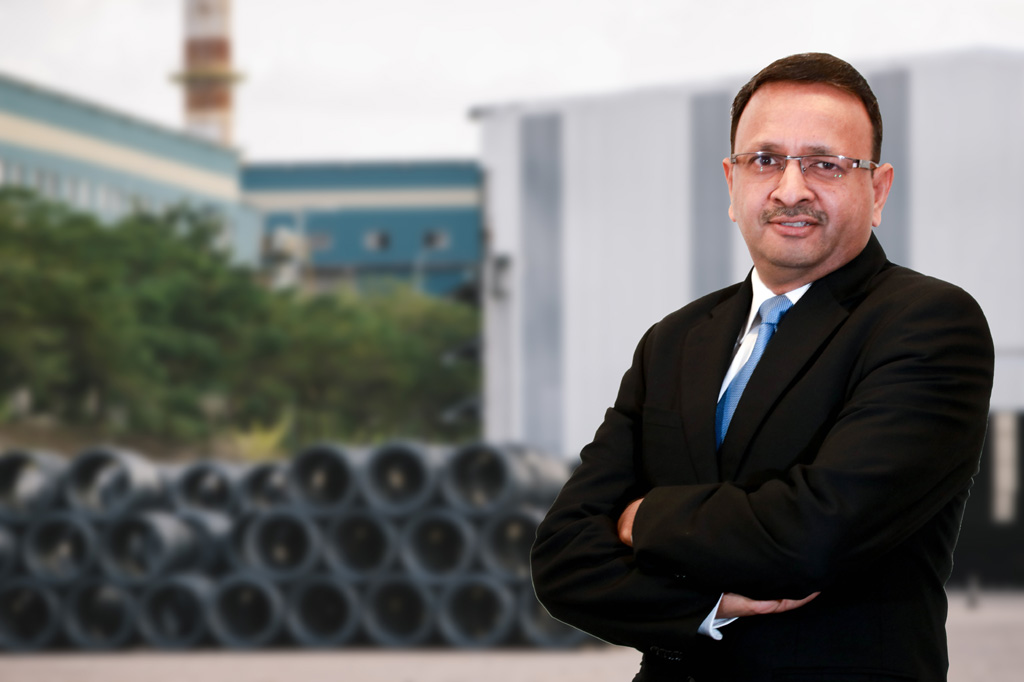
    Tata Steel – Thailand is one of the renowned names in manufacturing of long steel products. SteelMint in interaction with Mr. Rajiv Mangal, President & CEO of Tata Steel (Thailand) Public Company Limited learned about his views on ramp up plans of the company and expected increase in country’s crude steel production in the coming years. Below are the edited excerpts from the interview

    1. Has Thailand steel industry poised for growth, what is the future outlook?

    Unlike other countries in ASEAN region where dependence of steel sector on construction is very high (>75%), Thailand’s steel consuming sectors are diverse. Total apparent finished goods steel consumption in the country was 17.4 MnT in 2018, up by 4.8% Y-o-Y. This translates to approx. 263 kg per capita of steel consumption. Construction, Machine & Appliances and Automobiles sectors consumed 55%, 21% and 19% shares of the total steel consumed in 2018 respectively.

    As per Iron & Steel Institute of Thailand (ISIT), steel consumption in 2019 is likely to be around 19 MnT , an increase of approx. 8% in 2018. Personally, I feel growth will be in the range of 4-6% on account of continuing trade frictions in international arena and political uncertainty in the country after the general elections in March 2019.

    2018 witnessed a Y-o-Y increase in automobile, cement and canned seafood production by 8.9%, 1.2% and 13.6% respectively. With the first car policy after effects almost gone and huge infrastructure development plans announced for next five years by the Thai Govt, steel consumption is expected to witness healthy growth coming years.

    There are roughly 20 crude steel-making facilities in Thailand, nearly all of which use electric arc furnace technology to produce steel. In comparison, over 150 hot-rolling, cold rolling, cold-drawing, and coating mills are in operation in Thailand which relies heavily on imports of semi-finished and finished steel products for their manufacturing inputs.

    2. Is steel capacity utilization low in Thailand?

    In 2018, Thailand imported 15.2 MnT of steel, an 8 percent increase from 14.2 MnT in 2017. At the same time, domestic production was approx. 7.1 MnT with average capacity utilization below 50%. This is not good for the financial health of the domestic steel industry. One of the major reason for low capacity utilization in Thailand is that 100% steel production is based on secondary route of steel making. This makes the cost of steel produced locally higher than primary route steel manufactured in major steel producing countries like China, Japan and Korea. At the same time, most of the steel made in the country is in upstream and commodity by nature. With new blast furnace based capacities coming on stream in Vietnam and Malaysia in last one year, challenge for Thai steel producers have aggravated. Need of the hour is consolidation and shifting up in the value chain.

    3. What are the measures being taken by Tata Steel Thailand to increase production and demand from local mills and how is the scenario after HBIS take over?

    Tata Steel Thailand has a rated capacity of 1.7 MnT pa of long products spread across three manufacturing sites in Thailand. By virtue of better product mix, pan Thailand reach and sale of branded products, average capacity utilization of the company is in the range of 70-75%. This is much higher than country’s average. Exports account for 10-12% of the total sales. During 2011-16, Thailand saw widespread dumping of wire rods from China. With structural changes in Chinese steel industry and Thai Govt imposing tariff and non-tariff measures, imports from China has come down in last 2 years.

    In coming years, Tata Steel Thailand plans to enhance capacity utilization beyond 80-85% by increasing sale of high end wire rods suitable for auto sector, ready to use Cut & Bend products and high strengthRebars for construction companies. With strong brand presence in Laos, Cambodia and Myanmar, exports to these countries is also poised to go up.

    The share purchase agreement signed with HBIS in end Jan’19 is not yet closed.

    4. Do you see steel scrap imports rising in coming years in Thailand, what is your forecast?

    As scrap remains the primary raw material for steelmaking in Thailand, its consumption is bound to increase in line with steel production increase in coming years. At the same time, domestic steel industry has taken up with the Govt to promote exports of value added products and discourage export of scarce raw material like steel scrap. Another factor to be closely tracked is increase in steel production & consumption in Vietnam and Malaysia from the new investments in last 2-3 years. If these countries resort to aggressive exports, Thailand may witness increased imports of semis and finished products. Thus rate of change in import of scrap in Thailand will depend upon policy for prevention of scrap exports and imports of semis and finished steel from neighboring countries.

    To know more on scrap industry in emerging markets, book your seat at SteelMint’s 4th Steel Scrap, Billet & DRI Summit. The conference is being organized during 27-29’th Aug’19 in Bangkok, Thailand.
    ~ Inputs by Dr. Sheena Abraham

    Know More

  • How US China Trade War Could Alter Global GE Market Scene

    How US China Trade War Could Alter Global GE Market Scene

    There is a distinct possibility of low-grade Chinese GE flooding the Indian market with the duty hike imposed by the US on Chinese imports.

    Adding a new chapter in the ongoing trade war between two major global economies, the US and China, the former created a stir last week by announcing a hike in tariffs on certain goods from the existing 10% to 25%. The laundry list of products with increased duties includes Graphite Electrodes (GE). It would be interesting to analyze whether this additional levy might impact China’s GE exports to the US.

    The dominant steelmaking route in the US is EAF. In 2018 the country’s electric furnace capacity stood at 76 MnT, which means the country’s GE requirement is quite high. The US is home to the GE behemoth GrafTech International with a total installed capacity of 230,000 tonne from four plants located in the US, Mexico and Europe.

    US reliant on GE imports

    Nevertheless, the US is still dependent on GE imports to meet it requirements because GrafTech’s US plant, with a capacity of 28,000 tonne, is lying idle (with effect from the second quarter of 2016) as a part of the overall capacity reduction in the industry that began in early 2014.

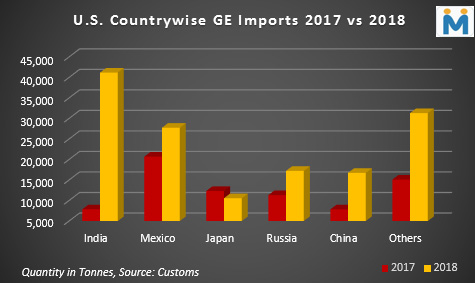
    As per US customs data, in 2018 the economic superpower imported about 127,586 tonne of GE with highest imports coming from India (32%) followed by Mexico (22%) and Russia (14%). The percentage share of China in total US GE imports stood at 13%. Thus, although not a major exporter to the US, China has a share in that country’s electrodes imports, and now with the tariff surge that share is likely to decline.

    Opportunity for other GE exporters

    This situation could well throw open opportunities for other GE exporting countries such as India, Russia and Japan to cater to US demand that was hitherto supplied by Chinese exporters. In fact, India’s share in US GE imports has already registered a significant uptick on a Y-o-Y basis from 10% in 2017 to 32% in 2018. India’s exports to the US must also have increased as supplies to a key importer, Iran, stopped after the imposition of sanctions on the Islamic Republic by the US in August last year.

    Chinese GE exports to India to Spike Further

    According to market sources, China mainly exports HP grade electrodes to the US. The US’ share in China’s total GE exports in 2018 stood at 7% and with the new tariff system in place China will divert its GEs to other countries like India. India has become a key destination for lower grade (HP/RP) electrodes exports for China after the anti-dumping duty on GE imports into India was removed in August last year. China’s share in India’s total electrode imports increased from 14% in 2017 to 56% in 2018.

    China’s GE market scenario

    Chinese GE prices that were falling incessantly for almost six months have now turned stable. Current prices in China of UHP grade GE of size 450mm are heard to be in the range of RMB 26,000 – 28,000/MT (USD 3,800 – 4,100/MT) whereas 600mm GEs are in the range of RMB 48,000 – 53,000/MT (USD 7,000 – 7,700/MT). The price of HP grade electrodes 400mm in size are in the range of RMB 22,000 – 24,000/MT (USD 3,200 – 3,520/MT).

    After the end of the winter heating season in March, Chinese steel mills scale up production. Therefore, during this period GE prices in that country surge too. But this year, domestic steel demand in China has turned tepid amid slow growth in the automobile and infrastructure sectors. Thus, at present steel mills in China have adopted a wait and watch policy resulting in GE prices turning stable.

    On the raw materials front, domestic needle coke prices too remained stable this week. Domestic needle coke price is heard to be in the range of RMB 20,000-25,000 per tonne (USD 2,950 – 3,660/MT) whereas the imported offers are heard to be in the range of USD 4,000-4,600/MT.

    Fluctuating GE price dynamics

    As China already has excess GE supplies, amid the surge in taxes, China’s electrodes exporters will have two options: either to lower their GE offers further and continue exporting to the US or interrupt the price dynamics of lower grade GEs of other countries, especially India, with their increased supplies. How will Chinese GE exports affect global price dynamics this year? To know more register for the 2nd Global Graphite Electrode Conference to be organized by SteelMint Events from 27-29 August, 2019 in Thailand.

    Know More

  • China to Achieve Expected Goal of 20% Scrap Ratio Ahead of Schedule – Li Shubin  

    China to Achieve Expected Goal of 20% Scrap Ratio Ahead of Schedule – Li Shubin  

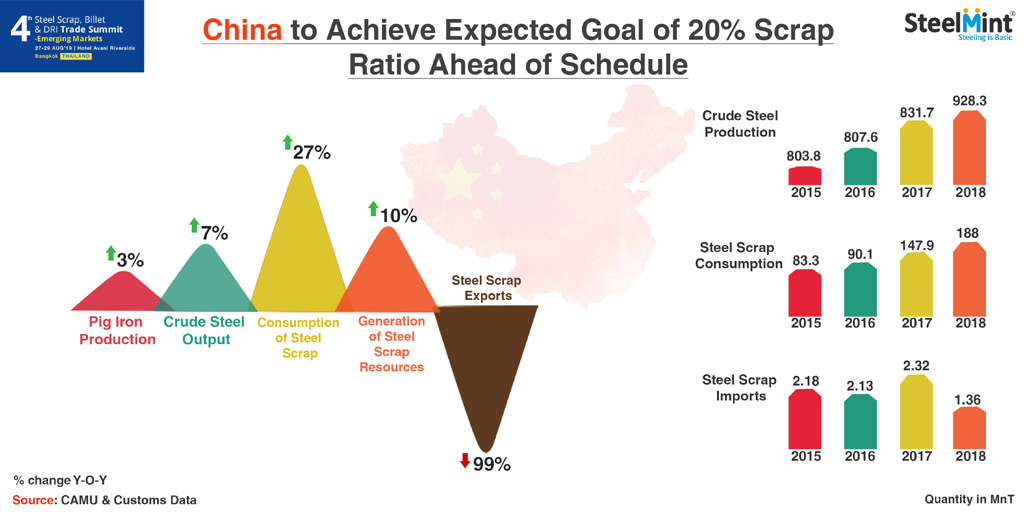
    Li Shubin, Executive Vice President and Secretary General of China Waste Steel Application Association pointed out that China’s waste steel resources utilization level has achieved new breakthroughs, and the development of the “13th Five-Year Plan” of the scrap steel industry is expected to be completed two years and three months ahead of schedule. The plan proposes a scrap target ratio of 20%. Not only that, the total consumption of scrap steel, the combined consumption of scrap steel and the proportion of scrap steel application have reached the best level in China’s steel industry after the removal of large flat furnace smelting process, and it also marks the development of China’s scrap steel industry.

    China’s scrap resources and consumption continue to increase steadily –

    In 2018, China’s total consumption of scrap steel in the whole year was 188 MnT, an increase of 39.68 MnT, an increase of 26.9%. The scrap consumption was 202.3 kg/ton, an increase of 24.5 kg/ton, an increase of 13.8%. Among them, converter scrap consumption was 152 kg/ton, an increase of 23.8 kg/ton, an increase of 18.6%; electric furnace scrap consumption of 662.8 kg/ton, an increase of 2.2 kg/ton, an increase of 0.3%. The scrap ratio was 20.2%, an increase of 2.45% points Y-o-Y; the electric furnace steel ratio was 9.8%, an increase of 0.5% points Y-o-Y.
    In the first two months of this year, the total consumption of scrap steel in the country was 29.33 MnT, an increase of 3.97 MnT, an increase of 15.6%.
    According to the statistics of the Scrap Association, the total amount of scrap steel resources generated in the country in 2018 was 220 MnT, an increase of more than 20 MnT, an increase of 10%. Iron and steel enterprises produce 50 MnT of scrap steel, accounting for 23% of total resources; social procurement of scrap steel is 170 MnT, accounting for 77% of total resources. Among them, the total consumption of scrap steel in iron and steel enterprises was 188 MnT, accounting for 85.5% of the total resources.

    Problems being faced by Chinese steel scrap industry?

    1. China’s waste steel recycling is still relatively low compared with the global average. There is a gap between China’s scrap ratio and the global average. It is necessary to speed up the increase of scrap ratio and increase the ratio of electric furnaces to accelerate the development of China’s scrap steel application industry.
    2. The current national policy measures to use green resources for scrap steel and short-process steelmaking. It needs to be further strengthened.
    3. The fiscal and taxation [2015] No. 78 document does not fully honor the preferential policies for the scrap steel enterprises. The focus should be on full use of existing capital channels such as green manufacturing, guide and encourage social capital to increase support for scrap steel application, and strengthen departments with finance and taxation. Communicate and coordinate to promote the implementation of the VAT refund and refund policy, and ensure that eligible enterprises are eligible for tax incentives.

    Steel scrap prices to see no major fluctuation!

    The China Iron and Steel Association predicts that steel prices will remain range bound in 2019 and there will be no major decline in scrap steel prices. The recent analysis believes that the price level of the scrap market in 2019 should fluctuate around 2,500 yuan/ton (including tax price), there will be no major decline and there will be no 2015-style decline.
    Li Shubin believes that scrap prices and steel prices are linked and related to the cost of hot metal. As long as steel prices are firm, steel companies have substantial profits, scrap demand will not be greatly reduced, scrap prices will not fall sharply, but there will be no big climbs. It is reasonable for heavy scrap to float at around 2,500 yuan/ton.

    What are major opportunities available for scrap processing and distribution companies?

    1. 7th batch of scrap access of the Ministry of Industry and Information Technology is about to begin
    2. China’s new regulations on the dismantling of scrapped cars, which will help achieve the integrated development of the scrap industry.

    Encourage scrap processing enterprises to expand and group development through mergers and acquisitions, support steel companies to lead the establishment of large-scale scrap processing and distribution enterprises, drive the green development of upstream and downstream industrial chains, and guide the rational flow of scrap steel resources.” Li shared.
    To know more on Rising Importance of Steel Scrap in China, book your seat at SteelMint’s 4th Steel Scrap, Billet & DRI Summit and get a chance to hear views of Li Shubin. The conference is being organized during 27-29’th Aug’19 in Bangkok, Thailand.

    Know More

  • China still not major competitor in UHP grade GE market: GrafTech

    China still not major competitor in UHP grade GE market: GrafTech

    In its Q1 2019 earnings call held recently, US-based Graphite Electrode (GE) major GrafTech highlighted the company’s sales and financial performance, market prospects in the short term and the likely risk emerging from the upcoming Chinese GE additions. Listed below are the key points revealed by GrafTech’s top management:

    A majority of Chinese manufacturers are still new in the UHP GE business:

    Asked about the potential risk from the rising GE capacities in China, GrafTech’s top management highlighted that China is adding to its GE capacity massively because with 10% EAF capacity in that country almost 100 MnT of crude steel is being produced by the EAF route. The nation is planning to expand EAF capacity to 20% by 2021, which signifies the addition of another 75 to 100 MnT (equal to the entire US arc furnace industry) of crude steel to existing capacity. In order to service such a huge magnitude of EAF capacity, the country would obviously require GE capacity additions.
    As regards UHP grade GEs, GrafTech’s top management said a couple of Chinese producers are working for years to produce UHP electrodes and during the shortage last year, customers selectively bought Chinese UHP grade GE on a trial basis. However, it has taken years for a couple of well-established Chinese producers to reach a point from where they can produce UHP grade GEs with a consumption and breakage rate that steel producers would prefer to try. UHP electrodes are used in high-intensity applications and high-production melt shops.
    Thus, barring a few, a majority of new GE capacity additions that are claiming to be UHP grade don’t have the experience of producing high-grade GEs. It is unclear how much new capacity is being added to bolster UHP grade production and how long it will take to build and run UHP grade GE plants.

    Availability of good quality needle coke still a big hurdle:

    Asked about the availability of petroleum-based needle coke required to produce high-grade GEs, GrafTech highlighted that producing high-grade petroleum-based needle coke is not easy and it takes years to develop the process and secure specific decant oil supplies. Decant oil, used to produce needle coke, is a secondary product, basically a leftover at the bottom of the barrel during the oil refining process. As refineries have different operations, the quality of decant oil varies widely from refinery to refinery. So it is difficult to secure decant oil with those properties that are required for petroleum needle coke, which, in turn, is required to manufacture high-grade electrodes used in high-intensity melt shops.

    Demand for needle coke from China’s EV segment:

    Top GrafTech executives pointed out that China has a burgeoning requirement of needle coke from the expanding electric vehicles segment. In order to manufacture efficient battery with long life, premium quality petroleum-based needle coke is required. The Chinese still mix different products, including petroleum needle coke and pitch needle coke as well as natural graphite. This is because it’s all about the ability for the product to transfer a charge in the most effective and efficient way. Thus, the Chinese GE industry will face competition from the domestic battery industry which could well prove to be a deterrent to high-grade electrodes production in the future.

    BOX

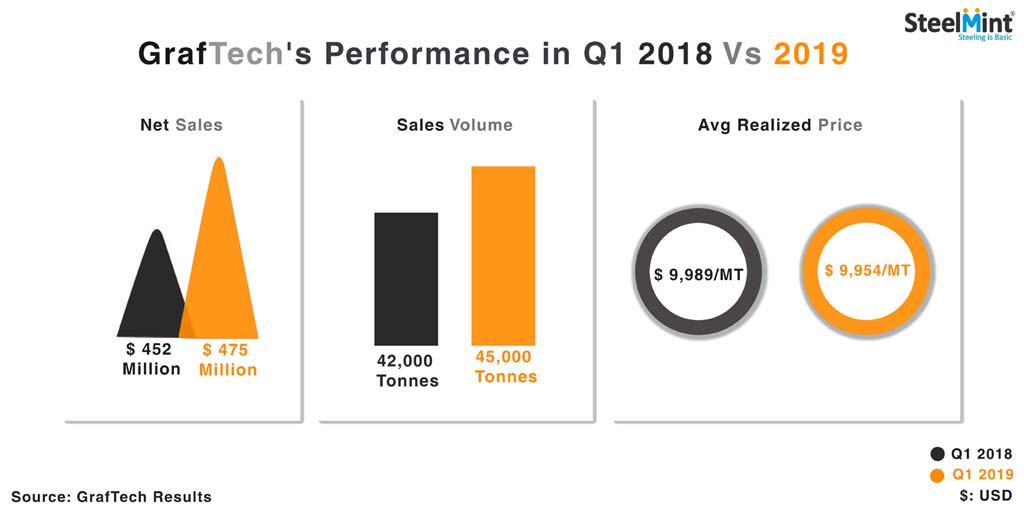
    Snapshots of GrafTech’s Q1 CY19 Performance

    • Net sales rise by 5% Y-o-Y from USD 452 million in Q1 2018 to USD 475 million in Q1 2019
    • Company registers an increase in sales from 42,000 tonne in Q1 18 to 45,000 tonne in Q1 CY19
    • Average realised price from sale in Q1 CY19 recorded at USD 9,954/MT against USD 9,989/MT in Q1 2018
    • GE major plans to sell majority of volumes on long term (3-5 years), take-or-pay, fixed price or volume contracts
    • Company has entered into long-term agreements with more than 100 customers for 675,000 tonne at an average contract price of USD 9,800/MT for 2018-2023.
    • GraftTech’s ‘Take-or-Pay’ agreements are estimated to reduce from 148,000 tonne (as of 31 Mar’19) to 120,000 tonne in 2022 with average price to plunge from USD 9,800 in 2019 to USD 9,700/MT in 2022.
    • Company plans to focus on operational improvements with capital expenditure of USD 60-70 million in 2019.

    Know More

  • South Korea: Ferrous Scrap Imports from US Rise Sharply in Q1 2019

    South Korea: Ferrous Scrap Imports from US Rise Sharply in Q1 2019

    South Korea – world’s 2nd largest ferrous scrap importer after Turkey has witnessed sharp rise in ferrous scrap imports from US in Q1’2019. South Korean ferrous scrap imports hit a record volume of more than 4 years high in the first quarter of 2019, the customs data maintained with SteelMint showed.

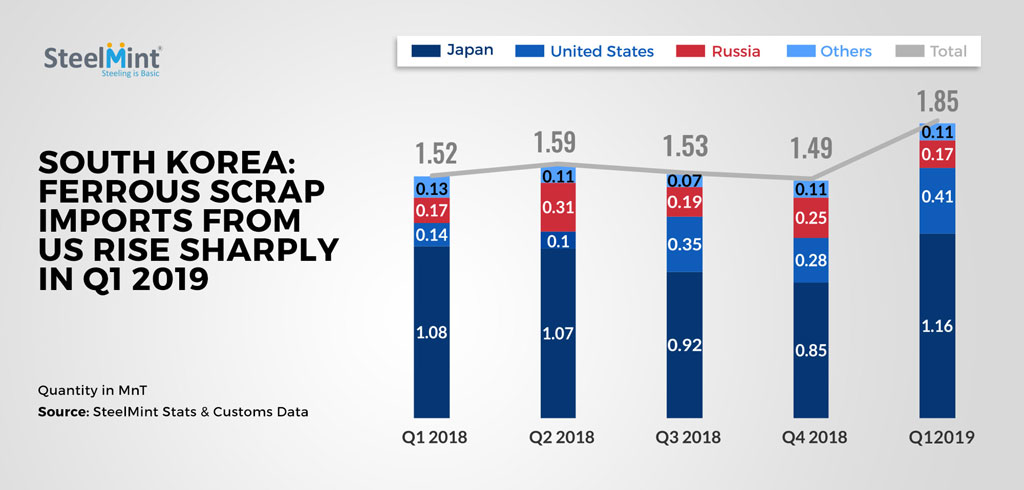
    South Korean ferrous scrap imports stood at 1.85 MnT ferrous scrap in Q1’2019, up 24% Q-o-Q against 1.49 MnT in Q4’2018 while jumped 22% against 1.52 MnT ferrous scrap in Q1’2018 on yearly premises. Scrap imports recorded in Feb’19 hit 53-month high against earlier highest was at 671,974 MT in Sept’14.

    Notably, US has supplied 0.41 MnT ferrous scrap to South Korea in Q1-2019, up 46% Q-o-Q against Q4’2018 while exports multiplied almost three folds against just 0.14 MnT recorded in the same quarter last year.

    Why was a shift in preference towards US scrap?

    Japanese domestic scrap prices remained on higher side in March ahead beginning of Golden Week holidays. Amid expectation of hike in prices, South Korean steel mills had booked bulk cargoes in previous months from US and Russia.

    Hyundai’s bidding for Japanese scrap is considered to be the benchmark for East Asian scrap market. The steelmaker has resumed open bidding in Mar’19 after a gap of two months. It had discontinued bidding amid high inventories and comparatively higher Japanese prices during Jan-Feb’19.

    Also Hyundai Steel had planned maintenance activities at its factories including Incheon steel mill during 3rd-19th February. Company officials had plans to reduce local scrap prices ahead of facility repair.

    Japan continues to remain the largest scrap supplier in Q1 2019

    Despite observing marginal fall in total scrap exports in Q1 2019, Japan exported 1.16 MnT ferrous scrap to South Korea, observing a rise of 36% Q-o-Q against 0.85 MnT ferrous scrap in Q4’2018 and a rise of 7% Y-o-Y against 1.08 MnT in Q1’2018. Japan occupied the highest 63% share in total scrap imports in Q1’2019 followed by US and Russia occupying 22% and 9% share.

    US stepped up as second largest supplier position surpassing Russia amid less clarity on scrap export ban from the Russian government. Russia supplied 0.17 MnT ferrous scrap to South Korea down 32% Q-o-Q against 0.25 MnT in Q4’2018. Russian scrap yards continued attracting higher prices domestically resulting in remaining on the higher side in Q1’2019 in comparison with Japan & US.

    Hyundai Steel aims at 3.5 MnT ferrous scrap imports in CY19

    The largest ferrous scrap consumer in South Korea- Hyundai Steel aims to bolster its ferrous scrap consumption to around 10 MnT in CY19. Out of total around 3.5 MnT scrap is anticipated to be imported in 2019. The company is likely to bolster its overseas ferrous scrap procurement lineup by strengthening the long term relationship with supplying scrap yards globally in 2019.

    According to World Steel Association, the country’s crude steel output stood at 18.10 MnT during Q1’2019 marginally up 2% against 17.81 MnT produced during same quarter last year. South Korean finish steel prices are driven by imported scrap prices. Country’s finish long exports remained stable at around 0.6 MnT in Q1’2019 while finish flat exports jumped 12% Q-o-Q to 6.14 MnT in Q1’2019 against that of Q4’2018.

    To know more on Japanese scrap supply-demand, book your seat at SteelMint’s 4th Steel Scrap, Billet & DRI Summit and get a chance to hear views of Mr Arshdeep Singh, Director Vital Solutions. The conference is being organized during 27-29’th Aug’19 in Bangkok, Thailand.

    Know More