SteelMint Events

Category: Graphite Electrode & Needle Coke

  • How Are Steel Markets Aligned For 2020?

    How Are Steel Markets Aligned For 2020?

    The Global events have continued to affect Price dynamics of Steel Industry in 2019. There prevails turbulence and uncertainty as we face the big question of how will the market pan out in 2020?

    Amidst Trade Wars caused by US Protectionism and High imports tariff has compelled China to seek new markets, increasing its Steel Exports. This coupled with China’s oversupply has naturally bothered other major markets and they wary about China Flooding the Steel Markets in 2020?

    Iran also is coerced by US sanctions to sell its Billet Cargos at discounted prices altering the dynamics of Billet Markets.

    In the other part of the world, Emerging Markets of South and South East Asia (Bangladesh, India, Indonesia, Pakistan & Vietnam) have increased their sea-borne scrap imports manifolds in the last few years. This has created new and encouraging opportunities for suppliers across the globe. This potentially might put Asia as the new benchmark for sea-borne scrap.

    Iron-ore prices are on a 5 year high after the tragic Vale dam collapse in Brazil facilitating many buyers to take the steel scrap route of Steel-making.

    China’s emissions standards tightening further in 2017 led to hundreds of smaller mills to shut under stricter enforcement. This invited a sudden traction in EAF route of steel-making that in-turn catapulted the Graphite Electrode prices, GE being the essential raw material involved in there which has no other substitute. Just as the prices seem to be normalizing now, China increased its GE production further that instills some fear in GE producers if this act could further pull down the prices of Graphite Electrode and upset the global markets, yet again.

    There’s a lot that will be discussed and deliberated upon by the Global Buyers, Suppliers, Steel Mills, GE Producers & Analysts who are gearing up to attend the 4th Steel Scrap, Billet and DRI Trade Summit alongside the 2nd Global Graphite Electrode Conference by SteelMint Events. The conference is scheduled to be organized during 27-29th Aug 2019 at Hotel Avani Riverside, Bangkok

    Know More

  • Japan’s Graphite Electrodes Major Showa Denko to upgrade its European Production Sites

    Amid the increased graphite electrodes supplies from China and subsequent fallin global GE prices, Japan’s key electrodes manufacturer, Showa Denko has decided to improve its Carbon division’s production facilities in Europe with a planned investment of 5 billion yen.

    The company has in total seven production sites located in Japan, Europe, U.S. and rest of Asia with the largest share in world’s production capacity of UHP grade electrodes. Showa Denko has launched a medium term plan this year‘TOP 2021’ and under this plan, it plans to achieve the synergy effect of business integration while ensuring stable supply and optimizing supply cost at respective graphite electrode production sites.

    In line with its aim of business integration, it is essential for SDK to establish a global system for supplying graphite electrodes with the same high quality. Thus, the company has decided to improve facilities at its three production sites in Europe, in Germany, Spain and Austria, for the purpose of improving quality and stabilizing production. These sites are controlled by SDK’s consolidated subsidiary SHOWA DENKO CARBON Holding GmbH, which is based in Germany. The construction work and quality improvement efforts are scheduled to begin in 2019 for completion in 2020. This upgradation work is anticipated to reduce SDK’s total production capacity by around 5% during this period. The company aims to achieve its target of being best in terms of quality for its customers and keep on improving the profitability of electrodes business.

    Recently the company’s top management have expressed their opinion that despite the increased supplies from China, the bullish conditions will continue in case of the UHP grade large size electrodes market.

    SDK anticipates surge in large-diameter GE demand

    The graphite electrodes can be majorly divided into two. These are large-diameter graphite electrodes, which are used for melting scrap steel to create electric furnace steel, and small-diameter graphite electrodes, which are used to maintain the molten state of iron that has been melted in a blast furnace or electric furnace. The production of large diameter GE requires both technological expertise and high-quality raw materials (needle coke) and Showa Denko is amongst the few three companies globally that manufactures good quality large-diameter GE.

    Now, as per the company’s top management, with the growing EAF facility around the world especially in North America and East Asia amid environmental concerns to reduce pollution, the demand for large-diameter electrodes will continue to rise whereas their supply will remain tight which is set to support the GE prices.

    Company undeterred by current fall in GE prices

    In its own earnings forecast for calendar 2019, Showa Denko has projected that its inorganics segment – which includes graphite electrodes – will generate 148 billion yen in operating profit (USD 1.36 billion), up by 11.8% year-on-year. Figures from the first quarter show that the company’s graphite electrode sales stayed at largely the same level as that seen last year.

    While another Japanese GE major, Tokai Carbon has made a downward revision in its earnings forecast for second half of 2019 based on the current market situation, Showa Denko didn’t change its existing prediction of continued high sale prices for graphite electrodes, expecting the average price here for 2019 to be around five times that seen in 2017. The company’s GE price contracts with Japanese and other East-Asian customers for Apr-Jun quarter have been finalised at prices 5-10% more against corresponding quarter of last year.

    Apart from this, the capacity additions in China’s GE sector are majorly going to be focused on small diameter GEs resulting which no major impact on the demand-supply balance of large-diameter is expected. The strong growth prospects of North American steel sector the general expectation is that demand for graphite electrodes will be steady in the medium term.

    Know More

  • China Needle Coke Prices Reverses the Global Trend

    China Needle Coke Prices Reverses the Global Trend

    The upheaval in graphite electrodes demand in past two years and a steady surge in the requirements for graphite anodes for lithium-ion batteries in China has boosted the needle-coke demand in the country.

    In 2018, the overall performance of China’s needle coke market was relatively stable with prices showing an uptrend and reaching to its high in the month of November. However, towards the end of 2018, the plunge in steel demand from downstream sector in China adversely impacted the country’s graphite electrode requirement and so does the needle coke demand and prices.

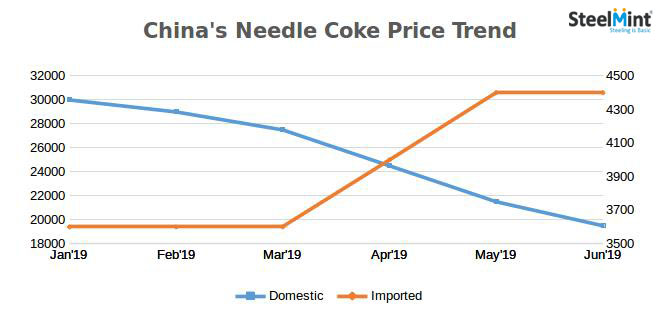
    With the start of 2019, China’s domestic needle coke prices have been falling and have registered a plunge of 35% in the time span of six months. However, the price of high-quality needle coke required for UHP grade GE (usually imported) have been rising continuously recording a surge of 22% during Jan-Jun’19. The domestic needle coke prices in China are currently trending in the range of RMB 19,000-20,000 (USD 2,750 – 2,900/MT) whereas imported needle coke prices are at 4,200 – 4,600/MT.

    According to customs data, in first four months of 2019, China’s petroleum-based needle coke import volume was 46,413 tonnes, 70% of which came from the United Kingdom, 15.3% from the United States, and 9.5% from Japan whereas country’s coal-based needle-coke imports were 27,819 tonnes of which 62% came from South Korea and 38% from Japan.

    Although, the domestic needle coke produced in China still has some time to match the global standards, with the help of some research and development, the quality of the same have improved to some extent and few products have been able to mark their entry in the international market also.

    At present the production capacity of domestic needle coke in China is in the period of rapid expansion and in 2019 some new projects will be officially put into operations:

    China’s upcoming capacities in case of coal-based needle coke:

    Company Name Planned Capacity Estimated year of operation Type
    CNPC Jinzhou Company 100,000 2019 New expansion
    Shandong Yida New Material 70,000 2019 New expansion
    Shandong Jingyang Tech 70,000 2019 New expansion
    SinoPec Maoming Company 100,000 2020 New entry
    Sinopec Jinling Company 100,000 2020 New entry
    Liaoning Baolai Bio-energy 120,000 2020 New entry
    Total 560,000

    China’s upcoming capacities in case of petroleum-based needle coke:

    Company Name Planned Capacity Estimated year of operation Type
    Kaifeng carbon Anshan thermal-energy new material 20,000 2019 New expansion
    Henei Kaifeng Carbon New Material 40,000 2019 New expansion
    Shanghai Baosteel Chemical 100,000 2019 New expansion
    Anshan Steel Holding 40,000 2019 New entry
    Zaozhuang Thriving Carbon Tech 40,000 2019 New entry
    Pingdingshan Risun New Material 40,000 2019 New entry
    Baoshun Chem 50,000 2019 New entry
    Tsdr New Energy 100,000 2019 New entry
    Shanxi Jinzhou Chem 40,000 2019 New entry
    Shanxi Fuma Carbon Material 40,000 2020 New entry
    Ningxia Baichuan new material 50,000 2020 New entry
    Total 560,000

    With the new capacities coming up in China’s needle coke sector and tepid graphite electrodes demand due to sluggishness in downstream sector, the country’s domestic needle coke prices are anticipated to fall further.

    Know More

  • China: Dull EAF Scenario Weigh Graphite Electrodes Prices Down

    China: Dull EAF Scenario Weigh Graphite Electrodes Prices Down

    With the GE prices in China falling since November last year and then becoming stable over past one month, the big question hovering is where is the country’s electrodes prices are heading to. To get an answer to this let us analyse few of the important happenings in the country’s GE and steel market.

    As per the SteelMint sources, although the lower grade graphite electrodes prices plunged down further this week, the UHP grade GE prices of higher size continues to remain unaltered over past one month.

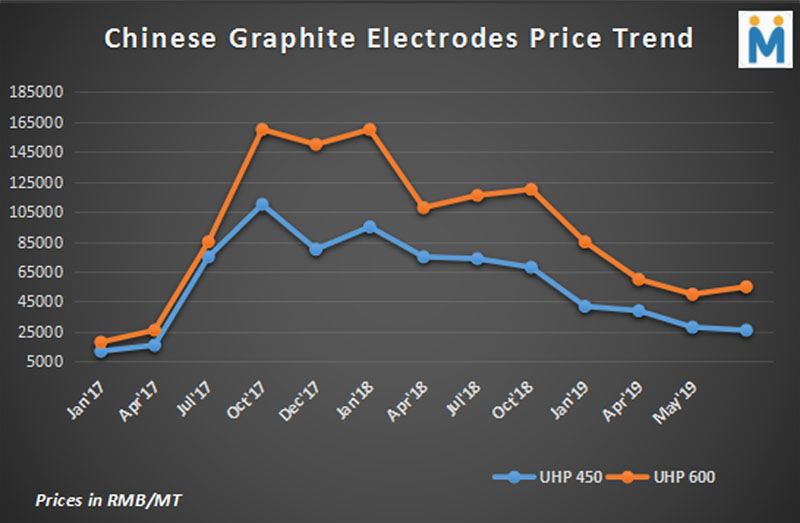
    The current prices in China of UHP grade GE of size 450mm are heard to be in the range of RMB 24,000 – 26,000/MT (USD 3,470 – 3,760/MT) whereas that of size 600mm are in the range of RMB 48,000 – 60,000/MT (USD 6,940 – 8,675/MT). The price of HP grade electrodes of 450mm are in the range of RMB 21,000 – 22,000/MT (USD 3,040 – 3,760/MT), according to China based CBC data.

    The demand for higher grade electrodes of size 600mm-700mm have increased in the overseas market as the quality of the same have improved over the period of time, thus supporting their prices. However, in case of non-UHP grade and lower size UHP electrodes, there is a situation of overcapacity amid tepid demand from downstream sector and difficulties in development of EAF steelmaking. In fact few small GE units have temporarily shut down their operations and have adopted wait and watch approach.

    Obstacles in steel production via EAF route

    As highlighted by director of Iron & Steel department of China’s MIIT (Ministry of Industry & Information Technology) costs are restricting the development of EAF steelmaking in the country. The cost of EAF steel is higher by around RMB 400-500/MT (USD 58-72/MT) compared to that from converters and reason being higher raw material costs. The scrap prices that adds up to around 75% of the EAF costs are currently trending at a higher range. In most favourable condition, the scrap prices of around RMB 1,600/MT would make EAF more competitive against blast furnaces, but current scrap prices are around RMB 2,300-2,400/MT making electric furnaces a costly route of steel production. Apart from scrap higher cost of electricity, which comprises 6-15% of the total cost of EAF production is also contributing to slower development of EAF steelmaking facilities in China.

    Availability of scrap might also prove to be hindrance for EAF steel manufacturers in the near term. This is because in 2018, steel produced in China Steel produced down the EAF route in China in 2018 was almost 90 MnT. Total scrap use in all steelmaking was 220 MnT. But with integrated steelmakers consuming 160 MnT, only 60 MnT was used by EAFs and thus if the percentage of EAF steel output increases, scrap will be in short supply therefore in the near term.

    The likely price trend of GE in near term

    As per the market survey carried out by an agency, the average operating rate across 33 Chinese electric arc furnace (EAF) steelmakers that use steel scrap, rather than iron ore, as feedstock is expected to dip from 80% in May to 79% in ongoing month of June.

    This downtrend have been supported from the fact the mills in south are facing heavy rainfall thus, hurting demand and weighing down on prices, pushing mills into losses. As a matter of fact some mills have curtailed their production amid anticipation of heavy losses.

    Given the EAF market scenario, the GE prices especially that of non-UHP and lower size, are unlikely to move up in the upcoming time period. In case of UHP grade electrodes of higher size, the positive overseas demand is likely to support their prices

    Know More

  • IMO 2020 Regulation May Jolt Global Graphite Electrode Industry

    IMO 2020 Regulation May Jolt Global Graphite Electrode Industry

    IMO 2020 is likely to exert pressure on the main consumers of needle coke – the GE and lithium-ion battery industries

    At a time when it seemed that the panic in the global Graphite Electrode (GE) industry had subsided and prices had returned to normal levels almost after two years, with supplies from China witnessing a dramatic surge, another surprise might just be in the offing. This is the new IMO 2020 regulations to be implemented from 1 January, 2020 which are expected to have a tangible effect on needle coke supplies and prices.

    What are the IMO 2020 regulations?

    From 2020 the International Maritime Organization (IMO) will require ships to reduce their emissions to be equivalent to use marine fuels with a maximum sulphur content of 0.5%, far lower than the current 3.5%. This new measure requires the maritime industry to comply but the shipping industry is not yet ready to deal with this regulation.

    This stringent sulphur regulation has led ship owners and operators to mull all available options they have in order to comply with the IMO regulation, and refiners are considering producing more low-sulphur fuel to meet possibly higher demand, as both parties anticipate an unprecedented change in the marine fuels supply seascape.

    Industry experts believe that given the limited time left and with the shipping industry being unprepared, there are three options for those forced to comply with the new regulation: first, ship owners can install exhaust gas cleaning systems on their ships. Second, ships can run on clean LNG gas as fuel, Third, they can buy compliant fuels at higher costs.

    The installation of exhaust gas cleaning system will definitely lead to increase in costs for the ship owners and operators further resulting in higher freight charges whereas the option of switching to cleaner gas is not easy at all. In case of last option, the refineries have been reluctant to undergo large capital investments required for the major upgrades to increase production of low sulphur marine fuel oils.

    How will the regulation affect needle coke prices?

    Needle coke – an already scarce product – is a key raw material in GE production, which is used both in EAF steel-making and manufacturing of synthetic graphite used as anode material for lithium ion batteries that power electric vehicles.

    There are two types of needle coke – petroleum needle coke produced at oil refineries by converting decant or slurry oil along with high quality vacuum residue (both by-products of the refining process) and coal-based needle coke (sometimes called ‘pitch needle coke’, or just ‘pitch coke’) made from coal tar pitch, a by-product of coking metallurgical coal in BF steel-making.

    There are only 10 needle coke manufacturers in the world, with the majority of them producing petroleum needle coke. Out of the 10, seven operate outside China with Phillips 66 (US and UK) being the largest, followed by Seadrift in the US and C-Chem, Petrocokes, JX Nippon and Mitsubishi in Japan. Indeed, ex-China capacity has remained broadly flat over the past 10 years given the high capital costs, technical expertise and stringent regulatory processes required to set up a greenfield needle coke project. In contrast, China is not only a net importer of needle coke but also a large producer, primarily through the coal-based route, with Sinosteel being the largest.

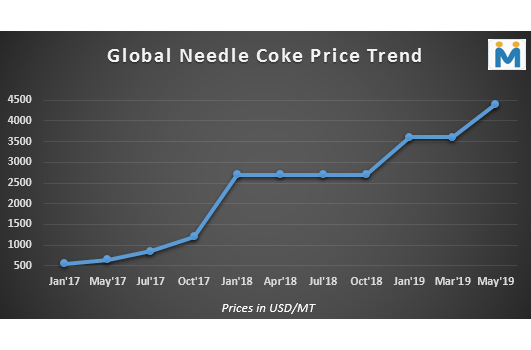
    Supply side structural changes in China in the last two years have resulted in the promotion of EAFs thereby boosting GE demand and consequently needle coke requirements and prices.

    Under the new IMO rules, the price of low-sulphur crude oil required to produce needle coke is expected to rise as more of it will be diverted toward marine fuels. Needle coke producers would be forced to contend with either increased competition for feedstock or investments in equipment to allow use of high-sulphur oil. Either way, IMO 2020 is likely to exert pressure on the main consumers of needle coke – the GE and lithium-ion battery industries.

    How trade dynamics may change

    Despite rise in demand, no major greenfield or brownfield needle coke projects have been announced outside China over the past few years given the high capital investment as well as technical challenges involved.

    In the case of China, although many steel companies and GE manufacturers have invested in needle coke units due to sudden spurt in demand, a majority of them are coal-tar pitch based projects and environmental concerns will limit supply of coal-tar pitch especially during the winter heating season in a bid to maintain air quality. In case of the handful of petroleum-based projects, the two major challenges are lack of technical knowhow and sourcing of good quality feedstock (low-sulphur crudes) the supply of which is already limited.

    Subsequently, the strong demand from steelmakers and the lithium-ion battery segment as well as the enforcement of the IMO 2020 restrictions will eventually tighten the supply of needle coke from next year onwards thereby adversely affecting prices.

    Know More