SteelMint Events

Category: Steel Scrap & Recycling

  • China to Achieve Expected Goal of 20% Scrap Ratio Ahead of Schedule – Li Shubin  

    China to Achieve Expected Goal of 20% Scrap Ratio Ahead of Schedule – Li Shubin  

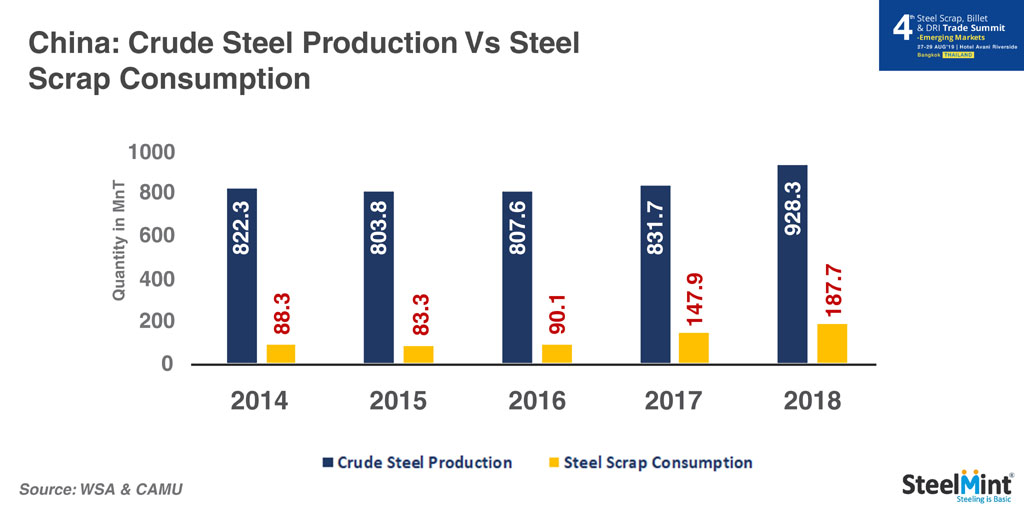
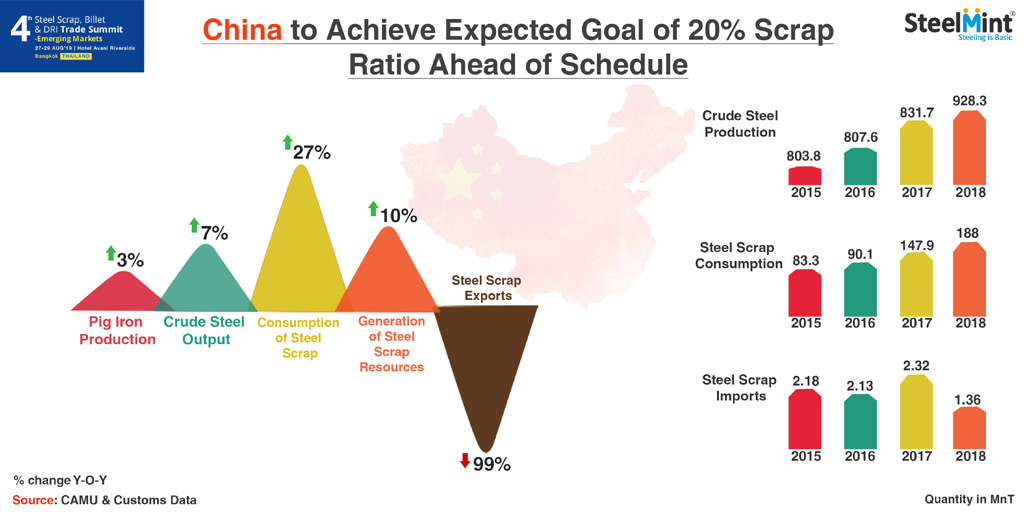
    Li Shubin, Executive Vice President and Secretary General of China Waste Steel Application Association pointed out that China’s waste steel resources utilization level has achieved new breakthroughs, and the development of the “13th Five-Year Plan” of the scrap steel industry is expected to be completed two years and three months ahead of schedule. The plan proposes a scrap target ratio of 20%. Not only that, the total consumption of scrap steel, the combined consumption of scrap steel and the proportion of scrap steel application have reached the best level in China’s steel industry after the removal of large flat furnace smelting process, and it also marks the development of China’s scrap steel industry.

    China’s scrap resources and consumption continue to increase steadily –

    In 2018, China’s total consumption of scrap steel in the whole year was 188 MnT, an increase of 39.68 MnT, an increase of 26.9%. The scrap consumption was 202.3 kg/ton, an increase of 24.5 kg/ton, an increase of 13.8%. Among them, converter scrap consumption was 152 kg/ton, an increase of 23.8 kg/ton, an increase of 18.6%; electric furnace scrap consumption of 662.8 kg/ton, an increase of 2.2 kg/ton, an increase of 0.3%. The scrap ratio was 20.2%, an increase of 2.45% points Y-o-Y; the electric furnace steel ratio was 9.8%, an increase of 0.5% points Y-o-Y.
    In the first two months of this year, the total consumption of scrap steel in the country was 29.33 MnT, an increase of 3.97 MnT, an increase of 15.6%.
    According to the statistics of the Scrap Association, the total amount of scrap steel resources generated in the country in 2018 was 220 MnT, an increase of more than 20 MnT, an increase of 10%. Iron and steel enterprises produce 50 MnT of scrap steel, accounting for 23% of total resources; social procurement of scrap steel is 170 MnT, accounting for 77% of total resources. Among them, the total consumption of scrap steel in iron and steel enterprises was 188 MnT, accounting for 85.5% of the total resources.

    Problems being faced by Chinese steel scrap industry?

    1. China’s waste steel recycling is still relatively low compared with the global average. There is a gap between China’s scrap ratio and the global average. It is necessary to speed up the increase of scrap ratio and increase the ratio of electric furnaces to accelerate the development of China’s scrap steel application industry.
    2. The current national policy measures to use green resources for scrap steel and short-process steelmaking. It needs to be further strengthened.
    3. The fiscal and taxation [2015] No. 78 document does not fully honor the preferential policies for the scrap steel enterprises. The focus should be on full use of existing capital channels such as green manufacturing, guide and encourage social capital to increase support for scrap steel application, and strengthen departments with finance and taxation. Communicate and coordinate to promote the implementation of the VAT refund and refund policy, and ensure that eligible enterprises are eligible for tax incentives.

    Steel scrap prices to see no major fluctuation!

    The China Iron and Steel Association predicts that steel prices will remain range bound in 2019 and there will be no major decline in scrap steel prices. The recent analysis believes that the price level of the scrap market in 2019 should fluctuate around 2,500 yuan/ton (including tax price), there will be no major decline and there will be no 2015-style decline.
    Li Shubin believes that scrap prices and steel prices are linked and related to the cost of hot metal. As long as steel prices are firm, steel companies have substantial profits, scrap demand will not be greatly reduced, scrap prices will not fall sharply, but there will be no big climbs. It is reasonable for heavy scrap to float at around 2,500 yuan/ton.

    What are major opportunities available for scrap processing and distribution companies?

    1. 7th batch of scrap access of the Ministry of Industry and Information Technology is about to begin
    2. China’s new regulations on the dismantling of scrapped cars, which will help achieve the integrated development of the scrap industry.

    Encourage scrap processing enterprises to expand and group development through mergers and acquisitions, support steel companies to lead the establishment of large-scale scrap processing and distribution enterprises, drive the green development of upstream and downstream industrial chains, and guide the rational flow of scrap steel resources.” Li shared.
    To know more on Rising Importance of Steel Scrap in China, book your seat at SteelMint’s 4th Steel Scrap, Billet & DRI Summit and get a chance to hear views of Li Shubin. The conference is being organized during 27-29’th Aug’19 in Bangkok, Thailand.

    Know More

  • South Korea: Ferrous Scrap Imports from US Rise Sharply in Q1 2019

    South Korea: Ferrous Scrap Imports from US Rise Sharply in Q1 2019

    South Korea – world’s 2nd largest ferrous scrap importer after Turkey has witnessed sharp rise in ferrous scrap imports from US in Q1’2019. South Korean ferrous scrap imports hit a record volume of more than 4 years high in the first quarter of 2019, the customs data maintained with SteelMint showed.

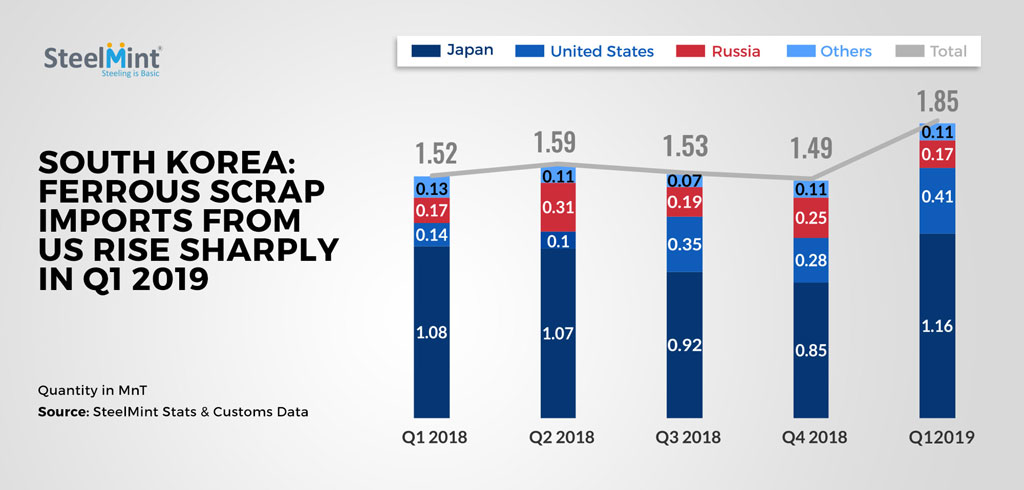
    South Korean ferrous scrap imports stood at 1.85 MnT ferrous scrap in Q1’2019, up 24% Q-o-Q against 1.49 MnT in Q4’2018 while jumped 22% against 1.52 MnT ferrous scrap in Q1’2018 on yearly premises. Scrap imports recorded in Feb’19 hit 53-month high against earlier highest was at 671,974 MT in Sept’14.

    Notably, US has supplied 0.41 MnT ferrous scrap to South Korea in Q1-2019, up 46% Q-o-Q against Q4’2018 while exports multiplied almost three folds against just 0.14 MnT recorded in the same quarter last year.

    Why was a shift in preference towards US scrap?

    Japanese domestic scrap prices remained on higher side in March ahead beginning of Golden Week holidays. Amid expectation of hike in prices, South Korean steel mills had booked bulk cargoes in previous months from US and Russia.

    Hyundai’s bidding for Japanese scrap is considered to be the benchmark for East Asian scrap market. The steelmaker has resumed open bidding in Mar’19 after a gap of two months. It had discontinued bidding amid high inventories and comparatively higher Japanese prices during Jan-Feb’19.

    Also Hyundai Steel had planned maintenance activities at its factories including Incheon steel mill during 3rd-19th February. Company officials had plans to reduce local scrap prices ahead of facility repair.

    Japan continues to remain the largest scrap supplier in Q1 2019

    Despite observing marginal fall in total scrap exports in Q1 2019, Japan exported 1.16 MnT ferrous scrap to South Korea, observing a rise of 36% Q-o-Q against 0.85 MnT ferrous scrap in Q4’2018 and a rise of 7% Y-o-Y against 1.08 MnT in Q1’2018. Japan occupied the highest 63% share in total scrap imports in Q1’2019 followed by US and Russia occupying 22% and 9% share.

    US stepped up as second largest supplier position surpassing Russia amid less clarity on scrap export ban from the Russian government. Russia supplied 0.17 MnT ferrous scrap to South Korea down 32% Q-o-Q against 0.25 MnT in Q4’2018. Russian scrap yards continued attracting higher prices domestically resulting in remaining on the higher side in Q1’2019 in comparison with Japan & US.

    Hyundai Steel aims at 3.5 MnT ferrous scrap imports in CY19

    The largest ferrous scrap consumer in South Korea- Hyundai Steel aims to bolster its ferrous scrap consumption to around 10 MnT in CY19. Out of total around 3.5 MnT scrap is anticipated to be imported in 2019. The company is likely to bolster its overseas ferrous scrap procurement lineup by strengthening the long term relationship with supplying scrap yards globally in 2019.

    According to World Steel Association, the country’s crude steel output stood at 18.10 MnT during Q1’2019 marginally up 2% against 17.81 MnT produced during same quarter last year. South Korean finish steel prices are driven by imported scrap prices. Country’s finish long exports remained stable at around 0.6 MnT in Q1’2019 while finish flat exports jumped 12% Q-o-Q to 6.14 MnT in Q1’2019 against that of Q4’2018.

    To know more on Japanese scrap supply-demand, book your seat at SteelMint’s 4th Steel Scrap, Billet & DRI Summit and get a chance to hear views of Mr Arshdeep Singh, Director Vital Solutions. The conference is being organized during 27-29’th Aug’19 in Bangkok, Thailand.
    Know More

  • How Indian Majors are Gearing up for Billion Dollar Auto Recycling Industry ?

    How Indian Majors are Gearing up for Billion Dollar Auto Recycling Industry ?

    New Delhi — India is talking clean-ups. India is talking environment. India is talking recycling.

    While the government is expected to bring in new laws on scraping and end-of-life vehicles soon, some corporate houses have already taken the first steps into the USD 10 billion scrap market.
    Mahindra MSTC Recycling Pvt Ltd, a joint venture between Mahindra group and state-owned MSTC Ltd set up a plant in Greater Noida last year and aims to have 30 plants by 2021-22. Tata Steel Ltd is in a planning stage for a similar venture.

    “Recycling is going to be a big thing… I would say in the next 4-5 years there is going to be a struggle in the sector,” Sumit Issar, managing director, Mahindra Intertrade Ltd said in a telephonic interview, referring to the competition with the existing players.

    “We would like to bring some change in the way recycling is done in India. That’s what we are focusing on.”
    With foreign technology and equipment, Mahindra MSTC has authorizations from the government and is processing automobiles and household appliances in an environment friendly way, selling the output to steel furnaces.

    Tata Steel is planning to build a scrap processing facility in Gurgaon and plans to replicate the same in Pune, Sanand and other automotive hubs, Anand Sen, president TQM and steel business, Tata Steel was quoted as having said in an Economic Times report last year.
    “We are currently exploring this space and would be in a position to share once our plans are firmed up,” a spokesperson from Tata Steel said in reply to an email seeking further details of their plans.
    “In more developed countries, scrap is a well-established industry with a robust ecosystem… The Indian government has recognized this challenge.”

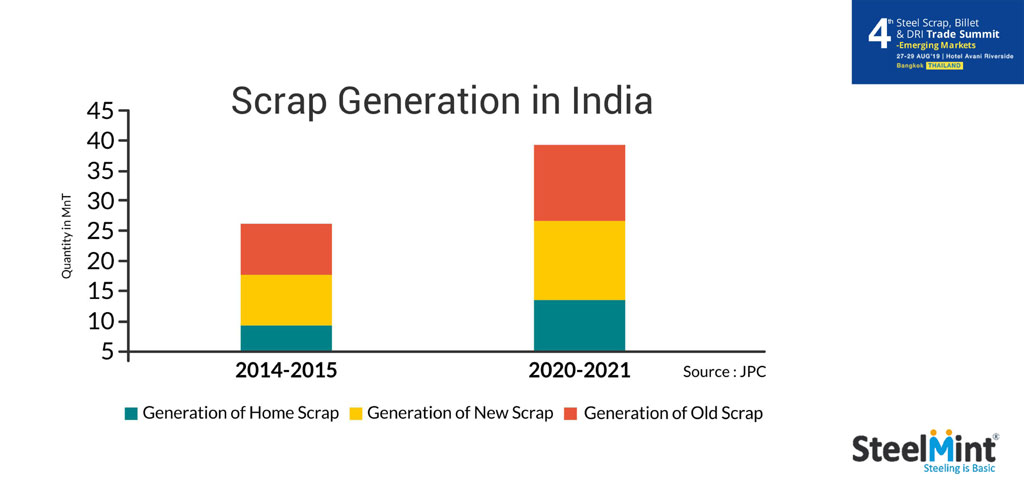
    The demand for scrap in India is 30 MnT per annum where domestic generation is 25mt and the balance 5 MnT is imported, according to data from Tata Steel.
    It is small as compared to India’s steel production of around 100mt, but supply is likely to increase due to the impending government policies, rapid urbanization and economic activity.

    Competitor is a giant – But recycling is unlikely to be a cakewalk for these large corporate. The massive unorganized and fragmented market is seen continuing to dominate the business and be a hard bargain for the corporate recyclers who would have to struggle to break even.

    “The challenge is that the informal sector is so big across the country that very little comes into the organised sector,” Issar said.
    Companies like Mahindra and Tata Steel are banking on the fact that they could introduce greater degree of processing and value addition to the scrap and have higher safety standards and environmental concerns.

    Other companies being named as likely entrants to the recycling business are Maruti Suzuki India Ltd and Toyota Kirloskar Motor Pvt Ltd. The spokesperson of Maruti said the company didn’t wish to comment while the spokesperson for Toyota Kirloskar said there were no such plans at the moment.

    Social change

    As the economy matures, the call for environmental protection rises. China is an example of this – on the government’s directive, more scrap is being used by steel mills to reduce pollution. India too is following suit.

    “The (scrap) policies are in the draft stage… it can be safely assumed that they would address some of the challenges faced by the steel scrap industry,” Tata Steel’s spokesperson said.
    “They might stipulate some governance mechanisms like authorizations and de-authorizations, environmentally compliant processes, safety practices and more… they may look at ways to create and nurture the ecosystem for recycling including training and skilling of work force.”

    What’s happening with India auto recycling industry?

    To know more about Indian recycling scenario do attend 4th Steel Scrap, Billet & DRI Trade Summit to be organised by SteelMint Events in Bangkok, Thailand from 27-29th Aug’19. The event will attract around 550+ delegations including ferrous scrap consumers, traders and processors in the steel industry across the globe. Wherein one can also explore more on What’s happening with India auto recycling industry? in the session scheduled for Mr. Vijay Arora, Vice President – Strategy, Operations And Business Development, Mahindra Group Accelo, India.

    Know More

  • China’s Scrap Generation to Increase by 10 MnT in 2019 – CAMU

    China’s Scrap Generation to Increase by 10 MnT in 2019 – CAMU

    Mr. Tao Jiangshan, deputy secretary general of China Association of Metalscrap Utilization (CAMU) – DRI Working Committee, has been engaged in DRI production and consultation for 23 years. Mr. Jiangshan set up Tianjin Overworld Technology Consulting Co Ltd and also worked at Tianjin Pipe Group, in charge of technical and process work and head of new project. His early days were at pellet plant of Minmetals Luzhong  Metallurgical Mining where he got familiar with the DRI process. He was also chief editor of China CCM.com taking care of information on steel raw materials and compilation of field reports.

    Mr Jiangshan graduated from China Central South University, majoring in pellet/sinter DRI of mineral processing department. Here are excerpts from an e-mailed interview

    Q: What is CAMU’s forecast for steel scrap usage in Chinese domestic steel mills in 2019 versus actual use in 2018?

    A: The quantity of scrap steel usable in the market will be more and more, scaling up by 10 million tons each year, while crude steel output will shrink. Secondly, steel mills will have more incentive to use scrap steels and the proportion of scrap will be higher. Thirdly, short route smelting will take up more proportion and the scrap ratio in EAF smelting as well we EAF steel ratio in output of crude steel will be higher. These three points highlight the optimistic trend in the course of scrap steel utilization and a promising future.

    Q: What is CAMU’s forecast for scrap generation in China in 2019 versus 2018 actual generation?

    A: The usable steel scrap in the market will become more and increase at pace of 10 million tonnes each year. The output of steel scrap in 2018 was 220 million tonnes and is expected to reach 230 million tonnes in 2019.

    Q: Will China have enough scrap to export? What is your forecast on steel scrap exports both near term and long term?

    A: Given that the fast increase in EAF steel output in recent years, coupled with gradual consumption by blast furnaces, the scraps are expected to be mainly consumed by domestic mills.

    Q: What are the government policies or incentives coming up that could encourage the setting up of more electric arc furnaces?

    A: By way of environmental protection and production limit as well as phase-out of outdated capacity, China’s government is taking the policy leverage to encourage legitimate steel mills to set up new EAF mills through capacity replacement.

    Q: What is the current price of steel scrap in China and what is the average price likely to be this year? At this price is it cheaper to produce steel via electric arc furnace than blast furnace?

    A:  The average price of HMS1 during Jan-Mar 2019 was at RMB2,320/ton while HMS2 at RMB 2,120. In China, the production cost by blast furnace is more economical.

    Q: Going forward, what is your outlook for steel scrap industry in China and the world?

    A: With the further deepening of structural de-capacity on supply side, steel mills especially scrap processing enterprises are set to embrace promising opportunities.
    The “Green Industry Development Plan (2016-2020)” issued by The Ministry of Industry and Information Technology proposed that “by year 2020, the utilization of scraps recycled will reach 150 million tonnes” and this target will most probably be met in this October.

    And the provision “by year 2025, steel made of scrap should account for 30% of the total” proposed in “Steel Industry Adjustment Policy” is also achievable. “The 13th five-year plan for Steel Scrap” enacted by CAMU has proposed that by year 2020, the steel made of scrap will take up 20% of total output, which doubled the target as proposed in “the 12th five-year plan” and is achievable before this year end.  All those achievements have signaled that an era of mass utilization of steel scrap has come.

    To know more on China’s rising scrap generation, consumption and growth of EAF in steel making, be a part of 4th Steel Scrap, Billet & DRI Trade Summit in Bangkok, Thailand, to be held from 27-29th August 2019.

    ~ Inputs from Ruchira Singh with the help of Arthur Li

    Know More

  • Will United States Ferrous Scrap Exports Slow Down in 2019?

    Will United States Ferrous Scrap Exports Slow Down in 2019?

    United States – world’s second largest ferrous scrap exporter after EU-28 has marked successive growth in annual ferrous scrap exports volumes since last three years. But will the same momentum continue taking its EAF ramp up plans into consideration?

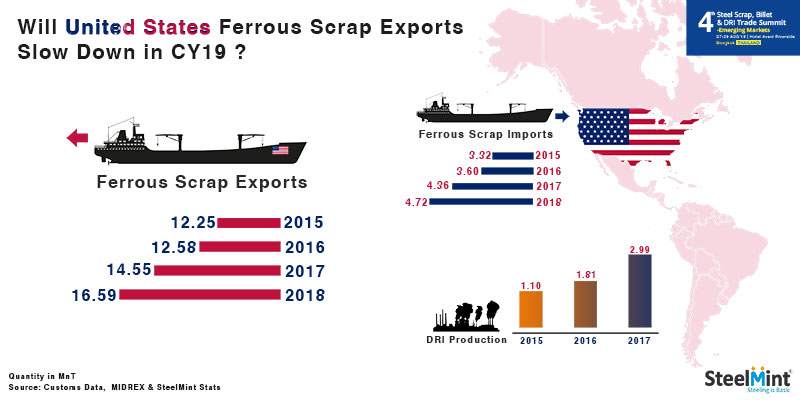
    US exported 16.59 MnT ferrous scrap in CY18. Trade participants have already pointed out that CY19 could be the year of significant importance for the global economy considering impact of Trade war and sanctions.

    US scrap consumption to increase in coming years?

    1. Ramping up of EAF capacities and investments in the US – In Jan’19, Nucor Corp. announced a new EAF mill of USD 1.4 billion in the Midwest to produce 1.2 million tons steel per annum. Steel Dynamics, a producer based in Fort Wayne, Ind., plans to build a USD 1.8 billion mill with an EAF in the southwestern U.S. with an annual capacity of 3 million tons. GFG Alliance, a British conglomerate, announced plans in January to expand its U.S. steel production by 800,000 tons a year and restart a second electric arc furnace at a South Carolina plant. In Feb’19, U.S. Steel Company said it would begin construction on an EAF at its Fairfield plant near Birmingham, Ala.

    2. Rise in DRI production – As per Midrex reports, total DRI production in North America (USA & Canada) recorded at 4.60 MnT in CY17 up 44% Y-o-Y against 3.20 MnT in CY16. While that in Latin America recorded at 10.51 MnT in CY17, up 14% Y-o-Y against 9.19 MnT in CY16. These numbers are expected to have increased in CY18 with US turned as a supply merchant with the first HBI plant in the United States, located outside Texas ramped up production in 2017. Also, Cleveland-Cliffs, Inc. had announced in June of 2017, plans to build a 1.6 MnT pa HBI Plant in Toledo, Ohio, USA.

    3. Increasing ferrous scrap imports – US ferrous scrap imports recorded at 4.72 MnT in CY18, up 8% Y-o-Y against 4.36 MnT in CY17. The US exports a lot of low-quality scrap, but imports high-quality raw material. That means there is a shortage of prime grade scrap there.

    4. Rising crude steel production on increasing EAF output – According to world steel association, US crude steel production recorded at 86.60 MnT in CY18, up 6% Y-o-Y as against 81.61 MnT in CY17. US total crude steel production was recorded at 78.47 MnT in CY16 comprising of 67% share of EAF route while 33% share of blast furnace production. Reports suggest that country’s EAF steel output has been constantly increasing since past couple of years resulting in rising domestic scrap demand apart from rising scrap imports which may lead to limit exports in CY19.

    The imposition of tariffs has provided the much-needed protection to American steel producers who have long struggled to cope with a tide of cheap foreign imports. The punitive tariffs appear to be bearing fruit as reflected by a decline in U.S. steel imports in CY18.

    Scrap oversupply situation in Turkey, Brexit dynamics in Europe, Iran driven suffocation, changing dynamics of recycling in India, will keep global scrap demand volatile in CY19. Thus, it seems scrap consumption in US will increase in near term and emerging scrap markets like Vietnam, South Korea, Bangladesh, Pakistan and Indonesia could have to pay high for US scrap in CY19.

    The imposition of tariffs has provided the much-needed protection to American steel producers who have long struggled to cope with a tide of cheap foreign imports. The punitive tariffs appear to be bearing fruit as reflected by a decline in U.S. steel imports in CY18.

    Scrap oversupply situation in Turkey, Brexit dynamics in Europe, Iran driven suffocation, changing dynamics of recycling in India, will keep global scrap demand volatile in CY19. Thus, it seems scrap consumption in US will increase in near term and emerging scrap markets like Vietnam, South Korea, Bangladesh, Pakistan and Indonesia could have to pay high for US scrap in CY19.

    4th Steel Scrap, Billet & DRI Trade Summit

    Don’t miss the opportunity of meeting global buyers and sellers at the 4th Steel Scrap, Billet & DRI Trade Summit in Bangkok, Thailand, to be held from 27-29th August 2019.

    Know More