SteelMint Events

Tag: Intervista

  • Mughal Steel to Raise Output, Eyes Infrastructure Growth

    Mughal Steel to Raise Output, Eyes Infrastructure Growth

    Mughal Iron & Steel Industries Ltd. is Pakistan’s largest steel producer and perhaps the largest importer of scrap as well. From a modest beginning as a trading company in 1950, it moved to steel production and today it plays a significant role in the region’s economic development. One of the people at its helm is Mr Fahad Javaid Mughal, a director in the company, who holds a bachelor’s degree in international business from Australian National University, Australia.

    Here follows excerpts from a telephonic interview with Mr Mughal:

    1. How is the global steel scrap market looking this year?

    The US halved its 50% tariff on Turkish steel imports this month and the market spiked up instantly. But I’m thinking, demand is not going to stay very high for Turkish steel because I see US fulfilling its demand for steel domestically and it might take some time for Turkey to establish itself in the US market after a lull.

    2. What is your price forecast for steel scrap?

    I see prices in Pakistan under $330-335/tonne, CFR, in the next few months as against $320-325/tonne at present. Currently, Turkish scrap prices have been at $295-297/tonne on average, though variations do occur because of demand. However, I can see Turkish scrap rates staying over $290/tonne, CFR. Turkish rebars are seen around $490/tonne. Pakistan’s buying price is approximately $25-30/ tonne higher than that of Turkey due to freight.

    3. How is the local market for steel doing in Pakistan?

    Demand in Pakistan might rise in two month’s time as the government is to release funds for some projects. There could be an upward impact on prices to the extent of $10-15/tonne. Turkey may start buying aggressively and that might also have an impact on prices. Once US starts to to buy, the market dynamics will change.

    4. How are the China Pakistan Economic Corridor (CPEC) and Silk Road projects shaping up? How much of a boost will these projects mean for Pakistan’s steel producers?

    The premier of both China and Pakistan had a meeting recently and we are expecting new tenders for the projects. Four new MoUs were signed. The new tenders would be modified tenders. Demand is expected to arise by the end of this year. The local industry is working along with CPEC even though it is not supporting all the steel mills. It depends on the brand and prices.

    5. How is the demand for steel in Pakistan’s home market?

    At present, the per capita consumption of long-rolled steel products in Pakistan is 24kg which is the lowest in the Asia-Pacific region. Our neighbouring country, India, has per capita consumption of long-rolled steel products of 50kg. So in the coming years, Pakistan steel market will definitely grow and our expectation is that the per capita consumption will increase to 35kg. Demand from commercial and home sectors are doing good. Now government has to allocate a good amount of funds for new projects like dams, flyovers, motorways and others. As per the new budget announced in June, Government has imposed a Federal Excise Duty of 17% and abolished special sale tax procedures on scrap and billet import. This is favourable for the steel industry as a whole, as tax net will expand and it will make a level playing field for all the manufacturers in steel sector.

    6. How is the Pakistani government protecting the industry from the onslaught of Chinese exports?

    There is protection. For instance, there is a 43% tariff on rebars especially from China. Steel industry is happy and has invested in furnaces.

    7. How much steel will Pakistan produce in 2019-20?

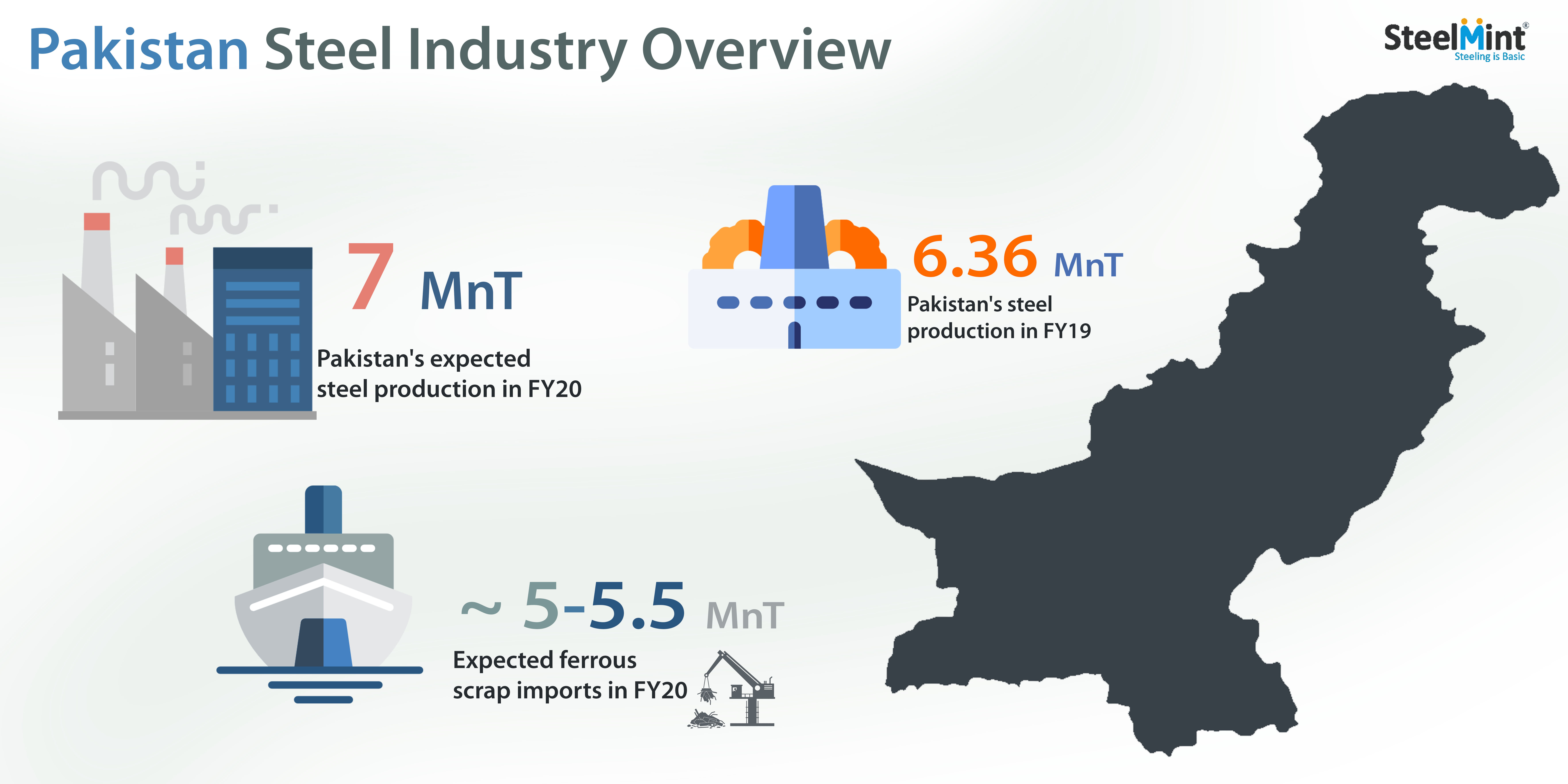
    Pakistan is expected to produce 7 MnT of all steel products this year. In 2017-18, Pakistan produced 7 MnT of steel, but in 2018-19, it fell by 9.2% owing to the depreciation of the local currency. Pakistan’s rupee depreciated by 40%, scrap prices went up and duties also went up. The industry could not pass on the cost to the customer. From 2020 onwards, we expect a steady rise from current levels.

    8. What are the expansion plans of Mughal Iron & Steel Industries?
    We are the largest producers of steel in Pakistan with a capacity of 0.7MnT. In another two months our capacity will rise to 1.1 MnT. We also have a 60 megawatt coal-based power plant coming up which is expected to be ready in one and half to two years from now.

    9. How much of steel scrap will Pakistan buy this year (2019-2020)?

    Pakistan will buy tentatively 5 MnT of steel scrap this year, but this can further increase if the upcoming steel capacities become operational in 2019-20.

    In order to know more on Pakistan steel and scrap trade markets, book your seat at SteelMint’s 4th Steel Scrap, Billet & DRI Trade Summit. The conference is being organized during 27-29’th Aug’19 in Bangkok, Thailand.

    ~ Inputs by Ruchira Singh

    Know More

  • Tata Steel Thailand Plans to Ramp Up Steel Capacity Utilization – Mr. Rajiv Mangal

    Tata Steel Thailand Plans to Ramp Up Steel Capacity Utilization – Mr. Rajiv Mangal

    Tata Steel – Thailand is one of the renowned names in manufacturing of long steel products. SteelMint in interaction with Mr. Rajiv Mangal, President & CEO of Tata Steel (Thailand) Public Company Limited learned about his views on ramp up plans of the company and expected increase in country’s crude steel production in the coming years. Below are the edited excerpts from the interview

    1. Has Thailand steel industry poised for growth, what is the future outlook?

    Unlike other countries in ASEAN region where dependence of steel sector on construction is very high (>75%), Thailand’s steel consuming sectors are diverse. Total apparent finished goods steel consumption in the country was 17.4 MnT in 2018, up by 4.8% Y-o-Y. This translates to approx. 263 kg per capita of steel consumption. Construction, Machine & Appliances and Automobiles sectors consumed 55%, 21% and 19% shares of the total steel consumed in 2018 respectively.

    As per Iron & Steel Institute of Thailand (ISIT), steel consumption in 2019 is likely to be around 19 MnT , an increase of approx. 8% in 2018. Personally, I feel growth will be in the range of 4-6% on account of continuing trade frictions in international arena and political uncertainty in the country after the general elections in March 2019.

    2018 witnessed a Y-o-Y increase in automobile, cement and canned seafood production by 8.9%, 1.2% and 13.6% respectively. With the first car policy after effects almost gone and huge infrastructure development plans announced for next five years by the Thai Govt, steel consumption is expected to witness healthy growth coming years.

    There are roughly 20 crude steel-making facilities in Thailand, nearly all of which use electric arc furnace technology to produce steel. In comparison, over 150 hot-rolling, cold rolling, cold-drawing, and coating mills are in operation in Thailand which relies heavily on imports of semi-finished and finished steel products for their manufacturing inputs.

    2. Is steel capacity utilization low in Thailand?

    In 2018, Thailand imported 15.2 MnT of steel, an 8 percent increase from 14.2 MnT in 2017. At the same time, domestic production was approx. 7.1 MnT with average capacity utilization below 50%. This is not good for the financial health of the domestic steel industry. One of the major reason for low capacity utilization in Thailand is that 100% steel production is based on secondary route of steel making. This makes the cost of steel produced locally higher than primary route steel manufactured in major steel producing countries like China, Japan and Korea. At the same time, most of the steel made in the country is in upstream and commodity by nature. With new blast furnace based capacities coming on stream in Vietnam and Malaysia in last one year, challenge for Thai steel producers have aggravated. Need of the hour is consolidation and shifting up in the value chain.

    3. What are the measures being taken by Tata Steel Thailand to increase production and demand from local mills and how is the scenario after HBIS take over?

    Tata Steel Thailand has a rated capacity of 1.7 MnT pa of long products spread across three manufacturing sites in Thailand. By virtue of better product mix, pan Thailand reach and sale of branded products, average capacity utilization of the company is in the range of 70-75%. This is much higher than country’s average. Exports account for 10-12% of the total sales. During 2011-16, Thailand saw widespread dumping of wire rods from China. With structural changes in Chinese steel industry and Thai Govt imposing tariff and non-tariff measures, imports from China has come down in last 2 years.

    In coming years, Tata Steel Thailand plans to enhance capacity utilization beyond 80-85% by increasing sale of high end wire rods suitable for auto sector, ready to use Cut & Bend products and high strengthRebars for construction companies. With strong brand presence in Laos, Cambodia and Myanmar, exports to these countries is also poised to go up.

    The share purchase agreement signed with HBIS in end Jan’19 is not yet closed.

    4. Do you see steel scrap imports rising in coming years in Thailand, what is your forecast?

    As scrap remains the primary raw material for steelmaking in Thailand, its consumption is bound to increase in line with steel production increase in coming years. At the same time, domestic steel industry has taken up with the Govt to promote exports of value added products and discourage export of scarce raw material like steel scrap. Another factor to be closely tracked is increase in steel production & consumption in Vietnam and Malaysia from the new investments in last 2-3 years. If these countries resort to aggressive exports, Thailand may witness increased imports of semis and finished products. Thus rate of change in import of scrap in Thailand will depend upon policy for prevention of scrap exports and imports of semis and finished steel from neighboring countries.

    To know more on scrap industry in emerging markets, book your seat at SteelMint’s 4th Steel Scrap, Billet & DRI Summit. The conference is being organized during 27-29’th Aug’19 in Bangkok, Thailand.
    ~ Inputs by Dr. Sheena Abraham

    Know More

  • China’s Scrap Generation to Increase by 10 MnT in 2019 – CAMU

    China’s Scrap Generation to Increase by 10 MnT in 2019 – CAMU

    Mr. Tao Jiangshan, deputy secretary general of China Association of Metalscrap Utilization (CAMU) – DRI Working Committee, has been engaged in DRI production and consultation for 23 years. Mr. Jiangshan set up Tianjin Overworld Technology Consulting Co Ltd and also worked at Tianjin Pipe Group, in charge of technical and process work and head of new project. His early days were at pellet plant of Minmetals Luzhong  Metallurgical Mining where he got familiar with the DRI process. He was also chief editor of China CCM.com taking care of information on steel raw materials and compilation of field reports.

    Mr Jiangshan graduated from China Central South University, majoring in pellet/sinter DRI of mineral processing department. Here are excerpts from an e-mailed interview

    Q: What is CAMU’s forecast for steel scrap usage in Chinese domestic steel mills in 2019 versus actual use in 2018?

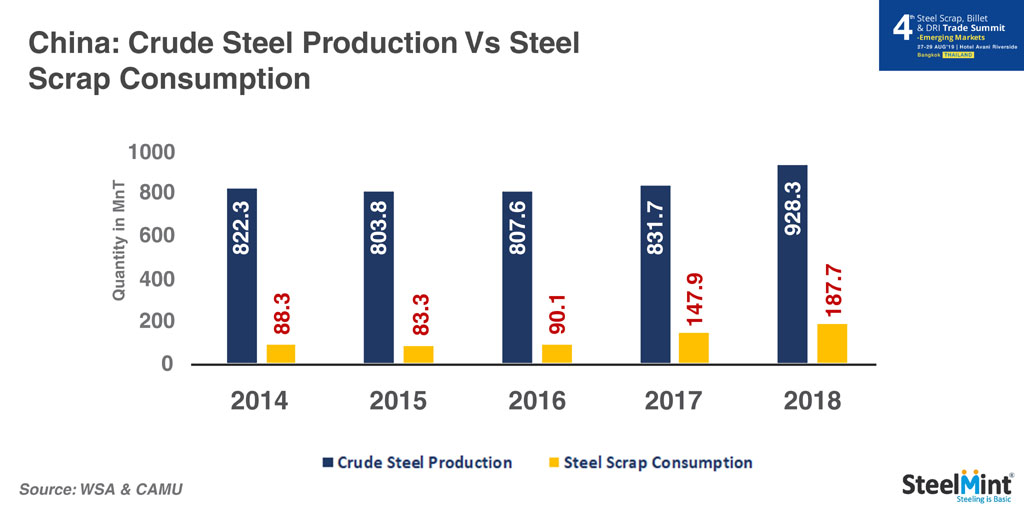
    A: The quantity of scrap steel usable in the market will be more and more, scaling up by 10 million tons each year, while crude steel output will shrink. Secondly, steel mills will have more incentive to use scrap steels and the proportion of scrap will be higher. Thirdly, short route smelting will take up more proportion and the scrap ratio in EAF smelting as well we EAF steel ratio in output of crude steel will be higher. These three points highlight the optimistic trend in the course of scrap steel utilization and a promising future.

    Q: What is CAMU’s forecast for scrap generation in China in 2019 versus 2018 actual generation?

    A: The usable steel scrap in the market will become more and increase at pace of 10 million tonnes each year. The output of steel scrap in 2018 was 220 million tonnes and is expected to reach 230 million tonnes in 2019.

    Q: Will China have enough scrap to export? What is your forecast on steel scrap exports both near term and long term?

    A: Given that the fast increase in EAF steel output in recent years, coupled with gradual consumption by blast furnaces, the scraps are expected to be mainly consumed by domestic mills.

    Q: What are the government policies or incentives coming up that could encourage the setting up of more electric arc furnaces?

    A: By way of environmental protection and production limit as well as phase-out of outdated capacity, China’s government is taking the policy leverage to encourage legitimate steel mills to set up new EAF mills through capacity replacement.

    Q: What is the current price of steel scrap in China and what is the average price likely to be this year? At this price is it cheaper to produce steel via electric arc furnace than blast furnace?

    A:  The average price of HMS1 during Jan-Mar 2019 was at RMB2,320/ton while HMS2 at RMB 2,120. In China, the production cost by blast furnace is more economical.

    Q: Going forward, what is your outlook for steel scrap industry in China and the world?

    A: With the further deepening of structural de-capacity on supply side, steel mills especially scrap processing enterprises are set to embrace promising opportunities.
    The “Green Industry Development Plan (2016-2020)” issued by The Ministry of Industry and Information Technology proposed that “by year 2020, the utilization of scraps recycled will reach 150 million tonnes” and this target will most probably be met in this October.

    And the provision “by year 2025, steel made of scrap should account for 30% of the total” proposed in “Steel Industry Adjustment Policy” is also achievable. “The 13th five-year plan for Steel Scrap” enacted by CAMU has proposed that by year 2020, the steel made of scrap will take up 20% of total output, which doubled the target as proposed in “the 12th five-year plan” and is achievable before this year end.  All those achievements have signaled that an era of mass utilization of steel scrap has come.

    To know more on China’s rising scrap generation, consumption and growth of EAF in steel making, be a part of 4th Steel Scrap, Billet & DRI Trade Summit in Bangkok, Thailand, to be held from 27-29th August 2019.

    ~ Inputs from Ruchira Singh with the help of Arthur Li

    Know More