SteelMint Events

Tag: Iron Ore

  • India: What is the status of iron ore blocks auctioned since 2015?

    India: What is the status of iron ore blocks auctioned since 2015?

    • Over 60% of auctioned blocks in Odisha, Karnataka since the MMDR Amendment Act, 2015
    • Average auction premium at over 100%
    • Production to increase as many auctioned mines may come onstream

    Around 100 iron ore mine blocks have been successfully auctioned in India since the historic amendment of the Mines and Minerals Development & Regulation Act (MMDR Act) in 2015, as per SteelMint data.

    MMDR Amendment: Key facts

    The landmark MMDR Amendment Act, 2015 paved the way for the introduction of the auctions regime in India’s mining and minerals sector by replacing the older first-come-first-serve system in a bid to ensure transparency in allocation of mineral blocs.

    The reforms undertaken in 2015 have resulted in successful auctions of 273 mineral blocks in different states of the country since 2016. Importantly, the pace of mineral auctions has quickened since the MMDR Amendment Act of 2021, with around 105 iron ore blocks getting auctioned in FY’23.

    This has been possible due to radical reforms in the 2021 Amendment such as the abolition of the ‘end-use’ restriction for auctions and uninterrupted transfer of valid old environmental clearances to the preferred bidder.

    It bears recall that the 2015 MMDR amendment had set forth specific clauses as regards renewal of mine leases. While merchant mines had their leases extended till 2020, the captive iron ore mines were given a timeline till 2030 after which those mines must come under the auction hammer.

    In order to augment domestic iron ore supplies, Section 8(A) of MMDR Act was further amended allowing any lessee of a captive mine to sell minerals up to 50% of the total mineral produced in a year after meeting the requirement of the end-use plant linked with the mine. This, however, would require an additional amount to be paid to the concerned state government.

    Similarly, government companies or corporations whose mining leases have been extended after the commencement of the MMDR Amendment Act, 2015, shall also pay such additional amount for the mineral produced after the commencement of MMDR Amendment Act, 2021.

    The additional amount for extension of mining leases is 1.5 times the prevailing rate of royalty for iron ore mines.

    Auctioned blocks

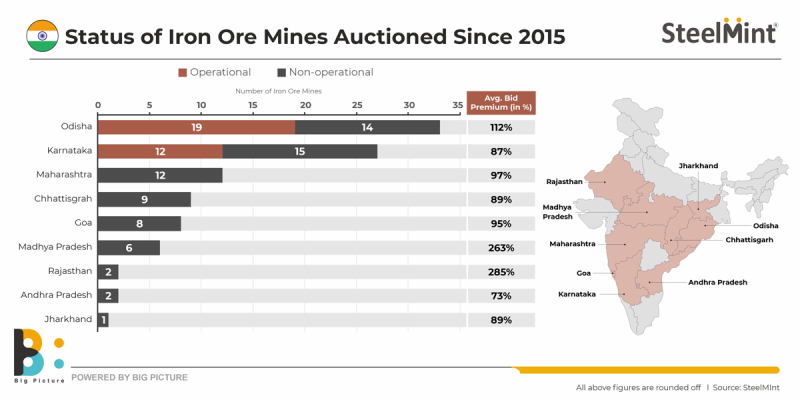
    Notably, out of the 100 iron ore blocks auctioned thus far, 33 are in Odisha and 27 in Karnataka – India’s leading iron ore producing states. Among the other key producers, 12 blocks are in Chhattisgarh, 9 in Maharashtra and 8 in Goa.

    Details of auctioned blocks
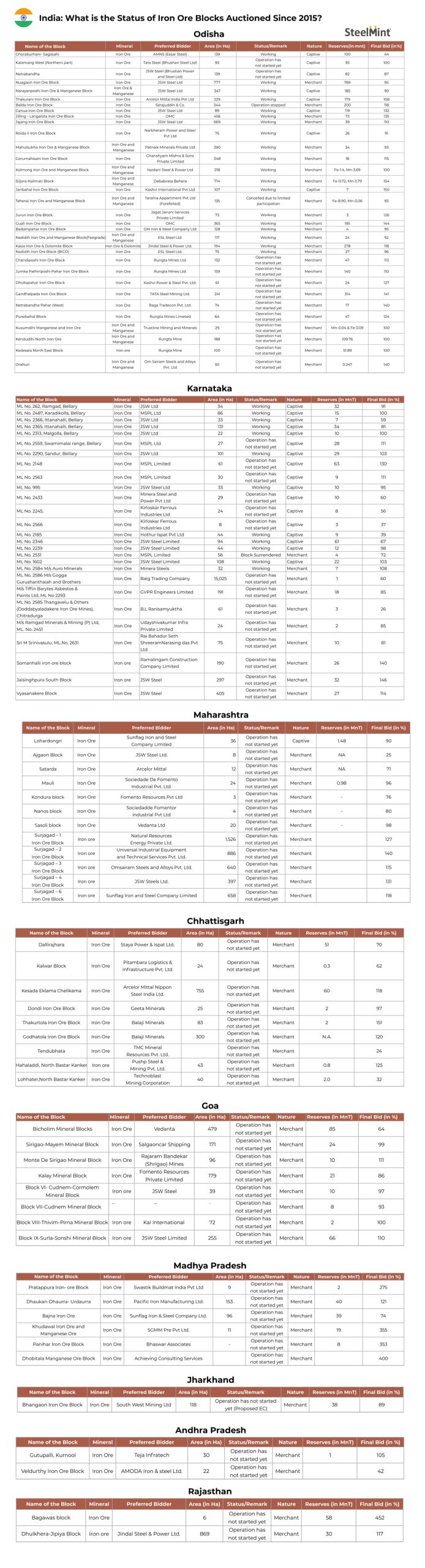
    There are blocks in Madhya Pradesh and Andhra Pradesh, too. However, major iron ore-producing-state Jharkhand has just one block. A lion’s share of that state’s iron ore production is accounted for by captive steel producers.

    In an indicator of over-enthusiastic participation in iron ore auctions – mainly by steel players eager to secure long-term supplies in view of surge in capacity – the general average auction premium quoted stands at over 100%, as per SteelMint estimation.

    Outlook

    India’s iron ore production in FY’23 inched towards 260 million tonnes (mnt). Out of the auctioned blocks, just over 30-odd are in working status which shows that many more mines – especially those auctioned since 2021 – will move towards operationalisation sooner rather than later.

    Therefore, SteelMint’s outlook is positive as regards iron ore production even as domestic steelmaking capacity gathers pace.

    What are the key government policies that may reshape the Indian minerals industry and how long might high premiums sustain for mineral block auctions? Gain cutting-edge insights from experts on these issues and much more at SteelMint Events’ flagship 6th Indian Iron Ore & Pellet Summit to be held from 24-26 August at JW Marriot, Kolkata.
  • Singapore International Ferrous Week Date: 22-26 May, Place: Singapore

    Singapore International Ferrous Week
    Date: 22-26 May, Place: Singapore

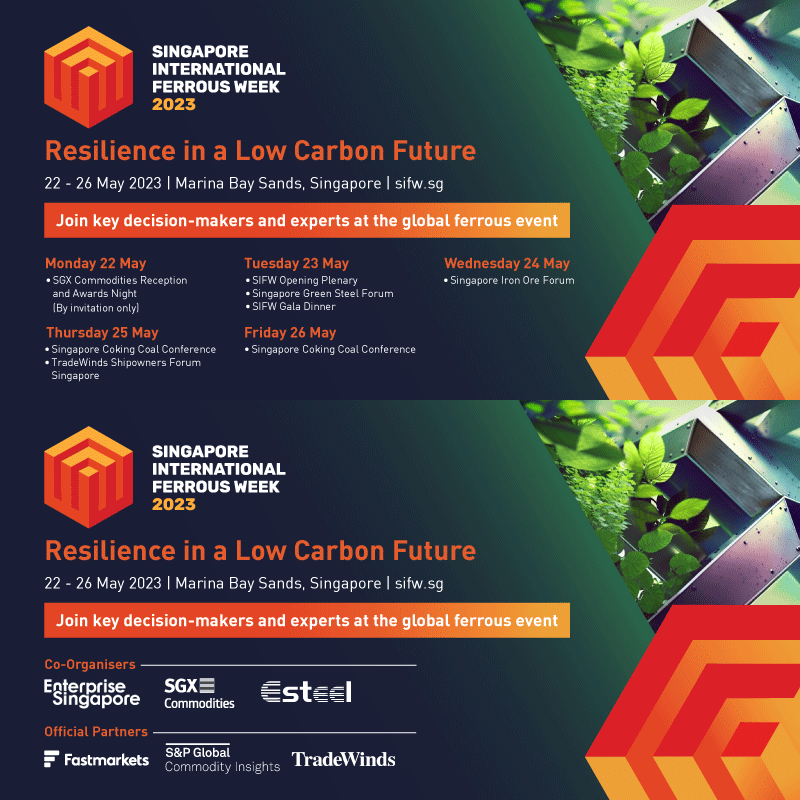
    The Singapore International Ferrous Week (SIFW) will take place from 22 to 26 May 2023 in person at the Sands Expo and Convention Centre, with 4 exciting forums and conferences. Formerly known as the Singapore Iron Ore Week (SIOW), the week-long event has been expanded to cover the entire steel making value chain to give participants deeper insights and more networking opportunities.

    More than 1,000 delegates joined us last year for the week-long hybrid event. Themed ‘Resilience in a Low Carbon Future’, SIFW 2023 will gather the global commodities community for a face-to-face event, comprising four forums focusing on the challenges and opportunities facing the iron ore, steel, shipping and coal industries’ pursuit of sustainability.

    For the past decade, this annual must-attend event is a platform for the ferrous and shipping industry to connect and exchange insights in a fast-evolving global environment.

    Co-organised by Enterprise Singapore, SGX Commodities and Esteel together with partners, SIFW 2023 promises a host of exciting events from 22-26 May 2023.

    Register button

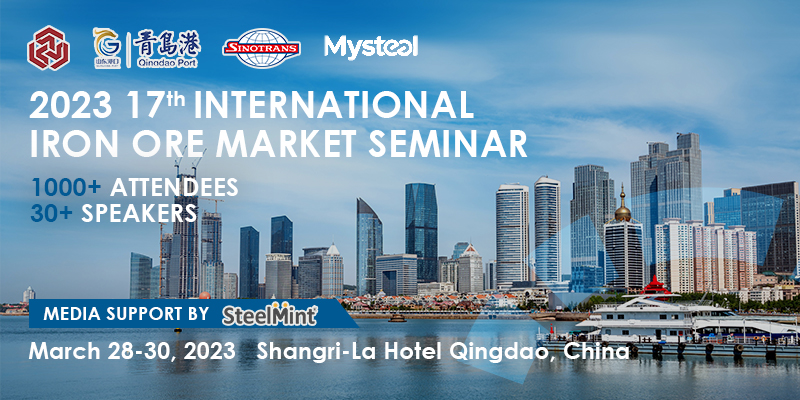
  • 17th International Iron Ore Market Seminar   Date: 28 – 30 March, Place: Qingdao

    17th International Iron Ore Market Seminar
    Date: 28 – 30 March, Place: Qingdao

    The 17th International Iron Ore Market Seminar will be held on March 28-30 in Qingdao, which will discuss the current hot topics in China’s iron ore and steel market

    Industry leaders, well-known scholars and experts have been invited to share their understanding of the market for the present and the coming year and will conduct a comprehensive and multi-angle in-depth interpretation of the ferrous metal market and help the participants in the ferrous metal industry to make an early layout.

    Register button

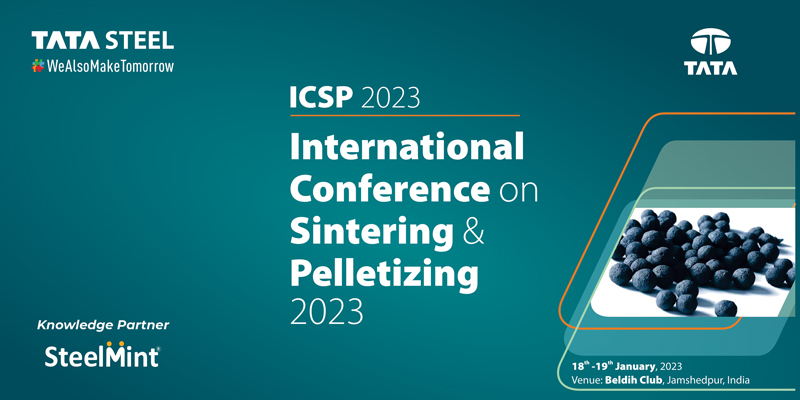
  • International Conference on Sintering & Pelletizing 2023

    International Conference on Sintering & Pelletizing 2023

    Sintering and Pelletizing are the widely used technologies for agglomeration of iron ore fines. Over the years signicant improvements have taken place in the area of utilization of low-grade iron ore, minimizing energy input, increasing productivity & quality at minimum cost. Tata Steel along with IIM Jamshedpur and Pellet Manufacturers association of India (PMAI) is pleased to organize the International Conference on Sintering and Pelletizing 2023. The conference will be conducted in a hybrid mode.

    The conference will provide an opportunity for researchers, academicians and industry professionals to interact and deliberate up on the major challenges and opportunities in the iron ore agglomeration processes. It will contribute to the advancement of the agglomeration technology resulting in efficient Iron making operation.

    Date: 18-19 January, 2023

    Venue: Beldih Club, Jamshedpur, India

    Register button

  • Karnataka may add up to 9 mnt iron pellet capacities in next few years

    Karnataka may add up to 9 mnt iron pellet capacities in next few years

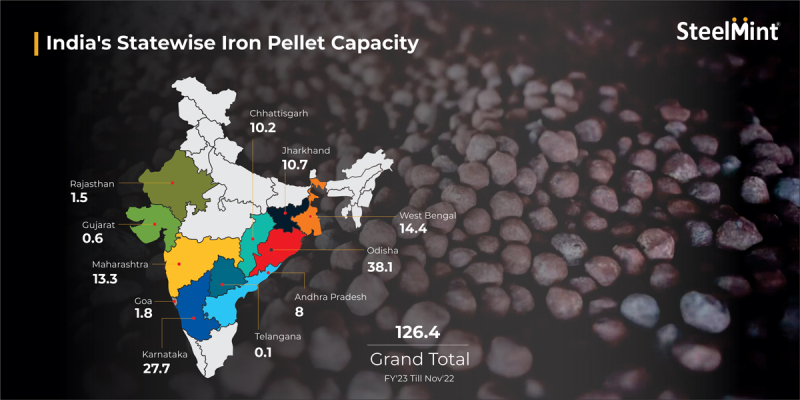
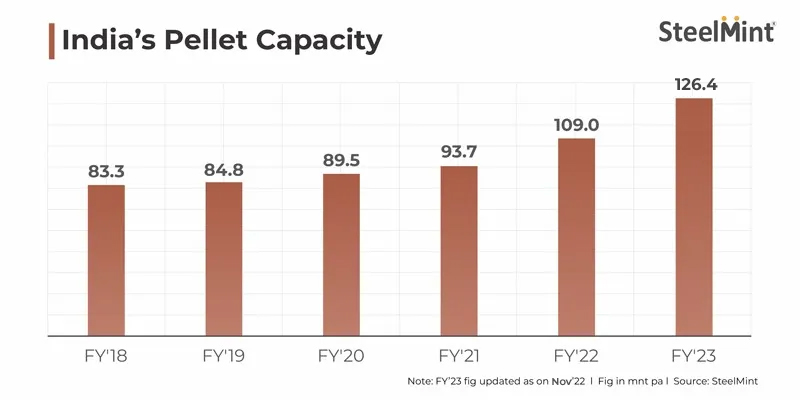
    India’s pellet-making capacity has expanded rapidly in recent years along with the steady rise in crude steelmaking capacity. SteelMint estimates that the country’s pellet production capacity currently stands at 126 million tonnes (mnt), which is 16% higher than 109 mnt in FY22.

    Karnataka’s share in India’s total pellet capacity is around 21% at 27.7 mnt currently. It has the second-largest pellet production capacity among Indian states, with Odisha topping the list at over 38 mnt. Karnataka emerged as the second-largest iron ore producing state in India in FY22 with production of about 40 mnt – roughly 16% of the country’s total production.

    Pellet capacity expansion

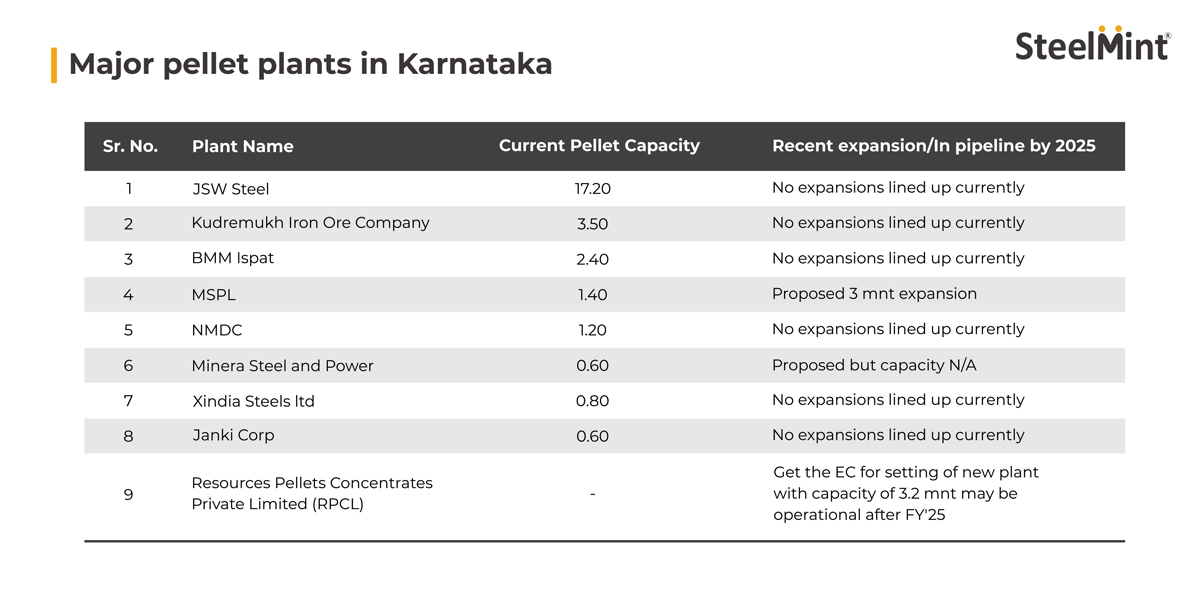
    SteelMint data shows that there are a few pellet capacity expansion projects in the pipeline in Karnataka. These are the following:

    • MSPL is looking to expand its plant capacity to 3 mnt by 2025 from around 1.4 mnt at present.
    • Minera Steel and Power has proposed to raise its pellet capacity. The company’s current capacity is 600,000 t per annum.
    • Vedanta Limited has invited expressions of interest (EoI) from competent Indian and international business partners for establishing a 3 mnt per annum pellet plant in the state supported by captive iron ore supply. The Sesa Goa iron ore mine in Karnataka has an operational capacity of 6 mnt/year.
    • Resources Pellets Concentrates Private Ltd. has received EC for setting up a 3.2 mnt/year pellet plant, which is expected to start operations after 2025.
    • Steel major JSW Steel’s present pellet plant capacity in Vijaynagar is 17.2 mnt. The company increased its capacity by about 8 mnt from 9.2 mnt previously.

    Why are pellet capacities increasing?

    Rising crude steel capacities to boost pellet usage – In conjunction with rising crude steel capacity in India, DRI (sponge iron) production is growing simultaneously. The country’s DRI output, which was a little under 40 mnt in FY22, is expected to rise to 50 mnt by 2030. Likewise, pellet usage in sponge iron production is increasing fast. The share of pellet-based DRI in India has increased to around 65% against 35% for iron ore lump-based sponge iron. One key reason is that iron ore lump availability and deliveries remain tight, and so sponge players are shifting towards pellets for quicker deliveries.

    Lower coke consumption – Use of pellets in blast furnace steelmaking is also gaining traction. This is because increased use of pellets enables permeability in the furnace and seamless gas flow within it, as well as smooth descent of the ferrous burden. This facilitates energy efficiency by way of reduced coke consumption and chemistry control. The primary mills have increased the pellet burden in BF to around 25% at present, which is expected to go up to 30-35% in the coming time, SteelMint estimates. With India’s steelmaking capacity projected to climb to over 250 mnt by 2030 and with production from the BF-BOF route expected to be around 55% of the total at around 140 mnt, pellet usage in primary steelmaking is set to increase.

    Benefits over sinter usage – Pelletisation is a cleaner process than sintering with a substantially reduced carbon footprint. With the massive push for decarbonisation and green steel, India’s targeted 300 mnt/year crude steel capacity by 2030 will have to be supported by pellets. Unlike sinter, pellets give mills the flexibility to handle low-grade ore. Higher grade reserves are getting depleted over time, making sintering costly and less environment friendly.

    Increased iron ore availability in Karnataka post lifting of mining caps – Karnataka’s iron ore production stood at around 40 mnt in FY22, while total demand is estimated at around 35-38 mnt. India’s Supreme Court has raised the iron ore production ceiling in Karnataka from 35 mnt to 50 mnt from the A and B category mines. The production cap in Bellary has been raised to 35 mnt from 28 mnt, while in Chitradurga the ceiling has been raised to 15 mnt from 7 mnt. Going forward, the production cap may be relaxed further ensuring increased supply of ore for pellet production.

    Ease of export restrictions – The Supreme Court has recently lifted curbs on exports of iron ore and pellets from Karnataka and eased restrictions on sales from the districts of Bellary, Chitradurga and Tumkur. This has gone a long way in opening up the market for producers and has given an edge to pellet-makers to enhance capacity in the years to come.

    What may happen?

    India’s crude steelmaking capacity is projected to increase to around 200 mnt by 2025 from around 150 mnt at present, as per SteelMint estimates. Likewise, iron ore demand is estimated to rise to nearly 250 mnt by 2025 from around 200 mnt at present. Therefore, the prospects of pellet capacity expansion in the short term are bright not just in Karnataka but across the country.

    Karnataka Road Show

    How is Karnataka’s iron ore and pellet industry shaping up post SC verdict? What is the potential in terms of production, demand, exports, and sales? Are you an industry stakeholder keen to find answers to these and several other queries? Book your seat at SteelMint’s Road Show-cum-Conference on Karnataka’s Mining Sector to be held on 19-23 January, 2023.