SteelMint Events

Tag: Iron Ore

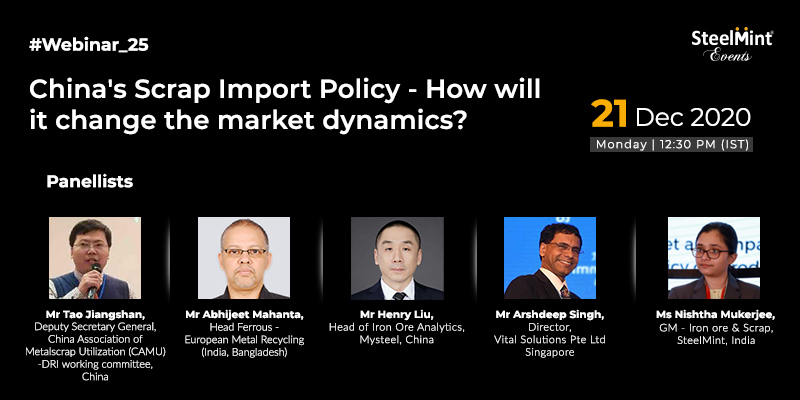
  • China’s Scrap Import Policy – How will it change the market dynamics?

    China’s Scrap Import Policy – How will it change the market dynamics?

    The global steel and scrap industry is awaiting the announcement from the Chinese govt. regarding reforms on resumption on scrap imports. Sources expect announcements to be made shortly and may be implemented from Jan’ 2021. This move is likely to boost Chinese scrap import volumes which have fallen drastically from CY’17. The global steel market awaits its announcement and its impact on global scrap, iron ore, and steel prices

    Key points of discussion:-

    • What is this policy?
    • When is it expected to get implemented?
    • How will this change the trade flows- supplies and prices?
    • Will there be a shortage of scrap in the global market?
    • Potential markets for scrap supply to China
    • Will it impact the global billet market?
    • China’s heavy dependence on iron ore imports to come down?

    Speakers

    • Mr. Tao Jiangshan, Deputy Secretary General of China Association of Metalscrap Utilization (CAMU) – DRI working committee, China
    • Mr. Abhijeet Mahanta, Head Ferrous – European Metal Recycling (India, Bangladesh)
    • Mr. Henry Liu, Head of Iron Ore Analytics, Mysteel, China
    • Mr. Arshdeep Singh, Director, Vital Solutions Pte Ltd, Singapore
    • Ms. Nishtha Mukerjee, GM – Iron ore & Scrap, SteelMint, India

    Date:

    21st December, Monday at 12:30 PM (IST); 3:00 PM (Singapore time); 11 AM (Dubai Time)


    Register button

    ×[formidable id=23]
  • What is Driving Chinese Steel Demand, How Long Will it Continue?

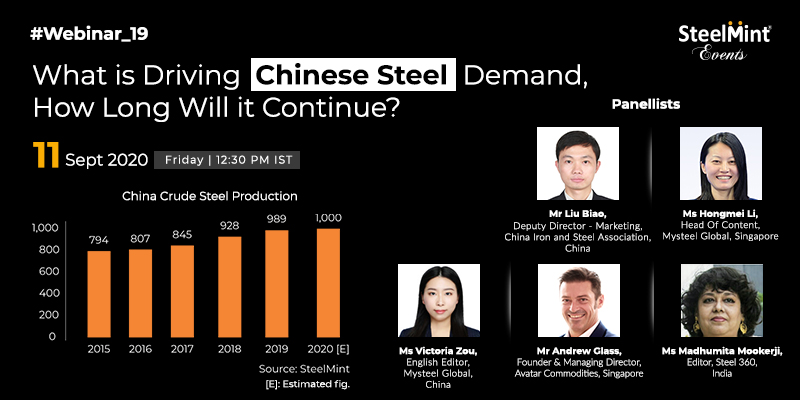
    What is Driving Chinese Steel Demand, How Long Will it Continue?

    Connect with us on Friday, 11th Sept, 12:30 PM (IST), 3:00 PM (Singapore time), 11:00 AM (Dubai time) as we gain insights from our panellists to understand the effect of COVID-19 on the Iron & Steel Industry.

    Panellists :

    • Mr Liu Biao, Deputy Director – Marketing, China Iron & Steel Association, China
    • Ms Hongmei Li, Head Of Content, Mysteel Global, Singapore
    • Ms Victoria Zou, English Editor, Mysteel Global, China
    • Mr Andrew Glass, Founder & Managing Director, Avatar Commodities, Singapore
    • Ms Madhumita Mookerji, Editor, Steel 360, India


    Register button

    ×[formidable id=20]

    An unusual period in history, the coronavirus pandemic has unleashed a series of unprecedented events affecting every industry. Staying on top of trends and accurate analysis is paramount now more than ever to manage uncertainty, change and continuously adapt to new and evolving market conditions.

    According to July’s custom data, China’s iron ore imports have surged up by 24% making it a record from a year earlier. This is driven by shipments from miners and buoyant demand as the economy bounced back after disruptions from the coronavirus pandemic. China steel output is set to rise by 4%, rupturing 1 Billion MT for the first time. How has China’s steel production and demand managed to stay ahead during these unprecedented times when the rest of the world is still recovering from the COVID-19 hit?

    Amid the growing push for decoupling and economic distancing, the changing relationship between China and the rest of the world will influence competition and opportunities in the Steel market. Continuous monitoring for emerging signs of a possible new world order post-COVID-19 crisis is a must for aspiring businesses and their astute leaders seeking to find success in the now changing Iron & Steel market landscape.

    Let’s explore the viewpoints from influencers in the market and learn the various opportunities this new normal presents.

    Key points of discussion:

    • What is driving Steel Imports to China, how long it may continue?
    • What is changing the daily business operations globally?
    • Prospects for Iron & Steel market in terms of Hedging & Trading
    • Indian steel exports at an all-time high, what is the future outlook?
    • What new businesses have been triggered globally and will it benefit steel or not?


  • India: Odisha’s Iron Ore Mine Auction Bid Premiums Go Above 100%

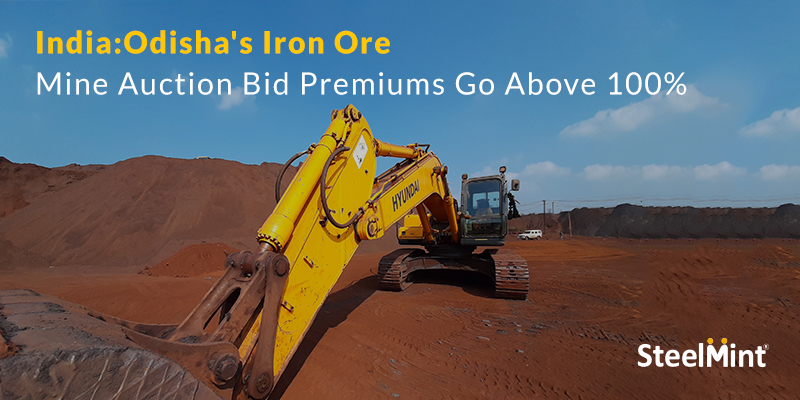
    India: Odisha’s Iron Ore Mine Auction Bid Premiums Go Above 100%

    Last week to this week, the state government auctioned four mines (two captive and two merchant). The auctions received aggressive bids. The first block that was auctioned on 29th January for Nuagaon mines (reserves 792.93 MnT), was won by JSW Steel Ltd which bid 95.2% for the block.

    The second block was auctioned on 30th January for Narayanaposhi mines (reserves 190.6 MnT), and was also won by JSW Steel with its bid at 98.55 %.

    The third block, Thakurani(reserves 180 MnT), fetched highest premium at 107.55% and was won by ArcelorMittal. The fourth block, Balda iron ore (reserves 210.17 MnT) was retained by Serajuddin and Co. at a premium of 118.05%.

    Another 15 mines will be put under the hammer on a daily basis and market expects aggressive bidding for most of them. In addition to the current list of 20 mines, a new list of 7 mines will also be introduced for auctions this month.

    What does the premium signify?

    The premium is the key figure to evaluate the bids. This premium is a percentage of the price of the iron ore that is set by the Indian Bureau of Mines (IBM) each month for different states and grades. The premium will be taken by the state as its tax.So if ArcelorMittal’s winning bid is 107.55%, it means, ArcelorMittal will pay 107.55% of the monthly value of the IBM set price of iron ore to the state government. This will be on per tonne of iron ore sold by ArcelorMittal.

    The premium is not the only tax the new owners will pay to the state government. There will also be a royalty 15% of base price, District Mineral Fund contribution 30% of Royalty and NMET (National mineral exploration trust) 2% of Royalty that will be charged separately on the base price. Premium and royalty will be charged on sales of iron ore and not on production.

    The high premiums are set to put iron ore prices on a different orbit altogether. Since many of the large companies are emerging as the winners, they will become the new price makers in the market.

    Track the results of Odisha mines auction & bids received as on 5th Feb 2020 below:

    Download Pdf

    To learn how the mines auction 2020 unfolds, be a part of SteelMint Events’ 4th Indian Iron ore, Pellet and DRI Summit which is scheduled on 2-3 March 2020, in Hotel LaLiT, New Delhi.

  • Indian Govt Issues Directive on Environmental Clearance, Will India See a Major Iron Ore Disruption?

    Indian Govt Issues Directive on Environmental Clearance, Will India See a Major Iron Ore Disruption?

    Odisha govt finds fresh EC (Environmental Clearance) directive unacceptable. Miners feel transition delay will be only of six months

    A new directive, issued on November 29, by the Union Ministry of Mines, seems to have whipped up a controversy. As per the new proposals, successful bidders in the upcoming mineral auctions will have to apply for fresh environmental clearances (ECs) against the earlier anticipation that the same would be extended for two years. While on the one hand, Odisha is bracing to seek modifications in the new proposals, merchant and captive miners do not seem too perturbed, saying the delay in the transition process will not be anything to write home about. The new lessee has to apply afresh to the environmental advisory committee (EAC) of the Ministry of Environment & Forests (MoEF).

    Unacceptable to Odisha Govt.

    Speaking to SteelMint, a high ranking official at ministry of mines, Odisha, said that the state had “reservations” on this new November 29 directive. He said, a Union Ministry of Mines meeting has been slated on December 10, which he will be attending, and where he intends to take up some of the key issues.

    He said: “We feel the existing EC should be made valid for at least another two years so that the new successful bidder can immediately take up the lease operations. The new directive is not acceptable to us. We had sought extension of the present EC validity for at least two years, in the name of the new lessee. The present directive does not indicate that. Nothing has been said on that.”

    He further said: “We will put forward our points and then let us see if the government can clarify, make some modifications in the proposals. Our key point is that the new bidder has to be supported in taking up operations immediately after the expiry of the lease. The present directive does not support that because of the fresh EC hurdle. “

    He emphasised that there is another point on which he needs clarity. “…The application shall be appraised accordingly for grant of environmental clearance subject to the same validity period as was initially granted…”

    Speaking on the above point, official said: “I do not know what the environmental advisory committee (EAC) of the ministry would mean here because all the leases expire by March 2020.”

    Officials in the Odisha state government indicated that earlier there was a consensus between state and Centre that the EC will be extended for a period of two years but after this notification, successful bidders have to apply for an EC, which will go through a process of due diligence. Even if the government works efficiently, it will take at least six months to get the new EC cleared (against a normal period of two years).”

    EIMP, public hearing exemptions

    Sources in leading merchant miners say they do not think there will be a huge delay because the government, under the new proposals, has exempted the new bidder from preparing a new environmental impact assessment (EIA) study and environmental impact management plan (EIMP), “which takes up a lot of time” along with the public hearing.

    But, importantly, the new successful bidder has to continue working with the same production capacity of the previous lessee. He cannot increase from the existing production volume.

    The EIMP has to cover a monsoon and a summer season study which a lessee has to submit along with the EC application. The lessee has to give the two-season study of the mine area and the periphery, which takes almost one year. Then the report is prepared. Subsequently, the bidder has to submit the study along with the application. This entire process takes more than a year.

    However, under the new directive, the new bidder has to apply afresh and the old EIMP cleared by the earlier lessee will be considered by the committee, in what is being regarded as a big plus-point.

    Another aspect that has been exempted is the public hearing. The State Pollution Control Board organises and conducts the public hearing. This report is then submitted to the EAC of the MoEF. The entire process takes six months to get completed.

    In fact, there is a two-stage process to the EC application. First the bidder has to apply for the terms of reference (TOR). Then the public hearing and EIMP reports are taken into consideration. “The two stages of the EC application process normally take one-and-a-half to two years,” reiterated an industry source.

    “The time taken to issue an EC is actually because of these two aspects, the EIMP and the public hearing,” added the source.

    But the exemption for both is applicable only when the mines are put to auction and a new successful bidder comes in, and takes over the existing mine.

    Possible delay of six months

    When asked about the most worrisome aspect – whether the new directive would delay resumption of mining operations after the new lessee takes over, sources feel there is really nothing to be concerned about. A source said there will definitely be a lapse between the time the new lessee takes over and production resumes, because there will be discontinuation of mining operations till the new EC is in place. “The new bidder will not immediately be able to start mining until he gets the new EC.

    But he added that since the hurdle of a new EIMP and public hearing are being dispensed with, it will take 2-3 months for a fresh EC to be issued and six months at best on the higher side from the time of the application, instead of the usual one-and-a-half to two years,” reasoned the source..

    “So, the transition will not be delayed too much since it will only entail the process of applying for the new EC and making a presentation before the MoEF EAC. This committee takes the hearing and recommends to the government whether the EC should be granted or not,” explained another source.

    Importantly, if the new bidder subsequently wants to increase production further than the previous lessee’s volume, then he has to undergo the old process – apply afresh, go through the public hearing and prepare a fresh EIA and EIMP and present the same before the committee.

    Corroborating, a source from a large steel company which is also a participant, said: “For a 2020 expiring mine having EC (after 2006), the new lessee would be able to get fresh clearances easily provided the production plan is within the EC limit of earlier lessee.”

    The source added that only after “filling a Form 1, clearances would be given… So, there will be ease for new lessees after winning in the auctions, provided they do not increase their production target.”

    Will India See a Major Iron Ore Disruption?

    To learn how the mines auction 2020 unfolds, be a part of SteelMint Events’ 4th Indian Iron ore, Pellet and DRI Summit‘ which is scheduled on 2-3 March 2020, in Hotel LaLiT, New Delhi.