SteelMint Events

Tag: Noncoking

  • India’s coal imports to surge again on peak summer demand?

    India’s coal imports to surge again on peak summer demand?

    The massive surge in coal consumption led by ever-expanding power demand has left India scrambling to secure adequate supplies despite a significant push seen towards increasing domestic production.

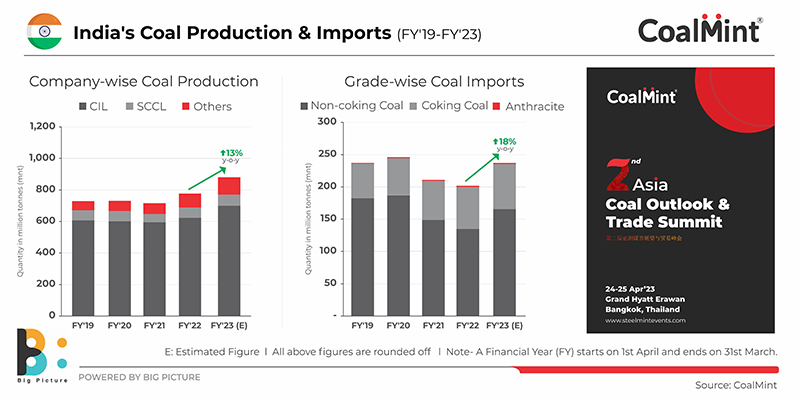
    In FY2022-23, the country scaled new heights in coal production. Till February, total coal production increased by 15% to 784.41 million tonnes (mnt), thereby surpassing the previous high of 777.26 mnt recorded in the previous fiscal.

    Leading from the front, state-run miner-Coal India Ltd (CIL) has maintained higher production and is well on course to meet the fiscal target of 700 mnt. In addition, gradual opening of new captive mines has also provided remarkable contribution in production growth.

    India’s dependency on coal imports, particularly of thermal coal, hit a low on the backdrop of Covid-induced demand disruption. However, improvement in economic activities paved the way for higher imports last year, and there is an increasing likelihood that the pattern would be followed again in a situation where present demand outstrips domestic coal supply.

    Govt intervenes to ensure energy security 

    Reinstating its stance towards imports, the Ministry of Power (MoP) has instructed power plants to resort to imports by procuring 6% (by weight) of their needs for blending with domestic coal till September, 2023 failing which curtailment in domestic supply has been proposed.

    The decision has been taken to ensure smooth operations at thermal power stations. Interestingly, similar provision was also introduced last year. That time, the blending ratio was kept at 10%.

    In this regard, India’s largest power producer, NTPC, has decided to import around 5.4 mnt of coal during first half of next fiscal (FY2023-24). The company has already floated two separate tenders seeking a total of 2 mnt of imported coal. The due date for bid submission is 18 April, 2023.

    Also, for the second time, the ministry has asked imported coal-based (ICB) power plants to resume operation at full capacity this year by invoking the emergency law under Section 11 of the Electricity Act, 2003.

    In addition, a tender has been floated to procure electricity from ICB plants for April-May when power availability is expected to be less than demand.

    These provisions would provide ICBs an avenue for power sale, due to which these utilities will need to explore the global market for running their operations.

    Challenges facing non-power sector

    In India, the power sector accounts for a lion’s share of domestic coal supply. Hence, at a time when coal demand from the power plants had increased this year, domestic miners were left with no choice than to lower the supplies meant for the non-power sector.

    Incidentally, CIL had diverted additional production volumes towards sales against Fuel Supply Agreements (FSA), which refers to long-terms contracts initiated with the power utilities. On the other hand, allocations via regular e-auctions, which constitute 20% of CIL’s sales, were curtailed.

    Under these circumstances, CIL’s coal dispatches to the non-power sector are set to decline for the second straight year in FY23.

    Moreover, CIL’s decision not to renew long-term contracts for coal supplies under linkage auctions meant for the non-power sector, has further escalated the supply crunch for this sector at a time the demand for power is showing no signs of slowing down.

    Price factor 

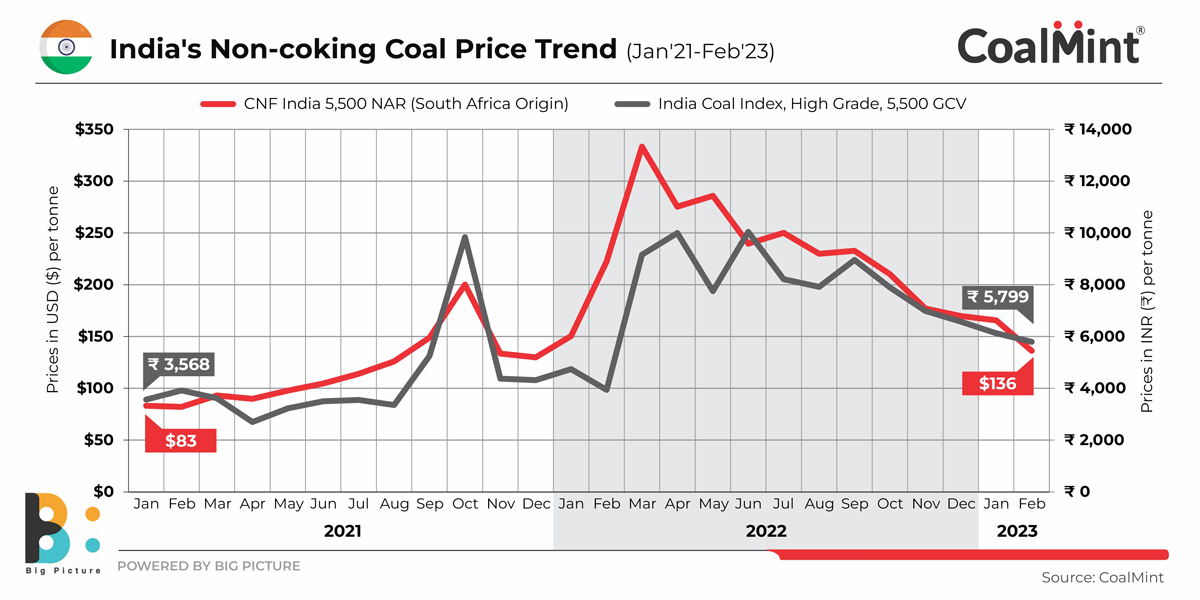
    In the aftermath of the Russia-Ukraine war, coal supply chains had altered which resulted in prices touching record highs. However, prices have started to decline since the second half of 2022 amid reduced appetite from China and rise in production seen from the major exporter Indonesia.

    Meanwhile, reduced Russian coal exports to Europe were balanced by hike in supplies from Colombia and South Africa.

    In India, domestic prices touched unprecedented levels due to factors arising from geopolitical turmoil and prevailing supply cuts. Notably, healthy competition was seen amongst the buyers to procure the limited material offered at auctions. In addition, the introduction of the single window auction, which brought the entire gamut of customers on to a common platform, also pushed bid prices higher.

    Upon improvement in supplies, prices have seen significant correction, but still are assessed above year-ago levels. In the scenario where both global and domestic prices have come down, but the latter is still overpriced given its low energy-content, the Indian buyer will be banking more on seaborne material as it provides greater value in terms of quality.
    Thrust on steel production 

    Augmenting steel production is essential to supporting economic growth. At the same time, the government’s thrust on import substitution in the steel sector has resulted in the Performance-Linked Incentive Scheme (PLI) being introduced.

    Moreover, there is a strong case for increasing output after the government had lifted the 15% export duty imposed on finished steel. This move might prompt the steelmakers to explore the export market to fetch higher price realisations.
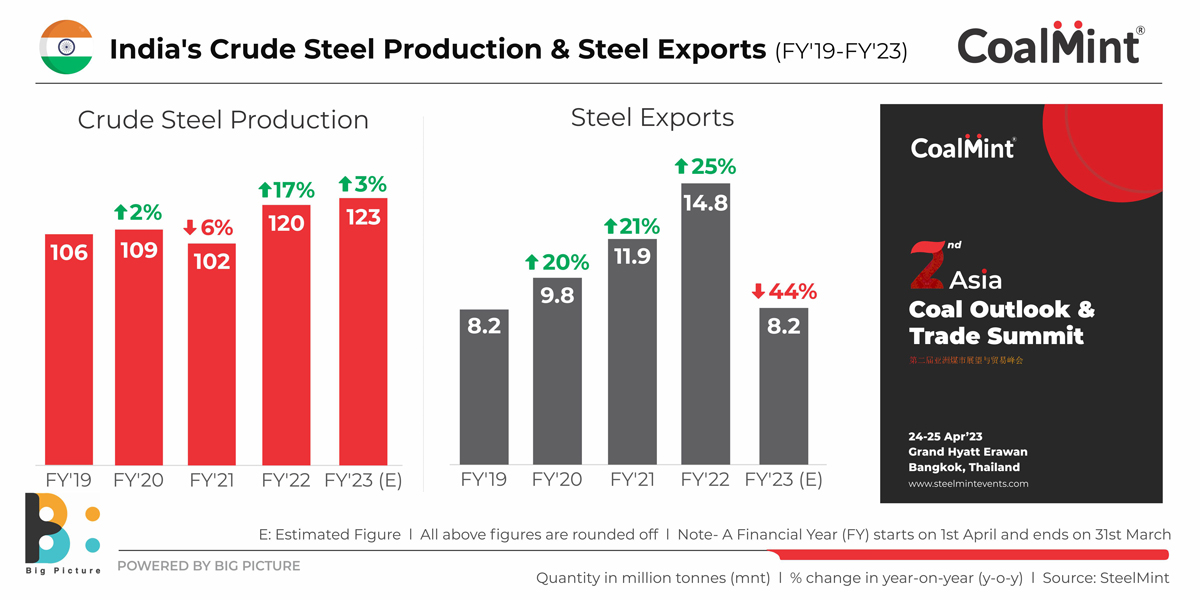
    Therefore, the dependence on coking coal as well as PCI imports is bound to increase with the higher generation of liquid steel through the primary route. Given that India has scarce coking coal reserves, of which only a meagre portion has low ash content, the big steel companies are not in a position to reduce their dependence on imports in the foreseeable future.

    Outlook 

    Stepping up the plan to increase domestic coal availability, the government has introduced several policy reforms to support the mining sector. These include extension of mining lease period, eliminating prior approval required for capacity expansion, along with creation of a single window system.

    Moreover, regular auctions are being conducted for allocation of coal blocks under the commercial mining scheme. In view of the dwindling response from the prospective bidders, the sale was made lucrative by providing relaxation in payment terms and improving the feature of blocks offered in the lot.

    These measures paid off as a total of 25 blocks were sold in the recently concluded sixth tranche, marking the highest allocation recorded for a single tranche.

    CIL is also exploring opportunities to re-open abandoned mines which had been closed mainly on account of difficult mining conditions and financial losses.

    With elections round the corner and the pressing need to avert a power crisis, imports are likely to play a key role in satiating rising demand.

    2nd Asia Coal Outlook & Trade Summit 

    There has been no let-up in India’s coal imports of late and 2023 may be another year likely to witness sustained growth. Will imports continue on an upward trajectory or will government intervention and the projected rise in domestic coal output help to rein in imports? To follow the debate, make sure you attend CoalMint’s 2nd Asia Coal Outlook & Trade Summit in Bangkok, Thailand, on 24-25 April, 2023.

  • Russia: Coking coal exports rise nearly 50% in 2022 on higher shipments to China, India

    Russia: Coking coal exports rise nearly 50% in 2022 on higher shipments to China, India

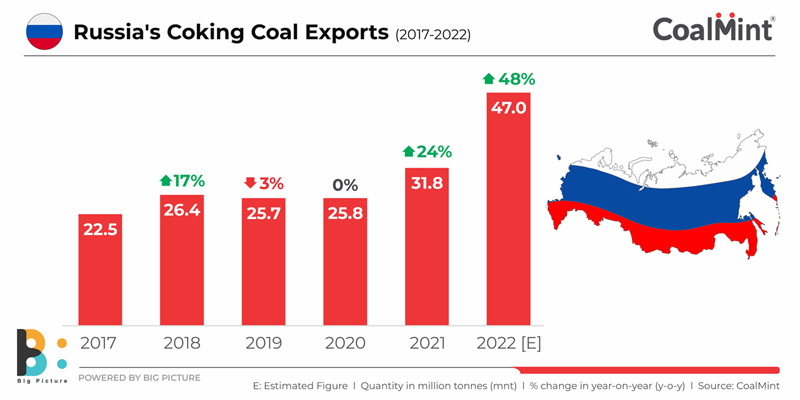
    Russia’s seaborne exports of coking coal and PCI coal are estimated to have increased by a sharp 48% y-o-y to 47 million tonnes (mnt) in 2022 from around 32 mnt in 2021, as per provisional data maintained with CoalMint. Although sanctions on Russia cut off seaborne supplies to traditional importers such as the EU, Japan and South Korea, increased exports to China and India contributed to the growth in export volumes.

    The EU has hitherto been heavily dependent on imports of Russian coal, which accounted for 46.7% of all EU imports of solid fuel last year, according to Eurostat data.

    Leading importers

    Russian PCI and coking coals saw stronger demand in China, and also into India, trading at prices lower than for alternative coals from Australia and North America.

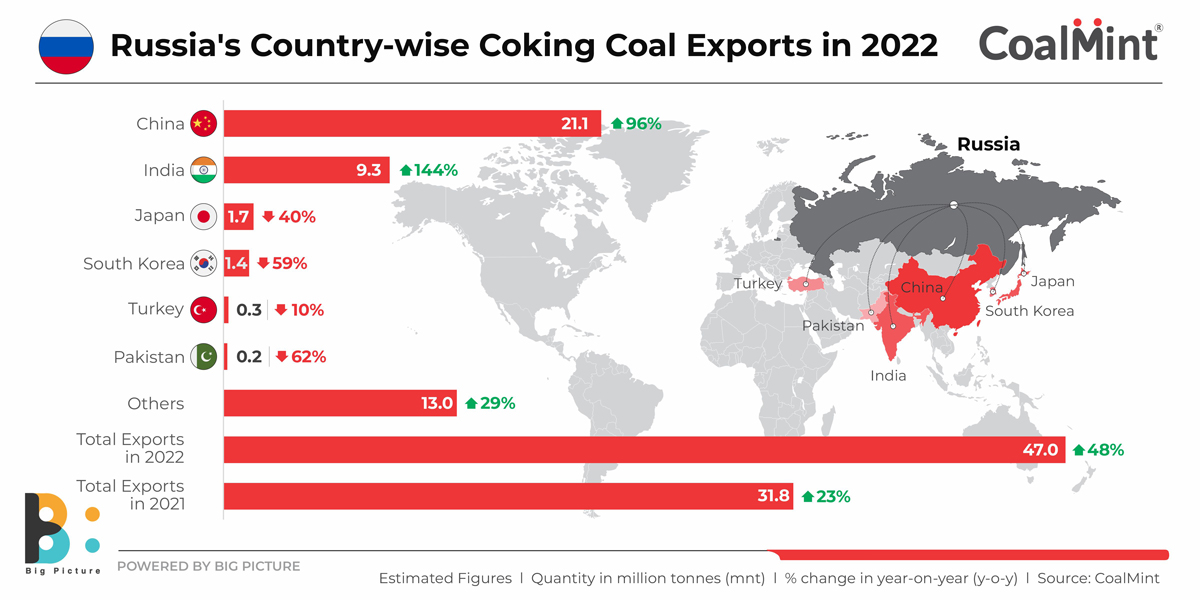
    Data reveal that Russia’s met coal exports to China increased by nearly 100% y-o-y to over 21 mnt in the year gone by. Despite China’s crude steel production falling around 2% y-o-y in 2022 and relatively low domestic coal prices due to extensive COVID-induced lockdowns, imports from Russia surged due to high discounts offered by Russian suppliers post imposition of trade sanctions.

    Russian met coal exports to India edged up even more sharply by over 140% y-o-y to 9.3 mnt. The country’s crude steel production increased by 6% y-o-y to over 124 mnt in 2022 while coking coal imports were stable at around 70 mnt. Cheaper Russian cargoes were lapped up by Indian coal importers amid high global coal prices following the outbreak of the Russia-Ukraine war.

    On the other hand, Russia’s exports to traditional markets such as Japan and South Korea fell by 40% and 59%, respectively amid sanctions.

    Moreover, the ban on the transport of Russian coal was amended in September and allowed for the provision of services like shipping, financing and insurance needed to transfer coal and other products by ship to destinations outside the EU in order to alleviate the energy crisis worldwide. Since then Russia’s seaborne coal exports jumped sharply, with many of the shipments going to Asia.

    Outlook

    Russia’s production of met coal increased by 4.5% to 105 mnt in 2022, as per Rosstat data. However, higher export shipments may not be possible due to logistical bottlenecks. Cancellation of discounts on coal freight levied by the RZD may exert pressure on suppliers to curtail discounts. Also, China’s lifting of an unofficial ban on Australian coal imports, higher shipments by Mongolia and enhancement of domestic production are likely to affect China’s imports of Russian coal.

    However, Russian suppliers looking to ramp up exports to China know that higher discounts are likely to increase the attractiveness of Russian cargoes, even for Indian buyers. Going forward, India’s coking coal demand is likely to increase and – quality considerations apart – if Australian supplies become costlier post China’s re-entry into the Asian seaborne met coal market, Indian buyers may have to fall back on Russia.

    2nd Asia Coal Trade Summit

    Will Russian met coal exports to Asia increase in 2023? How will trade dynamics pan out with the continued sanctions on Russian exports? How is Russia gearing up to consolidate its logistical networks to channel increasing volumes to Asian buyers in the coming years? For in-depth insights on such pressing issues and more, sign in for CoalMint’s 2nd Asia Coal Trade Summit to be held in Bangkok, Thailand on 24-25 April, 2023

  • How might Asian coal trade dynamics change if China lifts ban on Australian coal?

    How might Asian coal trade dynamics change if China lifts ban on Australian coal?

    Australia’s Foreign Minister Penny Wong met with her Chinese counterpart Wang Yi in Beijing on 21 December, 2022, as the trading partners seek to stabilise their diplomatic relationship. Wong’s visit is the first by an Australian minister since 2019 and the first formal talks in Beijing since 2018.

    It is widely expected that a thaw in the bilateral relationship will have a positive outcome for trade. If market chatter is anything to go by, the possibility of China lifting its informal embargo on a host of Australian exports, most prominently coking coal, is by no means remote.

    China had levied an informal ban on its top coal sourcing destination in the latter half of 2020 as tensions escalated between the two trading partners over a series of issues. China was one of the leading coal importers from Australia till 2019 with the latter exporting about 25% of its total coal (both thermal and coking) exports to China.
    As relations between the two countries are heard to be improving, speculation is rife that coal trade might resume once again.

    China-Australia trade dynamics: how it changed?

    Australia accounts for 58% of global seaborne trade in metallurgical coal, while China, the world’s largest steelmaking hub, accounts for 55% of global steel production.

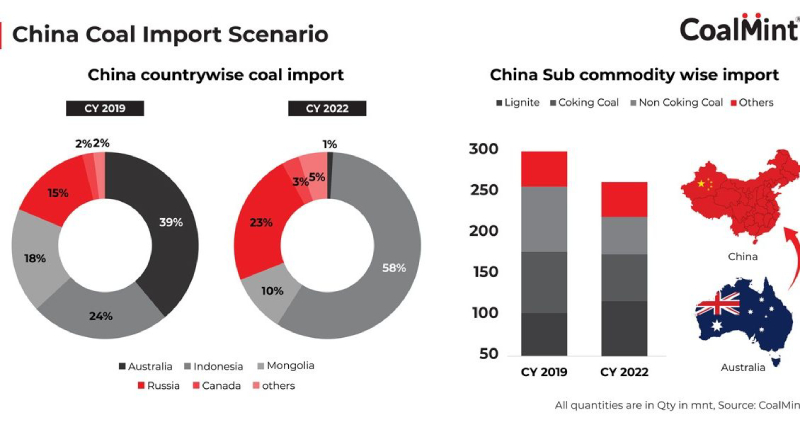
    China imported 197 million tonnes (mnt) of coal in 2019 (before the informal ban), of which 40% was imported from Australia. Commodity-wise, Australia’s share in China’s coking coal imports stood at 40%, while for thermal coal it was 60%.

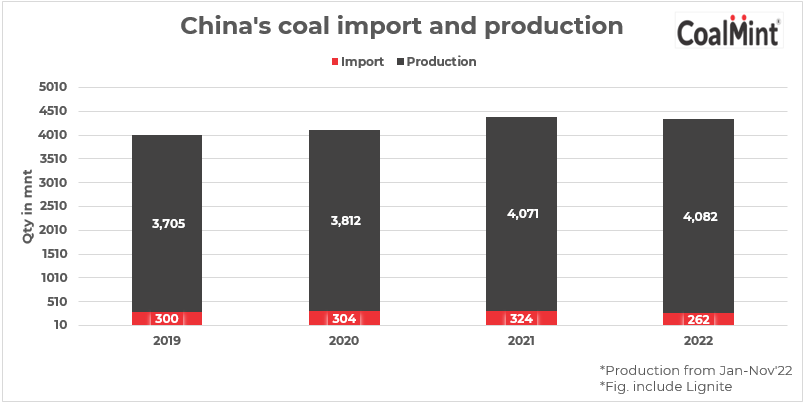
    Post 2020, China focused on increasing its domestic coal production. Compared to 2019, China’s domestic coal production jumped 20% to 4,452 mnt in 2022.

    While imports continue to arrive in China, the absence of Australian cargoes has been filled by met coal imports from the US, Canada and Russia. For thermal coal, imports from Indonesia, Russia and Colombia increased substantially.

    Interestingly, the share of Russian coal in Chinese imports increased noticeably after the Russia-Ukraine war earlier this year and subsequent sanctions imposed by European countries.

    Russia’s share in China’s total coal imports have gone up to 22% this year against 10% in 2019 and 12% in 2022. Chinese buyers favour Russian coal for its high quality and low prices.

    What might happen if China-Australia trade resumes?

    As per CoalMint analysis, even if trade resumes between the two countries the situation is unlikely to revert to what it was in 2019.

    This is because the Russia-Ukraine war has changed global coal trade flows. With sanctions on Russia by a majority of western countries and a few Asian ones too, Russian coal is being diverted to China at much cheaper rates.

    On the other hand, Australian coal has found favour in key economies such as Europe, Japan, and South Korea. This has resulted in Australian coking and thermal coal prices trending at high levels. Australian thermal coal prices are still elevated by about 24% as against January this year.

    While global steel and thermal coal demand remains slow at present due to Covid and recessionary pressure, in the long run if Australian coal miners are hoping for Chinese buyers to make a return to the market, their hopes are likely to be dashed. Given the fact that Australian coal is massively uncompetitive against its rivals coupled with the fact that China is raising its domestic output, it is uncertain whether Australian coal exports to China will resume in a big way.

    Asia Coal Trade Summit 2023

    Keen to attain insights on Asian coal trade flows and the emerging demand-supply dynamics in the continent? How may China’s coal demand pan out in the near term and what factors are likely to shape met coal trade flows in 2023? Sign in for CoalMint’s Asia Coal Trade Summit to be held at Bangkok, Thailand, in April 2023

  • 2023 Indonesia Coal Outlook Conference

    2023 Indonesia Coal Outlook Conference

    The government is committed to achieving net zero emission target by 2060 by reducing its dependency on coal and at the same time developing renewable energy generation.

    The government has prohibited the construction of new coal power plants and will terminate the operation of coal power plants in stages that will make coal demand in the general electricity sector start to decline to only 150.0 Mt in 2040 and only 19.0 Mt in 2050 before down to zero in 2060.

    In 2022, Indonesia is eying to produce 663 million tons with domestic coal use up to 165.7 million tons. Most of coal for the domestic utilization, around 100 million tons, is dedicated for electricity generation.

    Many still believe that during energy transition period, coal as reliable and affordable energy source is still required to generate electricity for most emerging countries in Asia, including Indonesia. The government encourages domestic coal utilization for industrial purposes, such as local smelter and cement industries and the development of domestic coal downstream projects such as coal to dimethyl ether (DME) and coal to methanol to support domestic gas and chemical industries.

    In the meantime, Indonesia’s coal export to traditional export market of China and India continue to increase this year.

    The Central Statistics Agency (BPS) reported Indonesia’s coal export to Europe also jumped by 143.7 percent to US$191.2 million in the second quarter of this year compared to $78.4 million in the first quarter with the largest coal export destinations of Italy, the Netherlands, Poland and Switzerland.

    The conference would explore the critical factors on will the coal survive amid global energy transition?

    The conference would also highlight the future of traditional markets of China, India, Japan, Taiwan and Korea as well as the European countries as well as the issues that will shape the future of metallurgical and coking coal.

    Register button