SteelMint Events

Tag: Recycling

  • 10th MRAI International Material Recycling Conference

    10th MRAI International Material Recycling Conference

    Material Recycling Association of India has consecutively organized nine successful International Indian Material Recycling conferences in 2013, 2015, 2016, 2017, 2018, 2019, 2020, 2021 and 2022 at Delhi, Mumbai, Delhi, Jaipur, Goa, Kochi, Delhi, Goa and Delhi respectively.

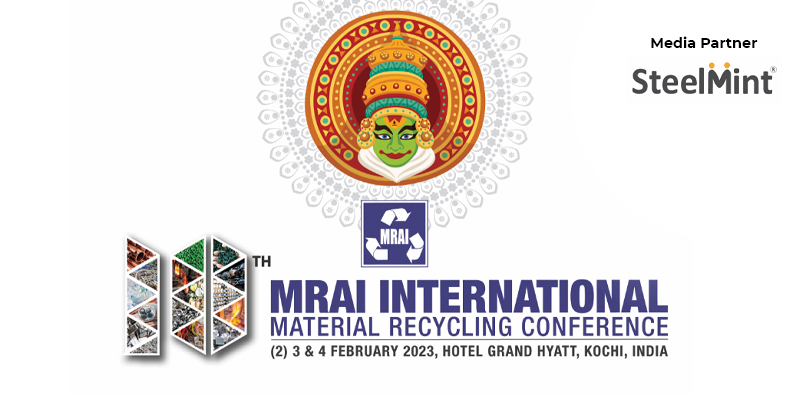
    On average 1600+ Delegates, (including 450 Foreign Delegates) attended the above Conferences. With your continuous trust and overwhelming support, MRAI is organizing its 10th International Indian Material Recycling Conference #IMRC2023 on (2) 3 & 4 February 2023 in Grand Hyatt Kochi, Bolgatty Kerala.

    The event will focus to bring back India and International Recyclers under one roof for Networking and showcasing their business interest, technology, services, new innovations, perspective, etc. 2000 Delegates and 79 Exhibitors representing Recycling Fraternity are expected to attend the 10th IMRC – 2023.

    A Luxury waterfront hotel: Grand Hyatt on Bolgatty Island, Kochi is is at a distance of just 32 km which takes approx.. 40 minute from Cochin International Airport (COK)

    Register button

  • BIR World Recycling Convention – Dubai

    BIR World Recycling Convention – Dubai

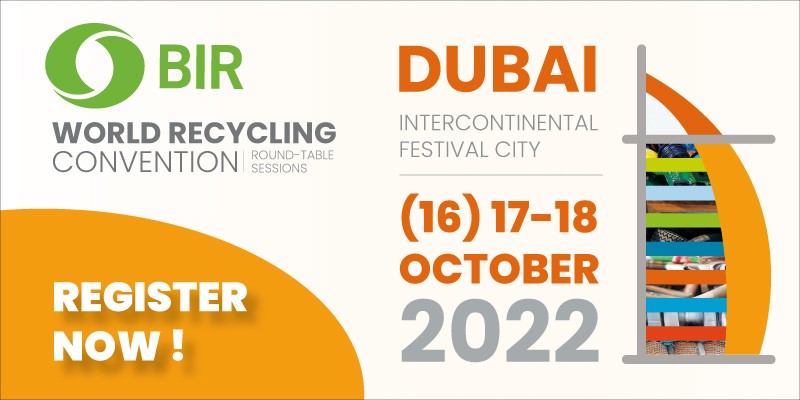
    BIR is returning to Dubai for our World Recycling Convention (Round-Table Sessions), (16) 17-18 October 2022!

    Tapping into the vast business opportunities of the Middle East was one of the many reasons why BIR decided to go back to the coveted conference destination of Dubai. This city never fails to impress and surprise, with constant innovation and superlatives while offering exquisite convention venues with all the amenities that make a business stay feel like a holiday.

    Registration is now open! Register today to access the best rates & hotel availability.

    Register button

  • SteelMint Reports: South Asia, world’s largest ship scrapping yard, has wind in its sails

    SteelMint Reports: South Asia, world’s largest ship scrapping yard, has wind in its sails

    The global ship-breaking or ship recycling industry has witnessed a major shift in recent years owing to environment concerns. On one hand, ship-breaking is a green process wherein a ship at the end of its life cycle is dismantled for further re-use. On the other hand, it is a complex process of dismantling that includes issues like workers’ safety and health aspects and further challenges to the environment.

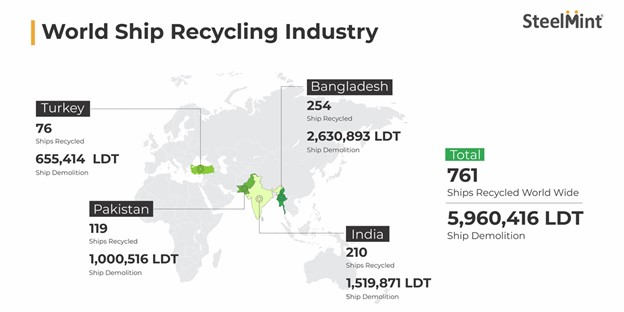
    However, the ship recycling market is gaining momentum annually. A total of 761 ships were broken worldwide in CY2021 against 631 in CY2020, out of which 583 were sold to the beaches in South Asia – the world’s largest ship recycling hub in 2021.

    There has been a noticeable improvement in ship-breaking volumes in 2021. Lockdown restrictions had pulled down import volumes in 2020. Diversion of oxygen for medical purposes also impacted volumes.

    Ships can be classified into six broad categories like general cargo, bulk carriers, oils tankers, passengers ships, drill and war ships. The approximate age or lifespan of a ship is 25-30 years.

    South Asia recycling market

    South Asia has been referred to as the “World’s ship scrapping yard”, with India, Bangladesh and Pakistan collectively dismantling and processing scrapped vessels globally. India, Pakistan and Bangladesh together accounted over 80% share of the global ship recycling market in 2021.

    • India: India, with its natural geographical advantage, recycled 210 ships and demolished 1,519,871 LDT in 2021 as against 203 ships, amounting to 1,757,983 LDT, in the previous year. Similarly, the country demolished 770,000 LDT in H1CY2022 at Alang Port.
    • Bangladesh: Bangladesh recycled 254 ships amounting to 2,630,893 LDT in 2021 compared to 1,843,442 LDT and 144 recycled ships in 2020. In H1CY2022 the country demolished 760,000 LDT of ships at Chittagong Port.
    • Pakistan: Pakistani players recycled 119 ships with a collective tonnage of 1,000,516 LDT in 2021 compared to 778,256 LDT and 99 recycled ships in 2020. In H1CY22 the country demolished 380,000 LDT of ships at Gadani Port.

    Price trends

    • India’s ship-breaking import prices jumped to $525/LDT in 2021 as compared to $360/LDT in 2020, significantly up by $165/LDT.
    • Pakistan’s ship-breaking import prices surged to $544/LDT in 2021 as against $364/LDT in 2020, significantly up by $180/LDT.
    • Likewise, Bangladesh’s ship-breaking import prices rose to $552/LDT in 2021 in contrast to $361/LDT in 2020, significantly up by $191/LDT.

    The average material recovery depends upon the type of material extracted from the ship. Re-rollable ferrous scrap recovery is 67%, meltable ferrous scrap around 12% whereas cast iron is 4% and non-ferrous scrap, 1%.

    HKC and green recycling

    Considering the hazardous nature of the industry, one key obstacle is that there is no fixed legislation to follow. The Hong Kong International Convention for the Safe and Environmentally Sound Recycling of Ships was adopted at a diplomatic conference held in Hong Kong in 2009.

    The convention was adopted to ensure that ships, when being recycled after reaching the end of their functioning lives, do not create any unnecessary hazards to human health, safety and to the environment.

    South Asian countries have decided to ratify and implement the Hong Kong Convention. Towards that, the relevant ministries have drafted regulations to make the ship recycling industry safe for their workers and the environment by implementing the Hong Kong Convention (HKC).

    Outlook

    Amid the current scenario, availability of vessels is limited and prices remain steady due to sluggish economies and low steel demand from end-user industries. As a result, market sentiments are gloomy and buyers cautious.

    But ship-breaking volumes may increase in the short term due to favourable weather conditions which will support increased construction activities. It may be mentioned, a major portion of ship-recycled scrap finds its way into the construction sector.

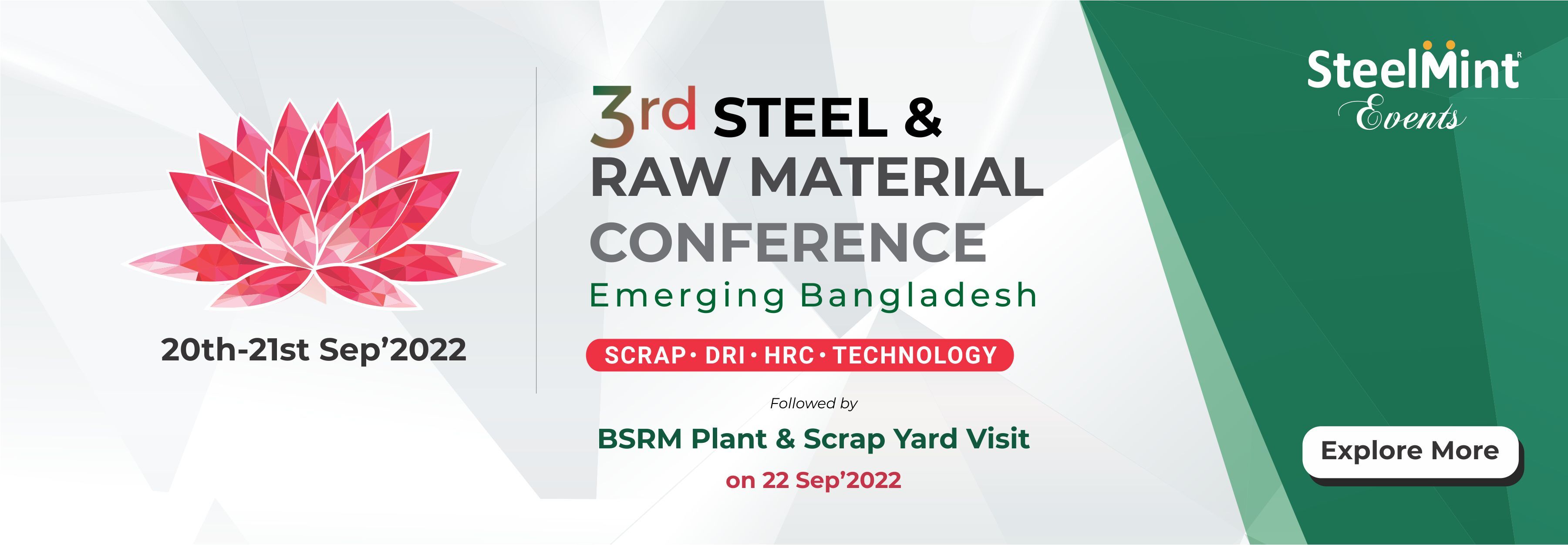
    SteelMint Events will be hosting the 3rd Steel & Raw Material Conference, Emerging Bangladesh, on 20-21 September, 2022 at Hotel Radisson Blu, Chittagong, Bangladesh. The conference will explore key issues like the country’s steel production and demand outlook, global scrap trade flow changes, especially post-the Russia-Ukraine war, the ship recycling scenario, key emerging sectors, price trends and a lot more.
  • BIR World Recycling Convention Week 2020

    BIR World Recycling Convention Week 2020

    Monday, 12 Oct – Friday, 16 Oct 2020, starts at 15:00 (CEST)

    Online commodity webinars and networking sessions

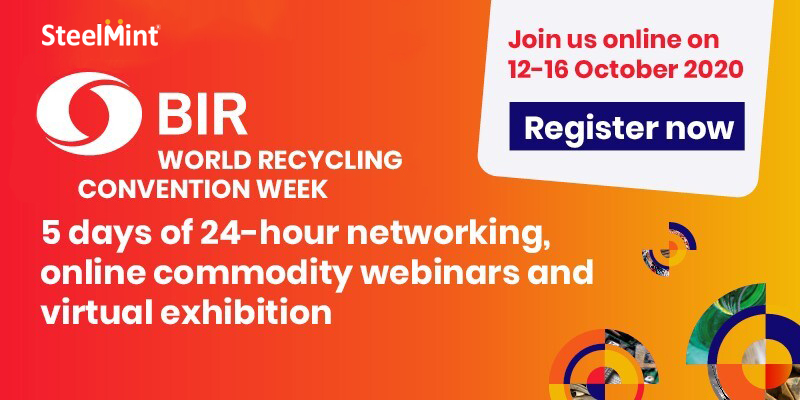
    The BIR World Recycling Convention Week 2020 will be a five-day online event, from 12 to 16 October 2020. You can expect the same quality content as during our face-to-face conventions plus innovative networking opportunities providing a smooth virtual conference experience.

    A safe and successful BIR Convention for all concerned—this is our first priority. Due to uncertainties related to travel restrictions worldwide, the BIR World Recycling Convention 2020 will now take place fully online. This will enable more people to attend and provides participants from all around the world with the opportunity to do business from the comfort of their offices and homes, within their own time zones.

    Don’t miss out!

    Registrations are now open, get your ticket from here!

    Tickets

    a. Gold Member registration – EUR 200.00*

    b. Ordinary Member registration – EUR 250.00*

    c. Non Member registration – EUR 400.00*

  • Bangladesh Observes Sharp Decline in Import of Scrapped Ships in Q3 2019

    Bangladesh Observes Sharp Decline in Import of Scrapped Ships in Q3 2019

    Bangladesh is one of the largest ship-breaking and recycling hubs in the world, which forms an important source of ferrous scrap to the country’s increasingly scrap-dependent steel industry. Bangladesh is on a course of surpassing India to become the country with the largest number of used ships imported in CY 2019.

    However in Q3’2019, the country witnessed a sudden slump in its imports of scrapped ships.

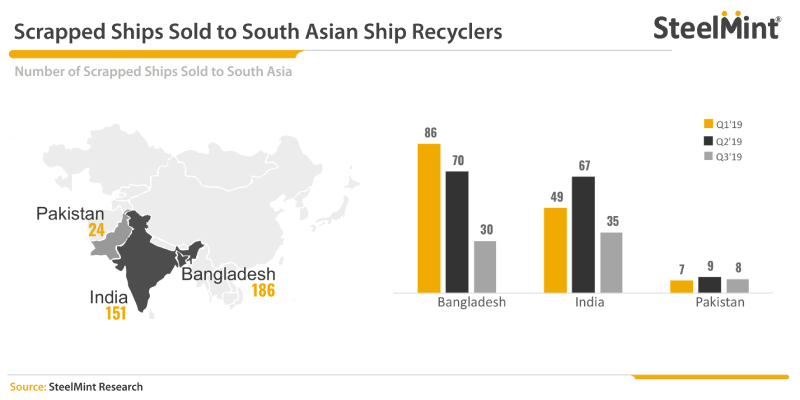
    The number of scrapped vessels imported to Bangladesh for ship-breaking and scrap generation, witnessed a significant fall of 57% Q-o-Q in Q3 CY’2019 with just 30 vessels being imported in the quarter, as against 70 vessels imported in Q2 CY’19, as per data released by NGO Shipping platform. Notably, in Q1’2019, the number of vessels imported stood at 86, the highest quarterly figure as yet.

    The major reasons attributed to the sharp fall in vessel import numbers in Q3 are the new taxes imposed in Bangladesh’s annual budget implemented from July’19, as well as the oversupply in the surplus imports in the preceding quarters. An additional VAT at a specific rate of BDT 1000/Tonne was imposed on import of scrap ships after the implementation of the budget, a change from the initial proposal of the budget in Jun’19, which had  proposed a 5% VAT on the value.

    In anticipation of the tax alterations in this year’s budget, most of the ship-breaking yards in the country had booked scrap vessels in excess, in the preceding Q1 and Q2’19. The surplus scrapped ships after being processed created an oversupply in the local scrap market of Chittagong which lasted for around 3-4 months, thus discouraging recyclers from importing further vessels, amid huge quantities of unsold inventories of scrap.

    The said over supply in the market also pulled down the ship yard scrap prices in the domestic market, with offers for local ship yard scrap, falling from BDT 37,000/MT to 29,000/MT ex Chittagong, within a span of just 3 months in the quarter.

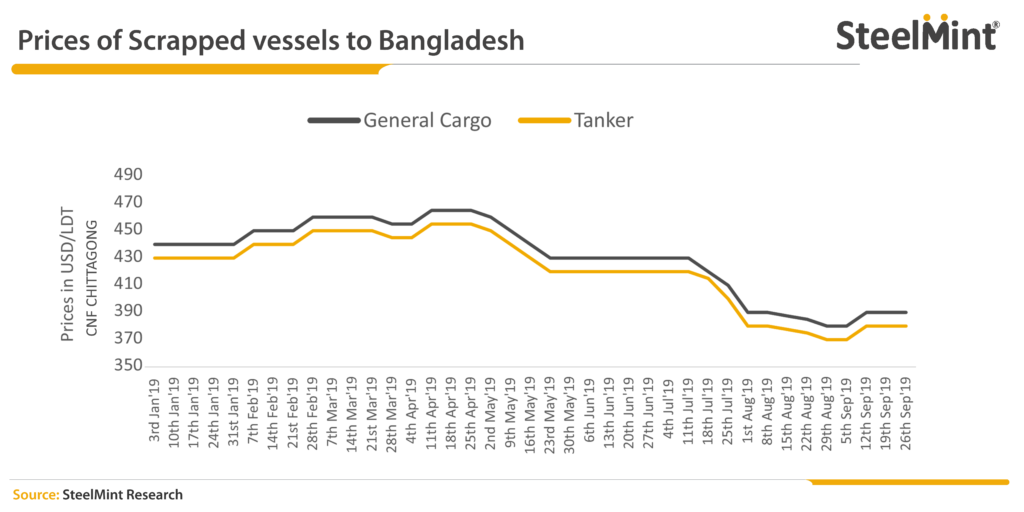
    The severely weakened demand for import of scrapped vessels from a major buyer like Bangladesh led to a continuous fall in its prices, with the offers for Tanker vessels sharply declining from USD 420/LDT CFR Chittagong in the beginning of Q3’19 to around USD 370/LDT CFR by Sep’19.

    On the other hand, for the period of Jan-Sep 2019, Bangladesh has considerably improved against other South Asian markets in terms of number of scrapped vessels imported and even surpassing India for the 1st time. From Jan to Sep’19, Bangladesh imported 186 scrapped vessels, against 151 vessels imported by India, while Pakistan remained at 3rd with just 24 vessels imported till Sep’19.

    In 2018 (Jan-Sep’18) Bangladesh had lagged behind India with 124 scrap vessels being imported during this period, as compared to 195 vessels imported by India. However, even with a significantly lesser number of vessels imported, Bangladesh had surpassed India in terms of total volume of scrapped ships imported, as the country’s volume for imports of scrapped vessels stood at 1.79 Million LDT in Jan-Sep’18, as against 1.46 Million LDT for India, thus indication that Bangladesh imported larger scrapped vessels on an average for recycling.

    To know more about ship recycling industry in Bangladesh book your seat at SteelMint’s 3rd Steel and Raw Material Conference, Bangladesh and get a chance to hear views of renowned industry participants from across the globe. The conference is being organized on 23rd-24th March 2020 in Chittagong, Bangladesh.

    Explore