SteelMint Events

Tag: sponge iron

  • Nepal’s sponge iron imports to hit all-time high in CY’22. What’s next?

    Nepal’s sponge iron imports to hit all-time high in CY’22. What’s next?

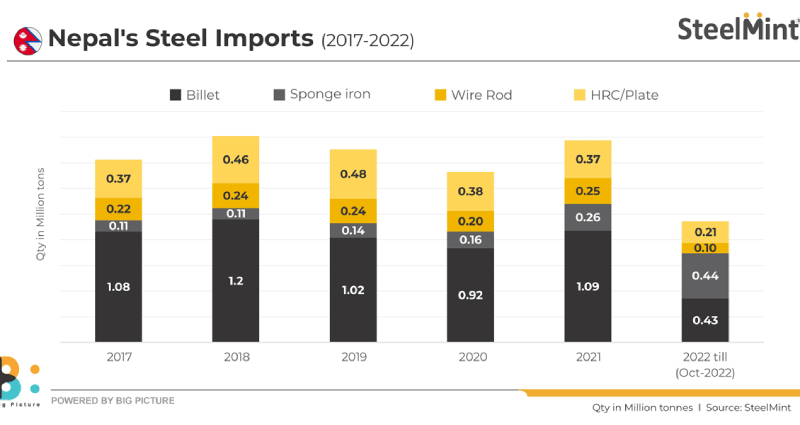
    Nepal, a landlocked nation, has registered significant growth in its metallics (sponge iron and pig iron) imports, as per data maintained with SteelMint. The country’s sponge iron imports rose by 120%, while pig iron imports rallied by 390% during January-October 2022 compared to the same period in the preceding year.

    The country registered about 440,000 t of sponge iron imports and around 41,000 t of pig iron imports during the first 10 months of 2022. Rising melting capacities in the nation is the key factor behind the constant rally in imports.

    Will imports rise further?

    SteelMint, in conversation with several industry leaders, learned that Nepal’s sponge iron imports is likely to reach over 500,000 t in CY’22, which will be a nearly two-fold rise against 260,000 t in CY’21.

    Along with this, pig iron imports are also expected to cross 45,000 t in CY’22, which will be over three-times higher than 12,600 t in CY’21.

    Who are benefitting?

    India is the largest producer of DRI in the world and in terms of imports Nepal has become a major importer of Indian DRI (sponge iron) after Bangladesh in CY22.

    With the rapid expansion in melting capacities in the neighbouring nations, sponge iron producers based in the eastern region (Odisha, Jharkhand and West Bengal) are largely benefiting from this, due to the advantage of logistics via rail, road and sea routes.

    Out of India’s total sponge iron exports, about 90-95% is from eastern India, while the remaining is from the central and southern regions depending on price competitiveness.

    Competitive Indonesian billet, wire rod offers

    With 15% export duty on Indian finished steels including wire rods, Indian wire rod producers of both the IF and BF routes are worried and hardly any deals have been concluded to Nepal due to competitive offers from Indonesia.

    Roughly, the landed cost to Nepal of Indonesian wire rods and billets are cheaper by $100/t compared to Indian material.

    Recently, Nepalese mills have placed another order for wire rods (size 6.5 to 7.0 mm) to Indonesia for a total of around 25,000 t for December or early-January shipments, SteelMint learned from trade sources.

    The deals took place at around $560/t CFR Haldia basis (east Indian port), which is equivalent to $600-605/t CPT Nepal. Earlier, mills in Nepal had booked a total of around 50,000 t of wire rods and around 25,000-30,000 t of billets.

    What’s next?

    Nepal’s steel industry is growing significantly in terms of capacity. The total annual capacity of the industry is about 3.5-4 million tonnes (mnt) per annum and annual steel demand is about 2-2.5 mnt.

    To know more about Nepal’s steel trade dynamics and changing import preferences, book your seat at the 2nd Nepal Steel & Trade Summit on 1-2 March, 2023 at Hotel Soaltee Crown Plaza, Kathmandu and get to hear from renowned industry participants from across the globe.
  • Bangladesh’s sponge iron imports from India to rise further on expanding steel melting capacities

    Bangladesh’s sponge iron imports from India to rise further on expanding steel melting capacities

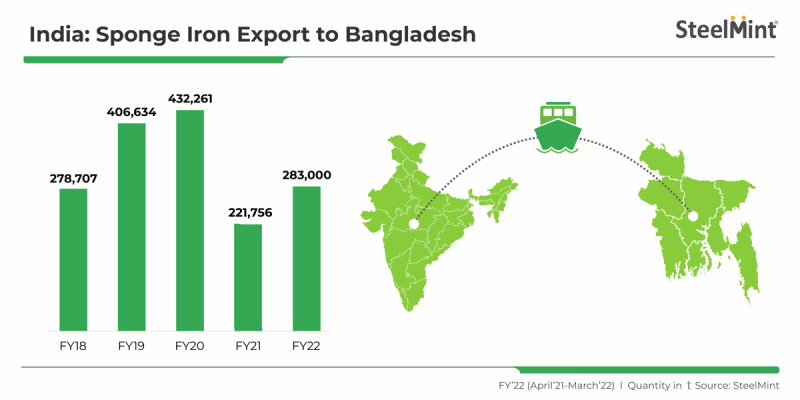
    Sponge iron imports by Bangladesh from India stood at 283,000 tonnes (t) in FY’22 (April’21-March’22). Although Bangladesh’s imports increased sharply from FY’21, volumes were still lower compared to the previous couple of fiscals. Imports, however, are expected to edge up in the coming time on account of rising steel melting capacities in Bangladesh and infrastructure projects in the pipeline.

    Notably, Bangladesh’s financial year starts on 1 July and ends on 30 June. The country’s sponge iron imports were recorded at a meagre 221,756 t in the Indian fiscal year 2021 (FY’21) due to the impact of the COVID-19 pandemic. Meanwhile in the first six months (January-July) of CY’22 the country imported 443,092 t of sponge iron from India, indicating a surge in demand. However, due to LC issues and the liquidity crisis buyers booked limited material during June-July.

    Bangladesh accounts for 41% of Indian sponge exports: Bangladesh has a share of 41% in India’s total sponge exports, with export volumes in FY’22 being recorded at 690,287 t. While Nepal accounts for the largest share – 53% – of India’s exports, Bhutan holds a share of 5%.

    Bangladesh’s sponge import prices: Imported sponge iron prices to Bangladesh stood at an average level of $494/t CNF Chittagong in FY’22.

    Market updates

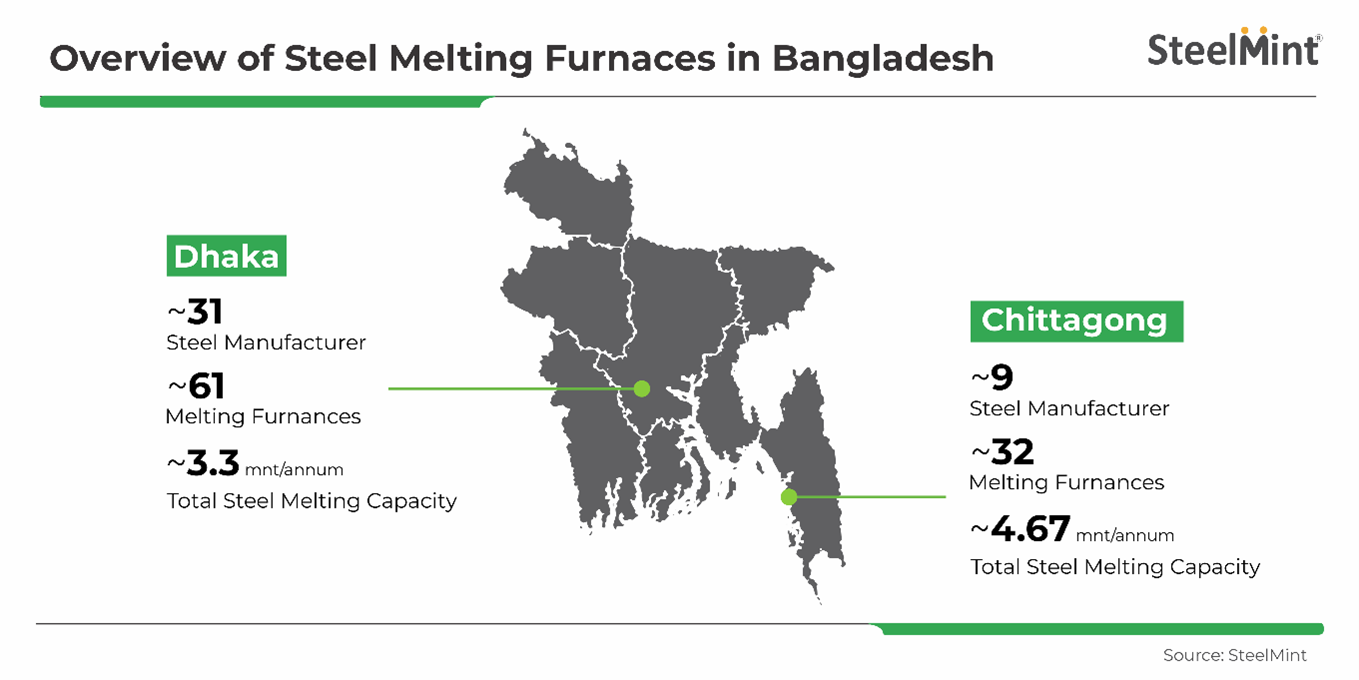
    • Chittagong – home to steel mills: The Chittagong region is the hub of the largest mills in the country, including the top four steelmakers and nine steel companies in all. Mills in the region operate 32 melting furnaces (29 IFs and three EAFs) with a total crude steel capacity of 4.67 mnt (including GPH Ispat’s Quantum EAF).
    • IF mills in Dhaka:  On the other hand, Dhaka has 31 mills in all which are relatively small in size, operating 61 induction furnaces (IF) with a total melting capacity of around 3.3 mnt per annum, while another four induction furnaces are operated by steelmakers in the Comilla region.
    • Furnace sponge-scrap ratio: The ratio of sponge iron in the steelmaking feed depends upon scrap quality. However, the percentage mix of sponge iron in the furnace hovers around 5%.

    As many steel manufacturers in Bangladesh are planning to expand their steel capacities, DRI imports from India are poised to rise further.

    To know more on Bangladesh’s sponge iron imports, book your seat at 3rd Steel & Raw Material Conference, Emerging Bangladesh on 20-21 September, 2022 at Hotel Radisson Blu, Chittagong, Bangladesh, and get a chance to hear renowned industry participants from across the globe on “How are Indian mills managing feed mix of Scrap/DRI/Pig Iron in Induction Furnaces (IF)”.


  • Analysis: Sponge iron producers switch to alternate coal blends amid shrinking margins, resilient import prices

    Analysis: Sponge iron producers switch to alternate coal blends amid shrinking margins, resilient import prices

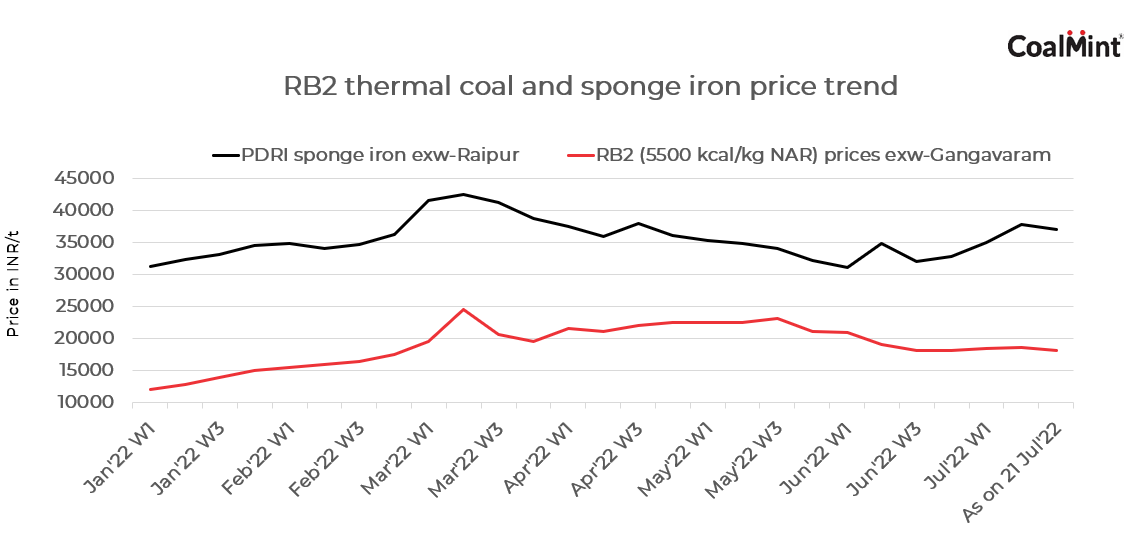
    Depressed sponge iron demand in the Indian domestic market, coupled with elevated South African coal prices and limited availability of domestic coal for the non-power sector, has compelled Indian DRI producers to experiment with coal from Mozambique, Russia, and even Australia.

    In fact, diversion of high-grade South African coal to Europe have already pushed sponge iron units in India to switch from the most popular RB2 (5500 kcal/kg NAR) grade coal from the country to low-CV RB3 (4800 kcal/kg NAR) since the past few months.

    As 4800 NAR has lower fixed carbon content vis-a-vis 5500 NAR, a higher quantity of the former is required to produce one tonne of DRI.

    Shrinking margins of DRI producers due to high South African coal prices have compelled them to look for alternate blends. Although sponge iron prices have picked up since the sharp decline following the government’s introduction of an export duty on steel, any major fall in coal prices has remained limited due to elevated global prices.

    CoalMint learnt from various mill sources that DRI producers are experimenting with various blends of Russian, Mozambican and Australian coal; any blend that fits the bill should have to be one that helps manufacturers tide over sluggish domestic demand and optimise costs of production that have more than doubled in one year.

    Mozambican coal: Steelmaker JSPL, after some initial experiments, has come up with certain findings pertaining to Mozambican VT 1 grade coal (from Vulcan Energy), which is a suitable alternative to South African RB2. About 0.8 t of this coal will be required to produce 1 tonne of sponge iron.

    However, some sponge iron producers in Chhattisgarh informed that while Mozambican coal seems a suitable alternative for DRI, it is low in volatile matter as compared to South African coal, which fails to make it an exact replacement for the latter. In fact, a blend of the two might give sponge iron units the desired results, sources informed. Very low-VM coal affects sponge metallisation rate.

    Russian coal: High-CV Russian thermal coal that is making its way to India at quite cheaper rates has also attracted the attention of sponge iron manufacturers. Although not used widely, experiments by a few indicate that it has South African RB1 grade coal qualities and its good FC and low sulphur content would make it an ideal choice for sponge producers. However, users are not very sure of the exact results and are of the opinion that a blend of South African and Russian coals could give desired outcomes.

    Australian coal: Interestingly, Australian thermal coal, not usually preferred by sponge iron plants because of its very high VM, is now being experimented with by few sponge iron units in south India as they are completely import-dependent.

    While Australian thermal coal is not coming into India in huge volumes since the past few months, a reputed importer, having its own mine in Australia, is heard to be bringing 4400-4600 NAR grade coal with low VM and FC, which is being used in a ratio of 70:30 (5500 NAR S. African: 4600 NAR Australian) for one tonne of sponge iron.

    Concerns persist

    While various blends are a ray of hope for the sponge iron sector, market participants have also highlighted a key concern that these blends make sense against the backdrop of sluggish demand in which plants do not have to function at full capacity and lower yield is expected.

    However, it would be interesting to see if any of these coals or blends can give higher yields during a period of buoyant demand. If successful, this could be a game changer for the sector as better realisations coupled with lower cost of production would help producers improve margins in the long run.

  • India: Sponge iron producers eye alternative Mozambican coal amid tight domestic supply

    India: Sponge iron producers eye alternative Mozambican coal amid tight domestic supply

    At a time when sponge iron manufacturers in India continue to deal with domestic coal shortage, quality issues regarding imported coal, and rampant volatility in prices, a new alternative is likely to emerge in the form of coal shipments from Mozambique.

    Mozambican coal is heard to be of good quality and cost-competitive against South African coal.

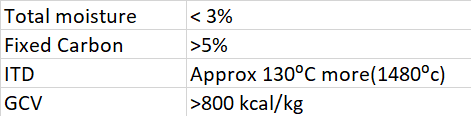
    One of India’s leading steel manufacturers, Jindal Steel and Power Ltd. (JSPL) has taken the initiative to experiment with Mozambican VT 1 grade coal (from Vulcan Energy formerly Vale Mozambique), which has shown positive results in sponge iron kilns of 500 TPD (tonnes per day), 350 TPD and 100 TPD capacities, wherein no mixing or blending is required.

    The coal that has already been used has resulted in average consumption of 800 kg/tonne (t) of sponge iron.

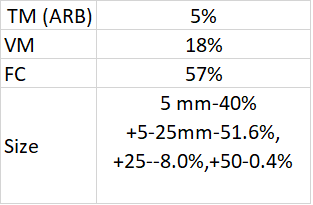
    VT 1 grade specifications:

    The advantages of VT 1 grade over South African RB2 (5500 kcal/kg NAR) used for sponge-making are as under:

    The trial data for 100% usage of VT 1 grade coal in different designs of sponge iron kilns are as follows:

    According to market participants, Mozambican coal is likely to gain more significance in the domestic sponge iron industry as Europe’s strong demand continues to keep South African coal prices high.

    Coal sourced from other origins such as Australia and Russia, however, are unlikely to be utilised as a full substitute for South African or Mozambican stocks.

    JSPL has proposed to maintain approximately 300,000 t of Mozambican coal at key ports around the country including Paradeep, Dhamra, Haldia, Kandla, Gandhi Dham, Raigarh, Angul and Ranchi from where sponge iron manufacturers can buy the coal in their local currency.

    This would mitigate the risk of opening LCs, handling bulk imports, inventory management, etc. The proposal has been suggested till the time coal supplies from domestic miner Coal India normalises.

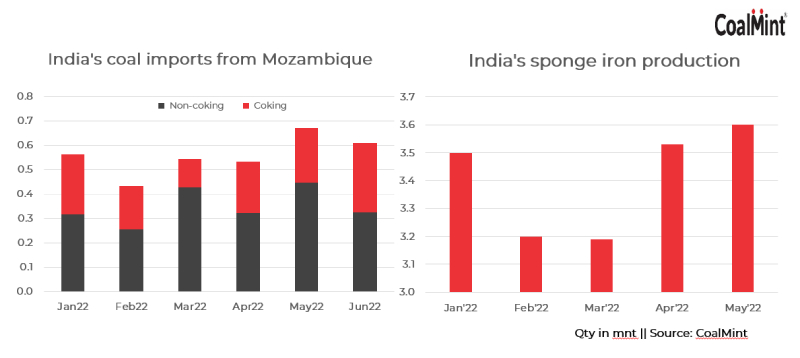
    India’s coal imports from Mozambique

    Major steel and cement companies are the biggest buyers of coal from Mozambique, with the share of thermal coal standing at around 2% and that of coking coal at 1% of India’s total imports in June.

    As per data maintained with CoalMint, the country’s total thermal coal imports from Mozambique was 2 mnt during the first six months of the year, up 109% y-o-y, while coking coal imports stood at 1.3 mnt, up 40% y-o-y.

    To know more about the changing trend of coal usage in the domestic sponge iron industry join us at India Coal Outlook Conference. CoalMint will be hosting the India Coal Outlook Conference on 3-4 August 2022 at The Lalit, New Delhi, to discuss the key issues pertaining to domestic coal production and supply, the government’s objective of controlling imports and domestic supply gap affecting many industries, the need to increase the purchasing power of Indian steel companies in the volatile global coking coal market as well as issues related to decarbonization of the coal value chain.

  • South Africa: Thermal coal exports to India falls 31% in June, overall exports rise marginally

    South Africa: Thermal coal exports to India falls 31% in June, overall exports rise marginally

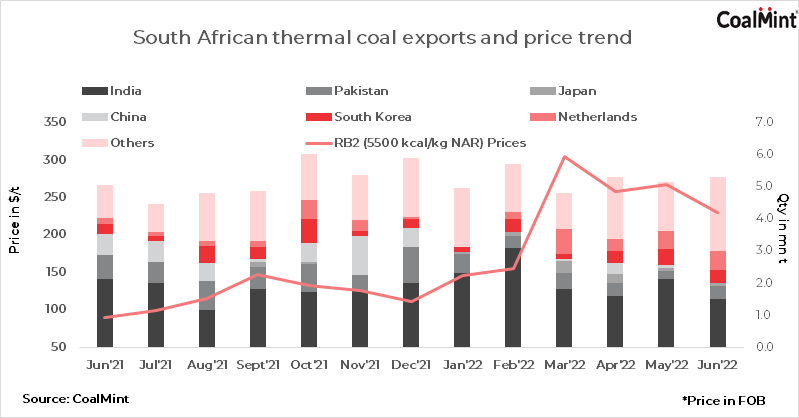
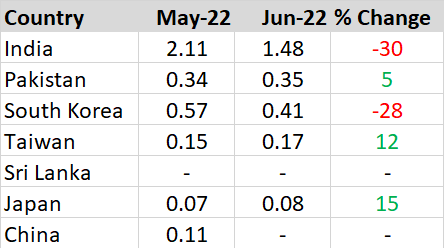
    South African thermal coal exports to India have recorded a steep decline of 30% m-o-m to 1.5 mnt in June, CoalMint vessel line-up data revealed.

    This fall in exports came as the demand from its top consuming sector, sponge iron had turned sluggish after the Indian government announced its decision to impose a hike in export duty on steel in the last week of May.

    While this decision has come with an intention to curb inflationary pressure in the domestic market, the same has made Indian steel less competitive in the export market.

    The domestic sponge iron prices in India, since then have eased by INR 3,000/t and again recovered and are currently assessed at INR 33,300/t exw-Raipur.

    The country’s overall thermal coal exports, however, rose marginally by 2% m-o-m to 5.3 mnt last month as increased demand from Europe offset lower exports to the Asian market.

    Shipments to the European market

    *Qty in mnt

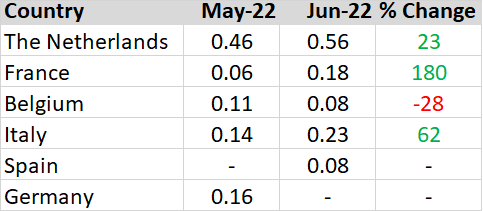
    With the approaching deadline for Russian sanctions to come into effect on Aug 10, European countries have increased their usage of thermal coal wherein South Africa forms a major destination for imports.

    Shipments from the country to Europe have seen a significant rise as exports to The Netherlands have risen by 23%, while that to France by a whopping 180%.

    Shipments to the Asian markets

    *Qty in mnt

    South African coal exports to most Asian markets have remained under pressure over its elevated coal prices.

    Shipments to South Korea fell sharply by 28% last month, while there were no exports to China last month. The strong demand for Russian coal in the Chinese market has led to the decline in imports from other origins.

    Exports to Pakistan recorded a slight rise of 5%. However, a major rise was capped as its local industry focused on importing coal from its neighboring country, Afghanistan.

    Shipments to Taiwan, however, rose by 12% due to their rising demand for coal following Russian sanctions.

    Short-term outlook

    Low-CV (4800 nar) South African coal demand has emerged strongly in the Indian market owing to its competitive prices over mid-to-high CV grades (5500 NAR) that may result in increased vessel arrival in the country in July.

    European demand, on the other hand, remains strong as several countries within the bloc including Germany, Austria, and The Netherlands have announced their plans to increase their coal usage for power generation. This may lead to an increase in South African total coal exports in the near-term.

    To know more about South African coal demand in India and its overall coal export trajecotry for the second half of the year join us at India Coal Outlook Conference. CoalMint will be hosting the India Coal Outlook Conference on 3-4 August 2022 at The Lalit, New Delhi, to discuss the key issues pertaining to domestic coal production and supply, the government’s objective of controlling imports and domestic supply gap affecting many industries, the need to increase the purchasing power of Indian steel companies in the volatile global coking coal market as well as issues related to decarbonization of the coal value chain.