SteelMint Events

Author: SteelMintEvents

  • Bangladesh Observes Sharp Decline in Import of Scrapped Ships in Q3 2019

    Bangladesh Observes Sharp Decline in Import of Scrapped Ships in Q3 2019

    Bangladesh is one of the largest ship-breaking and recycling hubs in the world, which forms an important source of ferrous scrap to the country’s increasingly scrap-dependent steel industry. Bangladesh is on a course of surpassing India to become the country with the largest number of used ships imported in CY 2019.

    However in Q3’2019, the country witnessed a sudden slump in its imports of scrapped ships.

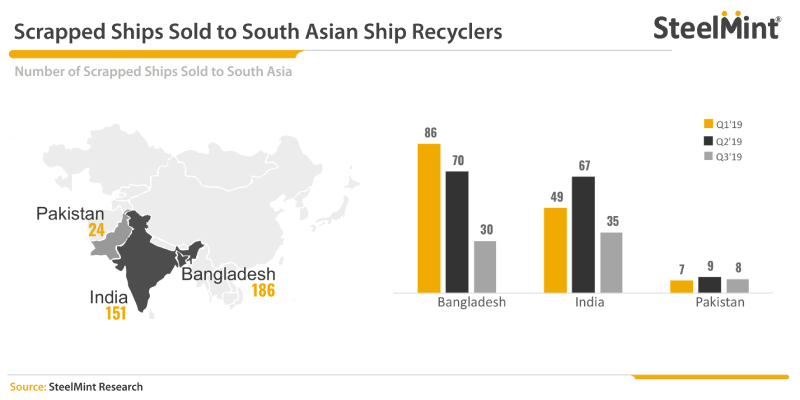
    The number of scrapped vessels imported to Bangladesh for ship-breaking and scrap generation, witnessed a significant fall of 57% Q-o-Q in Q3 CY’2019 with just 30 vessels being imported in the quarter, as against 70 vessels imported in Q2 CY’19, as per data released by NGO Shipping platform. Notably, in Q1’2019, the number of vessels imported stood at 86, the highest quarterly figure as yet.

    The major reasons attributed to the sharp fall in vessel import numbers in Q3 are the new taxes imposed in Bangladesh’s annual budget implemented from July’19, as well as the oversupply in the surplus imports in the preceding quarters. An additional VAT at a specific rate of BDT 1000/Tonne was imposed on import of scrap ships after the implementation of the budget, a change from the initial proposal of the budget in Jun’19, which had  proposed a 5% VAT on the value.

    In anticipation of the tax alterations in this year’s budget, most of the ship-breaking yards in the country had booked scrap vessels in excess, in the preceding Q1 and Q2’19. The surplus scrapped ships after being processed created an oversupply in the local scrap market of Chittagong which lasted for around 3-4 months, thus discouraging recyclers from importing further vessels, amid huge quantities of unsold inventories of scrap.

    The said over supply in the market also pulled down the ship yard scrap prices in the domestic market, with offers for local ship yard scrap, falling from BDT 37,000/MT to 29,000/MT ex Chittagong, within a span of just 3 months in the quarter.

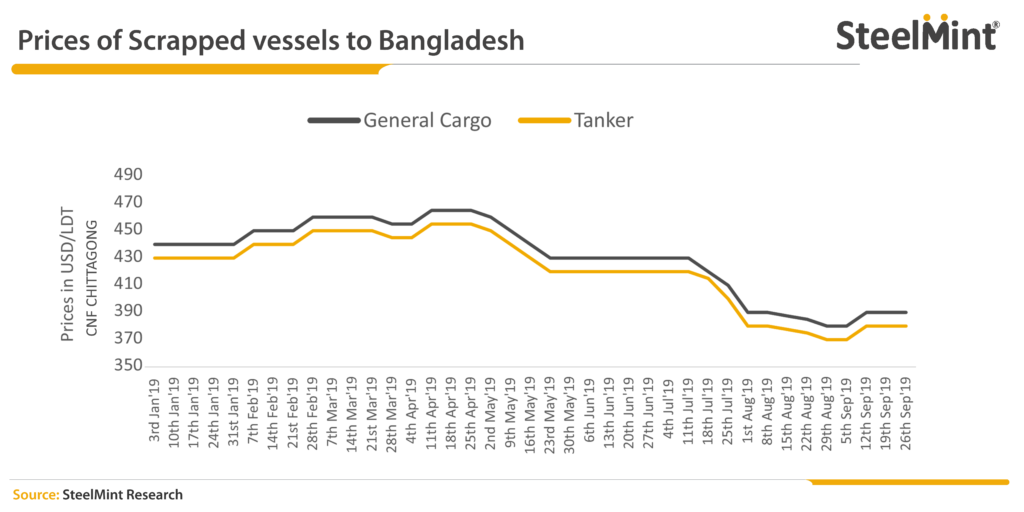
    The severely weakened demand for import of scrapped vessels from a major buyer like Bangladesh led to a continuous fall in its prices, with the offers for Tanker vessels sharply declining from USD 420/LDT CFR Chittagong in the beginning of Q3’19 to around USD 370/LDT CFR by Sep’19.
    On the other hand, for the period of Jan-Sep 2019, Bangladesh has considerably improved against other South Asian markets in terms of number of scrapped vessels imported and even surpassing India for the 1st time. From Jan to Sep’19, Bangladesh imported 186 scrapped vessels, against 151 vessels imported by India, while Pakistan remained at 3rd with just 24 vessels imported till Sep’19.

    In 2018 (Jan-Sep’18) Bangladesh had lagged behind India with 124 scrap vessels being imported during this period, as compared to 195 vessels imported by India. However, even with a significantly lesser number of vessels imported, Bangladesh had surpassed India in terms of total volume of scrapped ships imported, as the country’s volume for imports of scrapped vessels stood at 1.79 Million LDT in Jan-Sep’18, as against 1.46 Million LDT for India, thus indication that Bangladesh imported larger scrapped vessels on an average for recycling.

    To know more about ship recycling industry in Bangladesh book your seat at SteelMint’s 3rd Steel and Raw Material Conference, Bangladesh and get a chance to hear views of renowned industry participants from across the globe. The conference is being organized on 23rd-24th March 2020 in Chittagong, Bangladesh.

    Explore

  • Bangladesh Coal Imports Hit All-Time High in Oct’19 – CoalMint

    Bangladesh Coal Imports Hit All-Time High in Oct’19 – CoalMint

    Domestic coal supplies in Bangladesh has been under scrutiny ever since government’s decision to halt coal sales to the local industries was imposed back in Mar’18, which have paved way for subsequent higher coal imports.

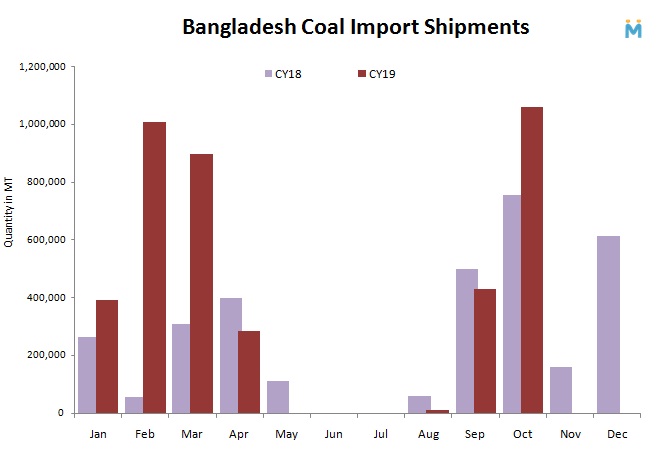
    Incidentally, Coal Shipments taken by the country have recorded a mammoth total during Oct’19, thereby helping the country to overtake the total imports registered in CY18.

    Data compiled by CoalMint research indicates that Bangladesh coal imports had attained its highest-ever total since the period from which vessel line-up information for the country was started.

    Coal Intake in Oct’19 was recorded at 1,061,867 MT rising 148% on the month from 428,585 MT in Sep’19.

    Bangladesh had made a slow start post monsoon, wherein after recording nil imports during May-Jul’19 only 10,000 MT coal was bought in the month of Aug’19. However, the exponential monthly rise in Sep’19 was subsequently followed by relatively superior imports in Oct’19, thereby helping the country to overtake the coal volume acquired in CY18 with two months to spare.

    In the first 10 months of CY19 (Jan-Oct’19), Bangladesh coal imports have reached 4,084,475 MT which was 28% higher than 3,220,882 MT noted in the whole period of CY18.

    There has been no sign of immediate resumption of coal supplies asserted by the latest updates provided by Barapukuria Coal Mining Company. Notably, whole 659.75 MT coal produced under its belt was solely delivered to the coal based station operated by Bangladesh Power Development Board (BPDB) as on 13 Nov’19, thus continuing the trend being followed after the ban was imposed.

    Major Coal Suppliers:

    The record import volume in Oct’19 was majorly catered from Indonesia, which remained Bangladesh’s preferred source for coal demand. Supplies from Indonesia rose 46% M-o-M to 624,690 MT in Oct’19, which was also marked 6% higher on the year from 590,450 MT in Oct’18.

    Coal receipt from South Africa also recorded its highest-ever monthly total in Oct’19, noted at 375,216 MT. Apparently, coal shipment from the country was seen after a gap of 6 months.

    Besides, first coal shipment from Mozambique in CY19 was also reported in October, which had supplied the remaining coal volume during the month.

    Country Oct’19 Sep’19 % Change
    Indonesia 624,690 428,585 46%
    South Africa 375,216
    Mozambique 61,961
    Grand Total 1,061,867 428,585 148%

    Source: CoalMint Research
    Quantity in MT

    Although, major portion of the coal imports are utilized by country’s brick manufacturers, coal demand in Bangladesh is expected to be supported by a series of coal-fired power stations slated to come online in the coming years.

  • Bangladesh to Add 17,304 MW Power Capacity to Meet its Energy Requirement

    Bangladesh to Add 17,304 MW Power Capacity to Meet its Energy Requirement

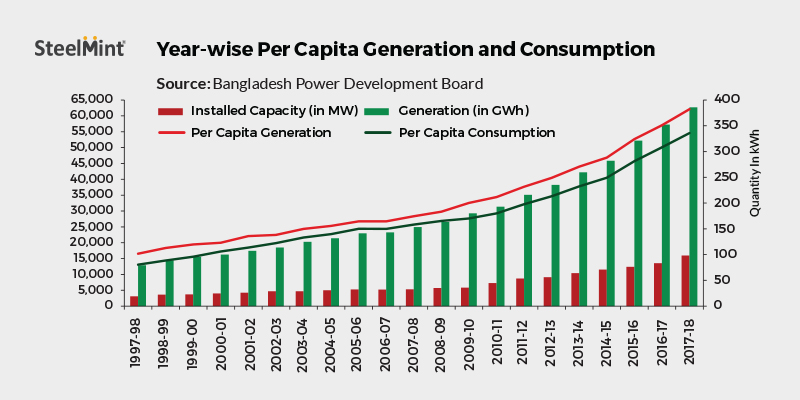
    In order to mitigate the demand-supply gap, Bangladesh has planned a massive expansion in power sector to cater its rising electricity demand. The road-map prepared by the government envisage around 17,304 MW new generation capacity addition by 2023.

    Incidentally, power sector is one of the booming sectors in the country, wherein largest energy consumers are residential sector, followed by industries, commercial and agricultural sectors.

    Out of the total capacity addition, 9,393 MW power units would be installed under public sector, followed by another 6,075 MW in private sector power plants, as depicted under the revised expansion plan updated in Jul’19. Remaining 1,836 MW would be catered by imports.

    For a longer run, the country has formulated a systematic expansion for growth in power sector, under the Power System Master Plan (PSMP) 2016. The underlying plan compiled for a period running from 2016 to 2041, also includes strategy for diversifying primary fuel supply.

    PSMP 2016 indicates that generation capacity requirement in 2021 would be 21,000 MW against the demand of 14,500 MW, in 2030 capacity requirement would increase to 31,000 MW against the demand of 27,400 MW and by the end of 2041 it would rise to 57,000 MW against the demand of 51,000 MW.

    At present, power generation from gas based plants is comparatively much higher than other fuels, which often fail to reach their usual capacity due to shortage of gas supply. Consequently, the country has taken up the decision to diversify primary source of fuel in order to reduce dependency on gas based power generation.

    By the end of 2041, Bangladesh is aiming to raise share of coal fired power generation to 35% at the expense of gas based generation which would be brought down to 35%. Remaining share accounted to power imports and generation from nuclear and renewable sources.

    Power Plant Performance in FY19

    Bangladesh’s power generation capacity has increased to 18,961 MW by the end of Bangladeshi fiscal year 2018-19 (Jul’18-Jun’19), recording an annual increment of 18.86% Y-o-Y.

    Despite claims of reducing dependency on gas based power, largest capacity addition was seen in power plants running on gas.

    Apparently, no capacities were added under coal based power station, thereby further reducing its share in total installed capacity. The country is, however, set to begin operation at its first imported coal based power plant in Jan’20 with the commissioning of Payra plant having an installed capacity of 1320 MW.

    Source FY19 FY18
    Installed Capacity % Share in Total Installed Capacity % Share in Total
    Gas 10877 57.37% 9713 60.89%
    Furnace Oil 4770 25.16% 3443 21.58%
    Diesel 1370 7.23% 1380 8.65%
    Power Import 1160 6.12% 660 4.14%
    Coal 524 2.76% 524 3.28%
    Hydro 230 1.21% 230 1.44%
    Solar PV 30 0.16% 3 0.02%
    Total 18961 100% 15953 100%

    Source: Bangladesh Power Development Board
    Quantity in MW

  • China-Funded Mega Power Plant Set to Strengthen Bangladesh’s Power Generation Capacity

    China-Funded Mega Power Plant Set to Strengthen Bangladesh’s Power Generation Capacity

    Bangladesh’s newly-constructed first unit of Payra coal-fired power plant has been completed and is scheduled to start commercial operation in December this year.

    We have a target to add 660 MW electricity from the first phase of 1,320 MW Payra power plant to the national grid from December 31 this year,” stated the country’s State Minister for Power, Energy and Mineral Resources Nasrul Hamid.

    “With the generation of 660 MW, the country’s power generation capacity will stand at 23,222 MW,” he added.

    The Payra Power Plant, located at Kalapara upazila in Patuakhali district of southern Bangladesh, consists of two 660MW ultra-supercritical coal-fired power generating units. Construction on the project started in late December 2017 at an estimated cost of USD 2 billion.

    Upon completion, the power plant will be operated by Bangladesh-China Power Company Limited (BCPCL), a joint venture firm of the Bangladeshi state-owned North-West Power Generation Company Limited (NWPGCL) and China National Machinery Import and Export Corporation (CMC).

    Notably, Bangladesh has at least 29 coal-fired power projects with a total capacity of 33,200 MW in pre-construction and under construction phases as of July this year.

    In addition to UK- and Japan-based companies, Chinese banks and companies are the leading driving force behind the planned coal-based power projects in Bangladesh.

    At present, the 525 MW Barapukuria subcritical plant in Dinajpur district is the only operational coal-fired plant in Bangladesh.

    Most of the proposed coal projects plan to use imported coal for power generation. Deep sea ports planned at Payra in Patuakhali district and Matarbari in Cox’s Bazar district would be required to import coal from Australia, India, Indonesia, and South Africa.

  • Bulk Ferrous Scrap Imports to Bangladesh Surge 39% in Jan-Oct 2019

    Bulk Ferrous Scrap Imports to Bangladesh Surge 39% in Jan-Oct 2019

    Bangladesh, an emerging steel market and one of the growing importers of ferrous scrap in Asia, has witnessed a sharp increase in bulk ferrous scrap imports in 2019.

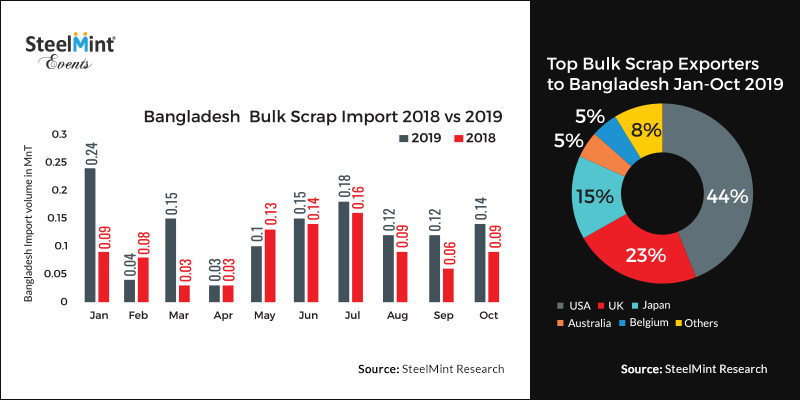
    During the period of Jan-Oct’19, bulk scrap imports to Bangladesh have been recorded at 1.25 MnT, witnessing a significant increase by 39% Y-o-Y as compared to 0.90 MnT during the same period Jan-Oct’18.

    Rising melting capacities and expansion plans of major steelmakers in the country has led to an increased ferrous scrap demand, while even more steelmakers are now turning active in booking scrap through bulk cargo vessels, as compared to only two major steelmakers booking bulk scrap till last year.

    46 bulk scrap vessels arrived at berth – So far in 2019, a total of 46 bulk vessels of ferrous scrap arrived on berth in Bangladesh’s sea port, which is again a sharp increase against 31 bulk vessels last year (Jan-Oct’18).

    USA remained the largest bulk scrap supplier – In terms of preferred origins for bulk scrap to Bangladesh, USA has remained the largest supplier in 2019 as well with 0.55 MnT as yet, however its share in total bulk scrap imported to Bangladesh has come down to 44% in 2019 (Jan-Oct) from 68% during Jan-Oct’18. However share of origins like UK, Japan and Australia considerably increasing their share this year.

    Increased preference for UK & Japanese scrap cargoes – In particular, bulk scrap imports share from UK has increased from 13% in Jan-Oct’18 to 23% in Jan-Oct’19. Interestingly, out of the 47 bulk vessels with scrap that have come to berth at Chittagong port this year, Japan has a contribution of 13 bulk vessels with nearly 0.2 MnT, recording a two-fold jump against same time span last year.

    In Oct 2019, bulk scrap imports to the country witnessed an increase by 19% M-o-M.

    After govt imposed import duty made billet imports to Bangladesh non viable since 2015, scrap imports gradually went on to completely replace billet imports to Bangladesh by 2018. Further, the share of bulk vessels in the total scrap imports to the country has also been observing an increase since then.

    To know more on Bangladesh scrap imports, book your seat at SteelMint’s 3rd Steel and Raw Material Conference, Bangladesh and get a chance to hear views of renowned industry participants from across the globe. The conference is being organized on 23rd-24th March 2019 in Chittagong, Bangladesh.

    Explore