SteelMint Events

Author: SteelMintEvents

  • Bangladesh proactively eyeing greener routes in power to achieve emission targets

    Bangladesh proactively eyeing greener routes in power to achieve emission targets

    • Strong emphasis being given to solar energy
    • Setting up of fresh coal-fired plants banned
    • More hydropower imports from Nepal planned
    Bangladesh, a key South Asian player in the steel manufacturing and ferrous scrap import space, is taking a proactive multi-pronged approach in its power sector to reach its emission targets.
    It is not only encouraging renewable energy (RE) expansion but has banned further setting up of coal-fired power plants.

    As per Climate Watch data, Bangladesh’s greenhouse gas emissions nearly doubled in 2018 from a decade ago although it remains a small emitter at a global level.

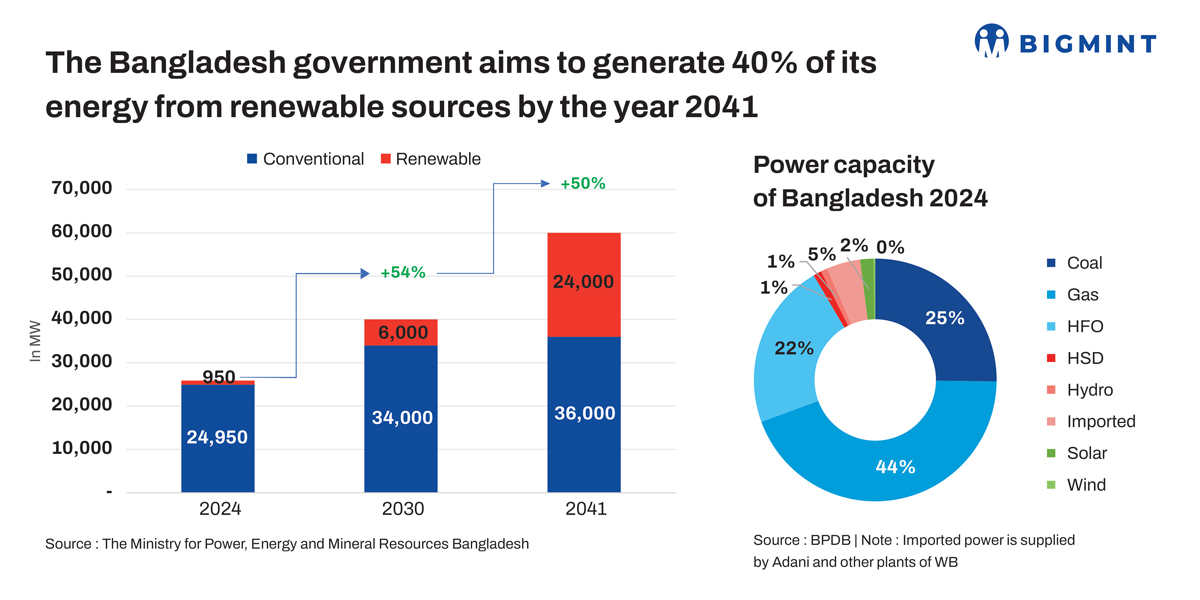
    Its Ministry of Power, Energy, and Mineral Resources announced a few years back that Bangladesh aims to generate 40% of its electricity from clean energy sources by 2041, a key component of the country’s long-term strategy for the power sector.

    State Minister for Power, Energy, and Mineral Resources, Nasrul Hamid, outlined that this plan involves importing about 9,000 MW through regional cooperation with neighboring countries.

    Additionally, the government has set a target to derive 10% of the total power generation from renewable sources by 2041. Currently, Bangladesh’s power generation capacity stands at 25,826 MW, with 1,160 MW being imported, mostly through hydropower from Nepal and Bhutan.

    The installed capacity of renewable energy in Bangladesh has risen to 950.72 MW.The government is confident in achieving a power generation capacity of 40,000 MW by 2030 and 60,000 MW by 2041, with a significant focus on renewable energy and regional energy cooperation.

    Current power sector scenario
    Bangladesh has an installed capacity of around 26,000 MW while its actual generation comprises around 14,300 MW.
    Its power demand varies according to season. In summer, the peak demand season, consumption hovers around 16,000-18,000 MW. Winter, the lean period, sees demand dropping to 9,000-10,000 MW.
    Within the 14,300 MW of current demand, the major chunk of 30-40% is contributed by gas-based power generation while 20-25% is coal based, 18-20% is HSFO (high sulphur fuel oil)-based, and the balance 3-5% comprise of renewables.
    But, due to higher tariffs, HSFO-based power plants are not being encouraged by the government.
    Gas-based plants contribute the highest to power generation essentially because of their comparatively higher efficiency level. The country sources locally from its own gas fields. The deficit in LNG is met through imports from the Middle East and Singapore. At present, the total LNG requirement is 3,500 MMcfd with which domestic production amounts to 2,700 MMcfd and the balance 800 MMcfd are imported.
    HSFO-based power generation comprises around 7400 MW. But tariffs here are quite high compared to gas or solar.

    While the bulk is contributed by gas, the share of coal-fired generation has been increasing steadily since 2019.

    According to Bangladesh Power Development Board (BPDB) official statistics, new power plants that are either already connected to the grid or are in the process of being linked will contribute significantly to the energy supply. The additions include:

    • 1,600 MW from Adani Group’s coal-fired power plant
    • 620 MW from the Rampal Power Plant
    • 1,224 MW from S Alam Group’s coal-fired power plant in Bashkhali, Chittagong
    • 718 MW from Reliance Power’s LNG-based plant in Meghnaghat
    • 590 MW from GE-Summit Meghnaghat-2’s LNG-based power plant
    • 584 MW from Unique Group’s LNG-based power plant, also in Meghnaghat.

    These new power sources represent a diverse mix of energy, with coal-fired plants providing a significant portion, alongside growing contributions from LNG-based facilities.

    How will Bangladesh’s power landscape change by 2030?
    Increased share of solar: The government is aiming to raise the share of RE generation from the present minuscule 3-5% to 15-20% by 2030. To achieve this target, the government is planning to encourage setting up of smaller solar power units along with 100-megawatt (MW) projects wherever land is available. The key challenge here lies in land scarcity. Thus, local power producers are trying to make the best use of available land, a source in Bangladesh informed. The common practice now is to seek around 400 acres of land parcels for setting up 100-MW solar projects. At present, around 100 MW is seen contributed by solar/RE sources.
    A few solar projects are underway. These include the Arabian Company for Water and Power Operations’ 300-MW solar power project and Sumitomo’s solar PP.
    “If we consider the next 5-6 years then solar power plants will be more in focus,” a source in Bangladesh observed to BigMint.
    Offshore wind project viability study underway: The country is also eying offshore wind projects but because of inadequate wind speeds in Bangladesh such projects may not be very viable. However, a feasibility study is under way for an offshore wind power project through the Bangladesh China Power Company Limited (BCPCL), a joint venture between Bangladesh’s North-West Power Generation Company (NWPGCL) and China National Machinery Import and Export Corporation.
    Government halts new coal-fired plants: The government has implemented a pause on the establishment of new coal-fired power plants, with several significant ongoing projects, such as the 1200×2 MW Matarari project, the 1320×2 Rampal project, and the 1320-MW Payra power plant, discontinuing their phase two construction.
    Nuclear plant on way: Bangladesh is also constructing the 3000-MW Rooppur Nuclear Power Plant (RNPP) in Pabna district — a significant infrastructure project currently underway. Once it comes into operation it will help to cover the deficit of 2,400-3,000 MW.
    As per government data, an additional 6,000-7,000 MW would come in, including the nuke plant, by 2026-27.

    Imports of greener source of power to increase: The government is in talks with Nepal for increasing imports of hydropower to broaden the green energy basket and help it reach closer to its emission goals. At present, Bangladesh is importing around 40 MW of hydropower from Nepal and the rest from India (700 MW from Adani Power and around 100 MW from the eastern part of India).

    Outlook
    Bangladesh’s power demand is expected to increase from the current levels to 33,000 MW by 2030, impelled by higher economic growth and further industrialization.

    Emphasis on HSFO-based generation is likely to wane because of the higher tariffs.

    Looking ahead, solar tariffs are likely to be competitive and remain contained in the range of 10-11 cents per unit since many players are jostling for space here. “The lower the tariffs quoted here, the higher the chances of receiving government approval,” informed a source in Bangladesh.

    4th Bangladesh International Trade Summit

    Bangladesh, a strategically significant country for Asia-Pacific, is emerging as a hotspot of growth through sustainable practices. The economic expansion is expected to encourage the participation of more global companies and attract forex for the country.

    BigMint Events will be hosting the 4th Bangladesh International Trade Summit on 14-15 May 2024, at Hotel Pan Pacific Sonargaon, Dhaka, Bangladesh. The two-day conference shall bring together key stakeholders from the steel, cement, and power industries, including industry stalwarts, policymakers, traders, and investors. It shall provide a network for collaboration and an ideal platform for discussion of prevailing industry trends and challenges.

  • FLAT STEEL 2024 17 Oct, 2024 |  Istanbul, Turkey

    FLAT STEEL 2024
    17 Oct, 2024 | Istanbul, Turkey

    About the Conference
    Global steel demand fell for a consecutive year in 2023 and is projected to see only a small rebound in 2024 as economies continue to grapple with the Ukraine war impact, high inflation, high costs and monetary tightening. The geopolitical scenario has deteriorated even further since the outbreak of war in Gaza and the investment climate remains shaky amid fears of conflict escalation in the Middle East.

    China’s post-Covid demand rebound was a damp squib last year, and post-Lunar New Year demand failed to materialise this year, with market players still awaiting the impact of Chinese government support measures. Chinese steel exports consequently continue to climb in 2024 after seeing a seven-year high in 2023. Chinese product is displacing HRC in other Asian markets. This has resulted in the EU’s “other country” quota for HRC being exhausted within days for multiple quarters. Last year, Japan, Taiwan and, especially, Vietnam increased their HRC shipments to the bloc.

    India is adding HRC capacity at pace, in anticipation of booming domestic demand after the stifling general election impact subsides. It, too, has seen sizeable imports from China and is eyeing the higher-paying EU market for exports of its HRC, frequently exhausting its quota.

    The first quarter of the year saw iron ore and HRC prices drop across the globe, with much talk of Chinese production cuts but thus far no action. EU mills are meanwhile being forced to cut production amid higher costs and imports taking a growing market share.

    The major flat steel-consuming automotive sector is expected to see weak growth at best in 2024 after being the only bright spot in 2023.

    Kallanish Flat Steel 2024 will debate the most important trends impacting the global flat steel market in order to understand what the industry has in store.

    Global Overview: Regional coil markets supply, demand and price trends
    Raw materials: Pricing developments and impact on flat steel market
    End-user demand: Impact of rising costs, inflation, and supply chain risks
    Overcapacity: Analysis of the longer-term global market trends
    Green transition: Challenges of sustainable steel industry decarbonisation
    Energy costs: Impact of higher energy costs on production
    China: will a demand rebound materialise? Will it cut production?
    EU production: will offline capacity be recommissioned amid high costs?
    European policy: How will CBAM account for EU mills’ export competitiveness?
    US: When will much-anticipated interest rate cuts materialise and boost sentiment?

     
    𝐅𝐨𝐫 𝐚𝐧𝐲 𝐈𝐧𝐪𝐮𝐢𝐫𝐢𝐞𝐬, 𝐜𝐨𝐧𝐭𝐚𝐜𝐭 𝐮𝐬 𝐚𝐭: Yashika Agrawal | [email protected] | +91 9993903483

    Website  | Registration

  • SUSTAINABLE MINING SUMMIT 13-14 June, 2024 |  Mayfair Lagoon, Bhubaneswar (Odisha)

    SUSTAINABLE MINING SUMMIT
    13-14 June, 2024 | Mayfair Lagoon, Bhubaneswar (Odisha)

    Rapid growth in population, need to improve living standards and focus on renewable energy transition has led to huge demand for mineral resources. Minerals are the basic building blocks for a sustainable world and mining industry plays a pivotal role in meeting the ever increasing demand for minerals and metals, necessary to improve quality of life. On the other hand, there are huge expectations that mining be done sustainably while addressing the complexities of socio-economic development, benefit sharing with stakeholders, mitigating climate change and impacts on the environment.

    To achieve India’s ambitious target of reaching net-zero by 2070, the Indian mining sector is striving to adopt clean energy decarbonization methodologies to reduce greenhouse gas emissions. There are several aspects available to decarbonize the sector, which includes energy efficiency, fuel switching, use of electric vehicles in mining, process modifications, material circularity, and resource efficiency. Hence, it is necessary to develop a roadmap, to integrate such initiatives for decarbonizing the sector.

    Along with this, it is also necessary to design mining operations with latest innovative technology towards the goal of ‘Atmanirbhar Bharat’. Digitalization and Artificial Intelligence (AI) technology can improve health, safety and environmental impact thus saving lives, reducing injuries, lowering emissions and waste, and increasing transparency and sustainability. The Indian mining industry has to take the lead in innovation in data-driven emerging technologies and incorporate digitization, automation and Internet of Things (IoT) systems for enhancing operational efficiencies.

    In this background, FIMI is organizing the Sustainable Mining Summit 2024 at Hotel Mayfair Lagoon, Bhubaneswar on 13-14 June, 2024. The summit aims to deliberate on various mining issues concerning sustainability, which will result in formulation of road-map for sustainable mining in India. Various stakeholders, including Government agencies, regulators, industry stalwarts, practicing managers, NGOs, academicians and strategists are expected to come together on this platform to deliberate on these very important issues at this turning point in the Indian Mining History.

    𝐅𝐨𝐫 𝐚𝐧𝐲 𝐈𝐧𝐪𝐮𝐢𝐫𝐢𝐞𝐬, 𝐜𝐨𝐧𝐭𝐚𝐜𝐭 𝐮𝐬 𝐚𝐭: Yashika Agrawal | [email protected] | +91 9993903483

    Website  | Registration

  • Bridging the Energy Gap: Bangladesh’s Strategic Pivot to Imported Coal

    Bridging the Energy Gap: Bangladesh’s Strategic Pivot to Imported Coal

    • Imported coal usage increasing at power plants
    • Scarce natural gas supplies support imports
    • Thermal coal imports may touch 19 mnt by 2026

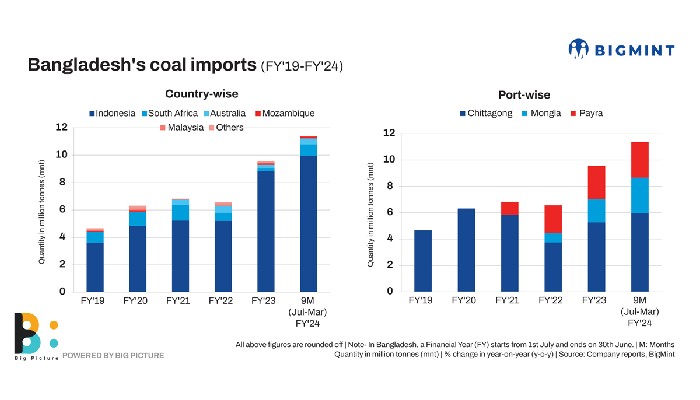
    Morning Brief: In the midst of its escalating energy demand, Bangladesh has witnessed a significant 44% y-o-y increase in coal imports in the Financial year 2023 (FY’23), reveals BigMint data. Volumes surged to nearly 12.75 million tonnes (mnt) last year compared to 8.83 mnt in FY’22, underscoring the nation’s growing reliance on imported coal.

    Factors pushing up coal imports

    Increased demand from power sector: The increase in coal imports can be attributed to several factors. Notably, a key reason lies in the heightened requirement of imported coal for power generation. Inflation-related issues and coal supply shortages have been leading to electricity disruptions. With the addition of the Matarbari power plant in the current fiscal year, demand for coal has experienced a remarkable upsurge. In fact, six power plants across the country are now operational, utilising imported coal as a primary fuel source.

    Natural gas shortfall: Bangladesh has also been experiencing a persistent shortage in domestic fuel supply, notably evident in the natural gas sector. Despite its historical dominance, the country’s natural gas reserves struggle to meet escalating demand, leading to a greater reliance on coal and imported natural gas. In a latest development, Petrobangla has invited bids for oil and gas exploration wherein nine shallow-sea and 15 deep-sea blocks have been put on offer.

    Nonetheless, given the time required to develop these gas blocks, coal appears to be a viable option to meet the growing energy needs of the country in the near term.

    Insufficient domestic coal supplies: In response to the surging energy demands, Bangladesh has witnessed a remarkable increase in domestic coal production, notably facilitated by the Barapukuria Coal Mining Company Limited (BCMCL). Several factors have contributed to this surge, including successful agreements with the Chinese contractor XMC-CMC Consortium, aimed at roadway development and maintenance, alongside continued coal extraction activities from underground mines. To meet the growing demand, BCMCL increased coal production by 57% y-o-y to 767,307 tonnes in FY23.

    However, despite the substantial increase in production, the country’s domestic coal supply still falls short of demand. This demand surge is evident in the country’s Annual Performance Agreement (APA) for the financial year 2022-2023, which aimed to sell 500,000 t of coal to the Bangladesh Power Development Board (BPDB). Due to BPDB’s high demand and BCMCL’s increased production, 0.76 mnt of coal were sold to BPDB in 2022-2023, surpassing the initial target. Notably, BCMCL ceased coal sales to local buyers from 19 March 2018, further accentuating the reliance on imported coal.

    Coal emerges as a cost-effective solution: Despite the availability of gas reserves, gas-based power plants dominate Bangladesh’s total power generation capacity. However, a persistent shortfall in natural gas supply, from as early as 2014, as highlighted by Petrobangla in its annual report, has led to a growing dependence on coal and imported natural gas.

    A comparative cost analysis reveals that while gas remains the cheapest source of power generation, coal emerges as a more economical option compared to alternative power sources.

    Falling prices led to higher imports: Furthermore, declining coal prices have further incentivized imported coal procurement. Prices of RB2 (5500 NAR), South African coal and 4200 GAR Indonesian coal dropped 50% and 27% y-o-y respectively and were assessed at $105.35 FOB Richards Bay and $63.3/t FOB Kalimantan in CY’23. This declining trend encouraged end-users to increase their purchases of imported coal, shaping Bangladesh’s coal import landscape.

    Tightened supply coupled with declining coal prices on the international stage prompted the country to recalibrate its approach to coal procurement. Notably, increased sourcing from Indonesia in CY’22 and a 34% rise in intake from traditional markets like South Africa, fuelled by falling prices, have shaped Bangladesh’s coal import landscape.

    Outlook

    It is anticipated that Bangladesh’s coal imports will likely increase in the near future due to escalating energy demands amidst inadequate domestic supply. Despite challenges like currency devaluation and supply disruptions, coal capacity expansion projects are underway to meet future energy needs. Projected coal consumption is expected to reach 19 mnt by 2026 from the present 13-14 mnt, driven by capacity additions and economic growth. Coal consumption is set to increase with plants like Matarbari and Banshkhali that are nearing commercial operation.

    4th Bangladesh International Trade Summit

    Bangladesh, a strategically significant country in the Asia Pacific, is emerging as a hotspot of economic growth. The country’s phenomenal economic expansion is fuelled by a buoyant steel sector which is on an expansion spree. This is expected to encourage the participation of more global companies and attract precious foreign reserves for the country.

    BigMint Events will be hosting the 4th Bangladesh International Trade Summit on 14-15 May 2024, at Hotel Pan Pacific Sonargaon, Dhaka, Bangladesh. The two-day conference looks to bring together key stakeholders from the steel, cement, and power sectors, including industry stalwarts, policymakers, traders, and investors. It seeks to provide a network for collaboration and an ideal platform for discussion of prevailing industry trends and challenges.
  • Bangladesh: Ferrous scrap imports witness contrasting trends in CY’23 amid macroeconomic headwinds

    Bangladesh: Ferrous scrap imports witness contrasting trends in CY’23 amid macroeconomic headwinds

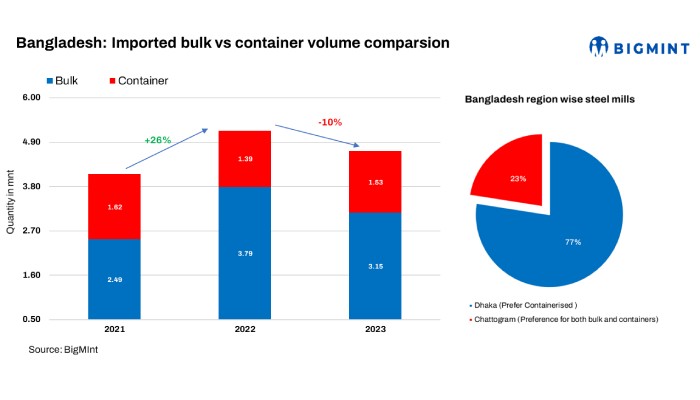
    Bangladesh has emerged as one of the top three importers of ferrous scrap in South Asia. Over the last three years (2021-2023), bulk scrap imports have grown from 60% to 67% of the country’s total imports.

    Overall bulk scrap imports in CY’23 witnessed a significant 17% drop to 3.16 million tonnes (mnt ) compared to 3.80 mnt in CY’22.

    Almost 15-20 bulk scrap vessels are booked every month by Bangladesh, which fell to 9-10 per month during the second half of CY’23. This decrease was attributed to challenges in LC openings and a weaker foreign exchange reserve. The country’s steel sector observed sluggish movement amid weaker sentiments for finished steel, followed by prolonged LC issues and subdued demand from downstream sectors in CY’23.

    Furthermore, shipments from the US and Japan decreased, with Turkish and Indian bulk buyers capitalising on the favourable parity situation.

    In the last two years (CY’22 and CY’23), container scrap volumes have witnessed a fluctuating trend (a 10% rise in container volumes at 1.52 mnt as against 1.38 mnt in CY’22). On the other hand, in CY’22, the container volume saw a 14% drop as compared to 1.61 mnt in CY’21).

    A sharp rise in freight rates, longer lead times, and unavailability have impacted the container market, and the container volume share dropped to 33% from 39% in 2021. The country is lately also exploring newer supplier geographies for container shipments including Singapore, Malaysia, and Hong Kong.

    Currency depreciation: The BDT has depreciated by 25%, and a majority of Bangladeshi importers who rely on usance LC due to the relative stability of the currency are making substantial losses now.

    However, due to a lack of port facilities, unloading at jetties is very slow, and vessels have to be unloaded at anchorages. In the event of imports edging higher, the problem is likely to intensify. Steel decarbonisation goals will raise global scrap demand, while supplies struggle to keep pace.

    Major exporters, such as the EU, are likely to prioritise local consumption and may discourage exports. This could have a major impact on the steel industry in Bangladesh.

    Weaker foreign reserves weigh on LC openings: Amid mounting pressure on foreign exchange reserves and exchange rate volatility, the country’s central bank has implemented measures to tackle the trade imbalance. Interest rates have increased in LC issuance, hampering scrap imports towards the second half of CY’23. The deposit required for LC approvals has also increased to 20% from the earlier 10%. Forex issues and remittances have dropped in the last two years. In response to higher imports compared to exports and remittances, however, some banks still impose 100% LC margins on essential commodities, impacting importers’ competitiveness.

    Price trend: BigMint’s yearly average price assessment for US-origin bulk HMS (80:20) stood at $430/t CFR Chattogram in CY’23 as against $501/t CFR in CY’22, followed by Japanese H2 bulk scrap yearly average assessment which stood at $425/t in CY’23 as against $505/t CFR in CY’22.

    BigMint’s yearly average price assessment for UK-origin containerised shredded and HMS (80:20) stood at $455/t and $430/t CFR Chattogram in CY’23, as against $534/t and $503/t respectively on a CFR basis in CY’22.

    Over the past two years, foreign exchange reserves have steadily declined due to high external payment obligations surpassing inflows from exports and remittances. Reserves plummeted from $40.7 billion in August 2021 to approximately $19 billion towards the end of CY’23. The dollar shortage has resulted in delayed or renegotiated import payments, with banks granted additional time to acquire the necessary foreign currencies.

    To meet IMF loan programme requirements and address the net reserve condition, the Bangladesh Bank introduced currency swaps with banks for the first time, allowing banks to provide foreign currencies in exchange for interest instead of the central bank directly purchasing dollars.

    As of January 2024, Bangladesh’s repo rate stands at 8%, up from 7.75% in December 2023, aimed at curbing inflation to 6%. LC settlements hit a three-year low in December 2023 at $4.53 billion, with the lowest recorded at $4.41 billion in November 2020. Bankers are now issuing two types of LCs: sight and deferred. Economists attribute improved liquidity in banks to increased remittances, foreign loans, and aid. While sight LCs require immediate payment, deferred LCs allow 90-180 days for settlement.

    Outlook

    The projected growth in urbanisation is set to drive new project announcements by 2027, fuelling increased steel demand. Improved infrastructure and a favourable global trade environment may stabilise forex reserves and unlock economic opportunities. Bangladesh’s top steel manufacturers are expanding capacity to meet rising steel demand in construction projects, signalling positive prospects for the steel and ferrous scrap import markets. Optimism prevails for steel mills as they look to stabilise import volumes, potentially boosting scrap trades in the near term.

    4th Bangladesh International Trade Summit

    Bangladesh, a strategically significant country in the Asia Pacific, is emerging as a hotspot of economic growth. The country’s phenomenal economic expansion is fuelled by a buoyant steel sector which is on an expansion spree. This is expected to encourage the participation of more global companies and attract precious foreign reserves for the country.

    BigMint Events will be hosting the 4th Bangladesh International Trade Summit on 14-15 May 2024, at Hotel Pan Pacific Sonargaon, Dhaka, Bangladesh. The two-day conference looks to bring together key stakeholders from the steel, cement, and power sectors, including industry stalwarts, policymakers, traders, and investors. It seeks to provide a network for collaboration and an ideal platform for discussion of prevailing industry trends and challenges.